
The Biggest Mistake Authors Make When Writing Dialogue
Tips to make your dialogue memorable
Introduction: Why Dialogue Is the Single Greatest Determinant of Character Memorability
The Spy Who Came in from the Cold is one of my favorite novels. But I do not remember every intricacy of the plot. I do not remember precisely what happened and when. Mr Robot is one of my favorite television shows. But I do not remember exactly what transpired in the eighth episode of the third season. Fight Club is one of my favorite movies. But I do not remember every link in the chain of events leading to the final, explosive scene.
However, if you presented before me three anonymous, unattributed samples of dialogue, I could tell you within two seconds which was uttered by Alec Leamas, which by Elliot Alderson, and which by Tyler Durden. And that is not because I have every line of their dialogue memorized; it is because each of the three characters is so well-written, so realistic, they have their own bespoke tone, their own manner of speaking.
Characters are the critical component of any novel. I recently read The Innocent by Ian McEwan, which I strongly recommend, but while in two months I will have forgotten every twist and turn of the labyrinthine plot, I will always remember Leonard Marnham and Maria Eckdorf. I am planning to re-read The Woman in the Window, not because I have forgotten the plot, but because I want to read about Dr. Anna Fox again.
Why is your best friend your best friend? Why is any person memorable? Somebody might be unnaturally attractive, but would you want to be their friend if they turned out to be antisemitic or unforgivably prejudiced? How would you find out they were? Because they said so. They spoke. They engaged in dialogue. What people say is often more important than how they look or, say, the way they walk.
So, if dialogue maketh character and character maketh story, it is crucial for authors to perfect their dialogue. I firmly believe a story with a lackluster plot can be saved by relatable characters with impeccable dialogue. People remember people. It is in our nature to be struck by the way somebody talks or the inflection in their voice. Anybody can tell which line was Rachel’s and which Joey’s.
In this article I shall address what I believe is the biggest mistake authors make when writing dialogue. While dialogue is the focus here the underlying principle can be extrapolated and applied to the plot as well. Before we get to the mistake I feel I must state this: I have recently penned several pieces on writing advice, but no writer is perfect. These are my opinions. I do not claim to be infallible. I am certainly open to your views.
I want us to improve together.
The Mistake: The Tendency Toward One-Liners and Clever Ripostes
I have noticed in many writers a tendency to exaggerate and overblow every aspect of a story simply because it is a novel. A novel is an event. And events have an implied magnitude, an inherent gravitas. Events must be made memorable, through spectacle and extravaganza. Nobody goes to a soccer match to drink tea. They want entertainment. They want action. They want over-the-top antics. They want an event.
Authors feel that sense of spectacle should extend to dialogue. Everybody remembers a good one-liner. Everybody remembers a witty riposte, a savage clapback. There are entire YouTube videos dedicated to celebrity clapbacks. I do not recommend watching them. You will jump from video to video until realizing hours later the sun has set and you have not gotten an iota of work done. The regret is crushing.
Every form of entertainment has value. Heavy metal is every bit valid music as classical piano; it just depends on each person’s taste. There is a reason movies have different genres. One-liners and ripostes have their place. But, in my experience, relatability elevates a character from iconic to timeless. Take James Bond. Bond has always been iconic. He has always been a staple. But before Skyfall, he was in dire need of reinvention.
Skyfall showed 007 vulnerable. Human. A man struggling with the effects of age. A man grieving. A relatable man. Is it any surprise Skyfall is still widely regarded as the best James Bond movie? Take Sherlock Holmes. He was always iconic. He was always revered. But he was out of reach. He was on a pedestal. Nobody could relate to Sherlock Holmes. Then came along Benedict Cumberbatch and suddenly he had relatable traits.
Would James Bond and Sherlock Holmes be as popular as they are today without those two? Would they seem human and not chimerical without those two? Would Lara Croft seem human without the Tomb Raider trilogy? Perhaps. But I, personally, doubt it. Relatability is what differentiates a character from a human being. I feel like I could run into George Smiley on the street. Or Jessica Jones. Or Monica Geller.
The novelty of entertainment has passed. The world has been told zillions of stories, been introduced to zillions of eccentric characters. Their time has passed. Nowadays people want gritty, realistic stories. They want relatable characters. There is a reason the Bond movies have had to evolve from mindblowing action set pieces and clever puns to grounded, personal revenge plots and a flawed, self-doubting anti-hero.
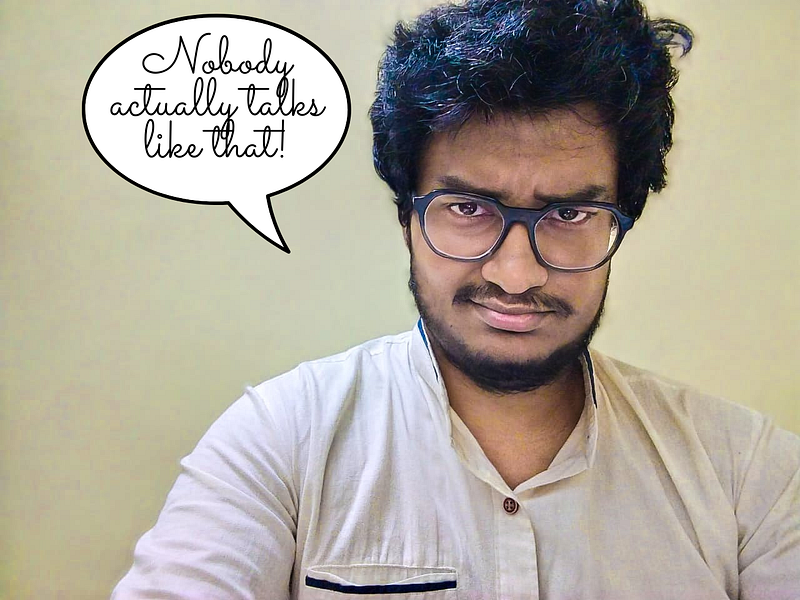
The current generation does not want fantastical. The current generation wants plausible. And while one-liners are entertaining, the simple truth is people just do not talk like that. One-liners destroy plausibility and relatability. The characters become cheesy cartoons, the plots antiquated and unrealistic. Style over substance. If you want proof, a case study, look no further than Marvel.
I used to love the MCU. But it has become overcrowded and overblown and everybody feels the same. Nowhere is that more apparent than in dialogue. When a hero is introduced, they are distinctive, they are unique. They have mystique. They have an aura. Then, within two movies, they become wise-cracking, one-liner delivering caricatures. Everybody sounds the same. That is the biggest reason I stopped watching after Doctor Strange.
One-liners are not axiomatically wrong. The problem is most authors think the dialogue sounds clever when it does not, and they employ them too frequently. A one-liner is impactful because of its rarity and brevity. Past a certain amount, one-liners just become liners. They lose their novelty. Finding that balance is impossibly difficult. That is why you will find no one-liners in my books. I am an idiot. I do not know where the line lies.
The Solution: Arguing for Conciseness and Simplicity Over Flamboyance
Sometimes I daydream and insert myself in fictional settings. I imagine talking to my favorite characters. How would a conversation with George Smiley go? Would I connect with Anna Fox? Would I enjoy talking to Elliot Alderson? Is that weird? Does anybody else do that? I am hoping they do, because that would make what I am about to say more authentic. People want characters that seem like fictionalized versions of real people.
The objective of entertainment is to transport the consumer to a different world. People read novels to be somewhere else, to become somebody else. How are they supposed to maintain their immersion if the characters keep cracking zingers? Constant witticisms create a barrier between the character and the reader and the only way to ensure this does not happen is to make the character talk normally, like an everyday person.
There is elegance in simplicity. Minimalism is profound. The author must know their character inside out. Some joke in the face of adversity to lighten the mood. Some fold in on themselves and become silent. Some are naturally caustic. Some speak conventionally. No two people react to the same stimulus in the precise same manner. The author must know their character. The rest is simple. Make them talk like they normally would.
To be clear, I am not advocating for a total ban on one-liners. I am saying they should not be overdone. When they are, the character comes off farfetched and unrealistic. Everybody delivers a good riposte now and then. But if they are made too frequent, their impact is lost. The same goes for the plot. A story does not need to be spiced up merely because it is a novel. Flamboyance is the enemy of realism.
In my experience, brevity and conciseness create impact. Four words have more punch than forty. When writing dialogue, I suggest short sentences. That ensures they are memorable and not unnecessarily waggish. If you want references, read any John le Carré novel. The dialogue is simple but poignant and spare but powerful. The same goes for Charles Cumming or Karen Cleveland. If one wants to be the best, one must learn from the best.
Closing Thoughts: The Only Exception to the Simple-Dialogue Rule I Have Come Across
Entertainment is subjective. Which means dialogue is subjective. You might not find witty a line I found ingenious. And vice versa. The problem arises when an author thinks they sound clever but in reality sound foolish. Witticisms are not one-size-fits-all. The timing must be right. The mood must be right. Sharp dialogue must not only be structurally sound. It must feel right. And most of the time it does not.
The only exception I have encountered is a series called The Newsroom, created by the renowned Aaron Sorkin, who also created The West Wing. The characters in The Newsroom speak nothing like real people. Everybody is clever. Everybody answers one-liners with one-liners. But somehow this comes across endearing and right. If you are looking for instances where constant witticisms actually work, check out The Newsroom.
If you enjoy my writing, please consider joining my newsletter for exclusive content and buying me a coffee. I am immensely thankful for all your support.