
The Biggest Lie About Money
I have been told garbage all my life

Imagine you were rich. Let’s say 8 digits on your bank account. In dollars, of course.
How would you feel? What would you do? Where would you live?
Would you be happier?
Take a moment and answer these questions. Imagine your life as a rich person as accurately as possible.
We all strive for money to some extent. For some, it is the top priority in what they do, while for others it is more important that what they do is fun, meaningful, or fulfilling. Money is secondary for them as long as they can make ends meet.
Here are a few quotes that come to mind on this topic:
The Classic:
Money does not make you happy
Funnily enough, the people who said that to me don’t have much themselves. How would they know?
Something tells me this one is simply a big cope.
Here is a quote that claims just the opposite:
When I was young I thought money was the most important thing in life; now that I am old I know that it is — Oscar Wilde
What is the truth now? Is there even one truth that applies to all of us?
I think for most people the truth lies somewhere in the middle between the two quotes. But before I elaborate on my personal assessment, I’d like to introduce you to what a recent study has shown.
So far I had heard on several occasions that after a certain point more money should not make you happier. According to older studies, this point should be at an annual income of about $75,000.
A Study Of 33,000 People Shows The Reality
University of Pennsylvania psychologist Matthew Killingsworth conducted a study of more than 33,000 employed adults in the United States.
The study was conducted as follows: Killingsworth used an app to ask the participants several times a day about their well-being in order to ultimately draw conclusions about the connection between prosperity and happiness.
The results were quite clear.
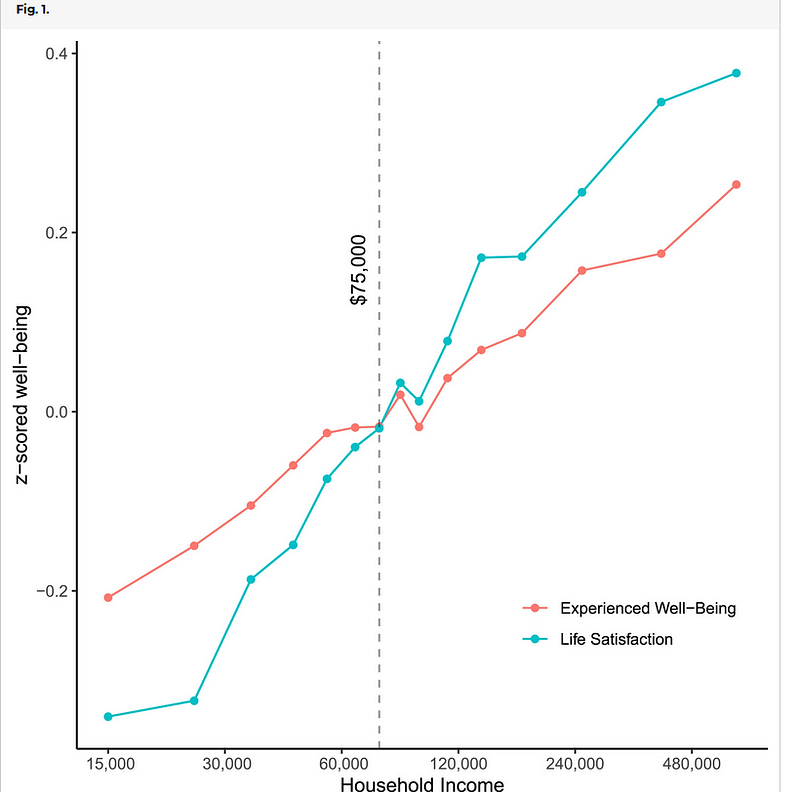
Both overall life satisfaction and daily well-being increase with increasing household income. Even at higher levels.
There was no evidence for an experienced well-being plateau above $75,000/y, contrary to some influential past research. There was also no evidence of an income threshold at which experienced and evaluative well-being diverged, suggesting that higher incomes are associated with both feeling better day-to-day and being more satisfied with life overall.
Graphically, it looks like this. The connection between income, well-being and satisfaction with life is undeniable.
Positive Feelings vs. Negative Feelings
What is the source of this higher satisfaction at a higher income? Is it just less bad feelings because you don’t have money worries, or does the money actually bring more positive feelings?
Or maybe even both? Let’s look at another chart.
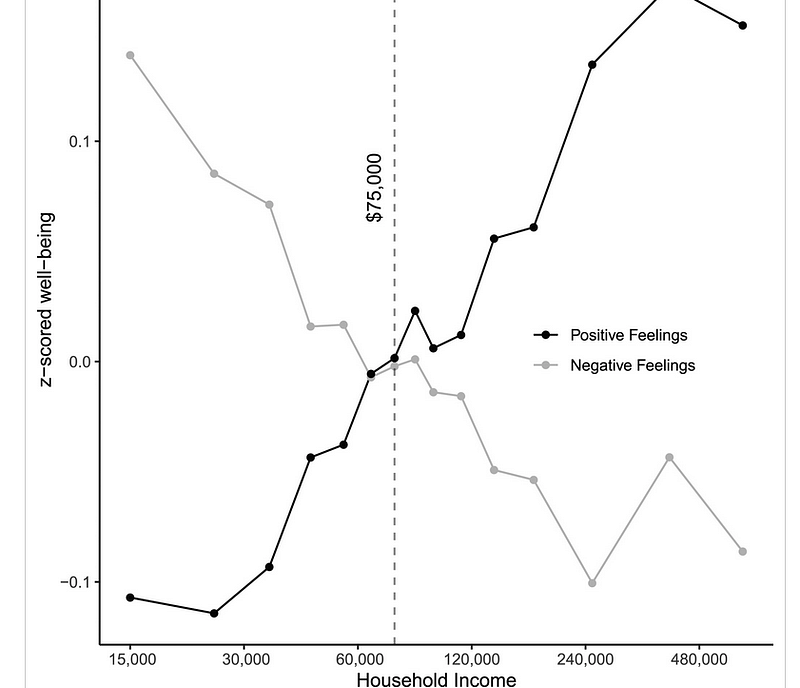
That almost looks like an X.
Again, the results are clear. Money promotes positive and reduces negative feelings.
My Personal Opinion
Since I don’t have too much money right now, more money would certainly improve my life.
When I think about it, the results make perfect sense.
I don’t think expensive cars or designer clothes make you happy.
Rather the really valuable things that a lot of money brings with it. I am talking about a sense of security, the freedom to travel a lot, being able to decide where you want to live, and maybe even not having to work anymore.
Of course, these things make you happy.
Thanks for reading!
Wait a second. You should get my articles in your inbox. Subscribe here. Maybe you also want to start writing on Medium yourself and make money. I made a whopping $3400 in my second full month! You only need a membership for $5 a month. If you sign up with my link, you support me with a part of your fee without additional costs.
I think you will also like these stories: