The Biggest Bad Ass in Big D
As we celebrate Women’s History Month, I’d like to recognize my Mama
I grew up on the cusp of learning how to iron my man’s shirts and the promise of the ERA. I credit my Mama for leading me away from the former and firmly in the direction of the latter. I knew I could do anything I wanted to or was capable of because she did it in the years leading up to my liberation.
June M. Krenzer was born in small-town Indiana, the daughter of a German immigrant and his wife, who heralded from Pennsylvania Dutch stock. She was one of three girls who took their cues from the strong — and often obstinate — Bavarian stock that my PawPaw brought to this country.
John — my grandfather on my Mom’s side — started his life in a burg near Munich. In pre-World War I Germany, he and his family found out soon enough that the Kaiser — remember, this was 15 years before Hitler — was already showing signs of the intolerance in Deutschland toward “different” groups. In this case, it was Catholics, so John and his family decided to try what they hoped was a more tolerant America.
My family lore gets a little obscure after that. I know that my grandfather ended up in Baltimore and was placed in a Catholic orphanage. I have no idea what happened to his parents and his siblings, but I know PawPaw made somewhat of a name for himself in Charm City. He didn’t like the structure of his new home, and tried to run away. He succeeded — after multiple tries, I’m told — at the age of 13 when he punched a Father in the nose and headed out to the Midwest.
In the small-town embrace of New Castle, Indiana, PawPaw grew up, met my grandmother Ruth and opened a Mom and Pop-type grocery store. As he and MawMaw aged and their three girls grew up, he sold the store to A&P and moved the family to Indianapolis.
But this is a story about my Mama, not my grandfather. She and her twin sister were tired of the same-old-same-old. They had a chance to experience something new when their Dad again picked up his roots and moved everyone to Washington, D.C. He went to sell insurance. His twins went to work for President Roosevelt’s War Department — the Pentagon’s predecessor — during Dubya Dubya Two.
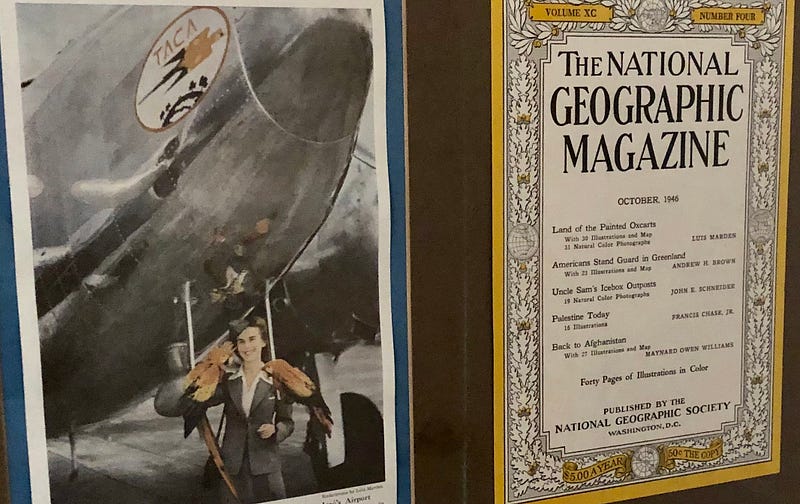
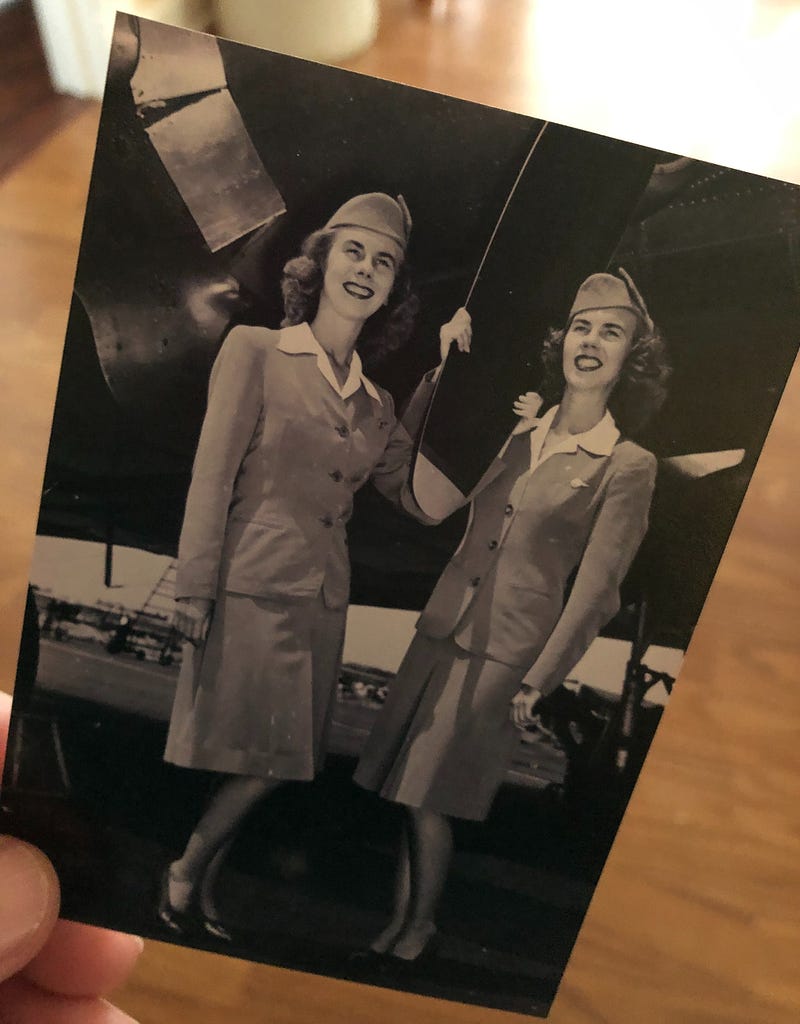
The Krenzer Twins, as they were known, didn’t settle long for secretarial work. They heard about a chance to see the world and moved back to the Midwest — Chicago, this time. From there, they went to Miami, where both snagged positions as stewardesses — flying the Friendly Skies with TACA, The Airline of Central America. To say they were different — attractive, outspoken and for gosh sakes, twins — was an understatement. They became well-known on the routes between Miami and Tegucigalpa, Honduras; also between Miami and Managua, Nicaragua, and points in between and all around thereabouts. Alerted by the airline’s PR arm, newspapers wrote about my Mom and my Aunt. Mama was featured in a 1946 issue of National Geographic — posing for a story about San Jose, Costa Rica, written and shot by Luis Marden, a well-known Nat Geo photographer at the time.
Mama used to tell us about her airline exploits — how the propeller-driven aircraft (no jets back then) had to make several passes at the landing strips in small Central American countries to shoo the cows off the field. How she flew with pilots who’d been on a bender the night before they were scheduled — and showed up for duty still drunk. How later, when she moved to San Francisco after hiring on with Pan American, a steward was sucked out of the back of the plane near the galley over the Pacific, en route to Honolulu. She flew all over — to South America, to East Asia, to the Caribbean. Her job was Mama’s passport to seeing the world and learning a lot about herself.
Mom met my Dad during the apex of her career in the air. He worked for Pan Am running airport ops in Port of Spain, Trinidad. They decided to get married — the boy from small-town Texas and the girl from small-town Indiana — and they stayed in Trinidad for a couple of years before coming back to the States, settling in suburbia and starting a family.
She never said the transition stateside was a culture shock, but I’ll bet it was. Mom and Dad eventually moved to suburban New York, and Daddy took the train into the city every day for work. She stayed at home and did “Mom” things, as prescribed by 1950s and ’60s suburban life. She played bridge. She took on the unenviable (but we kids thought it was great) task of “Cookie Mom” for my Girl Scout Troop, sorting out the sales of third- and fourth-graders and ending up with quite a few extra boxes in our family’s pantry to even everything out. She carpooled, and volunteered at church and at school; she took us to friends’ houses, and decamped to the neighborhood swimming hole in the summer. She was always the best-looking Mom poolside. And, I might add, the only one who wore a two-piece.
We eventually moved to Dallas, Texas, for Daddy’s work, but it was in the ultra-misogynistic Southwest that Mama found her wings again. She decided to go back to work. She took several different sales and secretarial jobs over the 11 years she lived in Big D, but never took no guff from no one, as my Nana (Daddy’s Mom) would say. A cherished family Christmas memory proves what a bad ass my Mama really was.
For awhile, she signed on as a “Kelly Girl,” working temp clerical jobs at various downtown banks. One job featured a boss who thought he was the star of a real-life version of “Mad Men” — way before that series enshrined what it was like for some of us during the turbulent ’60s, when race relations, Vietnam and a push for gender equality were stirring up the country and some — yeah, it was mostly guys like those in downtown Dallas bank towers where my Mama worked — just refused to move beyond the parameters that had put every woman in her place prior to all the upheaval.
To say this temporary boss was a “dick” would be to minimize the problem. He never said “please”. He never said “thank you”. He grabbed the butts of younger women in the office, but somehow intuited that had he tried anything fast with Mom, he probably would have ended up with his cojones in a vise. The pièce de résistance, though, was his push to get his Christmas cards done on time.
I don’t know why his wife didn’t participate in this yearly ritual, or why he didn’t try to take it on himself — oh, OK, I know why he wouldn’t deign to volunteer— but the task fell to Mom to finish before the office closed for a week at Christmas. Again, he didn’t say “please”, nor did he say “thank you”, but plopped a humongous pile of cards and envelopes on her desk and said something like, “You can ask Judy (his personal assistant, I think) for the list,” before walking past Mama and slamming his office door.
So Mom was supposed to put each of these tacky, pre-signed cards in envelopes, seal them, address them, put stamps on them and mail them. Hundreds and hundreds of cards over two weeks. I’m sure the bank paid, but these holiday missives were beyond the corporate kind — some were for Aunt Becky and Grandma Winifred, too. In other words, send my family’s cards out to the world and to my extended brethren, too. If that’s not the Christmas Spirit, I don’t know what is.
Mom wanted to get paid, so she did it. She carefully checked and cross-checked names and addresses with Judy if a question came up, and ended up with two big department store-sized shopping bags of completed Christmas cards. Mr. Big Bank Officer never talked to her about her assignment, asked her how it was going, or thanked her for her toil and trouble. In fact, on the day the office closed early for the holidays, he walked out past Mom’s desk, and didn’t stop, nor say a single blessed thing to anyone. He was gone to celebrate with his family, and Mom, I guess, was left to mail his family’s Christmas cards. As simple as that, Don Draper.
Those days Mama took the bus back to our Dallas home. It was convenient, and a lot less expensive than parking downtown. She picked up the bags of cards, said goodbye to her co-workers — it happened to be the last day of her temporary assignment — and wished everyone a Merry Christmas and a Happy New Year. Then she took the elevator downstairs and walked out to the corner bus stop.
There happened to be a mailbox on that corner where Mom waited every afternoon. And right next to that a trash receptacle, one of those large ones often featured on city street corners. I’ll bet you can guess what Mom did. Totally last-minute but very on-brand for my Mama. She chucked both bags — full of hundreds of Christmas cards she’d labored over for two weeks — in the trash.
What’s that truism? Oh, yeah, good riddance to bad rubbish. She’d never see that particular Don Draper again. And he was probably too stupid to realize why his corporate friends and family never received his holiday cards, if he even noticed.
We’re celebrating Women’s History Month in March. I’d like to nominate my Mama, for the Biggest Bad Ass in Big D. She deserves that honor, and much, much more.