
The Big Bang
What Science Does Not Face
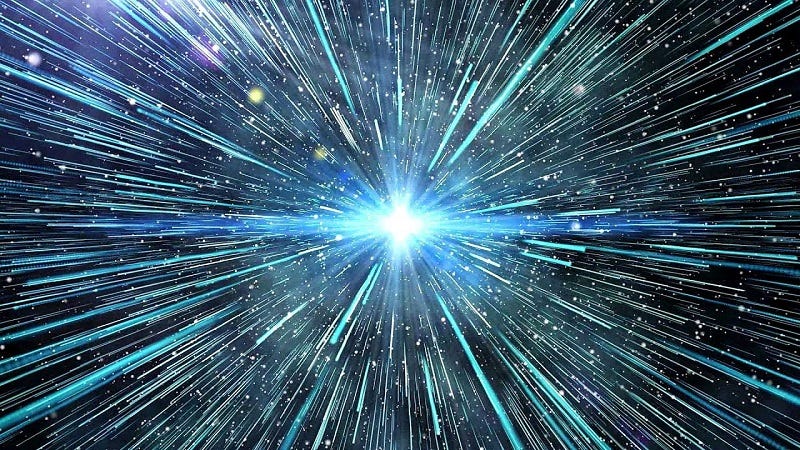
The one thing Science does not want to face: The Cause of the Biggest Bang
Yes, of course it’s all very well, and impressive, this Big Bang theory and all, and for many, especially for those in the scientific community, it holds a lot of water. And no, I’m not here to argue against the theory as such, for I’m certainly not qualified to, no, I’m here just to point out that this theory skirts (and not very gracefully) the even Bigger Question: what caused the Big Bang?
Another way to put it: What, exactly, Banged?
It remains one of those imponderables, for no one will (most likely because no one can) give us a straight answer. It seems up there, rubbing elbows with the answer to, “If God is goodness and love personified, how come there is so incredibly much suffering (both just and unjust) on this earth, among the people he made in his image and professes to love beyond human comprehension?”
The way this question is skirted, and not very elegantly either, is that His ways are capital-M Mysterious and it’s not our place to reason why. And even if we knew, you would not understand anyway.
Skirting indeed.
So, what about this Big Bang. Let’s see what Google has to say about it.
Scientists believe, says Google, that the universe began with every speck of its energy compressed into a very tiny point. At some point, this packed point, stationed at — or, more accurately, just before — the very beginning of Time — this extremely dense (think head-of-a-pin dense) point exploded with unimaginable force, creating matter as it propelled outward to form the billions of galaxies of our universe.
Astrophysicists calls this titanic explosion the Big Bang.
A quick note on the unimaginable force. From other accounts of the Baby Universe’s expansion rate at the infinitesimal moments just after ignition, it expanded far, far, far faster than the speed of light (see below). Doesn’t that violate Albert Einstein’s relativity theory? one is forgiven for asking. I’ve asked that myself more than once, before I realized that the universe was not, in fact, expanding within itself, i.e., the universe where Einstein’s theory applies but into the primordial Emptiness beyond, where Einstein would not apply.
And I notice a clever and probably unintended sleight-of-hand here: with every speck of its energy compressed into a very tiny point. A very, very tiny point. Again, think pinhead. But don’t swallow this sentence before you chew, for here’s the enormous assumption: All this compressed energy existed, in toto, before time. There’s no getting away from that assumption. It’s there, in plain daylight.
But let’s return to Google and our birth story:
Astrophysicists tell us that all matter found in the universe today — that we now find in people, plants, animals, the earth, stars, and galaxies — was created at that very first moment of time, thought to be about 13 billion years ago.
Note: at the very first moment of time — again underlining that all this pin-head sized, compressed energy already existed prior to time itself, which clock started with a Bang, as it were.
Google goes on to tell us: The Big Bang was unlike any explosion you might witness on earth today. Take a hydrogen bomb explosion, for instance, whose center registers approximately 100 million degrees Celsius, and moves through the air at about 300 meters per second. In contrast, cosmologists believe that the Big Bang flung energy in all directions at the speed of light (300,000,000 meters per second, a million times faster than the H-bomb — see note, below, though) and estimate that the temperature of the entire universe was 1000 trillion degrees Celsius at just a tiny fraction of a second after the explosion. Even the cores of the hottest stars in today’s universe are much cooler than that.
Important Note, and do follow me on this: Wikipedia begs to differ with Google on expansion rate. Google’s initial answer (see above) was that the universe expanded at the speed of light. Wikipedia, on the other hand, states that, according to current theory, during the inflationary epoch (which lasted about 10–32 of a second after the Big Bang, which obviously is not very long) the universe suddenly and violently expanded increasing its volume by a factor of at least 1078 (translating to an expansion of size by a factor of at least 1026 in each of the three dimensions), equivalent to expanding an object one nanometer (about half the width of a molecule of DNA) in length to one approximately 10.6 light years (say 62 trillion miles) long. That is 10.6 light years in the tiniest micro-fraction of a second. I’d say that beats the speed of light by a comfortable margin.
By the way, in physical cosmology the inflationary epoch was the infinitesimal period in the evolution of the early universe when, according to inflation theory, the universe underwent its rapid exponential expansion.
After this initial 10–32-of-a-second rush, a much slower and gradual expansion of space continued until around 9.8 billion years later when it began gradually to pick up expansion speed again. This expansion is still accelerating.
Back to Google, who now has decided to agree with me: There’s another important quality of the Big Bang that makes it unique. While an explosion of a man-made bomb expands through air, the Big Bang did not expand through anything. That’s because there was no space to expand through at the beginning of time. Rather, physicists believe the Big Bang created and stretched space itself, expanding the universe.
I can safely rest that particular case, then.
Note: Still, there must have been some existing space, if only the space needed to house the energy pin-head, right? The space that the Big Bang expanded, no?
Still, this is why Einstein still holds true — there was no space, no universe for the universe to expand into, no gravities, nothing. Sheer emptiness, and I’m not sure there can be anything such as laws governing sheer emptiness.
Google continues: For a brief moment after the Big Bang, the immense heat created conditions unlike any conditions astrophysicists see in the universe today. While planets and stars today are composed of atoms of elements like hydrogen and silicon, scientists believe the universe back then was too hot for anything other than the most fundamental particles — such as quarks and photons — to exist.
Also, as the universe expanded, the energy of the Big Bang became more and more “diluted” in space, causing the universe to cool.
Rapid cooling allowed for matter as we now know it to form, although physicists are still trying to figure out exactly how this happened. About one ten-thousandth of a second after the Big Bang, they believe protons and neutrons formed, and within a few minutes these particles began sticking together to form atomic nuclei, mostly hydrogen and helium. Hundreds of thousands of years later, electrons stuck to the nuclei to make complete atoms.
About a billion years after the Big Bang, gravity now compelled these atoms to gather in huge clouds of gas, which eventually collected into stars which in turn gathered to form the collections we now call galaxies.
Where do planets like earth come from? Over billions of years, giant stars have baked hydrogen and helium atoms in their hot cores to form heavier elements like carbon and oxygen. These large stars eventually exploded, blasting these new elements into space.
This matter then re-condensed into both new stars and planets (with their satellites) that now make up solar systems like our own.
As for proof, Google goes on to say that over the past one hundred years, astrophysicists have uncovered a great deal of compelling evidence to support the Big Bang theory. Among this evidence is the observation that the universe is, in fact, still expanding. By looking at light emitted by distant galaxies, scientists have found that these galaxies are rapidly moving away from our own galaxy, the Milky Way. An explosion like the Big Bang, which sent matter flying outward from a point, explains this observation.
Another critical discovery was the observation of low-level microwaves permeating space. Astronomers believe that these, literally minute waves, whose temperature hovers around -270 degrees Celsius (which is only about three degrees Celsius above absolute zero) are the remnants of the Big Bang and the extremely high-temperature radiation (since cooled, obviously) it produced.
Interestingly, astronomers can estimate how hot the universe used to be by looking at very distant clouds of gas through high-power telescopes.
Since the light from these clouds can take billions of years to reach our telescopes, we see such bodies as they appeared eons ago. And, conforming to theory, these ancient clouds of gas seem to be hotter than younger clouds.
Scientists have also been able to support the Big Bang theory by ascertaining the relative amounts of different elements in the universe.
In fact, they’ve found that the universe contains about 74 percent hydrogen and 26 percent helium by mass, which are the two lightest elements. All other (heavier) elements — including those common on earth, such as carbon and oxygen — make up just a tiny trace (a small fraction of one percent) of all existing matter.
This data in hand, scientists have shown, by theoretical calculations, that these abundances could only have resulted in a universe that began in a very hot, dense state, and then quickly cooled and expanded, which is exactly the kind of universe that the Big Bang theory predicts.
All right, thanks Google. Still skirting, though.
My question is: Where did all this energy, so incredibly compressed that letting it loose created the universe, come from? For this entire theory rests on the assumption that it already existed — outside of, or just before time.
I’d like to think that if there’s matter, even in the form of dense energy, there is also time, for they come as a pair, time and matter, along with space — even if microscopically small in this case.
So small, perhaps, that we can simply overlook its existence and pretend nothings there? So small, anyway, as to be virtually nothing? Is that the sleight-of-verbal-hand lesson we’re supposed to take away from this?
It’s not nothing today, though, is it?
I obviously don’t have the answer, but I do have the question.
Apropos of which, I wrote one of my innumerable Wolfkus (Haikus by a Wolf) the other day, which said:
If nothing were ever hidden — Every question would have an answer.
Based on which (and I do hold this to be a very much true Wolfku), since my Big Bang question doesn’t have an answer, there must be something hidden, and very well at that, somewhere. Methinks.
And Mankind (along with the Wolf) ponders on.
© Wolfstuff
P.S. If you like what you’ve read here and would like to contribute to the creative motion, as it were, you can do so via PayPal: here.


