
The Best Options Strategies For A Bear Market
Two Income Trading Strategies For a Declining Market

One of the things we like most about options trading is there are several strategies that can be used to generate returns during different market environments. However, trading stocks is a more rigid process with fewer strategies to choose from.
A Bear Market
At the time of the publication of this article, the S&P 500 index is down 17% so far during 2022, and the NASDAQ Composite is down 26% year to date. Higher interest rates, increased inflation, a war in Ukraine, a shutdown in China, higher energy prices, and fears of slowing macroeconomic growth are all hurting investor sentiment, which has led U.S. equity markets to decline significantly. Despite the current market weakness, there are several ways for options traders to earn income. Traders can also use these same strategies during bear markets in the years ahead.
Theta Wins
The options trading strategies we almost always prefer for any market environment are ones that benefit from theta decay. In our view, theta decay is one of the few “free lunches” in finance. We believe consistently trading strategies that benefit from theta decay can generate steady monthly income that can supplement or replace income earned from a job.
Markets can go up, down, or sideways. And the direction of the market can have an impact on which options trading strategy to execute. But the most important factor we use for determining our trading strategy is implied volatility.
A study by Tastytrade indicates that implied volatility can overestimate a market move 83% of the time. But most importantly, the study also showed the higher the implied volatility is, the more different it is from actual volatility. Therefore we use implied volatility as a critical indicator for strategy selection.
A Low Implied Volatility Strategy
If implied volatility is at the lower end of its one-year historical range and traders are bearish on a stock or market, and out of the money put calendar spread can outperform because a rise in implied volatility will help the strategy’s performance.
Traders can execute calendar spreads with bearish bias by selling an out-of-the-money put with about a 30-day expiration and at the same time buy about a 60-day expiration put with the exact same strike price.
Traders can make money if the theta of the short put decays faster than the long put. Calendar spreads are attractive because theta decay accelerates the closer the options get to expiration.
Below is a trade example of a calendar spread that we did in a bear market.
Trade Example of Calendar Spread:
At the time of the trade on Friday, May 20, the SPY ETF was trading at 390.14.
We sold a SPY 385 strike price June 17 put, with 29 days to expiration.
At the same time, we bought the SPY 385 strike price July 15 put, with 57 days to expiration.
The net debit was $388, not including commissions.
Below is the profit graph at expiration.
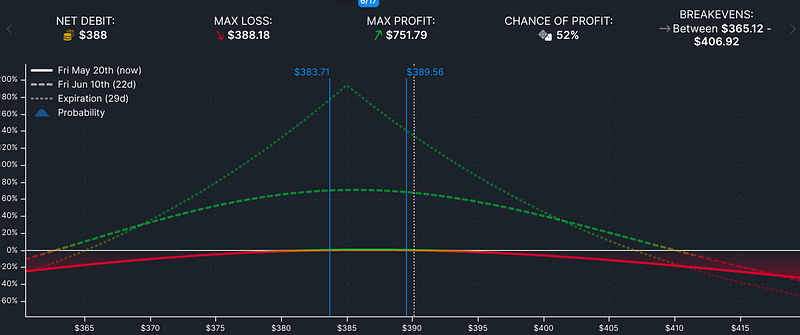
Our profit plan was to close out the spread 7–9 days later for a 10% profit. Our risk management plan is to close the trade with a 10% maximum loss.
What Happens 7 Days Later?
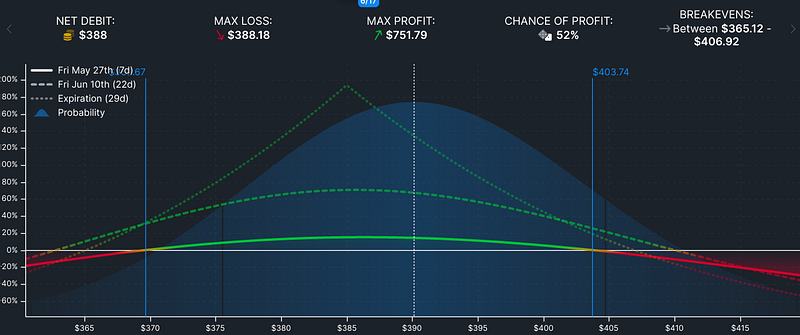
The above image is the forecasted profit graph for Friday, May 27, 2022, of the same calendar spread.
According to this graph, we should earn about a 14% profit in 7 days as long the SPY and implied volatility stay the same.
The implied volatility is likely to change, but the strategy has significant room for error if the SPY moves against us. The breakeven points at expiration are 365.12 and 406.12, which are 6.4% away on the downside and 4.3% away on the upside.
A typical calendar spread has about a 50% probability of profit, which is considered a low probability strategy. We often prefer higher probability strategies. It is possible to increase the probability of profit to about 70% with a double calendar spread. For more information on how to trade a double calendar strategy, see the article below.
A High Implied Volatility Strategy
Implied volatility will be high during a bear market most of the time. Volatility tends to rise during market declines. If implied volatility is high, selling call credit spreads is our preferred options trading strategy. Call credit spreads are directionally bearish. If implied volatility declines, credit spreads should experience good performance. High implied volatility leads to an increased level of premium income. Selling credit spreads when implied volatility is high and hoping it mean reverts could lead to favorable performance.
A Trade Example of a Call Credit Spread.
At the time of the trade on May 20, 2022, the SPY ETF was 387.57.
Sell SPY June 17, 413 Call $2.14 credit
Buy SPY June 17, 418 Call $1.39 debit
As of May 20, 2022, this trade generated a credit of $75
The total credit was $75, and the maximum loss was $425, not including commission. Therefore, if the trade expired out of the money in 29 days, the investment return would be 18%.
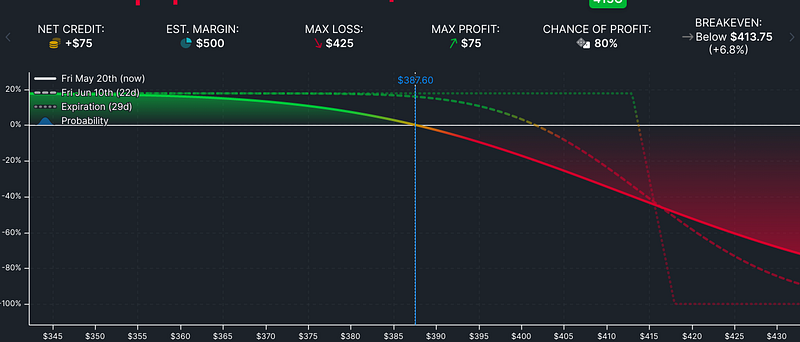
The SPX would need to rise 6.8% to 413.75 at expiration for the trade to break even.
According to OptionStrat, there is an 80% probability the SPX will close out of the money. However, there is a 20% chance the trade will lose money at expiration.
Our trade plan is to close out the trade at 10% within 7–9 days.
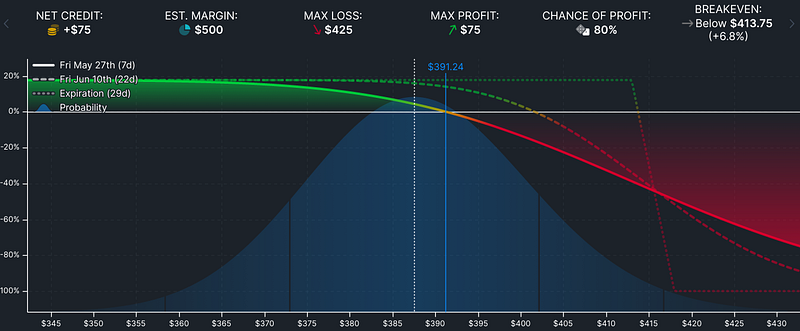
According to the 7-day profit graph on OptionStrat, the call credit spread profit would be 4.5% if the SPY and implied volatility remained the same. We would need to get some help with lower implied volatility or a decline in the SPY to get 10% profit in seven days. Otherwise, we would have to wait a little longer to get 10%.
Our risk management plan is to close the trade at a 10% maximum loss.
Final Thoughts
Options traders can still make money in a bear market. The trading strategy we use in a bear market will depend on whether implied volatility is at the high end or low end of its one-year historical range.
Call credit spreads can outperform when implied volatility declines; therefore, we look for it to be at the high end of its one-year historical range. Calendar spreads can outperform when implied volatility rises.
We hope you found this article helpful. Thanks for reading
Past performance does not guarantee future performance. This is not financial advice. Please consult your financial advisor.