
The Best of British Cinema: The Selfish Giant (2013)
Clio Barnard’s working class drama, adapted from Oscar Wilde’s story, is beautifully brutal
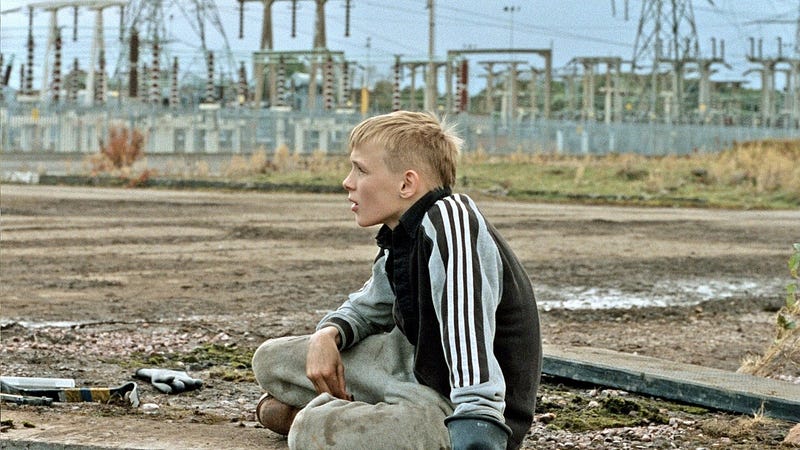
I will never forget the silence at the end of my first viewing of Clio Barnard’s 2013 film The Selfish Giant. I had, funnily enough, put the film off for years because of its title and my general distaste for the fantasy genre (I was picturing something along the lines of The BFG). Now I found myself stunned into silence by the power of the performances, the sound design and Clio Barnard’s excellent direction.
Adapted from Oscar Wilde’s story of the same name, the film focuses on Arbor (Conner Chapman, in his first performance), a young working class boy who, evidently, struggles with ADHD or something quite similar. He has quite severe behavioural issues and struggles at home, perhaps primarily because of his absent father who is never seen. Their home life is difficult, fractured and only further damaged by their lack of financial security. Conner’s best friend is Swifty (Shaun Thomas, also in his first performance), who is clearly a kind-hearted child with a slightly easier family life.
After Conner is expelled from school, he encourages Swifty to also leave so that, together, they can start to earn money and be providers for their households. Their intentions are, clearly, positive even if their leaving school so young is an evident issue. The two boys start collecting scrap metal, which is peppered everywhere in Barnard’s industrial West Yorkshire landscapes, and selling it to an older man called Kitten (Sean Gilder, who is commanding and intense whenever on screen) who is encouraging to Swifty and often ignorant towards Arbor.
This leads to a jealousy on Arbor’s part, and he retaliates by stealing some of Kitten’s scrap and selling it elsewhere. This goes wrong, as the men Arbor convinces to sell the scrap for him realise that it is stolen and keep the money… as well as telling Kitten what has happened. Kitten effectively forces Arbor into stealing some especially lucrative scrap… and tragedy strikes.
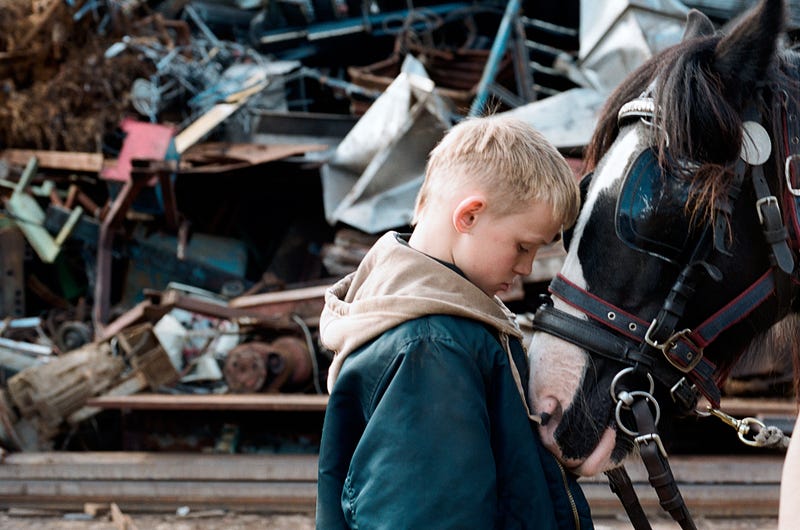
That tragedy is what has pushed me into a teary-eyed silence on both viewings of the film. It is a moment directed with astonishing tact that I don’t care to spoil, but just know, it is absolutely gut-wrenching. Tougher than a hard punch to the stomach to sit through. When I saw the film as part of a class in University, the reactions after were sore. They were emotionally effected to the point that they became frustrated with the film, refusing to believe that it would do such a thing to them. It’s simply that impactful, and the film intelligently leaves you in silence for a while afterwards to really feel that moment sink in.
But that moment is only one of a 90 minute film, and The Selfish Giant is full of brilliance from start to finish. Let’s not define it by its one stand-out moment.
The most apparent part of Barnard’s film is the acting. The performances from these two young boys are simply astonishing — they are completely authentic, far divorced from any amateurish over-acting. With a similar realism to the films of Ken Loach, felt in the film’s cinematography, its being shot on location and its unbelievably naturalistic performances, The Selfish Giant is achingly real from its opening shot to its ending.
However, this doesn’t mean that there isn’t room for poetics. Barnard takes the landscapes of her film and imbues them with a sense of brutal industrial poetry, at once beautiful and disturbing. There are beautiful images of Bradford, buried in telegraph wires and full of the lights of urban living. The buildings are beaten and derelict, but they are still beautiful. The same can be said for the sequences featuring the metal, or the exhilaration of some of the horse races which Arbor and Swifty are involved in. Electricity is frequently heard buzzing, among the sounds of industrial machines and the engines of a thousand cars. The film’s sound design, by Martin Jensen and Forbes Noonan, is massively commendable.
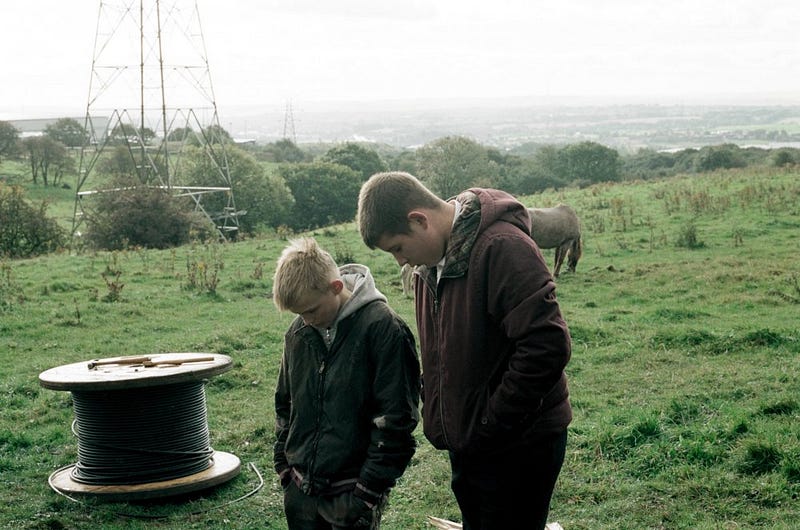
At the same time, there is a gritty realism to these shots and sequences that cannot be shaken. What makes Barnard’s film so masterful is that she is able to balance both of these ideas simultaneously, in a similar way to the work of other great directors such as Lynne Ramsay, Andrea Arnold or even Terrence Malick. There is a beauty in the grime, so to speak. As somebody who lives in a place similar to that shown in the film, seeing it presented in this way is especially impactful. The reality is captured, but the areas are loaned a certain elegance that really stands out.
Barnard still has not made a bad film, but The Selfish Giant is certainly the crowning jewel in her consistently strong filmography. It is a profoundly affecting film, completely unforgettable not only because of its engaging story of working class boys (one that crucially doesn’t feel as though it is packaging its working class story for a middle and upper class audience!) but the way that it tells that story using its beautifully grim aesthetics. Its performances are palpably real, its imagery is vivid and its impact is hefty enough to leave a mark on the viewer for the rest of their life.
To read the other parts of the Best of British Cinema focus, see the list below:
For more from me on film, see the list below:
Alternatively, if you want to support my writing, you can donate using Ko-fi.