The Most Terrifying Halloween Costume is Dressing Up as a Human Being
The Scariest Creature on Earth? Hint: It’s Not a Lion
As a child, my all-time favorite movie was The Lion King. The movie was released on July 7th, 1994, days before my third birthday. Four months later, my father passed away, and that’s when I got truly obsessed with the movie. How could I not feel like a vulnerable Simba who had just been left without his imposing father, Mufasa? Even today, I find myself gazing at the stars, hoping for some sort of blurry face and wise guidance from above.
Growing up, I always viewed lions as the ultimate rulers of the animal kingdom — dominant, ferocious, and the most fearsome beasts, defending their territory from evil hyenas and traitors. And the world seemed to agree, with lions perched atop the “hierarchy of fear.”
But as I grew up, I discovered that Simba and Mufasa were incorrectly labeled as the “kings of the jungle,” not just because most lions dwell in plains and grasslands or because lionesses take on the bulk of the hunting. Global surveys revealed that we humans hunt our prey at a much higher rate than these feline predators.
This translated to a reordering of the fear hierarchy: the roaring beasts, once the ultimate source of terror, are no longer at the top.
The Scariest Creature
A leopard, panting from its pursuit of an impala, clutches its hard-earned prey and heads to a quiet spot by a water hole. Just as it’s about to enjoy its meal, a mysterious, disembodied voice starts speaking calmly. The leopard pauses and gazes in the direction of the enigmatic voice.
In a strange twist, this leopard unwittingly abandons its lunch in the name of science. Because it’s us humans, the “super predators,” who are the scariest living creatures on Earth.
The Study
The findings of a recent study published in the journal Current Biology is the latest contribution from Clinchy et al., renowned for their extensive research on fear. Their work reveals that it’s not just the act of being preyed upon that has far-reaching consequences; it’s the fear of becoming prey that sends shockwaves through entire communities and ecosystems.
The study takes place in South Africa’s Greater Kruger National Park, a protected area covering approximately 1,328 square miles and home to one of the largest lion populations on the planet.
Collaborating with local partners from South Africa and other researchers, the team set up attached recorders and audio speakers to trees near 21 water holes, habitats that thirsty animals are reluctant to leave during the dry season. And tested the fear responses of various animals reacting to various sounds: peaceful songs of local birds serving as the control and more distressing sounds such as barking dogs, gunshots, growling lions, and calm human conversations. These human voices encompassed four common languages in the region: Tsonga, Northern Sotho, English, and Afrikaans, sourced from South African news clips.
To ensure fairness, the researchers equalized all sound types to equal volumes. Hence, any perceived scariness resulted from the content, not loudness. For this, they used the snarls and growls of lions instead of their much louder roars.
“The key thing is that the lion vocalizations are of them snarling and growling, in ‘conversation’ as it were, not roaring at each other,” Western University conservation biologist Michael Clinchy said. “That way the lion vocalizations are directly comparable to those of the humans speaking conversationally.”
Their chosen method for measuring animal behavior was relatively straightforward: observing how quickly individual animals fled and left the water hole. This behavior, running away, was both typical and easily quantifiable.
The Results
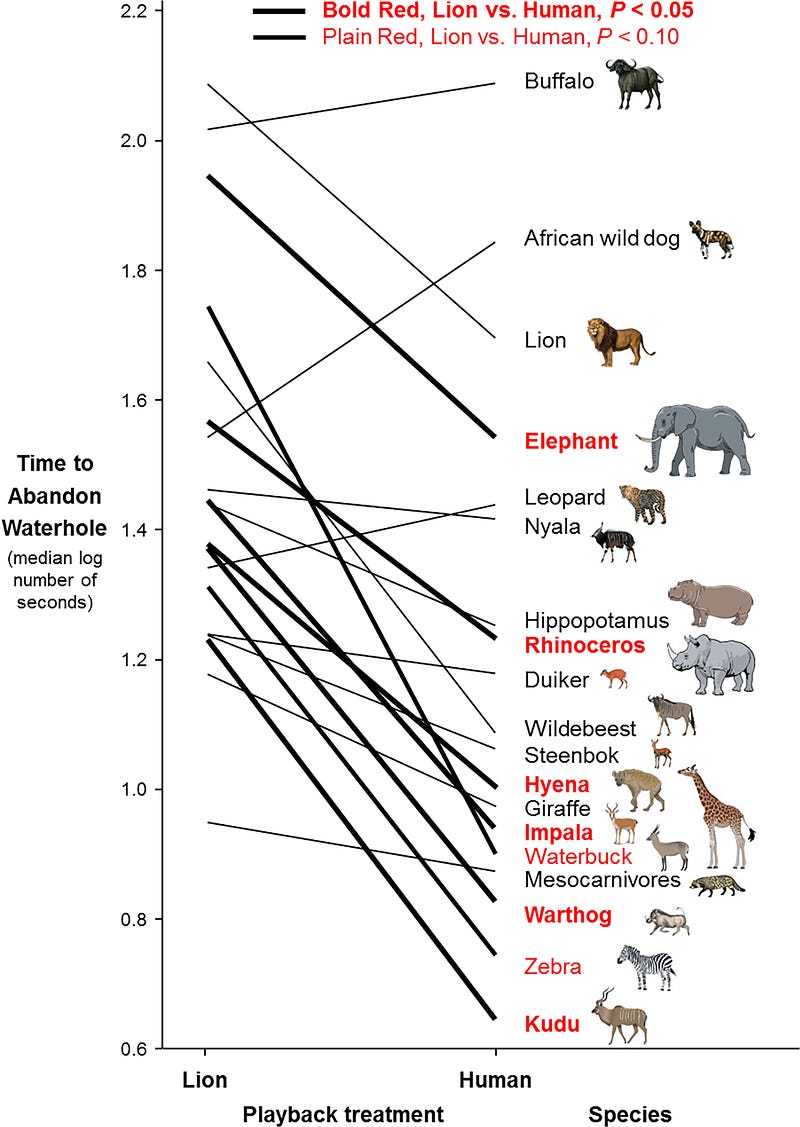
After analyzing 4,238 independent trials of videos and focusing on 19 different animal species, the study came to a straightforward conclusion: when confronted with human voices, animals were not just twice as likely to run, but they also abandoned water holes 40 % faster compared to when they heard lions, dogs, or gunshots. Fully 95% of species ran more from humans than lions (significantly in giraffes, leopards, hyenas, zebras, kudu, warthog, and impala) or abandoned waterholes faster (significantly in rhinoceroses and elephants).
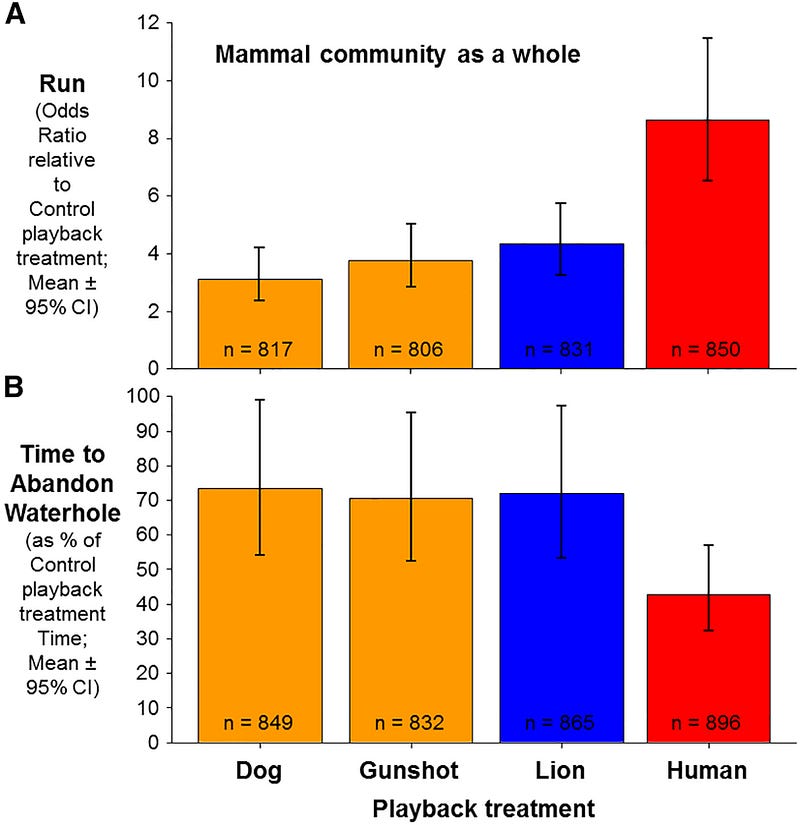
The reason behind this is also pretty straightforward: we humans, as predators, kill prey at much higher rates than other animals. Given our unprecedented lethality, the fear we evoke in wildlife communities can be predicted to be more potent and widespread than even the fear of lions, resulting in even more significant ecological impacts.
“There’s this idea that the animals are going to habituate to humans if they’re not hunted. But we’ve shown that this isn’t the case,” said Clinchy. “The fear of humans is ingrained and pervasive, so this is something that we need to start thinking about seriously for conservation purposes.”
The Curious Elephant Case
In contrast to most other animals, when elephants encountered the roar of lions, they didn’t run away. Instead, they exhibited extraordinary behavior by running toward the source of these sounds, sometimes even colliding with the recording devices in a rather forceful manner.
Interestingly, elephants are known for their aggressive reactions to lions, highlighted by Karen McComb, an animal communication researcher at the University of Sussex, whose team conducted acoustic experiments with elephants in Kenya. When elephants hear lion sounds, they tend to huddle together, protecting their young, and advance toward audio recordings of lions.
But they never did this to the playbacks of human voices. While elephants are mighty enough to confront and drive lions away collectively, they recognize that approaching humans armed with spears or guns could be fatal. This reaction, or the lack of it, underscores a noteworthy fact: even elephants, known for their strength and bravery, fear humans more than they fear lions.
Significance
In his work “The Voyage of the Beagle,” Charles Darwin discussed the fear of wild animals towards humans, shedding light on the historical precedence of this concept. This research added new conclusions about our place as Earth’s most fearsome, disturbing living species.
- The overwhelming fear of humans, often referred to as the “super predator,” surpasses even that of Africa’s most fearsome large carnivore, the lion, and possibly the world’s most alarming, considering its size and group hunting behavior.
- This heightened fear of humans extends throughout the savanna’s mammals, including those residing in one of the world’s top protected areas.
- This heightened fear of humans occurs precisely where one would expect lions to be most formidable, as this region is home to one of the world’s largest remaining lion populations, and waterholes are areas where the danger from lions is most pronounced.
- What’s most intriguing is that the sound of human vocalizations specifically incites the greatest fear in wildlife. This suggests that animals recognize humans as the actual threat, while disturbances like barking dogs are considered lesser proxies.
Similar experiments have demonstrated that various wildlife species, such as pumas, moose, kangaroos, wallabies, and wild boar, all hold a stronger fear of humans compared to other apex predators in their ecosystems, including leopards, wolves, bears, cougars, and dogs.
This fear is believed to be why mammals worldwide adjust their behaviors, including their movements and nocturnal activities, in proximity to humans.
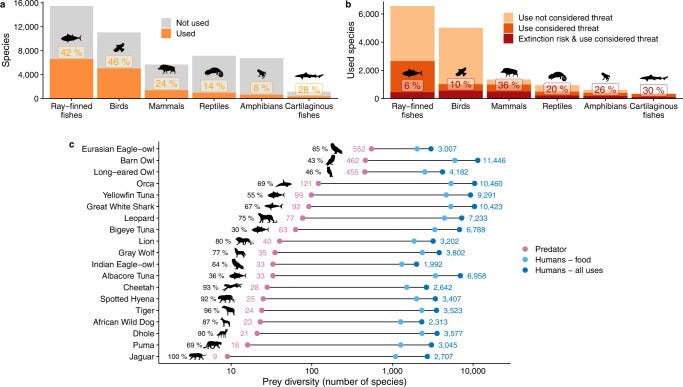
And the concept of pervasive fear of humans challenges the assumption of habituation in wildlife. From a conservation perspective, it is clear that wildlife perceives human presence as an immediate signal of danger. Closures and other restrictions on tourism should minimize the exposure of wildlife to humans for conservation purposes. Instead, we humans promote safaris.
Trick or treat?
The Super-Predator is The Super-Exterminator
African lions have been considered endangered since 2015, but lions are still among Earth’s biggest group-hunting land predators. Meanwhile, more than 1,600 animals and plants have been listed under the US Endangered Species Act since its inception 50 years ago. Less than 6% of the species have ever been delisted.
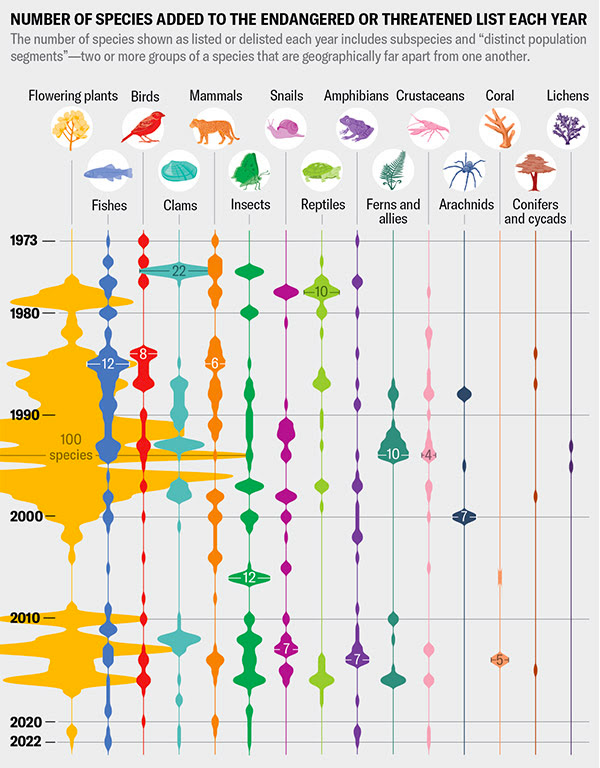
We are the human super-predators, supercharging against anything and anyone in our way. But if the paramount fear of the human “super predator” pervades the planet, this adds a new dimension to our worldwide environmental impacts, given it is also now evident that fear itself can significantly reduce wildlife numbers.
The world is getting uncomfortably close to an average temperature increase of 1.5°C above pre-industrial levels set by the 2015 Paris Agreement this year. This limit, considered crucial to avoid hitting points of no return, is now in jeopardy.
How long are we going to keep denying the climate crisis?
The impacts, once projected for 2050, are already upon us and hitting wildlife in its way.
The collapse of the eastern Bering Sea snow crab, our ever-growing industries killing 40 million birds per year, massive death of dolphins in Amazon linked to severe drought and heat, and the bestsellers: polar bears, whales, pandas, coral reefs, pumas and huemules threatened by the super predator’s actions.
Are we heading towards a modern Noah’s Ark of de-extinction after recovering RNA from an extinct species, the Tasmanian Tiger, for the first time? Do we really need to?
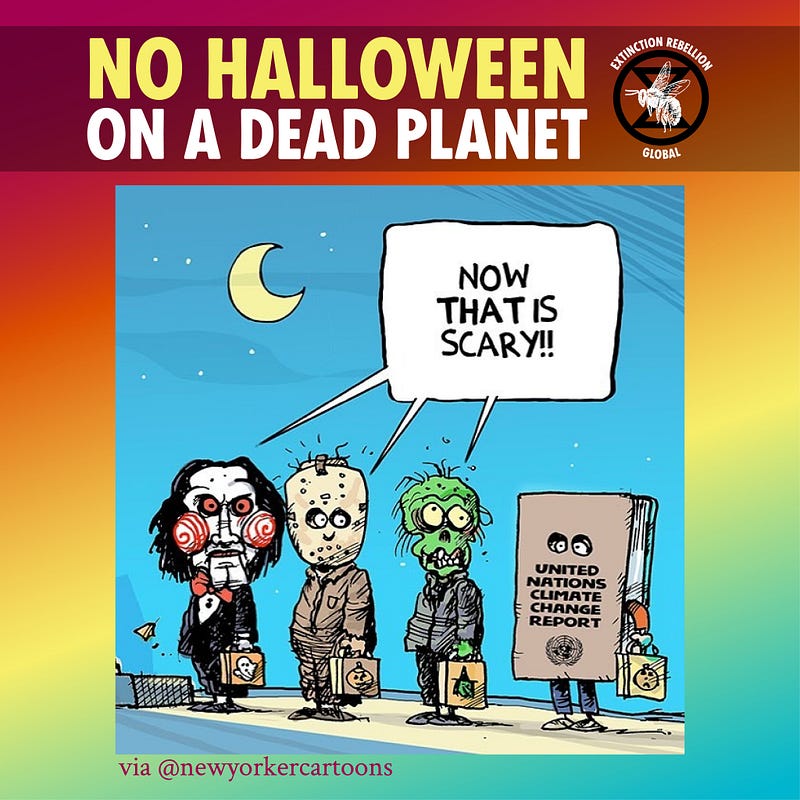
So, if you are looking for the scariest Halloween costume and debating between Jigsaw, Freddy Krueger, or Frankestein, just dress in your regular human being outfit.
There’s nothing scarier out there.
Thank you for your thorough reading and support! If you crave more insights into climate change, scientific progress, and geopolitics with a Patagonian twist, subscribe to the newsletter Antarctic Sapiens and dive into thought-provoking content weekly.