
The ‘Best-Case’ Scenario is Still Awful
The harsh reality of slow-motion collapse
I want things to get better.
I hope the record heatwaves and “once-in-a-century” floods stop happening every year. I hope the current “megadroughts” end.
Because of course, I do.
But there’s a big difference between hoping for the best and planning for the (much more likely) future. Especially when ignoring reality puts the lives and livelihood of tens of millions of people at risk as places like the American West dry out.
It’s important to stay optimistic, but providing life-sustaining water to 40 million people (and the majority of America’s agriculture) should involve more than just reading The Secret and making a vision board.
Because the simple truth is that the effects of climate change aren’t magically going to go away because you don’t want to think about it.
The Colorado River is drying up.
In fact, according to the August 2022 update from the U.S. Bureau of Reclamation (USBR) — the people in charge of U.S. dams and reservoirs—the most likely scenario for Lake Mead and Lake Powell over the next two years is that things will continue to get worse.
And even the “best-case scenario” isn’t anything to get excited about.
Lake Mead Water Level Projections (2022–2024)
The latest USBR projection shows that Lake Mead water levels are likely to drop another 30 feet— or 1 million acre-feet of water over the next two years.
That’s a lot of water.
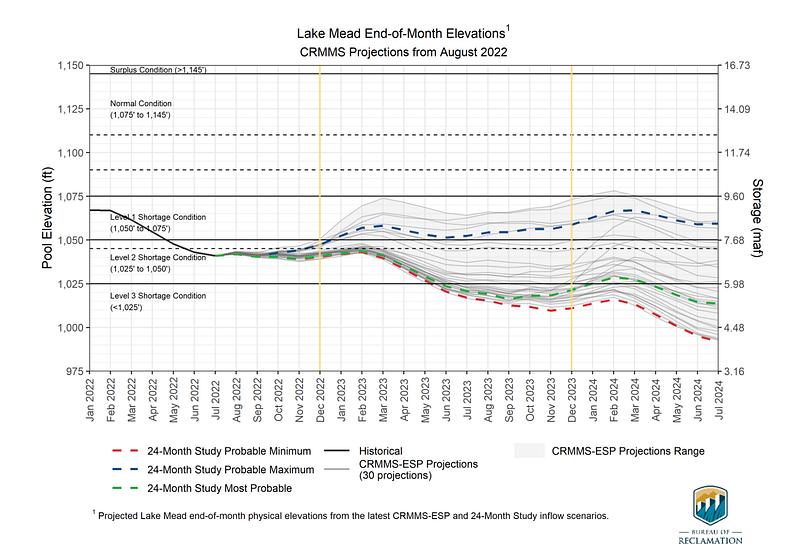
This graph is cluttered, but pay attention to the dotted green line near the bottom. That’s the “most probable” outcome based on historical water usage, storage, and inflow. And you don’t have to be a hydrologist to see that the green line is a lot closer to the red line (“probable minimum”) than the blue line (“probable maximum”).
Aka Lake Mead water levels will continue to drop even further below the record-low levels that we’re at today. And it will keep dropping for (at least) the next two years.
To put this into perspective, the total amount of water in the Colorado River Basin was “set” at 15 million acre-feet per year. I say “set” because this number was decided by surveyors during the 1922 Colorado River Compact which established water rights for six U.S. states and Mexico. They originally wanted it the estimates to be even higher — 18 million acre-feet.
And most experts agree that they overestimated the amount of water in the Colorado River during what was a very wet period.
“Whatever method of analysis of the water supplies of the Colorado River is used, the results are essentially the same, i.e., there is not enough water in the river to satisfy the apportionments under the Compact and the allocation to Mexico under the Mexican Water Treaty.” — Royce J. Tipton, civil engineer, “Water Supplies of the Colorado River,” 1965
The point is, we’ve never had 15 million acre-feet of water in the Colorado River Basin. And in the next two years, Lake Mead alone is going to lose another million acre-feet.
But it gets worse. Because even if things go “great,” the situation in the Colorado River won’t get better.
The Best Case Scenario: Still Not Great
If you look at that Lake Mead projection again, you’ll see that the best case —the blue line—barely rises above current levels over the next two years. The best case scenario is that things basically stay the same.
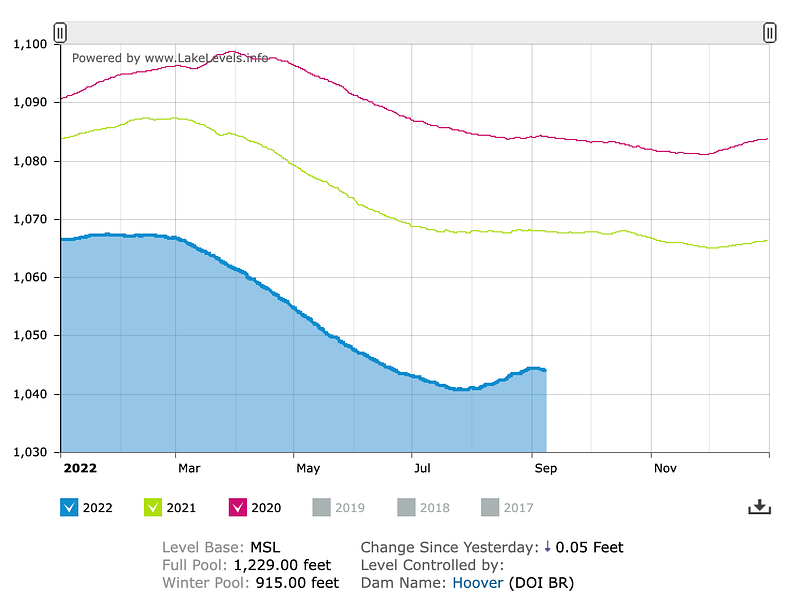
And remember, Lake Mead is lower than it’s ever been.
It’s about 20 feet lower than it was last year at this time (which was a “historic low”), and almost 50 feet lower than 2020 (yet another “historic low”).
How many “historic lows” can you have before you accept that the systems we rely on are broken?
“Novel” Climate Change is Here
Here’s the thing about projections; they are educated guesses. We learned that during COVID. Projections for cases and death counts were all over the map, especially during the early days when no one knew what the heck was happening.
But even months into the pandemic, many of the scariest projections undercounted the death count in the U.S. — often by hundreds of thousands of people.
The problem is that even “good” projections are based on historical data and assumptions rooted in current thinking. Because that’s all we have to go on.
But like COVID, we are at the beginning of something new — something we don’t understand. For lack of a better term, we are experiencing the effects of “novel” climate change.
And we are not prepared.
That’s why you hear words like “historic,” “unprecedented” and “record” thrown around so often to the seemingly endless floods, fires, heatwaves, and droughts.
How many “once-in-a-century” climate disasters can you experience before you have to redefine what that means?
Climate models are getting better, but we are still not great at predicting the effects of climate change. It’s just too complex. Too big. There are too many variables, like Californians using 19% more water last March — during a drought.
If anything, our current climate projections are too conservative. Climate predictions for 2050 are already happening.
The rules have changed.
The New Normal is Here
Historical weather data is not a map to help us predict the future, but a fading memory of a past we will never experience again in our lifetimes. The “new normal” is worse than we hoped, and it’s happening way faster than we ever expected.
We aren’t going to make it to 2050 if we don’t change the way we build our cities, grow our food, and live our lives. We have to stop hoping for things to magically get better when all the evidence shows that we’re headed in the opposite direction. We will simply run out of the things that make our convenient modern lives possible.
Like water.
Because even our best-case scenarios predict that we will look back on 2022 as the “good ol’ days.”
And I don’t know about you, but that doesn’t make me feel too optimistic about the future.
Shawn Forno is a very left-handed travel writer with 15 years of experience, (Lonely Planet, Tortuga Backpacks). He’s also created and managed content strategies for creators like Matt D’Avella (director of Netflix’s The Minimalists) and brands big and small. Shoot him an email if you want to work together or check out the travel channel he runs with his wife.