
The best $1,000 I ever spent: Prepfully software engineering mock interviews
Is it worth paying for practice technical interviews for software engineers?
My answer is a strong yes; they were crucial to my interview success in getting multiple >$500k offers. I used a service called Prepfully to schedule practice interviews.
However, I’ll qualify that answer by saying they’re useful only up to a point and only if you are taking actions on the feedback your interviewers provide.
This post is free; if you’d like become a paid subscriber, you can access all my other writing. Thank you!
What’s Prepfully?
Prepfully is a site that offers practice interviews for coding, system design, or behavioral questions. You can also schedule a consultative session to learn more about an interviewer’s day-to-day in the role and company you’re applying to, or to get general advice on how to break into their field.
Other sites offer similar services, but the quality varies.
This post is not sponsored by Prepfully; I’m sharing their service because it was the only mock interview service I used, and I genuinely recommend them.
Why would I want to pay for practice interviews?
Let’s say you’re looking for a Senior Software Engineer position at Google. Wouldn’t it be especially useful for someone who works at Google, who interviews people for that exact role, to interview you? Particularly if there’s more standardization for the interview rubric at a larger company like Google, your actual interview experience is probably going to come pretty close to this practice interview experience.
While the interviewers won’t ask you the exact questions used for actual interview loops, you can expect questions of similar difficulty. My practice interviewers asked me questions they asked in the last year but no longer actively use.
How did paid practice interviews help me?
I did several mock system design interviews.
I had passed more than 90% of my technical phone screens, but I wasn’t confident in my system design interview. I could talk about high-level system architecture and knew some buzzwords like “high availability,” “caching,” “SQL vs. NoSQL,” and “eventual consistency,” but I wasn’t sure if I was performing at the senior/staff engineer level. Watching Youtube system design videos and reading guides online wasn’t cutting it — I wanted to maximize my chance of clearing this interview.
I did mock interviews with two interviewers to benchmark how my initial system design interview would go — expectedly, not well. They gave me feedback that my framework for the interview was not organized, I couldn’t go deeper on some of the topics I mentioned, and I wasn’t driving the interview enough.
I improved significantly by doing mock interviews for system design. There is a big difference between just reading or watching other people’s answers to a system design interviewer, due to the open-ended nature of the question. I really learned how to lead the discussion by following a framework that I iterated on over the course of these interviews, and I quickly realized where my domain knowledge was lacking when my interviewers asked me more questions about how particular systems worked in-depth.
The results speak for themselves; I passed every system design interview from the companies I interviewed with. While I’m sure luck played a role, I knew I had increased my chances of success significantly by becoming more comfortable with system design questions and deepening my technical knowledge of specific system design concepts.
Why can’t I just ask my friends to interview me?
Your friends are (probably) nice people, and you (probably) like them, which is why they’re your friends. While that’s normally a pleasant dynamic, it works against you here in both directions:
- You’re probably more comfortable talking with your friends, so you’ll feel less nervous.
- Your friends are likely to give you more help or leeway with what you’re saying. Maybe your friends already have some idea of what you do for work, or worse, they are your coworkers, so your possibly bad explanation of your project doesn’t seem as bad to them.
Alternatively, your friend might be bad at delivering feedback, or you might be bad at receiving it from a friend. To avoid making it awkward, I recommend an interview from a stranger who has no interest in sugarcoating your interview feedback
Wow, $150 for an interview is really expensive. Is it worth it?
Let’s do some simple math. Say you do 10 interviews, so that’s $1,500.
How much is your salary going up with a new job offer? My yearly total compensation increased by over $100,000. That looks like a pretty solid deal to me.
Additionally, the skills I gain from these mock interviews isn’t a one-time thing; I can maintain those the next time I’m job hunting, and I’ll also be a better interviewer as a result.
How do I use these interviews efficiently?
I took notes after every session with my interviewer as they were giving me feedback. There were two areas I could work on after an interview:
- Domain knowledge; I needed go fill in some gaps in my knowledge, e.g. how does locking really work, what are the different locking strategies and tradeoffs of each?
- Structure; how do I lead the interview and what should I say to the interviewer to guide them from one section of the interview to the next (e.g. from “overall architecture” to a deep-dive on locking strategies)?
Should I do mock interviews for coding, system design, or behavioral interviews?
I primarily did system design interviews, as I knew that was my weakness. However, if I could go back in time, I would also do a behavioral interview to discuss my past technical work. Explaining your work to someone with no context is an important skill; you need to ensure your interviewer is following your explanation so you can explain your contributions clearly.
I did one coding mock interview. The first two questions the interviewer proposed were ones I had seen before on Leetcode. The last one I had not seen and managed to almost solve. Even then, my interviewer gave me useful feedback on how to communicate my answer better.
Should I stick with one mock interviewer or interview with multiple people?
I did a mix of both. For system design interviews, I interviewed with multiple people initially to get a sense of the different ways to structure an answer and saw the different ways interviewers might followup on certain concepts I bring up.
However, I found an interviewer who gave me more thorough feedback, so I stuck with them. This way, I could also get clear feedback on whether I was actually improving, since they had a baseline to compare against.
What site do you recommend for mock interviews?
I used Prepfully this time around. If you’d like to get $5 off your first interview, you can use my referral code RGVOXR when you sign up. Their interviews are usually more affordable, usually ranging from $100 to $130.
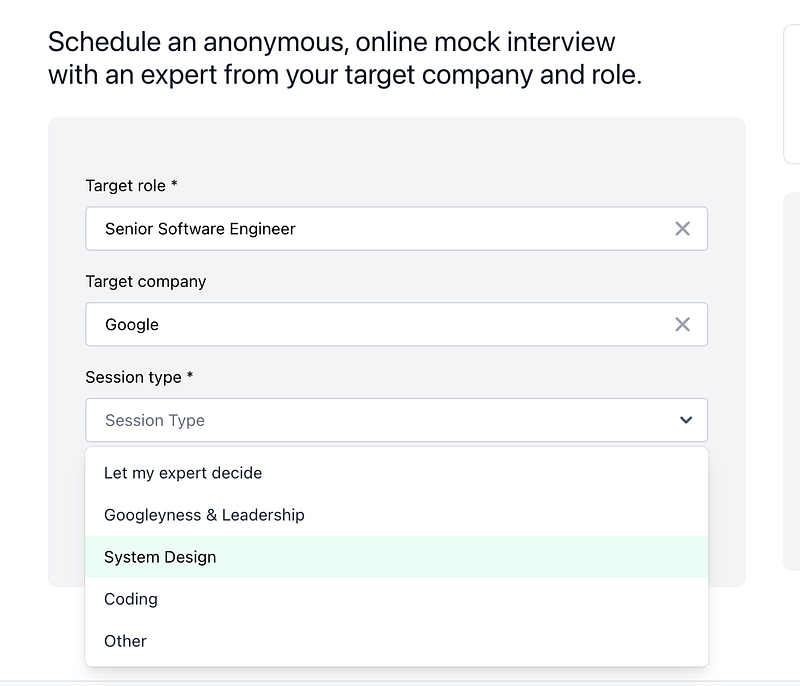
When scheduling an interview, you can specify the exact role, company, and type of interview you’d like. Note that the interview types may vary depending on the company.
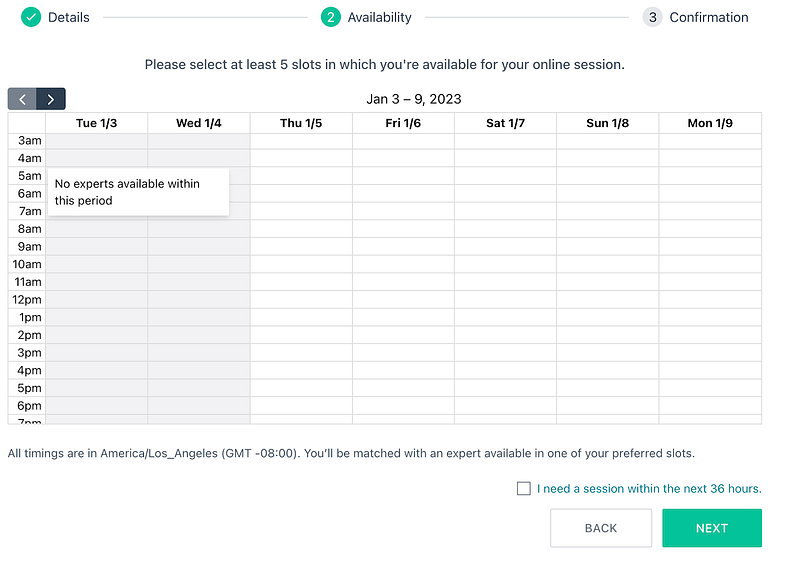
Submit your availability via the calendar and Prepfully will find experts who can meet you during that time. Prepfully works around candidates’ available timings, which is super convenient (you can do these on the weekend)!
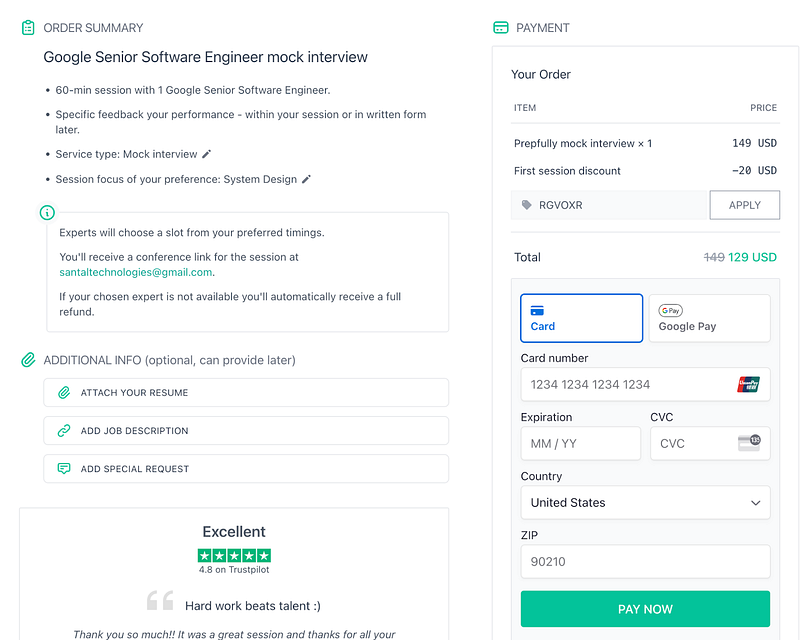
For your first interview, you get $20 off (again, if you use my code RGVOXR, you’ll get an additional $5 off).
After the interview, you can provide feedback to Prepfully, and your interviewer will also give you written feedback, including what your hiring decision would be.
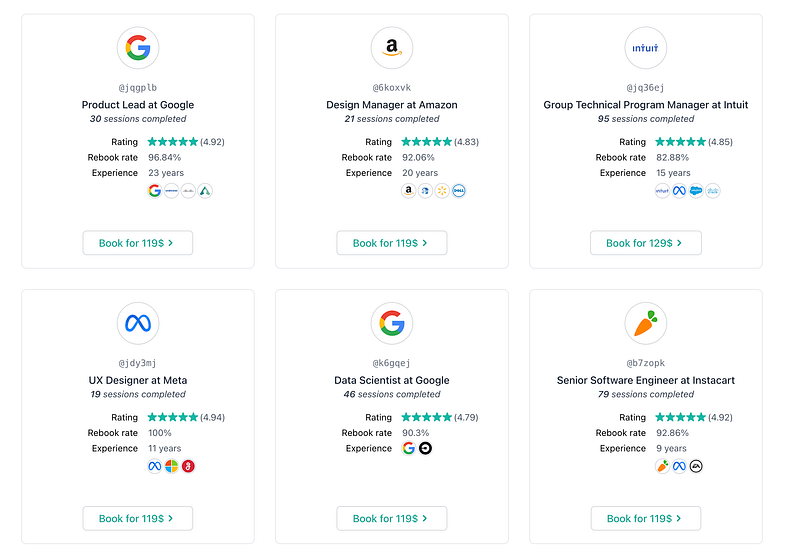
A newer feature they just launched: https://prepfully.com/coaches shows you where interviewers have worked, their rating, “rebook rate”, and pricing.
What happens if I have a poor interview experience?
Prepfully’s customer support was stellar. I emailed them to let them know the interview didn’t feel productive and why I felt that way. I asked them to refund me half my cost, which they gladly did, and offered to help me find a different interviewer who could better meet my needs. They responded promptly, and I was pleased with their overall response.
Will Prepfully tell my current employer that I’m looking for a new job?
Definitely a scary thought I’ve had. Prepfully keeps all parties anonymous by default (I also used a burner email account to sign up), and I found this lowered my stress around not performing well on an interview.

For more articles like this, follow me on Medium. Not a member yet? Join the community. Want more software engineering interview guides and coding question tips? Check out all of my writing organized by topic in this article.
If you have any requests for what I should write, please let me know!