
The “Bermuda Plan” or how to speed up project by removing people
The “Bermuda Plan” is a strategy of removing most people from a project (understand sending them on vacation to Bermuda) to allow the remaining core team to complete the project more quickly. The goal is to reduce team size and the coordination work at the same time, keeping the top performers focus on delivery and removing the under performers who are slowing down the projet.

The “Bermuda Plan” is a corollary of Brooks’s Law. Fred Brook is a Software Engineer and the author of The Mythical Man-Month published in 1975, that says:
“Adding manpower to a late software project makes it later”
Innocently, you’d think that adding more people to a project would make it move even faster, but that’s not entirely true. First of all, doubling a team does not make the project progress twice as fast. Then, to some degree, adding more people to a project will slow down team velocity because of the coordination costs.
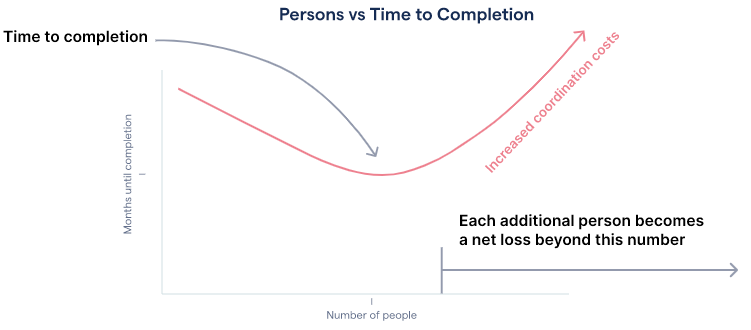
Here are Brooks explanations:
- People already in the project need to onboard newcomers: this reduces team velocity until newcomers can start delivering independently and this period can last a few months depending on the complexity of the project ;
- Some tasks cannot be easily divided, so adding more people won’t help: nine women can’t make a baby in one month ;
- More people means more communication channels due to the combinatorial explosion: communication works in a network and not in a tree, adding a new nth manpower will n new connections (eg: going from 3 to 4 people means going from 3 to 6 connections, going from 4 to 5 people means going from 6 to 10 connections).
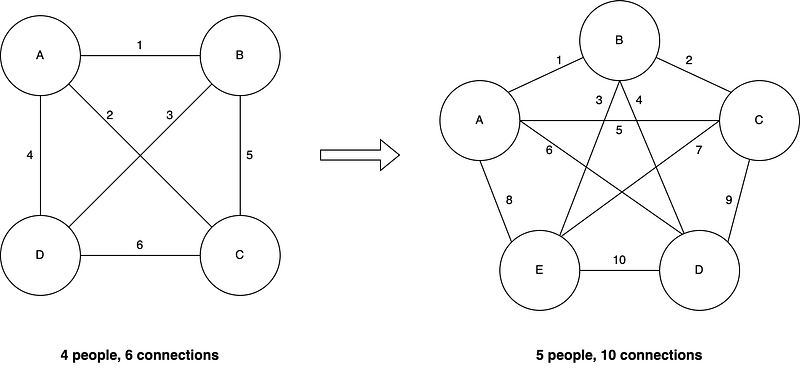
That’s why we invented the “Bermuda Plan”. When you reach the point where the coordination cost is greater than the value of the last resources, you can consider removing some people from the project and returning to your highest velocity.
Limitations
Brook was mainly talking about software engineering project, but I truly think this applies to every project.
Please note that the “Bermuda Plan” is a very short-term strategy. There are other ways to reduce coordination costs by improving organisation, communication channels and the integration of newcomers. Moreover, this is a very sensitive human resources decision, which can have a negative impact on the remaining team.
Brook’s law also considers all people from a project equal, but this is not true. Adding people with a lot of experiences or with a valuable knowledge about the project or with critical missing skills will most likely help to reduce the delay.
Of course, more people on the same project can slow down the project. Another solution is to divide the project into small independent projects to have a smaller and more efficient team on each sub-project.


