
The Benefits of Applying Synergy To Classroom Learning
Even seats of learning such as schools, can suffer from learning disabilities.
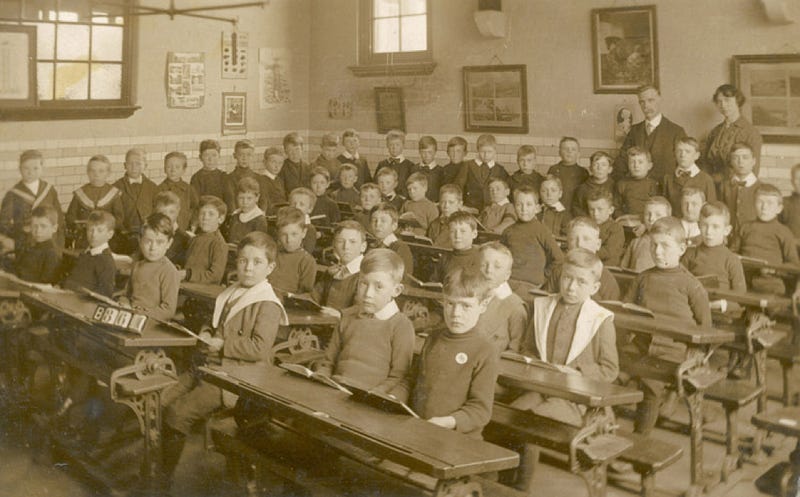
Whether we choose to believe it or not, the educational system, both public and private, hasn’t changed much in over 150 years.
You might see a few more smiles on the faces of a teacher’s twenty to thirty charges, and there may be a little more movement. The room may look more colorful and exciting, but still, the model is the same, and needs fixing.
Sticking a group of disparate youngsters into one classroom, all the same age, to be taught by one teacher, seems to say that it’s business as usual!
And it is!
The same bureaucratic standardized tests are meted out, year in, year out, and used as a measure of intellect, even though Howard Gardener’s Multiple Intelligences has been around for many years, and used successfully by teachers for just as many!
Yet at the coalface, little has changed.
We all learn in different ways, some hands-on, some hear something once, understand, and apply it, whilst others just lag further and further behind.
For many children, sitting on the floor can be a perfectly comfortable way both to sit and learn, but others are simply out of place in such a setting.
Chad, a Sudanese student I taught in recent times, was as skinny as a rake and as tall as a flag pole, and could not sit still. He was forever singing, and dancing to the beat of his imagination, yet, he was able to combine that with class work.
But not all children are so lucky. So we have to find ways to differentiate learning in order to be fair to all.
A friend used to pose this question to students doing their practicum with him . ‘Are you a sage on the stage, or a guide on the side?’
It was a serious question. What exactly is the role of the teacher? And if it’s to be a guide on the side, how does that play out?
I chose the above image because I wanted to highlight that, though I don’t believe we have totally solved the puzzle of efficiently and joyously learning, , there is at least, some joy and color in most classrooms.
But the one-size-fits-all approach is still lurking in schools, like an old friend that doesn’t quite get the message that his tenure has been totally used up. And we have to find ways to quietly make it go away.
There’s still a lot of bums on seats, or on floors, with students focused on something, usually a teacher, or the whiteboard!
It has to be otherwise, and look so!
I like to walk into a classroom that has the buzz, students working closely with each other, proffering ideas, debating whether something should be added to whatever they are researching, with that sense of inclusion.
Where there is BUZZ, you don’t see too much misbehavior. Groups are rarely homogeneous, deliberately so! Instead they are carefully selected to draw on talent.
In a busy classroom, and in such groups, the students begin the process of facilitating their own discovery. This is where synergy is activated, and learning takes place.
Synergy applies to: the interaction of multiple elements that when combined produce a total effect that is greater than the sum of the individual elements or contributions.
I used to be a TESOL teacher (teaching English as a second language), but after a few years, decided to go back into the classroom. That year, the special needs teacher approached me and asked if I would take the bulk of the ESL children in year one, the idea being that she and I would combine skills in order to ensure that no child would be left behind.
Please note: Having no child left behind was our principal goal.
Our belief was that we had to find ways to build confidence in the at-risk students, to facilitate their moving forward from one year to the next.
To that end we had a meeting of parents in order to formulate learning plans. Being of migrant extraction, almost all of them were anxious, as they felt they didn’t have the skills to support their children’s learning. We managed to convince them that all would be well.
To that end we set up after-school homework sessions targeting their needs, where parents could sit in, observe what was happening, and participate if they wanted to.
It had to be fun!
The you-can-do-it attitude was firmly entrenched from day one.
Mostly we worked on fun literacy games, sometime working in pairs, or groups of four. Everything was planned with small, achievable, empowering goals in mind.
It was so pleasing to watch the children’s faces light up with confidence in time, and not only achieve success, but also help other to do so as well. And it wasn’t long before parents began to be part of the equation.
Our ‘village’ was working together!
As with any group, gifted, migrant, or otherwise, there will always be those who cream to the top, and others what just need that extra bit of help.
The thing is, it’s easier to to determine exactly what kind of help is needed when working in ratios of 1:6 as opposed to whole-class, that is, 1:30!
And surely that is what learning is all about.
- making students feel comfortable
- determining their needs
- reassuring them at time of need
- and lots of fun!
- with teachers as guides on the side!
That year every child completed Year One, with a confidence they might never have had. Each was able to read and write at grade level. Not only that, but parents improved in English too, and with that, their confidence grew which enabled them to better help their children at home.
Once again, our ‘village’ had excelled itself!
Interestingly, absenteeism was significantly reduced. No prizes for guessing why!
The next year, we once again had too many children struggling to keep pace in literacy. My colleague and I approached the principal with the idea that we might run an early-school program for all at-risk students.
It was agreed to. Why wouldn’t you?
Three times each week, parents and children would start school at eight am. All work was centered around what was known as Big Books, at the time. These books use a lot of repetitive text, chants that even the most insecure student could gradually feel more secure in reading.
Once again, all children gained incredible ground in literacy, many of them surpassing some of the students we had deemed able. There’s a lesson here!
The thing is, we can so easily miss cues for learning. As teachers we really need to fully understand children’s strengths and weaknesses in order to provide a sound platform for growth.
Schools should be part of the community and not apart, and when this happens, and when students, staff and parents are united in a common goal, synergistic learning takes place.
For the teachers, having a clear understanding of what we wanted to achieve, and tailoring our teaching to children’s needs, because we were able to, truly enhanced the outcome.
Synergy is not a magical component of any system. It needs to be well planned, and implementable.
1. We must have plans in place for synergy to happen
Teachers working together, conferring with each other about specific needs of students, marrying those needs, and in our case involving parents, made for a positive outcome.
2. The role of the players
Although teachers will be considered to be the higher authority in the learning process, what we really want to do is ensure that we build students up to be independent learners.
3. Teachers are the facilitators
They provide the climate for learning, the comfort, the encouragement, and the will, so that less confident students will be willing to ask questions, to challenge each other, and to cooperate for a common good.
4. Students become the actors in their learning
This enables teachers to be both facilitators and advisers, a very different role from traditional teaching.
So what I have talked about applies to needs that we as teachers saw in the classroom, and how we managed to support small-group learning. However this can be applied to whole-class, and cross-grade learning, with effective management.
‘Alone we can do so little: together we can do so much.’ Helen Kellar