
The Benefits and Pitfalls of Special Education Law
And a few minor changes that could make a big positive difference

The Individuals with Disabilities Education Act (IDEA) is the federal statute parents of children with disabilities are most familiar with. It contains three parts: Part A, Part B and Part C. Of the three, Part B governs most of a child’s years in public education, as it addresses the provision of “free appropriate public education in the least restrictive environment for children with disabilities ages three through 21.” [emphasis added]
Within Part B, Sections 1412, 1414 and 1415 are the most relevant for the majority of parents, administrators and teachers — that is, those involved in the special education of children whose educational rights IDEA legislates.
I have a 26-year-old son who received special education up until he was 21. I’m also a special education teacher. In this article, I aim to briefly review the salient components of IDEA’s Part B and to reflect on how they play out in practice based on my experience as a parent and educator. To be clear, this experience mainly pertains to children with moderate to significant needs.
I will also humbly propose a couple of ideas to make IDEA fairer and more effective.
IDEA Part B, Section 1412: Free Appropriate Public Education and Least Restrictive Environment
Section 1412 contains two concepts central to IDEA, terms that parents learn about early on: free appropriate public education and least restrictive environment.
Here’s the language straight from Section 1412:
Free appropriate public education (FAPE):
A free appropriate public education is available to all children with disabilities residing in the State between the ages of 3 and 21, inclusive, including children with disabilities who have been suspended or expelled from school.
Least restrictive environment (LRE):
To the maximum extent appropriate, children with disabilities, including children in public or private institutions or other care facilities, are educated with children who are not disabled, and special classes, separate schooling, or other removal of children with disabilities from the regular educational environment occurs only when the nature or severity of the disability of a child is such that education in regular classes with the use of supplementary aids and services cannot be achieved satisfactorily.
How do the concepts of FAPE and LRE play out?
“Approriate” sure is a fuzzy word.
Free appropriate public education for all children with disabilities: Who’d argue that such a mandate is not a good thing for children with disabilities and their families?
It is. It means that no child with a disability can be denied a public education. That’s a big deal.
The tricky part of the law is tied to the term appropriate. Obviously, there are sometimes gaps between what a parent, an educator and an administrator consider appropriate. When it comes to the interpretation of the term, the gap between parents and administrators is often vast, even insurmountable.
For a parent (such as me) of a child with, say, autism and a cognitive disability (such as my son), appropriate means a program with highly trained, certified staff providing most of the instruction, a good portion of it one-to-one. Such a program is expensive.
For an administrator, an appropriate program would consist of a certified special education teacher who oversees the education of six children similar to mine, such that individual direct instruction from such teacher is minimal. Most of the individual instruction would be imparted by a teaching assistant, also known as a paraprofessional or aide.
Obviously, what an administrator considers appropriate costs a whole lot less than what a parent so finds. Each is coming at it from different angles and with opposite incentives.
A parent takes appropriate to mean a program that will allow her own significantly disabled child to make the most progress possible.
The administrator, in the best of cases, is trying to optimize how she spreads the funding she’s in charge of in the most effective way possible. She doesn’t have the best interest of only one child in mind, but the interest of the whole special needs population.
In the worst of cases, the administrator has the incentive to please the most vocal parents at the expense of the least involved, thereby disproportionately allocating funds.
“Appropriate” sure is a fuzzy word.
The concept of “least restrictive environment” came about in response to the widespread segregation of disabled children into programs that often provided minimal to no educational benefit.
LRE is often taken to mean the general education class. The majority of special education students learn best alongside non-disabled peers, given differentiated teaching and additional instruction.
Additional instruction, however, is not the way school districts go. Many students who would have benefited from the regular education instruction are pulled out during a portion of such instruction to receive their specialized services.
Conversely, some high-needs students spend too much time in a regular education class and everyone goes along because they’re in the LRE. There are students, however, whose needs are so significant that they hardly gain anything from spending most of their day in a regular class with an aide.
“Least restrictive environment” should always, ALWAYS, depend on the child’s needs. As it happens, LRE is sometimes used to justify either too much or too little time in regular education.
IDEA Part B, Section 1414: The Individualized Education Program
In a perfect world, each child would have a top-notch IEP that’s perfectly reflected in real life.
Under IDEA, every child with special education needs gets an Individualized Education Program (IEP) delineating how the student will be provided FAPE in the least restrictive environment.
This is how Section 1414 defines the IEP:
“The term ‘individualized education program’ or ‘IEP’ means a written statement for each child with a disability that is developed, reviewed, and revised in accordance with this section.”
Sounds simple, but, in reality, the IEP process is quite complex.
Section 1414 also specifies requirements surrounding the components of the IEP; the members of the team developing the IEP; and the timeline for creating, implementing and reviewing the IEP.
Also, Section 1414 lays out the evaluation process whereby eligibility for special education is determined, and requirements for parental consent.
How helpful is the IEP as a process and programmatic tool?
Very.
The law makes expectations about the process clear.
The main components of the IEP include:
- Present levels of performance: Where the student’s skills are in various areas (communication, academics, motor skills, behavior, etc.).
- Yearly goals and objectives for areas where the child isn’t “age-appropriate”.
- Services and supports needed to meet the goals and objectives in the IEP and to allow the child to make progress and participate in general education (or the LRE).
Again, it sounds straightforward and simple, but the reality is far from both.
How ambitious should the goals and objectives be? Parents, educators and administrators face different incentives when considering this question. Plus there’s no crystal ball that can determine how much progress any child can make in a year. If the child’s older and there’s some history on pace of progress, a slow pace could arguably be the result of a poor program.
Thus, parents will naturally want highly ambitious goals, not only because, well, the child’s their child, but also because the more ambitious the goals, the more services the child might get.
Administrators usually look to stretch resources (money and manpower) as far as they can, so the incentive is to promote programs that are sure to be met given the existing resources.
Teachers and therapists are in the middle of it all. Of all the people employed by districts, the teacher, and sometimes paraprofessional, spend the most time with the child and deeply care for him.
But teachers have more than one student so they must balance out multiple needs. Teachers usually look to include goals ambitious enough such that the child (and teacher!) will get enough support. When I talk about “support, I mostly mean the number of students on a teacher’s caseload, training for paraprofessionals, and space and equipment.
However, a teacher is never as invested as a parent is — not even close of course.
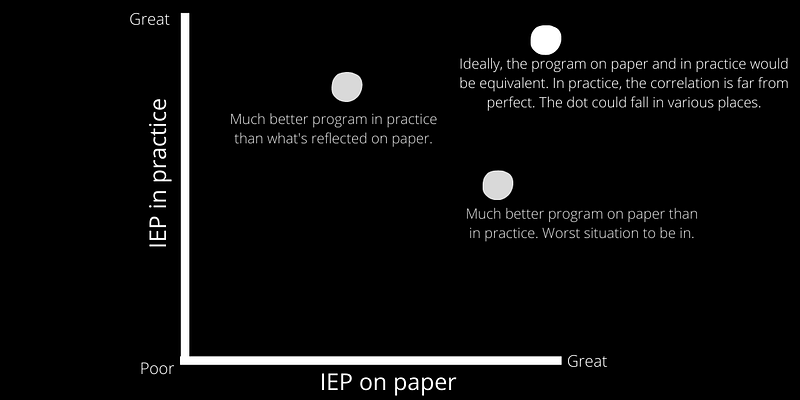
Then there’s the fact that, in the end, the IEP is a “written statement” that is memorialized on paper (or electronically nowadays). The paper will take anything you write on it. An IEP that’s perfect in all respects does not necessarily translate into a perfect program. Conversely, sometimes a child with a mediocrely constructed IEP gets fabulous services.
In a perfect world, each child would have a top-notch IEP that’s perfectly reflected in real life. The world, however, is far from perfect, as this simple chart illustrates:
IDEA Part B, Section 1415: Procedural Safeguards
The procedural safeguards delineate, for example:
- How the rights of children will be protected.
- The prior written notice schools must give parents before implementing or changing the IEP in any way.
- Parental rights to examine their child’s records, and the procedures to mediate disputes between parties or request and hold due process hearings.
The procedural safeguards must be given to parents annually. They’re the “fine print” if you will. Parents get asked at every meeting, “Did you get your procedural safeguards,” and “Do you have any questions about your procedural safeguards?” Generally, parents answer “yes” to the first question and “no” to the second. In reality, almost no parent reads them — until they do, which is when they’re vastly dissatisfied, disillusioned, or when they’ve lost trust in the process and humans.
Are the Procedural Safeguards too much or too little fine print?
The safeguards are important but too many stakeholders, particularly parents, go through the IEP process without ever having read them. And who would read, understand and retain a 15-page write-up, single-spaced?
Just flipping through the pages is overwhelming, especially when you’re meeting about your child and are often coping with the fact that he has special needs. It’s scary. I for one always had to excuse myself and head to the bathroom when my son’s IEP meetings were about to start.
The Procedural Safeguards would best meet their purpose if all stakeholders, particularly parents, understood them. I have never witnessed a deliberate effort for this to be the case. The one box that’s always checked is the parents stating, on the record, that they have received their procedural safeguards.
The IDEA statute is national, but its application unfolds in multiple ways all across the country.
As stated above, in a perfect world, each child would have a top-notch IEP that’s perfectly reflected in real life.
In our less than perfect world, children with pretty equivalent profiles often receive vastly different programs, certainly across states and districts. However, such can be the case even within the same district and the very same school.
At times, the reasons for this are fortuitous. Other times, it’s the direct result of how statutes translate into the real world, where various stakeholders have different viewpoints, priorities, and, yes, means.
When I write “fortuitous”, what I mean are situations that are hard to plan for or that districts can get away with. Examples of this include when a special education teacher happens to have a low caseload one year and one that’s twice as heavy the following year. It happens.
Another example is when you depend on teaching assistants. A stellar TA may be assigned to your group or a specific student one year, while, another year, you are assigned a really incompetent individual. No matter how hard you try to provide training, there’s only so much you can do. How tight the labor market is has a lot to do with this. Working as a special education TA doesn’t pay that much. It may be a rewarding job, yet it is often a pretty thankless one too.
Aside from the fortuitous factors at play, the statute lends itself to, shall we say, plotting and planning.
I’ll give a couple of possible scenarios. The student in these examples is based on my son at about 8 years old. The rest is fictional, a composite of various things I’ve seen happen in multiple districts and schools, and to various students and families I’ve known over the past 20 years.
The student, whom I’ll call Richard, has a comprehensive IEP that addresses speech and language, social/ emotional and behavioral needs, gross and fine motor skills, activities of daily living and all academic areas. Richard has autism and very significant cognitive and academic delays. Behaviors include poor attention, task avoidance, and, at times, disruptive and aggressive behaviors (swiping, throwing, screaming).
Program A: Great special education teacher and individual TA (who’s getting her teaching degree). Per week: 5 hours of individual instruction with the special education teacher, 5 hours of individual instruction with the TA, 5 speech and language sessions, 3 occupational therapy sessions and 2 physical therapy sessions. Per month: 2 hours of Board Certified Behavior Analyst support to the special education teacher, 2 hours of parent training with a certified staff member.
Program B: Great special education teacher and a so-so individual TA. Per week: 1 hour of individual instruction with the special education teacher, 4 hours of individual instruction with the TA, 3 speech and language sessions, 2 occupational therapy and 1 physical therapy.
Believe it or not, both programs could be considered appropriate. In the case of program A, however, a parent was likely heavily involved in arriving at what was considered appropriate.
How do parents make this happen? Sometimes, by asking. Simply by asking, insisting, and making it abundantly clear that they’ve done their homework, know full well what an integral part of the IEP process they are, and are steeped into the language of IDEA.
Other times, parents will hire an advocate or even a special education lawyer (I’ve done the latter). Some parents engage one when they feel that their child’s program is lousy, or when, for whatever reason, they no longer trust the process or the humans involved in it. A few parents just come to IEP meetings with an advocate as a matter of course.
In the end, children of the rich and privileged benefit the most from IDEA. I hate to write it because it makes me very sad. That’s the truth though. They’re more likely to have the time and money to aggressively advocate for their children, to consult with advocates and hire special education lawyers.
Could these small changes improve IDEA?
1. The Procedural Safeguards and IEP process must be explained better to parents.
There should be a concerted effort on the part of school districts to educate parents. For example, there could be user-friendly video tutorials about the IEP process that anyone without a legal background can understand, or a short and readable written version of the procedural safeguards — not just the lengthy handout written in small print and single-spaced. There are many great tech tools to make videos and format documents such that they don’t turn off already overwhelmed parents.
2. All parents should have access to legal advice if they decide on mediation or to file for a due process hearing.
Parents need a certain income to afford a special education lawyer to represent them at due process. All parents, especially low-income, should have access to a level of legal advice.
States should publish summaries or statistics on due process rulings. This could prevent frivolous cases. I analyzed my State’s hearings for 2019, and I can tell you that all cases related to parental requests for districts to pay for independent educational evaluation were decided in favor of districts (when the district had already conducted their own evaluations).
Did lawyers tell parents this before proceeding to file? Lawyers may have an incentive not to give parents this type of information.
By the time a judge makes a final decision on a due process case, both parents and districts have spent a great deal of money on lawyers — not to mention the stress the process brings, particularly to parents.
3. There should be a way to assess the comparative level of resources being devoted to some students with IEPs, while maintaining confidentiality.
I’m not talking about all students, but the small fraction of students with significant needs. I’ve seen too much disparity over my years in education, both as a parent and teacher. Yes, the IEP is, by definition, individualized, but level of services or hugely costly outplacements can depend largely on parental advocacy.
Here’s a (hypothetical) example: three students with very similar profiles had an unarguably inappropriate program over half a school year. One very involved parent notices, hires an advocate, and builds a case. This parent may get the district to provide twice as many services (at twice the expense) for her child as the other two students.
Even when children with equivalent high-needs profiles all have an appropriate IEP, at times the child with a hugely involved parent will have an IEP that’s far more “appropriate”.
Final Thought
It’s hard for taxpayers and school board members to digest spending 2x, 3x, even 5x as much money as the average per-student amount on a single child. That’s just the way it is — unless the child’s your own child of course. This is exactly why IDEA exists.
IDEA is tricky, and so is special education. Why? Because special education is labor-intensive and expensive, and human power and funds are limited. Level of need is highly correlated to the level of support a child needs, and school districts make choices when allocating resources.
It’s hard for taxpayers and school board members to digest spending 2x, 3x, even 5x as much money as the average per-student amount on a single child. That’s just the way it is — unless the child’s your own child of course. This is exactly why IDEA exists.


