
The Beauty of Ordinary Things: A Unique Artistic Vision
The understated brilliance of Jean Siméon Chardin
Some artists depict the most explosive or awe-inspiring subjects in their art. They are drawn to the most impressive, gruesome or magnificent sides of life.
The 18th century painter Jean Siméon Chardin took the opposite approach.
Working in an era when art was at its most theatrical — known as the Rococo period — Chardin pursued a style of painting that treasured the subtle beauty of the world around him. In an age of lavish excess, he was an artist who placed extraordinary emphasis on the most commonplace things.
Chardin drew influence from 17th century Dutch art, which had already mastered still life painting and its numerous possibilities, filling bowls of fruit and bouquets of flowers with hidden references to hope, despair, patriotism and death.
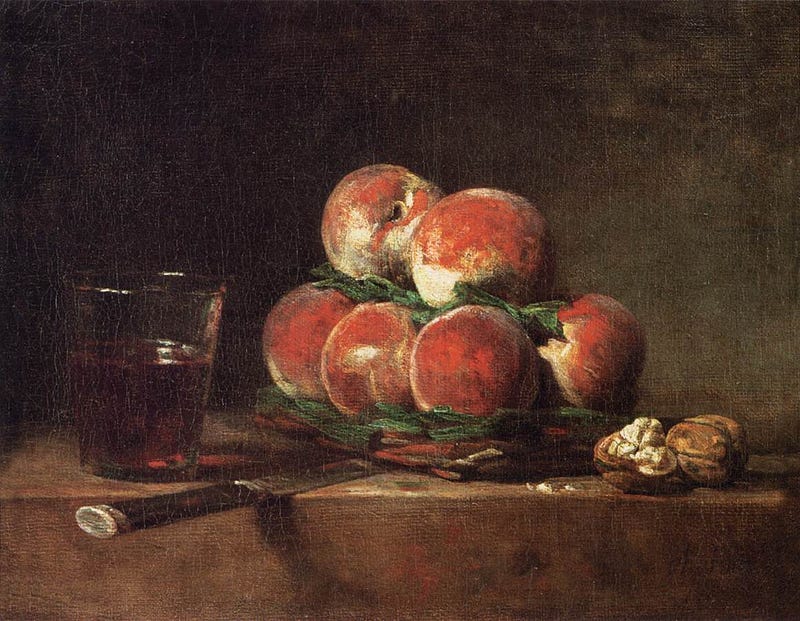
Chardin’s paintings do something else. They take us into the quietude of empty rooms and private recreations. Overt symbolism is dropped in favour of astute enchantment. Through depictions of loaves of bread, cutlery, saltcellars and coffee pots, his work creates a patchwork of texture and light that refuses to be trivial. A subject as simple as a basket of peaches is given the rich dignity of an important portrait.
In Basket of Peaches, notice how rich and plump the fruit is, and how Chardin has captured the slightly coarse texture of peach skin with patches of shadow. Notice also the knife wedged beneath the basket and how its oval handle sits proud of the tabletop with light falling on its silver tip.
Finding Beauty in the Ordinary
The son of a court craftsman, Chardin trained with the Rococo history painters Pierre-Jacques Cazes and Noël-Nicolas Coypel. He first exhibited in the Paris salon in the 1730s where the simplicity of his compositions made an immediate impression on both viewers and critics.
On first appearance, his paintings possess an austere air, yet they are tinged with a warmth that raises them from the level of the ordinary to something valuable. The unstressed elegance of his work steadily won him a popular reputation.
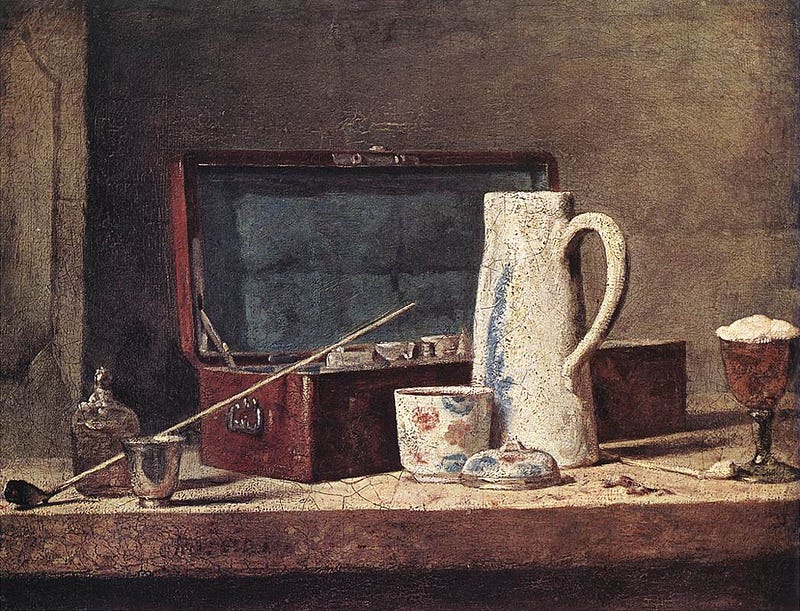
It is by looking at Chardin’s paintings that we can learn how, in art — and perhaps in life too — nothing is too trivial to act as a subject matter. The glint of light of a kitchen knife or the elegant stem of a clay pipe, have for Chardin the same magnificence as a scene from history or myth.
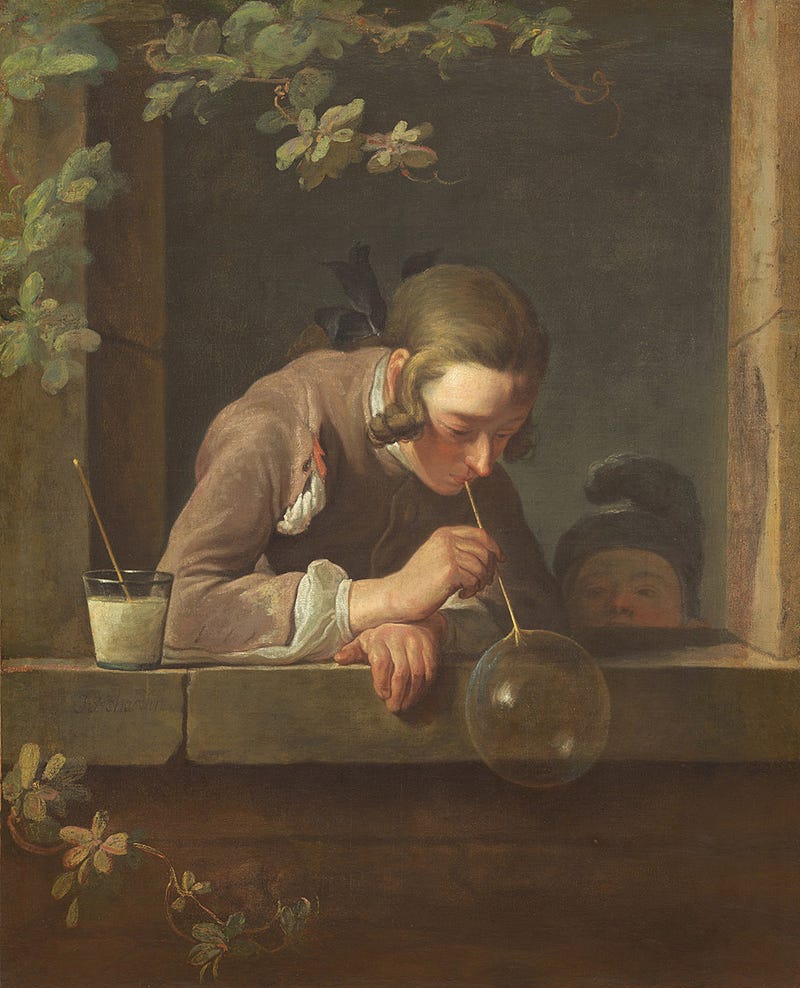
Around 1734, Chardin painted Soap Bubbles. The work shows a young boy blowing a soap bubble over the edge of a stone windowsill. In the shadows behind him, a younger boy watches on eagerly.
The energy of the painting resides in the fragile orb of the soap bubble, which appears about to pop at any moment. Indeed, as well as being a form of entertainment for 18th century children, bubbles were also symbolic of the fleeting nature of life, as depicted in Dutch prints that were widely distributed in France.
The painting works because of the meticulously constructed ambience. The boys take their recreation to the quietest corner of the house: the rectangular stone window acts as a frame for their play, holding the hunched over form of the older boy. Two tree branches add a softer aspect to the composition.
Influence and Legacy
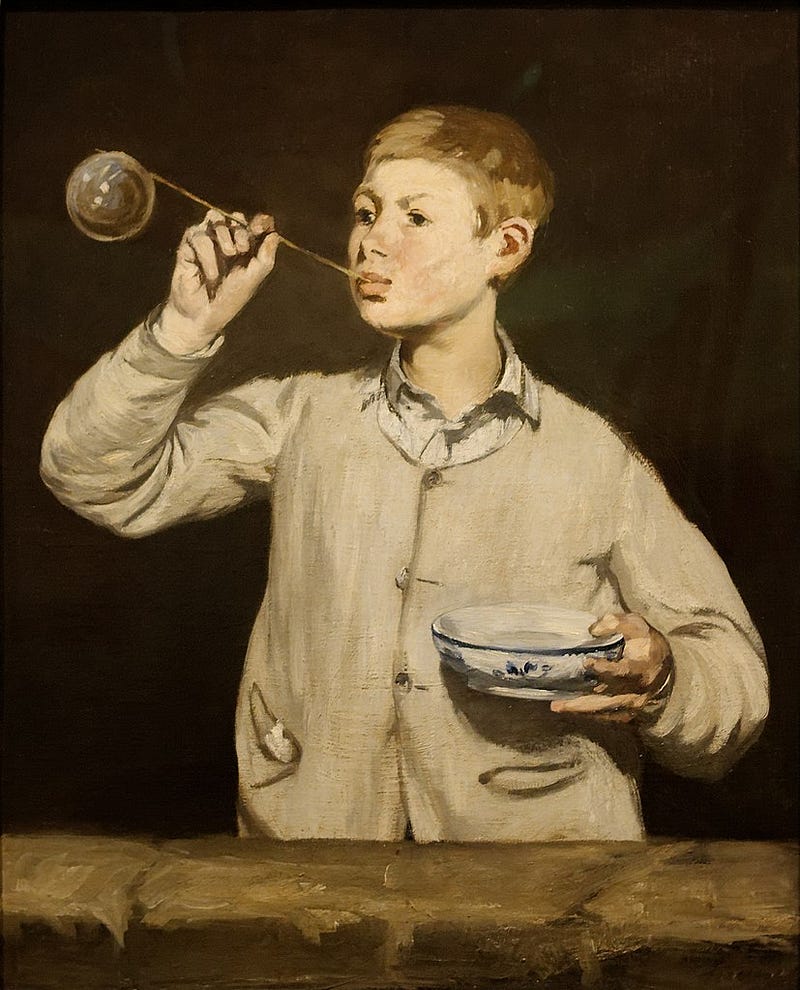
Many artists came under Chardin’s influence, perhaps most obviously Édouard Manet who admired his understated mode of painting. Manet made Boy Blowing Bubbles, which takes its lead directly from Chardin’s Soap Bubbles.
Henri Matisse was also a deep admirer of Chardin’s paintings and copied four of his works at the Louvre during his art studies. Chaïm Soutine and Georges Braque also drew inspiration from Chardin’s still lifes, and later, Giorgio Morandi was influenced by his paintings too.
Chardin’s appeal as an artist perhaps lies in the almost invisible feeling of promise that his paintings possess. His images often contain a moral, yet the message is always a subtle one, less theatrical or anecdotal than some of his contemporaries like William Hogarth. With Chardin, a sense of humane decorum reigns, giving rise to scenes that uphold the virtues of patience, play, hard work, and curiosity, reassuring us that the world has beauty in its variety — if only we are prepared to look for it.
In 1895, the French novelist Marcel Proust wrote about Chardin in an essay celebrating the artist’s “expression of the most intimate things in his life”. He argued that inspiration can come from the most commonplace of things, as he explained to an editor:
“…I have tried to show how the great painters initiate us into knowledge and love of the external world, how they are the ones ‘by whom our eyes are opened’, opened, that is, on the world.”

If you liked this, you may also be interested in my book Masterpieces of Art Explained, an examination of some of art’s most enthralling images.
Would you like to get…
A free guide to the Essential Styles in Western Art History, plus updates and exclusive news about me and my writing? Download for free here.
Join me…
On Instagram for more great paintings on the go!


