
The Beauty and Power of Discrete Calculus
Learn the inner workings of calculus by understanding a more general version and watch as the beauty unfolds
Not too long ago I was writing an article about the Planck length — a hypothetical shortest length in our Universe. Then it occurred to me that maybe the reason why our modern physics of gravity breaks down at tiny scales is that it is all about calculus (continuity and smoothness) but applied to real physical units like space and time.
In calculus, we make variables go to zero all the time including differences. But what if that doesn’t make any sense for physical units?
I started to develop a calculus from scratch where instead of taking limits, I only worked with discrete intervals. My hope was that we could then apply it to physics using the various Planck units to get some insight into what quantum gravity may look like.
I will show you my attack on this physical problem in another article because first, we need the mathematical theory described above which is completely independent of physics and is a beautiful mathematical subject on its own as you will see. It also seems that we get some very nasty and perhaps unsolvable (discrete) differential equations when trying to solve Einstein’s field equations discretely, but that is another story (and I am not done with those calculations).
Before we begin, I should mention that discrete calculus or calculus of finite differences is a known subject (even though I didn’t know that when I developed the theory) and is very well-studied, however, I have done a lot of Googling on this subject before writing this article to compare the known theory to mine and there are some things that I don’t see in the literature (in full generality) such as a chain rule for example.
This however depends on my abilities to Google stuff and so should not be taken very seriously. Nevertheless, even if it is known, it doesn’t stop us from developing this theory again and having a lot of fun while doing it.
In this article, we will derive a chain rule for discrete calculus as well as many other familiar rules from “ordinary” calculus.
I think that studying this subject will give us a better understanding of calculus as a whole because, in a sense, this is a more general theory. As you will see, calculus is a special case of this theory but we will derive formulas that hold for infinitely many types of calculus where only one of them is the continuous version you are used to working with.
Fundamentals of Discrete Calculus
The first thing we will deal with is notation. In mathematics, notation matters. Not that it dictates the underlying mathematics, but it can greatly increase ones learning or confuse the reader depending on what you choose. On top of that, we need to be careful not to conflict too much with the notation of the theory already established out there.
The theory of discrete calculus will depend on a parameter that I have chosen to call h because that seems to be the most common notation out there (I actually denoted it with a curly “ell” when I developed the theory). The point of this variable is, that depending on what you set it to, you get different results for your discrete derivatives and integrals.
Recall that the normal differential operator is usually denoted d/dx or D and the function it returns is usually denoted f’(x). Since the discrete derivative will depend on the variable h, we will incorporate that into the definition of the discrete derivative.
We define the discrete derivative with parameter h to be:

As you can see, this is just the formula for the slope of the secant going through the points (x, f(x)) and (x+h, f(x+h)). Note that in the special case where h = 0, we define

In the literature, you will find that most authors of discrete calculus limit themselves to the case h = 1 in which case the discrete derivative is called the forward difference operator and denoted by Δ. We will not limit ourselves to that but rather study the general case including regular old calculus of course!
Let’s kick this off with an example. The good old familiar exponential function would probably be a nice choice. Let’s see:
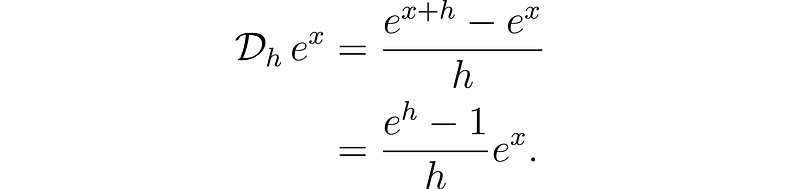
Hmmm. Not what we’d expected! A clue that this more general setting is not an easier one! But it makes sense. If we take the limit as h → 0, we get the usual result. I will leave that as an exercise for the reader.
Now that we have the definition in place, we need the definition for the discrete integral with parameter h.

Note that when h → 0 then the discrete analogs of differentiation and integration become the familiar ones from calculus. Also, note that the meaning of the sum in the definition of the discrete integral is really

Here m runs over the integers between 0 (inclusive) and (b-a)/h - 1. For calculation purposes, we assume that (b-a)/h is an integer and use the first definition, sometimes with subscript and sometimes with superscript on Σ.
We define a discrete antiderivative to be a function I f(x) = F(x, h) such that

This is consistent with the rest of the theory because there is a fundamental theorem of discrete calculus. And so our first true result is that we have
The fundamental theorem of discrete calculus

Here we assume that the discrete differentiation is with respect to the variable x.
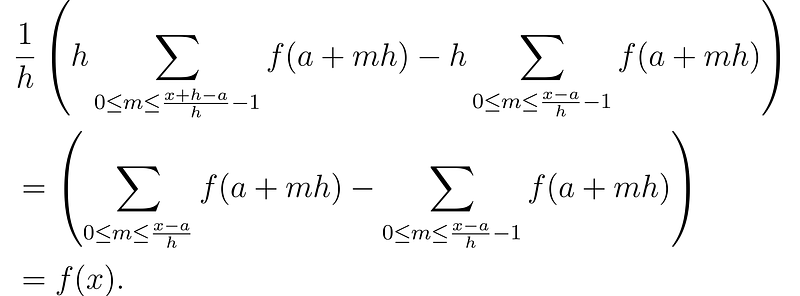
Let’s prove the first one above before giving another example of a discrete derivative. It is straightforward as we just use the definition. First, we use the definition of the discrete derivative.

and from here we unpack the definition of the discrete integral. Doing that gives us
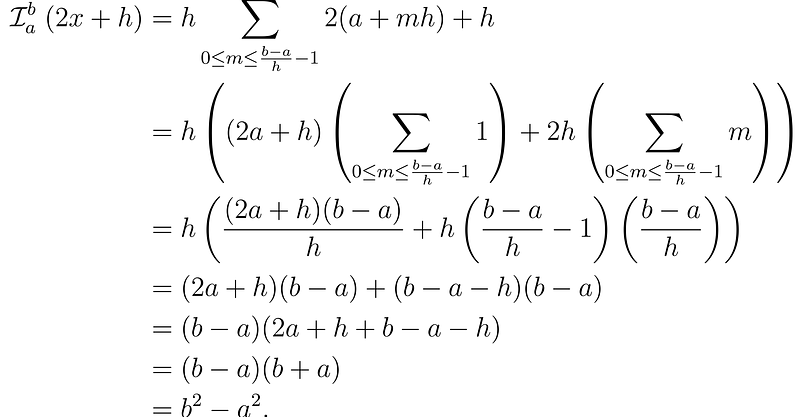
Before moving on, let’s see an example of the fundamental theorem in action. Let f(x) = x². By using the definition of the discrete derivative, it is easy to see that f*(x, h) = 2x + h.
Let us try to calculate the discrete integral with parameter h of 2x + h from a to b. The fundamental theorem says that it should be b² — a². Assuming (b-a)/h is an integer, we have
Very good.
Rules of Discrete Calculus
We will state the rules of discrete calculus in complete analogy with the rules of calculus. They should all boil down to the familiar rules of calculus when setting h = 0.
Before moving on, we introduce two more pieces of notation. This is simply for clarity.
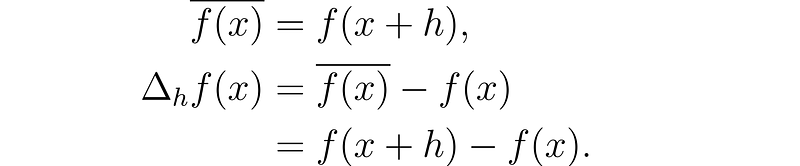
One should not get confused about the bar on top of f. It has nothing to do with complex conjugation for example.
On linear functions, discrete differentiation is the same as ordinary differentiation. That is, the discrete differentiation operator maps constant functions to 0 and functions of the form ax to a.
Linearity
As stated briefly above, the two first rules are familiar from calculus, and combined they are called linearity. The discrete differential and integral operators are both linear. For discrete differentiation, this means that

and

which are very easy to prove but good to know. The next result classically called the product rule is a bit different from the familiar one.
The product rule
In analogy with calculus, we have

This looks weird. The left-hand side is symmetric in f and g but it seems that the right-hand side is not. But in fact, it is because we could just as well put the bar on top of f in the second term which corresponds to swapping f and g in the expression.
The proof of this is easy. We just expand the right-hand side using the definition and cancel some terms.
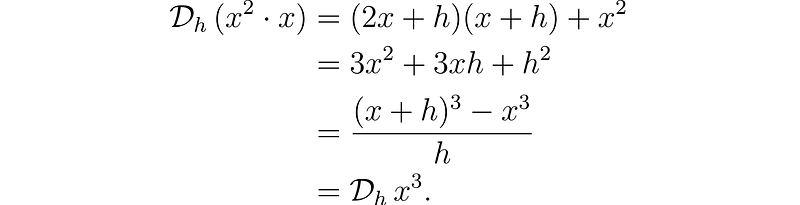
Let us see an example of this on the function h(x) = x³ = x²⋅ x. We can check that the product rule agrees with the definition in this case:
The chain rule
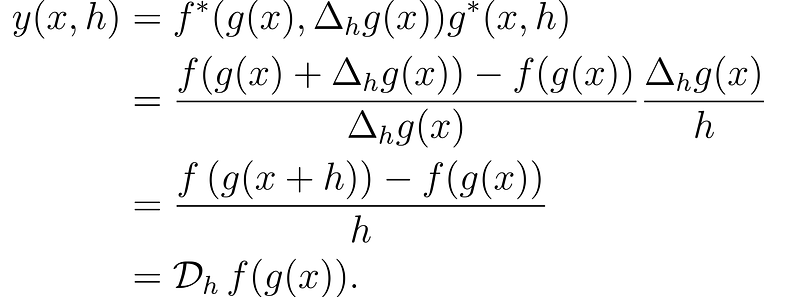
This result is amazingly beautiful. It is a general result that gives us the usual chain rule when h = 0. We have

To prove it let’s call the right-hand side of this y(x,h) and use the definition once again.
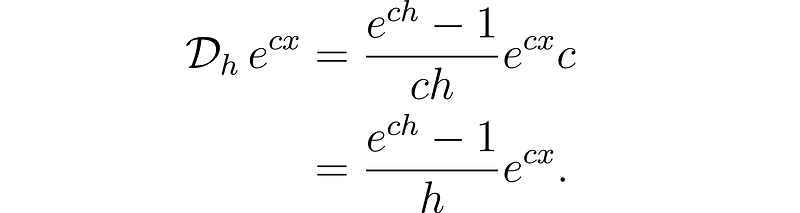
Let us use this to calculate the familiar family of eigenfunctions of the ordinary differential operator.
The quotient rule
Now that we have armed ourselves with the chain rule, we can use it together with the product rule to prove the quotient rule for discrete calculus.

Before proving it we need a result easily derivable from the definition, namely that

This will work as an outer function when we need to discretely differentiate a function on the form 1/g(x). By the chain rule and the above result, we have
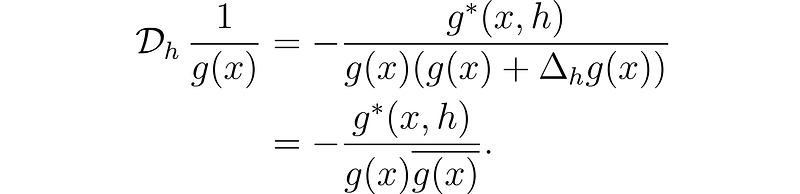
Now we can use the product rule on the functions f(x) and 1/g(x) to prove the quotient rule.
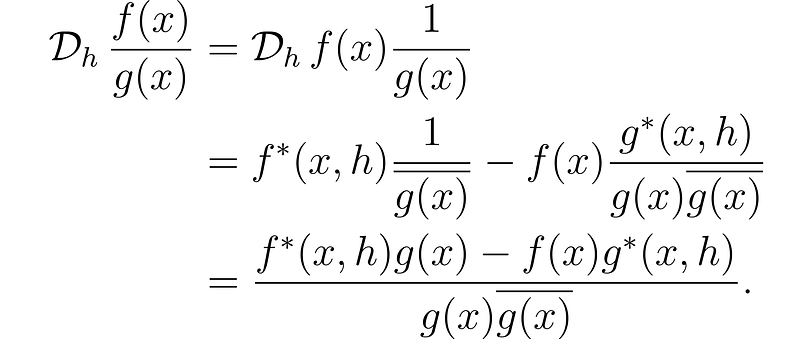
This again gives us the familiar quotient rule for differentiation when we set h = 0. We can now discretely differentiate functions such as

together with a wealth of other functions using our newly found tools. But what about rules for integration?
Discrete integration by parts
We have a product rule for discrete differentiation. We can use this to derive a rule for discrete integration by parts. Recall that in the product rule, because of symmetry, we can choose to have the bar over f or over g. If we choose to have it over f, discretely integrate on both sides, and rearrange, we get the following result.

We have stated this theorem in terms of indefinite discrete integrals and it will work just as well if we put limits of integration on the I’s. This is beautiful. Note the resemblance with ordinary calculus which states

Let us use this to calculate the discrete integral of x⋅e^x. To use the theorem, we need to find a discrete antiderivative of e^x but that is easy because we have already seen what the discrete derivative is. Also, the constant of integration doesn’t matter here, so we’ll just find the simplest discrete antiderivative. So set f*(x,h) = e^x and g(x) = x. Then by discrete integration by parts we have
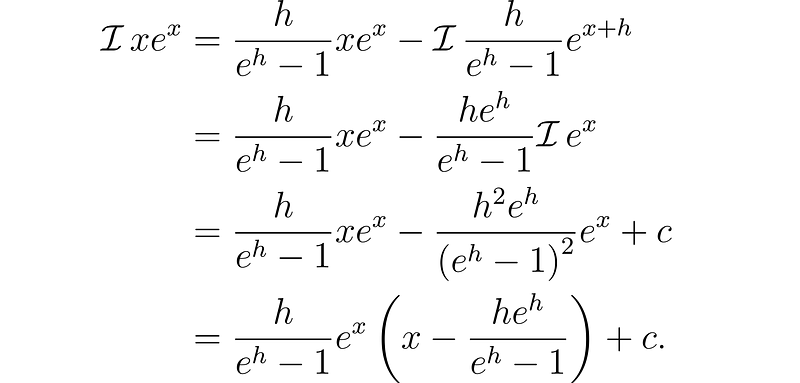
Here c is an arbitrary constant of discrete integration. If you are skeptical about this (I was when I saw it on my paper), then use the discrete product rule on the result on the last line and watch in amazement as all the nasty h’s cancel out leaving xe^x. Of course, when discretely differentiating, the constant c is mapped to 0 leaving the product. I would use linearity to factor out the first, constant factor, f as e^x, g as the last factor, and “bar the g”.
The Relationship With Calculus
If we think of discrete differentiation as a linear operator, we can actually write it in terms of the differential operator. I won’t go into too much detail because the article is already quite long, but this opens up a lot of exciting doors.
In particular, we have

Here D is the ordinary differential operator. Expanding the above out using the Maclaurin series for the exponential function yields

Let’s see how it works on the function e^x.
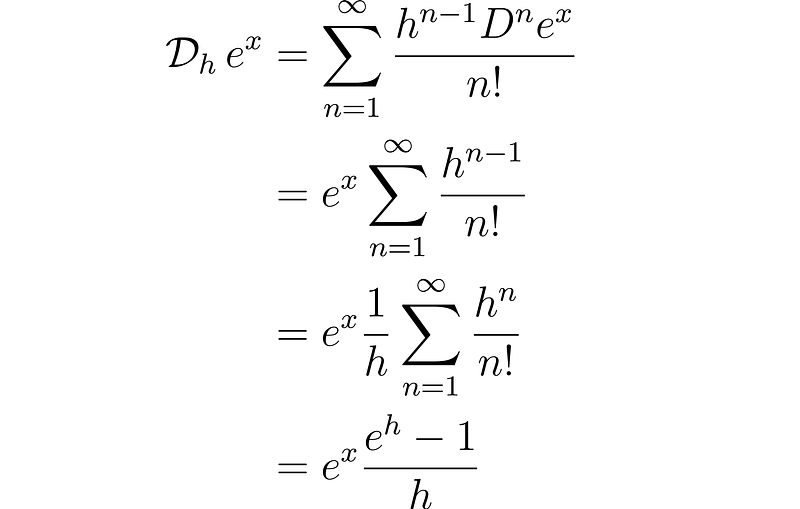
which of course we have established by now, but it is nice to see that it all fits together. We don’t have time to go with this approach in this article, but it should be mentioned at least.
What’s Next?
This article merely scratched the surface of this beautiful type of calculus. We derived a bunch of rules that we have collected in our arsenal. The next step is to actually use these results and find out new truths in this area of mathematics.
We could apply this to study discrete differential equations for example which would be (I think) an interesting article. We could also try to attack Einstein's field equations discretely using the Planck length as our smallest unit of distance when solving the corresponding system of discrete differential equations in order to find the metric tensor.
We could simply move on and see if we could find generalized formulae like the discrete Taylor series for example. And what about substitution? Is that possible in a discrete integral?
Let me know in the comments which road you want me to take when creating the next article about this topic.
If you like to read articles like this one on Medium, you can get a membership for full access: simply click here.
Thanks for reading.


