avatarJørgen Veisdal

Free AI web copilot to create summaries, insights and extended knowledge, download it at here

38118

Abstract

<span class="hljs-number">1950</span><span class="hljs-keyword">a</span>) Let us suppose that <span class="hljs-literal">two</span> intelligent individuals, Bill <span class="hljs-keyword">and</span> Jack, are <span class="hljs-keyword">in</span> <span class="hljs-keyword">a</span> position where they may barter goods but have no money <span class="hljs-keyword">with</span> which <span class="hljs-built_in">to</span> facilitate exchange. Further, let us assume <span class="hljs-keyword">for</span> simplicity that <span class="hljs-keyword">the</span> utility <span class="hljs-built_in">to</span> either individual <span class="hljs-keyword">of</span> <span class="hljs-keyword">a</span> portion <span class="hljs-keyword">of</span> <span class="hljs-keyword">the</span> total <span class="hljs-built_in">number</span> <span class="hljs-keyword">of</span> goods involved is <span class="hljs-keyword">the</span> <span class="hljs-built_in">sum</span> <span class="hljs-keyword">of</span> <span class="hljs-keyword">the</span> utilities <span class="hljs-built_in">to</span> him <span class="hljs-keyword">of</span> <span class="hljs-keyword">the</span> individual goods <span class="hljs-keyword">in</span> that portion. We give below <span class="hljs-keyword">a</span> table <span class="hljs-keyword">of</span> goods possessed <span class="hljs-keyword">by</span> <span class="hljs-keyword">each</span> individual <span class="hljs-keyword">with</span> <span class="hljs-keyword">the</span> utility <span class="hljs-keyword">of</span> <span class="hljs-keyword">each</span> <span class="hljs-built_in">to</span> <span class="hljs-keyword">each</span> individual. The utility functions used <span class="hljs-keyword">for</span> <span class="hljs-keyword">the</span> <span class="hljs-literal">two</span> individuals are, <span class="hljs-keyword">of</span> course, <span class="hljs-built_in">to</span> be regarded <span class="hljs-keyword">as</span> arbitrary.</pre></div><div id="4e57"><pre><span class="hljs-keyword">Bill's </span>good, <span class="hljs-keyword">Bill's </span>utility <span class="hljs-keyword">and </span><span class="hljs-keyword">Jack's </span>utility: (<span class="hljs-keyword">book, </span><span class="hljs-number">2</span>, <span class="hljs-number">4</span>), (whip, <span class="hljs-number">2</span>, <span class="hljs-number">2</span>), (<span class="hljs-keyword">ball, </span><span class="hljs-number">2</span>, <span class="hljs-number">1</span>), (<span class="hljs-keyword">bat, </span><span class="hljs-number">2</span>, <span class="hljs-number">2</span>),(<span class="hljs-keyword">box, </span><span class="hljs-number">4</span>, <span class="hljs-number">1</span>)</pre></div><div id="f4d6"><pre><span class="hljs-keyword">Jack's </span>goods, <span class="hljs-keyword">Bill's </span>utility <span class="hljs-keyword">and </span><span class="hljs-keyword">Jack's </span>utility: (pen, <span class="hljs-number">10</span>, <span class="hljs-number">1</span>), (toy, <span class="hljs-number">4</span>, <span class="hljs-number">1</span>), (knife, <span class="hljs-number">6</span>, <span class="hljs-number">2</span>), (hat, <span class="hljs-number">2</span>, <span class="hljs-number">2</span>)</pre></div><div id="6615"><pre>The graph <span class="hljs-keyword">for</span> <span class="hljs-keyword">the</span> bargaining situation turns out <span class="hljs-keyword">to</span> be a convex polygon <span class="hljs-keyword">in</span> which <span class="hljs-keyword">the</span> point <span class="hljs-keyword">where</span> <span class="hljs-keyword">the</span> product <span class="hljs-keyword">of</span> <span class="hljs-keyword">the</span> utility gains <span class="hljs-keyword">is</span> maximized <span class="hljs-keyword">is</span> <span class="hljs-keyword">at</span> a vertex <span class="hljs-keyword">and</span> <span class="hljs-keyword">where</span> there <span class="hljs-keyword">is</span> <span class="hljs-keyword">but</span> one corresponding anticipation, which <span class="hljs-keyword">is</span>:</pre></div><div id="bf70"><pre><span class="hljs-keyword">Bill </span>gives <span class="hljs-keyword">Jack: </span><span class="hljs-keyword">book, </span>whip, <span class="hljs-keyword">ball </span><span class="hljs-keyword">and </span><span class="hljs-keyword">bat </span><span class="hljs-keyword">Jack </span>gives <span class="hljs-keyword">Bill: </span>pen, toy <span class="hljs-keyword">and </span>knife</pre></div><p id="fddb">The graph depicting the bargain from Nash’s paper is as follows:</p><figure id="4bec"><img src="https://cdn-images-1.readmedium.com/v2/resize:fit:800/1*lJ_1wFf8ZsAKKr7X920ogQ.png"><figcaption>Example: The solution point is on a rectangular hyperbola lying in the first quadrant and touching the set of alternatives at but one point</figcaption></figure><p id="67f6">How Nash arrived at the result remains unclear. Nash’s close friend and co-editor of his 2002 autobiography <i>The Essential John Nash</i>, <a href="https://en.wikipedia.org/wiki/Harold_W._Kuhn">Harold Kuhn</a>, recalls about the paper: <i>“It is my recollection that it had been sent to von Neumann during Nash’s first year as a graduate student and that Nash made an appointment to remind von Neumann of its existence. In this scenario, it had been written at Carnegie Tech as a term paper in the only course in economics that Nash ever took.”, </i>adding however that<i> “Nash’s current memory differs from mine; in a luncheon with Roger Meyerson in 1995, he expressed the opinion that he had written the paper after his arrival at Princeton.</i></p><p id="e2d1"><i>“Whatever the true history of the paper, the examples suggest that it was written by a teenager; they involve bats, balls, and penknives. What is certain is that Nash had never read the works of Cournot, Bowley, Tintner, and Fellner cited in the paper’s Introduction.” — Harold Kuhn</i></p><h2 id="0e59">Meeting John von Neumann</h2><p id="da03">Although somewhat in opposition to von Neumann and Morgenstern’s work on <i>cooperative</i> game theory, Nash’s results establishing a foundation for <i>non-cooperative</i> game theory clearly had its origins in the formers’ work (indeed, illustrative of this, in 1978 Nash was awarded the <a href="https://en.wikipedia.org/wiki/John_von_Neumann_Theory_Prize">John von Neumann Theory Prize</a> for his discovery of the Nash equilibrium).</p><p id="7a7e">Only one documented account of communication between Nash on von Neumann can now be found, although there were surely many more now lost to time. According to Nasar, Nash went to talk to von Neumann a few days after he passed his general examination at Princeton in 1949, prior to his definition of the Nash equilibrium. As she writes:</p><div id="10b0"><pre>“He wanted, he had told <span class="hljs-keyword">the</span> secretary cockily, <span class="hljs-built_in">to</span> discuss <span class="hljs-keyword">an</span> idea that might be <span class="hljs-keyword">of</span> interest <span class="hljs-built_in">to</span> Professor von Neumann. It was <span class="hljs-keyword">a</span> rather audacious thing <span class="hljs-keyword">for</span> <span class="hljs-keyword">a</span> graduate student <span class="hljs-built_in">to</span> <span class="hljs-built_in">do</span>. [...] But <span class="hljs-keyword">it</span> was typical <span class="hljs-keyword">of</span> Nash, who had gone <span class="hljs-built_in">to</span> see Einstein <span class="hljs-keyword">the</span> year <span class="hljs-keyword">before</span> <span class="hljs-keyword">with</span> <span class="hljs-keyword">the</span> germ <span class="hljs-keyword">of</span> <span class="hljs-keyword">an</span> idea. [...] He listened carefully, <span class="hljs-keyword">with</span> his head cocked slightly <span class="hljs-built_in">to</span> <span class="hljs-literal">one</span> side <span class="hljs-keyword">and</span> his fingers tapping. Nash started <span class="hljs-built_in">to</span> describe <span class="hljs-keyword">the</span> proof he had <span class="hljs-keyword">in</span> mind <span class="hljs-keyword">for</span> <span class="hljs-keyword">an</span> equilibrium <span class="hljs-keyword">in</span> games <span class="hljs-keyword">of</span> more than <span class="hljs-literal">two</span> players. But <span class="hljs-keyword">before</span> he had gotten out more than <span class="hljs-keyword">a</span> few disjointed <span class="hljs-keyword">sentences</span>, von Neumann interrupted, jumped ahead <span class="hljs-built_in">to</span> <span class="hljs-keyword">the</span> yet unstated conclusion <span class="hljs-keyword">of</span> Nash’s argument, <span class="hljs-keyword">and</span> said abruptly, “That’s trivial, you know. That’s just <span class="hljs-keyword">a</span> fixed point theorem.”</pre></div><div id="2f2f"><pre>- Excerpt, <span class="hljs-string">"A Beautiful Mind"</span> <span class="hljs-keyword">by</span> Sylvia Nasar (<span class="hljs-number">1998</span>)</pre></div><p id="45ab">Von Neumann, in other words, did not see the value in Nash’s bargaining result. Nash himself however would later defend the great man’s reaction in a letter to Robert Leonard, stating, characteristically analytically, <i>“I was playing a non-cooperative game in relation to von Neumann rather than simply seeking to join his coalition. And of course, it was psychologically natural for him not to be entirely pleased by a rival theoretical approach”. </i>Both von Neumann and Morgenstern ultimately did however provide Nash with valuable guidance, and in the published version Nash makes sure to acknowledge the role of both, writing <i>“The author wishes to acknowledge the assistance of Professors von Neumann and Morgenstern who read the original form of the paper and gave helpful advice as to the presentation.”</i></p><h1 id="c415">The Nash Equilibrium (1950)</h1><p id="d76c">A few days after his meeting with von Neumann, Nash reportedly again “accosted” <a href="https://en.wikipedia.org/wiki/David_Gale">David Gale</a> on campus:</p><p id="a3c8"><i>“I think I’ve found a way to generalize von Neumann’s min-max theorem,” he blurted out. “The fundamental idea is that in a two-person zero-sum solution, the best strategy for both is … The whole theory is built on it. And it works with any number of people and doesn’t have to be a zero-sum game!”</i></p><p id="a47b">Characteristically, as Nasar writes, Gale was less enchanted by the possible applications of the work than the mathematics, stating in 1995 that <i>“The mathematics was so beautiful. It was so right mathematically.”</i></p><div id="5fd6"><pre>“Gale realized <span class="hljs-keyword">that</span> Nash’s idea applied <span class="hljs-keyword">to</span> a far broader <span class="hljs-built_in">class</span> <span class="hljs-keyword">of</span> <span class="hljs-built_in">real</span>-world situations than von Neumann’s notion <span class="hljs-keyword">of</span> zero-sum games. “He had a concept <span class="hljs-keyword">that</span> generalized <span class="hljs-keyword">to</span> disarmament”</pre></div><div id="e6ad"><pre>- Excerpt, <span class="hljs-string">"A Beautiful Mind"</span> <span class="hljs-keyword">by</span> Sylvia Nasar (<span class="hljs-number">1998</span>)</pre></div><p id="280e">Gale also helped Nash claim credit for the result as soon as possible by drafting a note to the National Academy of Sciences. Lefschetz submitted the note on their behalf, and the result appeared in <b>less than a single page</b> entitled <i>Equilibrium points in N-person games</i> in the <a href="https://www.ncbi.nlm.nih.gov/pmc/articles/PMC1063129/">36th volume of the Proceedings of the National Academy of Sciences</a> in January of 1950.</p><figure id="5373"><img src="https://cdn-images-1.readmedium.com/v2/resize:fit:800/1*9i-rzM9haYl3ahDd5Jye_Q.png"><figcaption></figcaption></figure><figure id="5765"><img src="https://cdn-images-1.readmedium.com/v2/resize:fit:800/1*_EpXWLUQSq1q_Y5Fh15sHQ.jpeg"><figcaption><b>Left</b>: Nash (1950b). Equilibrium Points in N-person Games. Proceedings of the National Academy of Sciences 36 (1). <b>Right</b>: My own copy of the publication.</figcaption></figure><p id="a698">The result, later to be known as the Nash equilibrium is now typically formally defined as follows:</p><div id="7636"><pre>Definition <span class="hljs-keyword">of</span> a Nash equilibrium <span class="hljs-keyword">Let</span> (S,f) be a game <span class="hljs-keyword">with</span> u players Sᵢ <span class="hljs-built_in">is</span> the <span class="hljs-keyword">set</span> <span class="hljs-keyword">of</span> strategies <span class="hljs-keyword">for</span> player i, S = S₁ x S₂ x ... x Sᵤ <span class="hljs-built_in">is</span> the <span class="hljs-keyword">set</span> <span class="hljs-keyword">of</span> strategy profiles <span class="hljs-built_in">and</span> f(x) = (f₁(x),...,fᵤ(x)) <span class="hljs-built_in">is</span> its payoff <span class="hljs-keyword">function</span> evaluated at x ∈ S. <span class="hljs-keyword">Let</span> xᵢ be a strategy profile <span class="hljs-keyword">of</span> player i <span class="hljs-built_in">and</span> x₋ᵢ be a strategy profile <span class="hljs-keyword">of</span> all players except player i.</pre></div><div id="cdf0"><pre>When each player i ∈ {<span class="hljs-number">1</span>,...,u} chooses a strategy xᵢ, resulting <span class="hljs-keyword">in</span> a strategy profile x = (x₁,...,xᵤ) <span class="hljs-keyword">then</span> player i obtains payoff fᵢ(x). Note <span class="hljs-keyword">that</span> <span class="hljs-keyword">the</span> payoff depends <span class="hljs-keyword">on</span> <span class="hljs-keyword">the</span> strategy profile chosen, i.e. <span class="hljs-keyword">on</span> <span class="hljs-keyword">the</span> strategy chosen <span class="hljs-keyword">by</span> player i <span class="hljs-keyword">as</span> well <span class="hljs-keyword">as</span> <span class="hljs-keyword">the</span> strategies chosen <span class="hljs-keyword">by</span> all <span class="hljs-keyword">the</span> other players.</pre></div><div id="b3f0"><pre>A strategy profile x* ∈ S <span class="hljs-keyword">is</span> a Nash equilibrium <span class="hljs-keyword">if</span> <span class="hljs-literal">no</span> unilateral definition <span class="hljs-keyword">in</span> strategy <span class="hljs-keyword">by</span> any single player <span class="hljs-keyword">is</span> profitable <span class="hljs-keyword">for</span> <span class="hljs-literal">that</span> player, <span class="hljs-literal">that</span> <span class="hljs-keyword">is</span></pre></div><div id="43e1"><pre>∀i<span class="hljs-punctuation">,</span><span class="hljs-keyword">x</span>ᵢ ∈ Sᵢ : fᵢ(<span class="hljs-keyword">x</span><span class="hljs-punctuation">,</span> <span class="hljs-keyword">x</span>₋ᵢ) ≥ fᵢ(<span class="hljs-keyword">x</span><span class="hljs-punctuation">,</span><span class="hljs-keyword">x</span>₋ᵢ)</pre></div><p id="26b4">Informally, the theorem states:</p><p id="9939"><i>A strategy profile is a Nash equilibrium if no player can do better by unilaterally changing his or her strategy.</i></p><p id="a503">That is, in a two-person game, a pair of strategies constitute a Nash equilibrium if player A’s choice is optimal, given player B’s choice, and B’s choice is optimal given player A’s choice. No player can singlehandedly change their strategy in order to obtain a more optimal result. Crucially, neither player knows what strategy the other will choose, but acts solely on the basis of their own interests, given their knowledge of other players’ interests. The finding generalizes to <i>n</i> players.</p><figure id="392a"><img src="https://cdn-images-1.readmedium.com/v2/resize:fit:800/1*wsRIQ_12mDFcwVJwe44pVg.png"><figcaption><b>Example: </b>Payoff matrix featuring a Nash equilibrium</figcaption></figure><p id="e7be">In the table above, the strategies and payoffs of a two-person game are shown. Player A can choose between the strategies Top and Bottom. If player A chooses Top, he will receive a payoff of 2 if player B chooses Left and 0 if player B plays Right. If player A chooses Bottom, he will receive a payoff 0 if player B plays Left, and 1 if player B plays Right. Thus, player A’s optimal choice depends on what he thinks player B will do (Varian, 2006 p. 506).</p><p id="df9e">In the table above, the strategy set (Top, Left) is a Nash equilibrium. To show it, note that if A chooses Top, then the best thing for B to do is to choose Left, since the payoff for B from choosing Left is 1 and from choosing Right is 0. If B chooses Left, then the best thing for A to do is to choose Top since then A will get a payoff of 2 rather than of 0. Thus, if A chooses Top, the optimal strategy for B is to choose Left ; and if B chooses Left, then the optimal strategy for A is to choose Top. So, we have a Nash equilibrium: each person is playing their optimal strategy, given the other player’s strategies.</p><h2 id="7d8d">Proofs of the Nash Equilibrium</h2><p id="20c9">As mentioned, Nash’s thesis proof (1950c) used Brouwer’s fixed-point theorem. A version of the <i>“clumsy, if totally original”</i> proof (Kuhn et al, 2002) by contradiction, included here primarily in the interest of completeness, goes as follows (Wikipedia, 2019):</p><div id="7ccb"><pre>Proof <span class="hljs-keyword">of</span> <span class="hljs-keyword">the</span> existence <span class="hljs-keyword">of</span> Nash Equilibria <span class="hljs-keyword">using</span> <span class="hljs-keyword">the</span> Brouwer fixed-point theorem (Nash, <span class="hljs-number">1950</span>c) For <span class="hljs-keyword">a</span> game G = (N, A, u) where N is <span class="hljs-keyword">the</span> <span class="hljs-built_in">number</span> <span class="hljs-keyword">of</span> players <span class="hljs-keyword">and</span> A is <span class="hljs-keyword">the</span> product <span class="hljs-keyword">of</span> <span class="hljs-keyword">the</span> actions <span class="hljs-keyword">of</span> all players, let Δ denote <span class="hljs-keyword">the</span> <span class="hljs-built_in">set</span> <span class="hljs-keyword">of</span> mixed strategies <span class="hljs-keyword">for</span> <span class="hljs-keyword">the</span> players. Let <span class="hljs-keyword">the</span> actions A <span class="hljs-keyword">of</span> <span class="hljs-keyword">the</span> players be finite, so <span class="hljs-keyword">as</span> <span class="hljs-built_in">to</span> ensure <span class="hljs-keyword">the</span> compactness <span class="hljs-keyword">of</span> Δ. For <span class="hljs-keyword">a</span> mixed strategy σ ∈ Δ, we define <span class="hljs-keyword">the</span> gain <span class="hljs-keyword">for</span> player i <span class="hljs-keyword">on</span> <span class="hljs-title">action</span> <span class="hljs-title">a</span><span class="hljs-title">A</span>ᵢ (<span class="hljs-title">the</span> <span class="hljs-title">benefit</span> <span class="hljs-title">player</span> <span class="hljs-title">i</span> <span class="hljs-title">gets</span> <span class="hljs-title">by</span> <span class="hljs-title">changing</span> <span class="hljs-title">his</span>/<span class="hljs-title">her</span> <span class="hljs-title">strategy</span> <span class="hljs-title">unilaterally</span>) <span class="hljs-title">to</span> <span class="hljs-title">be</span>:</pre></div><div id="801b"><pre><span class="hljs-attribute">Gain</span>ᵢ(σ,a) = max{<span class="hljs-number">0</span>, uᵢ(a,σ₋ᵢ) - uᵢ(σᵢ,σ₋ᵢ)}</pre></div><div id="7196"><pre><span class="hljs-keyword">Next</span>, define the <span class="hljs-built_in">set</span> of all players' gains <span class="hljs-built_in">as</span> g = (g₁, ... , gn) <span class="hljs-keyword">where</span> gᵢ(σ)(a) = σᵢ(a) + Gainᵢ(σ,a) <span class="hljs-keyword">for</span> σ ∈ Δ, a ∈ Aᵢ. </pre></div><div id="f504"><pre>Taking <span class="hljs-keyword">the</span> <span class="hljs-built_in">sum</span> <span class="hljs-keyword">of</span> both sides, we see that <span class="hljs-keyword">the</span> <span class="hljs-built_in">sum</span> Σ(gᵢ(σ)(<span class="hljs-keyword">a</span>)) <span class="hljs-keyword">for</span> <span class="hljs-keyword">a</span> ∈ Aᵢ is equal <span class="hljs-built_in">to</span> <span class="hljs-keyword">the</span> <span class="hljs-built_in">sum</span> <span class="hljs-keyword">of</span> Σ(σᵢ(<span class="hljs-keyword">a</span>) + Gainᵢ(σ,<span class="hljs-keyword">a</span>)), which restated is equal <span class="hljs-built_in">to</span> <span class="hljs-number">1</span> + Σ(Gainᵢ(σ,<span class="hljs-keyword">a</span>)) > <span class="hljs-number">0.</span></pre></div><div id="8621"><pre>Next, <span class="hljs-keyword">for</span> the <span class="hljs-function"><span class="hljs-keyword">function</span> <span class="hljs-title">f</span> <span class="hljs-title">define</span> <span class="hljs-title">f</span> = (<span class="hljs-params">f₁ ..., fn</span>): Δ → Δ <span class="hljs-title">and</span> <span class="hljs-title">f</span>ᵢ(<span class="hljs-params">σ</span>)(<span class="hljs-params">a</span>) = <span class="hljs-title">g</span>ᵢ(<span class="hljs-params">σ</span>)(<span class="hljs-params">a</span>) / Σ(<span class="hljs-params">gᵢ(<span class="hljs-params">σ</span>)(<span class="hljs-params">a</span>)</span>) <span class="hljs-title">for</span> <span class="hljs-title">b</span> ∈ ∈ <span class="hljs-title">A</span></span></pre></div><div id="a623"><pre>Each fᵢ <span class="hljs-keyword">is</span> a valid mixed strategy <span class="hljs-keyword">in</span> Δᵢ. Each fᵢ <span class="hljs-keyword">is</span> a continuous <span class="hljs-keyword">function</span> <span class="hljs-keyword">of</span> σ, <span class="hljs-keyword">and</span> so f <span class="hljs-keyword">is</span> a continuous <span class="hljs-keyword">function</span>. Being the cross product <span class="hljs-keyword">of</span> a finite number <span class="hljs-keyword">of</span> compact convex sets, Δ <span class="hljs-keyword">is</span> also compact <span class="hljs-keyword">and</span> convex. Applying the Brouwer fixed point theorem <span class="hljs-keyword">to</span> f <span class="hljs-keyword">and</span> Δ we conclude <span class="hljs-literal">that</span> f has a fixed point <span class="hljs-keyword">in</span> Δ, call <span class="hljs-literal">it</span> σ. We claim <span class="hljs-literal">that</span> σ* <span class="hljs-keyword">is</span> a Nash equilibrium <span class="hljs-keyword">in</span> G. To show this, <span class="hljs-literal">it</span> suffices <span class="hljs-keyword">to</span> show <span class="hljs-literal">that</span> each player gains <span class="hljs-literal">no</span> benefit <span class="hljs-keyword">by</span> unilaterally changing their their strategy, namely:</pre></div><div id="abd3"><pre><span class="hljs-selector-tag">i</span> ∈ {<span class="hljs-number">1</span>,...,N}, ∀<span class="hljs-selector-tag">a</span><span class="hljs-selector-tag">A</span>ᵢ : Gainᵢ(σ*,a) = <span class="hljs-number">0</span></pre></div><div id="45c8"><pre><span class="hljs-attribute">Now</span>, assume that the gains are not <span class="hljs-literal">all</span> zero. Therefore, ∃i ∈ {<span class="hljs-number">1</span>,...,N}, and a ∈ Aᵢ such that Gainᵢ(σ*,a) > <span class="hljs-number">0</span>. Note then that sum Σ(gᵢ(σ*)(a)) = <span class="hljs-number">1</span> + Σ(Gainᵢ(σ*,a)) > <span class="hljs-number">1</span> for a ∈ Aᵢ. </pre></div><div id="2570"><pre>Let C = Σ(gᵢ(σ*,<span class="hljs-keyword">a</span>)) <span class="hljs-keyword">for</span> <span class="hljs-keyword">a</span> ∈ Aᵢ <span class="hljs-keyword">and</span> let Gain(i,⋅) denote <span class="hljs-keyword">the</span> gain vector indexed <span class="hljs-keyword">by</span> actions <span class="hljs-keyword">in</span> Aᵢ. Since σ* is <span class="hljs-keyword">the</span> fixed point we have:</pre></div><div id="39b9"><pre>σ* = f(σ<span class="hljs-strong">) → σ</span>ᵢ = (1/(C-1))Gainᵢ(σ*,⋅)</pre></div><div id="4df6"><pre>Since C > <span class="hljs-number">1</span> (<span class="hljs-keyword">as</span> shown <span class="hljs-keyword">above</span>), σ<span class="hljs-keyword">is</span> <span class="hljs-keyword">some</span> positive scaling <span class="hljs-keyword">of</span> <span class="hljs-keyword">the</span> vector Gainᵢ(σ,⋅). We now claim <span class="hljs-keyword">that</span> </pre></div><div id="e3d1"><pre>∀i ∈ Aᵢ: σᵢ(<span class="hljs-keyword">a</span>)(uᵢ(<span class="hljs-keyword">a</span>ᵢ,σ₋ᵢ)) = Gainᵢ(σ*,<span class="hljs-keyword">a</span>)(<span class="hljs-keyword">a</span>)Gainᵢ(σ*,<span class="hljs-keyword">a</span>)</pre></div><div id="5af3"><pre>To see this, we <span class="hljs-keyword">first</span> note <span class="hljs-keyword">that</span> <span class="hljs-keyword">if</span> Gainᵢ(σ*,a) > <span class="hljs-number">0</span> <span class="hljs-keyword">then</span> this <span class="hljs-keyword">is</span> <span class="hljs-literal">true</span> <span class="hljs-keyword">by</span> definition (<span class="hljs-keyword">of</span> <span class="hljs-keyword">the</span> gain function). Now assume <span class="hljs-keyword">that</span> Gainᵢ(σ*,a) = <span class="hljs-number">0.</span> By our previous statements we <span class="hljs-keyword">then</span> have <span class="hljs-keyword">that</span> </pre></div><div id="2a13"><pre>σᵢ(<span class="hljs-keyword">a</span>) = (<span class="hljs-number">1</span>/(C<span class="hljs-number">-1</span>))Gainᵢ(σ,<span class="hljs-keyword">a</span>) = <span class="hljs-number">0</span>, <span class="hljs-keyword">and</span> so <span class="hljs-keyword">the</span> left term is <span class="hljs-literal">zero</span>, giving us that <span class="hljs-keyword">the</span> entire expression is <span class="hljs-number">0</span> <span class="hljs-keyword">as</span> needed. So, <span class="hljs-keyword">finally</span> we have that </pre></div><div id="b8be"><pre><span class="hljs-symbol">0 </span>= uᵢ(σᵢ,σ₋ᵢ) - uᵢ(σᵢ,σ₋ᵢ) = Σ(C - <span class="hljs-number">1</span>ᵢ(a)² > <span class="hljs-number">0</span></pre></div><div id="50f0"><pre>where <span class="hljs-keyword">the</span> <span class="hljs-keyword">last</span> inequality follows because σᵢ is <span class="hljs-keyword">a</span> non-<span class="hljs-literal">zero</span> vector. This is however <span class="hljs-keyword">a</span> contradiction, so all <span class="hljs-keyword">the</span> gains must be <span class="hljs-literal">zero</span>. Hence, we have shown that σ* is <span class="hljs-keyword">a</span> Nash equilibrium <span class="hljs-keyword">for</span> G.</pre></div><p id="472b">Awarding credit to David Gale, Nash later published a simpler proof of the same result, using the Kakutani fixed-point theorem. Again, in the interest of completeness, the proof is provided below (Wikipedia, 2019):</p><div id="e824"><pre>Proof <span class="hljs-keyword">of</span> <span class="hljs-keyword">the</span> existence <span class="hljs-keyword">of</span> Nash Equilibria <span class="hljs-keyword">using</span> <span class="hljs-keyword">the</span> Kakutani fixed-point theorem (Nash, <span class="hljs-number">1951</span>) To prove <span class="hljs-keyword">the</span> existence <span class="hljs-keyword">of</span> <span class="hljs-keyword">a</span> Nash Equilibrium (NE), let rᵢ(σ₋ᵢ) be <span class="hljs-keyword">the</span> best response <span class="hljs-keyword">of</span> player i <span class="hljs-built_in">to</span> <span class="hljs-keyword">the</span> strategies <span class="hljs-keyword">of</span> all other players.</pre></div><div id="c655"><pre>rᵢ<span class="hljs-comment">(σ₋ᵢ)</span> = arg max uᵢ<span class="hljs-comment">(σᵢ, σ₋ᵢ)</span></pre></div><div id="d85f"><pre>Here, σ ∈ Σ <span class="hljs-keyword">where</span> Σᵢ x Σ₋ᵢ <span class="hljs-keyword">is</span> a mixed strategy profile <span class="hljs-keyword">in</span> the <span class="hljs-keyword">set</span> <span class="hljs-keyword">of</span> <span class="hljs-keyword">all</span> mixed strategies <span class="hljs-keyword">and</span> uᵢ <span class="hljs-keyword">is</span> the payoff <span class="hljs-keyword">function</span> <span class="hljs-keyword">for</span> player i. Define a <span class="hljs-keyword">set</span> valued <span class="hljs-keyword">function</span> r: Σ → <span class="hljs-number">2</span>^Σ such that r = (rᵢ(σ₋ᵢ), r₋ᵢ(σ₋ᵢ). Proving the existence <span class="hljs-keyword">of</span> a Nash equilibrium <span class="hljs-keyword">is</span> equivalent <span class="hljs-keyword">to</span> showing that r has a fixed <span class="hljs-type">point</span>.</pre></div><div id="7934"><pre>Kakutani<span class="hljs-comment">'s fixed point theorem guarentees the existence of a fixed point if the following four conditions are satisfied:</span></pre></div><div id="5cff"><pre><span class="hljs-number">1</span>. Σ is compact, convex and non-empty <span class="hljs-number">2</span>. <span class="hljs-built_in">r</span>(σ) is nonempty <span class="hljs-number">3</span>. <span class="hljs-built_in">r</span>(σ) is upper hemicontinuous <span class="hljs-number">4</span>. <span class="hljs-built_in">r</span>(σ) is convex</pre></div><div id="773b"><pre>Condition <span class="hljs-number">1</span> <span class="hljs-keyword">is</span> satisfied <span class="hljs-keyword">from</span> <span class="hljs-keyword">the</span> fact <span class="hljs-keyword">that</span> Σ <span class="hljs-keyword">is</span> a simplex <span class="hljs-keyword">and</span> thus compact. Convexity follows <span class="hljs-keyword">from</span> players' abilities <span class="hljs-keyword">to</span> mix strategies. Σ <span class="hljs-keyword">is</span> non-empty <span class="hljs-keyword">as</span> long <span class="hljs-keyword">as</span> players have strategies.</pre></div><div id="a233"><pre>Condition <span class="hljs-number">2</span>. <span class="hljs-keyword">and </span><span class="hljs-number">3</span>. are satisfied <span class="hljs-keyword">by </span>way of <span class="hljs-keyword">Berge's </span>maximum theorem. <span class="hljs-keyword">Because </span>uᵢ is continuous <span class="hljs-keyword">and </span>compact, r(σ) is non-empty <span class="hljs-keyword">and </span>upper hemicontinuous. </pre></div><div id="a8fb"><pre>Condition <span class="hljs-number">4</span> is satisfied <span class="hljs-keyword">as</span> <span class="hljs-keyword">a</span> <span class="hljs-built_in">result</span> <span class="hljs-keyword">of</span> mixed strategies. Suppose σᵢ, σᵢ<span class="hljs-string">' ∈ r(σ₋ᵢ), then λσᵢ + (1 - λ)σᵢ'</span> ∈ r(σ₋ᵢ), i.e. <span class="hljs-keyword">if</span> <span class="hljs-literal">two</span> strategies maximize payoffs, <span class="hljs-keyword">then</span> <span class="hljs-keyword">a</span> mix between <span class="hljs-literal">two</span> strategies will yield <span class="hljs-keyword">the</span> same payoff. </pre></div><div id="2209"><pre>Therefore, there exists a fixed point in r <span class="hljs-keyword">and</span> a Nash equilibrium.</pre></div><h2 id="be38">Interpretations</h2><p id="4a01">Nash in his thesis proposed two ways of thinking about his equilibrium concept: one based on rationality and one based on statistical populations. In the rational interpretation, players are perceived as rational and they have complete information about the structure of the game, including all of the players’ preferences regarding possible outcomes, where this information is common knowledge. Since all players have complete information about each others’ strategic alternatives and preferences, they can also compute each other’s optimal choice of strategy for each set of expectations. If all of the players expect the same Nash equilibrium, and the game is played only once, then there are no incentives for anyone to change their strategies. In the interpretation according to statistical populations, Nash states that <i>“[i]t is unnecessary to assume that the participants have full knowledge of the total structure of the game, or the ability and inclination to go through any complex reasoning processes”. </i>This because “<i>What is assumed is that there is a population of participants for each position in the game, which will be played throughout time by participants drawn at random from the different populations. If there is a stable average frequency with which each pure strategy is employed by the </i>average member<i> of the appropriate population, then this stable average frequency constitutes a mixed strategy Nash equilibrium.” </i>(Nash, 1950c)<i>.</i></p><p id="7ce2">As Kuhn would later write:</p><div id="bfae"><pre><span class="hljs-comment">"The Nobel selection committee apparently took the two interpretations that are contained in the thesis seriously. The rational interpretation could have been argued by Cournot, but the statistical interpretation, which is so important for biological games, is wholly original. Although the nature of non-cooperative games is explained in all three of these papers, only the thesis contains an exposition of these two interpretations. When asked at the Nobel seminar why the interpretations were not included in the Annals paper. Nash responded, "</span><span class="hljs-type">I</span> don<span class="hljs-string">'t know whether it was just pruned down in style for the Annals of Mathematics."</span></pre></div><div id="f53b"><pre>- Excerpt, <span class="hljs-string">"The Essential John Nash"</span> <span class="hljs-keyword">by</span> Kuhn et al (<span class="hljs-number">2002</span>)</pre></div><h2 id="b892">Journal papers</h2><p id="7098">Nash’s thesis would eventually spawn three journal papers. The three articles contain three different proofs of the existence of Nash equilibria. The first, entitled <i>Equilibrium Points in N-person Games</i> (1950b) is the note Nash and Gale drafted for the Proceedings of the National Academy of Sciences. The second, called <i>Non-Cooperative games </i>(1951) was published in the Annals of Mathematics Vol. 54 (2). In <i>Two-person cooperative games</i> (1953), published in Econometrica 21, Nash extends his work on the bargaining problem (Nash, 1950a) to a wider class of situations in which threats can a play a role (Kuhn et al, 2002).</p><figure id="e3e1"><img src="https://cdn-images-1.readmedium.com/v2/resize:fit:800/1*oHI_yU4SfcCbSW3_U0B2WA.png"><figcaption></figcaption></figure><figure id="975c"><img src="https://cdn-images-1.readmedium.com/v2/resize:fit:800/1*G91nma4w3SRXHWzvLrgH4g.png"><figcaption><b>Left</b>: Nash (1951). “Non-Cooperative Games”. Annals of Mathematics 54 (2): p. 286–95. <b>Right</b>: Nash (1953). “Two-person Cooperative Games”. Econometrica 21 (1): p. 128–40.</figcaption></figure><h2 id="aba2">Applications</h2><p id="98a1">Barring its mathematical nature and interesting theoretical implications for economics, the Nash equilibrium is celebrated mostly due to its many real-world applications. Nasar (1998) highlights its role in <a href="https://en.wikipedia.org/wiki/Auction_theory">auction design</a> in the 1990s. Other applications typically highlighted are <a href="https://en.wikipedia.org/wiki/Prisoner%27s_dilemma">war and arms races</a>, <a href="https://en.wikipedia.org/wiki/Tit-for-tat">conflict mitigation</a>, <a href="https://en.wikipedia.org/wiki/Battle_of_the_sexes_(game_theory)">cooperation</a>, <a href="https://en.wikipedia.org/wiki/Stag_hunt">risk avoidance</a>, in the adoption of <a href="https://en.wikipedia.org/wiki/Technical_standard">technical standards</a> and <a href="https://en.wikipedia.org/wiki/Coordination_game">analysis of bank runs and currency crises</a>, <a href="https://en.wikipedia.org/wiki/Wardrop%27s_principle">traffic flow</a>, <a href="https://en.wikipedia.org/wiki/Tragedy_of_the_Commons">environmental legislation</a> and in analyzing evolutionary processes such as natural selection in <a href="https://en.wikipedia.org/wiki/Evolutionary_biology">evolutionary biology.</a></p><h1 id="2c0a">Other results</h1><h2 id="77f3">Real Algebraic Manifolds (1952)</h2><p id="1737">Nash’s other potential Ph.D. thesis result that he described as “<i>a nice discovery relating to <a href="https://en.wikipedia.org/wiki/Manifold">manifolds</a> and real <a href="https://en.wikipedia.org/wiki/Algebraic_variety">algebraic varieties</a></i>was very different from his work on the Nash equilibrium<i>.</i> Unlike his thesis, this very deep work was highly abstract and devoid of application, taking notice of as of yet undiscovered fundamental properties of geometric and algebraic functions and mappings.</p><p id="227a">In his paper <i>Real Algebraic Manifolds</i> (1952) Nash himself writes that the main purpose of the paper was to <i>“develop some connections between differential geometry and real algebraic geometry”.</i> Essentially he showed that any compact smooth manifold is diffeomorphic to some semialgebraic analytic submanifolds of some <b>R</b>ⁿ.</p><div id="c4ba"><pre>Definition <span class="hljs-keyword">of</span> <span class="hljs-keyword">an</span> algebraic variety A real algebraic variety, <span class="hljs-keyword">in</span> <span class="hljs-keyword">the</span> classical sense, is <span class="hljs-keyword">a</span> <span class="hljs-built_in">set</span> <span class="hljs-keyword">of</span> solutions <span class="hljs-built_in">to</span> <span class="hljs-keyword">a</span> <span class="hljs-keyword">system</span> <span class="hljs-keyword">of</span> polynomial equations over <span class="hljs-keyword">the</span> real numbers.</pre></div><p id="d0b8">Algebraic varieties are the central objects of study in algebraic geometry. They are objects defined by a locus of points described by one or more algebraic equations. One way of thinking about them is as a generalization to <i>n</i> dimensions of algebraic curves (set of points on the Euclidean plane whose

Options

coordinates are zeroes of some function of two variables) such as e.g. the unit circle, which is the set of zeros of the polynomial x² + y² — 1. The twisted cubic is an example of an algebraic variety, being a smooth, rational curve C of degree three in projective 3-space <b>P</b>³.</p><figure id="3af1"><img src="https://cdn-images-1.readmedium.com/v2/resize:fit:800/1*RrMRHNr0Bix69j5BboZiNQ.png"><figcaption>The twisted cubic is a projective algebraic variety, i.e. the image of the map <i>v</i>: <b>P</b>¹ → <b>P</b>³</figcaption></figure><div id="2ab0"><pre>Definition <span class="hljs-keyword">of</span> <span class="hljs-keyword">a</span> manifold A manifold is <span class="hljs-keyword">a</span> topological <span class="hljs-literal">space</span> that locally resembles Euclidean <span class="hljs-literal">space</span> near <span class="hljs-keyword">each</span> point, i.e. <span class="hljs-keyword">each</span> point <span class="hljs-keyword">of</span> <span class="hljs-keyword">an</span> n-dimensional manifold has <span class="hljs-keyword">a</span> neighborhood that is homeomorphic <span class="hljs-built_in">to</span> <span class="hljs-keyword">the</span> Euclidean <span class="hljs-literal">space</span> <span class="hljs-keyword">of</span> dimension n.</pre></div><p id="a401">Manifolds, on the other hand, are topological objects which locally resemble regular, normal Euclidean space i.e. “seem straight” in the case of a line in one dimension and “flat” in the case of a plane in two dimensions. Said simply, they are objects which globally are in fact topologically irregular, but locally seem not to be.</p><p id="227f">The concept of a manifold is now central to many parts of geometry because it allows complicated structures to be described and understood in terms of the simpler local topological properties of normal Euclidean space. This makes them especially useful in physics, and in particular, cosmology and astrophysics. In one dimension, a manifold may be a straight line or a circle, but not a figure eight because it has crossing points that are not locally homeomorphic to Euclidean 1-space. In two dimensions, manifolds are surfaces such as planes, spheres, tori, klein bottles and the real projective plane, all of which can be embedded in three dimensional real space.</p><p id="f457"><i>Algebraic manifolds, </i>are algebraic varieties which are also manifolds. That is, they are a set of solutions to a system of polynomial equations which also locally resemble Euclidean space near each point. They can be defined both for real and complex numbers. As such, algebraic manifolds are a generalization of the concept of smooth curves and surfaces defined by polynomials. The most trivial example is the sphere, which can be defined as the zero set of the polynomial x²+y²+z²-1=0.</p><p id="012a">Nash’s paper looks especially at algebraic manifolds over <b>R</b>, i.e. those manifolds consisting of points defined by real numbers. Such functions have since come to also be known as Nash functions:</p><div id="f4ff"><pre>Definition <span class="hljs-keyword">of</span> a Nash <span class="hljs-keyword">function</span> <span class="hljs-title">A</span> Nash <span class="hljs-keyword">function</span> <span class="hljs-title">on</span> an open semialgebraic subset U ⊂ Rⁿ <span class="hljs-keyword">is</span> an algebraic <span class="hljs-keyword">function</span> <span class="hljs-title">f:</span> U → R satisfying a nontrivial polynomial equation P(x,f(x)) = 0 for all x in U</pre></div><p id="09dd">Some examples of Nash functions are: 1. Polynomial and regular rational functions and 2. x → √(1+x²) is Nash on <b>R</b>.</p><p id="a2ce">According to Nasar, Nash’s paper on algebraic manifolds was the only paper he was every truly satisfied with (Nasar, 1998 p. 266).</p><h2 id="ec93">Manifold embedding (1956)</h2><p id="34f5">Nash’s work in topology is by many mathematicians often considered his most brilliant. As Nasar writes, Nash’s brash style had established a high bar for him to live up to among his peers — <i>“And, during a discussion in the common room, after one of Nash’s diatribes about hacks and drones, Ambrose said disgustedly, ‘If you’re so good, why don’t you solve the embedding problem for manifolds’ — a notoriously difficult problem that had been around since it was proposed by Riemann.”</i></p><p id="909d">Nash did.</p><p id="8d50" type="7">To what extent are the abstract Riemannian manifolds a more general family than the sub-manifolds of Euclidean spaces?</p><p id="07e6">The question above, through various permutations, had been considered by mathematicians since the mid-1800s. In 1873, <a href="https://en.wikipedia.org/wiki/Ludwig_Schl%C3%A4fli">Schlaefli</a> discussed the local form of the problem by conjecturing that a neighbourhood in an n-manifold would generally require an imbedding space of (n/2)(n + 1) dimensions. Later, the problem was considered by the likes of Hilbert, Tompkins, <a href="https://en.wikipedia.org/wiki/Shiing-Shen_Chern">Chern</a>, <a href="https://en.wikipedia.org/wiki/Nicolaas_Kuiper">Kuiper</a>, <a href="https://en.wikipedia.org/wiki/Maurice_Janet">Janet</a> and <a href="https://en.wikipedia.org/wiki/%C3%89lie_Cartan">Cartan</a> (Kuhn et al, 2002). Nash’s own characterization of the problem in his Nobel autobiography subtly hints at his reasoning for devoting attention to the problem: <i>“[The] problem, although classical, was not much talked about as an outstanding problem. It was not like, for example, the four-color conjecture.” </i>Rather famously, Nash would discount problems which he didn’t consider worthwhile of his time.</p><p id="80ae">Nash solved the problem in a highly technical paper entitled <i>C</i>¹<i>-isometric imbeddings</i> (1954). The paper is arranged in four parts. As Nash himself writes in Kuhn et al (2002): <i>“At the end of part C the treatment of compact manifolds is complete and we state Theorem 2, which is essentially this:</i></p><p id="ca1c" type="7">Every compact Riemannian n-manifold is realizable as a sub-manifold of Euclidean (n/2)(3n + 11)-space.</p><p id="d715">Nash’s theorem, later to become known as the <a href="https://en.wikipedia.org/wiki/Nash_embedding_theorem">Nash embedding theorem</a>, states that any kind of manifold (surface, body, etc) which exhibits a certain level of smoothness (i.e. is void of intersections and singularities) can be embedded in Euclidean space. As Nasar writes, Nash showed that you can “<i>fold the manifold like a silk handkerchief, without distorting it”.</i></p><figure id="66f8"><img src="https://cdn-images-1.readmedium.com/v2/resize:fit:800/1*QrR4ulY0rtzT6jv_CLFHig.png"><figcaption></figcaption></figure><figure id="626b"><img src="https://cdn-images-1.readmedium.com/v2/resize:fit:800/1*a4W26Slpz_xEw3lJBlxGFQ.png"><figcaption>From Part A of Nash’s paper C¹-isometric imbeddings<i> </i>(Nash, 1954</figcaption></figure><p id="7eca">Nash’s proof answers the question of whether it is possible <i>“to embed any Riemannian manifold in a Euclidean space?”</i>. On the one hand, this <i>“deeply philosophical question</i>” concerning the foundations of geometry had likely been one which every mathematician interested had asked himself (Nasar, 1998 p. 326). On the other hand, Nash’s proof provided an important and definitive answer to an open problem which most people, even most experts in the field, would have thought to be false. Unlike his work in game theory, the result established Nash as a first rate pure mathematician. As <a href="https://en.wikipedia.org/wiki/Mikhail_Leonidovich_Gromov">Mikhail Leonidovich Gromov</a> would state:</p><p id="bcf4"><i>“Nash was solving classical mathematical problems, difficult problems, something that nobody else was able to do, not even to imagine how to do it. … But what Nash discovered in the course of his constructions of isometric embeddings is far from ‘classical’ — it is something that brings about a dramatic alteration of our understanding of the basic logic of analysis and differential geometry. Judging from the classical perspective, what Nash has achieved in his papers is as impossible as the story of his life … [H]is work on isometric immersions … opened a new world of mathematics that stretches in front of our eyes in yet unknown directions and still waits to be explored”</i></p><h2 id="b32d">Partial differential equations (1958)</h2><p id="4d14">The paper that would eventually lead to Nash being awarded the Abel Prize alongside <a href="https://en.wikipedia.org/wiki/Louis_Nirenberg">Louis Nirenberg</a> in 2015 is entitled <i>Continuity of Solutions of Parabolic and Elliptic Equation</i>s (1958). The paper tackles nonlinear partial differential equations. Regarding its origins, Nirenberg recalled to Nasar (1998):</p><div id="7e3c"><pre>“I worked <span class="hljs-keyword">in</span> partial differential equations. I <span class="hljs-keyword">also</span> worked <span class="hljs-keyword">in</span> geometry. The problem had <span class="hljs-keyword">to</span> <span class="hljs-keyword">do</span> <span class="hljs-keyword">with</span> certain kinds <span class="hljs-keyword">of</span> inequalities <span class="hljs-keyword">called</span> elliptic partial differential equations. The problem had been around <span class="hljs-keyword">in</span> the field <span class="hljs-keyword">for</span> <span class="hljs-keyword">some</span> <span class="hljs-type">time</span> <span class="hljs-keyword">and</span> a number <span class="hljs-keyword">of</span> people had worked <span class="hljs-keyword">on</span> it. Someone had obtained such estimates much earlier, <span class="hljs-keyword">in</span> the <span class="hljs-number">1930</span>s <span class="hljs-keyword">in</span> two dimensions. But the problem was <span class="hljs-keyword">open</span> <span class="hljs-keyword">for</span> [almost] thirty years <span class="hljs-keyword">in</span> higher dimensions."</pre></div><div id="f3c3"><pre>- Excerpt, <span class="hljs-string">"A Beautiful Mind"</span> <span class="hljs-keyword">by</span> Sylvia Nasar (<span class="hljs-number">1998</span>)</pre></div><figure id="3dd1"><img src="https://cdn-images-1.readmedium.com/v2/resize:fit:800/1*6_8gZJKorPMu-o6kp-mc1A.png"><figcaption></figcaption></figure><figure id="6486"><img src="https://cdn-images-1.readmedium.com/v2/resize:fit:800/1*ZDtubTf4K0pDl8dm7x8OBw.png"><figcaption>Nash, 1958. Continuity of Solutions of Parabolic and Elliptic Equations. American Journal of Mathematics 80(4). pp. 931–954.</figcaption></figure><p id="0082">Supposedly, Nash started working on the problem as soon as it was suggested by Nirenberg, although first ensuring himself of the importance of the problem by checking with colleagues. <i>“For Nash, it had to be important in the opinion of others”</i> (Nasar, 1998). The problem fit Nash’s criteria.</p><p id="38c9">Mathematicians in the 1950s had known about relatively trivial routines for solving ordinary differential equations (ODEs) using computers. There were however, no established methods for solving nonlinear partial differential equations, such as those that occur during the turbulent motions of a jet engine. Nash himself wrote about the work:</p><div id="1eb1"><pre>“Little is known about <span class="hljs-keyword">the</span> existence, uniqueness <span class="hljs-keyword">and</span> smoothness <span class="hljs-keyword">of</span> solutions <span class="hljs-keyword">of</span> <span class="hljs-keyword">the</span> general equations <span class="hljs-keyword">of</span> flow <span class="hljs-keyword">for</span> <span class="hljs-keyword">a</span> viscous, compressible, <span class="hljs-keyword">and</span> heat conducting fluid. These are <span class="hljs-keyword">a</span> non-linear parabolic <span class="hljs-keyword">system</span> <span class="hljs-keyword">of</span> equations. An interest <span class="hljs-keyword">in</span> these questions led us <span class="hljs-built_in">to</span> undertake this work. It became <span class="hljs-built_in">clear</span> that nothing could be done about <span class="hljs-keyword">the</span> continuum description <span class="hljs-keyword">of</span> general fluid flow <span class="hljs-keyword">without</span> <span class="hljs-keyword">the</span> ability <span class="hljs-built_in">to</span> handle non-linear parabolic equations <span class="hljs-keyword">and</span> that this <span class="hljs-keyword">in</span> turn required <span class="hljs-keyword">an</span> <span class="hljs-keyword">a</span> priori estimate <span class="hljs-keyword">of</span> continuity.”</pre></div><div id="dc47"><pre>- Excerpt, <span class="hljs-string">"A Beautiful Mind"</span> <span class="hljs-keyword">by</span> Sylvia Nasar (<span class="hljs-number">1998</span>)</pre></div><p id="304b">According to Nasar, it took Nash about six months to arrive at his theorem, which was achieved from a process of Nash visiting Nirenberg’s office weekly to discuss his progress. <i>“It was weeks before Nirenberg got any real sense that Nash was getting anywhere” </i>(Nasar, 1998). By the spring of 1958 however, Nash was able to obtain basic existence, uniqueness and continuity theorems using methods of his own invention. Astoundingly, the methods involved <i>“transforming nonlinear equations into linear equations, and then attacking these by nonlinear means”</i> — something nobody had thought of before, <i>“a stroke of genius” </i>according to <a href="https://en.wikipedia.org/wiki/Peter_Lax">Peter Lax</a>, who followed his progress closely. About the technique, <a href="https://en.wikipedia.org/wiki/Lars_G%C3%A5rding">Lars Gårding</a>, a Professor of Mathematics at the University of Lund and specialist in partial differential equations similarly later declared <i>“You have to be a genius to do that”</i>.</p><figure id="2eb2"><img src="https://cdn-images-1.readmedium.com/v2/resize:fit:800/1*8evzifA74pCQdxvg2H5uiQ.png"><figcaption>The photo of Nash used in Fortune Magazine, July 1958 (Photo: <a href="https://en.wikipedia.org/wiki/Robert_Mottar">Robert Mottar</a>)</figcaption></figure><p id="56b7">Around the same time, Nash’s accomplishments indeed caught the attention of others as well. Fortune Magazine featured a story on the 30 year old in their July issue. The story was <a href="http://fortune.com/2015/05/30/john-nash-fortune-1958/">re-published</a> on the magazine’s website after Nash’s death in 2015.</p><h2 id="076e">Marvin Minsky’s Ph.D. problem</h2><p id="1ca1" type="7">“He was not a normal human being. He was pathologically logical.” — Marvin Minsky</p><p id="4520">Nasar fleetingly mentions <a href="https://en.wikipedia.org/wiki/Marvin_Minsky">Marvin Minsky</a>’s presence at Princeton in the 1950s a few times in her book. In speaking with her, Minsky draws a parallel between the personalities of himself and Nash, stating <i>“We shared a similarly cynical view of the world. We’d think of a mathematical reason for why something was the way it was. We thought of radical, mathematical solutions to social problems. At one point, Nash suggested a complete transfusion for something. If there was a problem, we were good at finding a really ridiculously extreme solution.”</i></p><p id="3ce5"><a href="https://vimeo.com/308851196">According to Minsky himself</a>, he was having trouble proving “<i>what can be accomplished by loops of neurons that are arranged in circular pathways, so that if you put a certain pattern in it will sort of echo around and under some conditions, the information that you originally put into such a loop will be gradually destroyed and the pulses will be come equally spaced.</i></p><p id="d9e3">Following a brief moment of reflection, Nash provided him with the necessary solution. <i>“Why don’t you expand that into a Fourier series?”.</i></p><p id="95ac"><i>“After a couple of hours I figured out what that would mean and I did it, and I proved this theorem.” — Marvin Minsky</i></p><h2 id="9fa5">Meeting Albert Einstein</h2><p id="7d0b">Although strongly highlighted here and in most other narrations of Nash’s work, game theory barely scratched the surface of his interests in mathematics at Princeton. As such, Nasar writes that <i>“it was a measure of Nash’ bravura and the power of his fantasy”</i> that he was not merely satisfied to walk by Albert Einstein as he was commuting between his house and his office at The Institute for Advanced Study in Princeton. Nash actually once requested an audience with him (Nasar, 1998).</p><p id="2476">A fresh new graduate student at Princeton, Nash made an appointment <i>“discuss an idea with Professor Einstein”</i> in his office in Fuld Hall. As Nasar writes, he was ushered into the messy, large and airy room with a bay window by Einstein’s Hungarian assistant <a href="https://en.wikipedia.org/wiki/John_G._Kemeny">John Kemeny</a> (the later inventor of <a href="https://en.wikipedia.org/wiki/BASIC">BASIC</a>). Nasar writes <i>“Einstein’s handshake, which ended with a twist, was remarkably firm, and he showed Nash to a large wooden meeting table on the far side of the office”.</i></p><div id="f26c"><pre><span class="hljs-comment">"As Einstein twirled the curls on the back of his head with his finger while sucking on a tobaccoless pipe, Nash matter-a-factly laid out his ideas about “gravity, friction and radiation”. The idea he had been thinking of revolved around the friction particles like photon experiences as it is moved through space by its fluctuating gravitational field interacting with other gravitational fields. Nash, Einstein and Kemeny discussed the topic for close to an hour, at the end of which Einstein ended concluding to the tall, broadshouldered 20-year-old that “You had better study some more physics, young man”</span></pre></div><div id="d326"><pre>- Excerpt, <span class="hljs-string">"A Beautiful Mind"</span> <span class="hljs-keyword">by</span> Sylvia Nasar (<span class="hljs-number">1998</span>)</pre></div><h2 id="0a49">At MIT</h2><p id="cef9">Following his graduation from Princeton, both Chicago University and the Massachusetts Institute of Technology (MIT) were interested in hiring Nash, then 23 years old. Nash chose the latter, beginning work as a <a href="https://en.wikipedia.org/wiki/C._L._E._Moore_instructor">C. L. E. Moore instructor</a> in MIT’s math department in June of 1951.</p><p id="1e7b">Anecdotes about Nash as an instructor at MIT abound. According to Nasar, on one occasion Nash was confronted by a grader on one of his exams for putting the following problem on a test:</p><div id="6acf"><pre>If you make up <span class="hljs-keyword">a</span> bunch <span class="hljs-keyword">of</span> fractions <span class="hljs-keyword">of</span> <span class="hljs-literal">pi</span> <span class="hljs-number">3.141592</span>…. If you <span class="hljs-built_in">start</span> <span class="hljs-built_in">from</span> <span class="hljs-keyword">the</span> decimal point, take <span class="hljs-keyword">the</span> <span class="hljs-keyword">first</span> digit, <span class="hljs-keyword">and</span> place decimal point <span class="hljs-built_in">to</span> <span class="hljs-keyword">the</span> left, you <span class="hljs-built_in">get</span> <span class="hljs-number">.1</span> Then take <span class="hljs-keyword">the</span> next <span class="hljs-number">2</span> digits <span class="hljs-number">.41</span> Then take <span class="hljs-keyword">the</span> next <span class="hljs-number">3</span> digits <span class="hljs-number">.592</span> And so <span class="hljs-keyword">on</span> <span class="hljs-title">and</span> <span class="hljs-title">so</span> <span class="hljs-title">on</span>. You <span class="hljs-built_in">get</span> <span class="hljs-keyword">a</span> sequence <span class="hljs-keyword">of</span> fractions between <span class="hljs-number">0</span> <span class="hljs-keyword">and</span> <span class="hljs-number">1.</span> What are <span class="hljs-keyword">the</span> limit points <span class="hljs-keyword">of</span> this <span class="hljs-built_in">set</span> <span class="hljs-keyword">of</span> numbers?</pre></div><div id="00ad"><pre>- Excerpt, <span class="hljs-string">"A Beautiful Mind"</span> <span class="hljs-keyword">by</span> Sylvia Nasar (<span class="hljs-number">1998</span>)</pre></div><p id="bc47">Apparently, the problem had never been solved before. Nash defended his doing so by stating <i>“Maybe, if people didn’t realize that the problem was ‘hard,’ they could solve it” </i>(Nasar, 1998).</p><h1 id="75bc">Mental illness (1959–80s)</h1><p id="84e6" type="7">“These ideas came to me the same way my mathematical ideas did. So I believed them” — Nash</p><p id="58ac">I resist the temptation many others have fallen to in their narrations of Nash’s life, namely to summarize it as a story about a highly intelligent paranoid schizophrenic. Illness aside, Nash was primarily a mathematician, a highly cited researcher and eventually both a Nobel Laureate and an Abel Prize recipient. However, in the interest of completeness, I will recount some anecdotes which may be of relevance to those interested in the properties of exceptional minds such as Nash’s.</p><figure id="b12c"><img src="https://cdn-images-1.readmedium.com/v2/resize:fit:800/1*O0JZ6tfYCC9zGj3WcHGaOg.jpeg"><figcaption>Nash and his wife Alicia Lardé Nash</figcaption></figure><p id="6f78">Nash’s mental illness first manifested as paranoia. Alicia lated described his behavior as erratic. However, <a href="https://www.nytimes.com/1994/11/13/business/the-lost-years-of-a-nobel-laureate.html">according to Nasar</a>, despite many eccentric appearances in and around MIT’s math department, Nash’s mental difficulties did not immediately take notice among his peers. As Raoul Bott recalled, <i>“his conversation always mixed mathematics and myth”. “In his game theory course, Nash behaved like his usual self, according to students who were in the class. […] He gave a midterm without announcing it in advance. He also paced a great deal and sometimes fell into reveries in the middle of lecturing or answering a student’s question.”</i> As he walked across the Charles river with two TAs, <i>“Nash embarked on a lengthy monologue that was difficult to follow. […] It concerned threats to world peace and calls for world government. Nash seemed to be […] hinting that he had been asked to play some extraordinary role”</i> (Nasar, 1996).</p><p id="a5be">The number theorist <a href="https://en.wikipedia.org/wiki/Atle_Selberg">Atle Selberg</a> recounted to Nasar about a seminar in Cambridge, where Nash was asking <i>“some questions I thought were in a sense, to my way of thinking, somewhat inappropriate to the subject. He seemed to see something quite different than what I had intended…. [His] questions were formulated as if I had some hidden, not fully disclosed, agenda that he wanted to discover. The lecture was about the rigidity of several locally symmetric spaces. Nash was in the audience. He asked some questions that seemed to imply I had a hidden, secret motive. He suspected it had something to do with the Riemann Hypothesis, which of course it did not. I was rather taken aback. This was something that had nothing to do whatsoever [with the <a href="https://readmedium.com/the-riemann-hypothesis-explained-fa01c1f75d3f">Riemann Hypothesis</a>].”</i></p><p id="ee65">Nash would be hospitalized for the first time in 1959. From Nasar’s interviews, she describes that the commitment was likely arranged by MIT’s psychiatric service, probably in consultation with the president of the university in conjunction with <a href="https://en.wikipedia.org/wiki/W._T._Martin">Martin</a> and <a href="https://en.wikipedia.org/wiki/Norman_Levinson">Levinson</a>. In 1961, he was admitted to the New Jersey State Hospital at Trenton where he received both antipsychotic medications and insulin shock therapy. Over the next nine years, he would spend periods in and out of psychiatric hospitals, bouncing between periods of lucidity and paranoia. After 1970, he was never committed to a hospital again, and famously refused all medications for the rest of his life. According to Nash himself:</p><p id="7665"><i>“After my return to the dream-like delusional hypotheses in the later 60s I became a person of delusionally influenced thinking but of relatively moderate behavior and thus tended to avoid hospitalization and the direct attention of psychiatrists.”</i></p><h2 id="e4f4">Nash’s view of his remission</h2><p id="6200"><i>“I don’t really remember the chronology very well, exactly when I moved from one type of thinking to another. I began arguing with the concept of the voices. And ultimately I began rejecting them and deciding not to listen”</i></p><p id="f9f7">Nash, by his own account and will, indeed stopped taking the medication he was prescribed sometime in the 1970s, stating<i> “I began to realize that I would not be getting out of the hospital unless I conformed and behave normally, and so in part I would do that — as if I would be sweeping the delusions under a rug.” </i>When asked how he got better, according to Kuhn, Nash said<i> “I willed it.” </i>implying that he chose to ignore his delusions and actively work to think rationally:</p><p id="1dcf"><i>“Gradually I began to intellectually reject some of the delusionally influenced lines of thinking which had been characteristic of my orientation. This began, most recognizably, with the rejection of politically oriented thinking as essentially a hopeless waste of intellectual effort.”</i></p><p id="6bf0">By the 1980s, Nash was back in Princeton working on mathematics and auditing classes. During this period, he would become known as “The Phantom of Fine Hall”, a <i>“shadowy figure who would scribble arcane equations of blakboards in the middle of the night” </i>(Kwon, 2010).</p><h1 id="ac39">The Nobel Prize (1994)</h1><p id="97ef" type="7">“Jubilant! We danced around our kitchen!” — Herta Newman</p><blockquote id="b8a8"><p>Several weeks before the 1994 Nobel prize in economics was announced on Oct. 11, two mathematicians — Harold W. Kuhn and John Forbes Nash Jr. — visited their old teacher, Albert W. Tucker, now almost 90 and bedridden, at Meadow Lakes, a nursing home near here. Mr. Nash hadn’t spoken with his mentor in several years. Their hour-long conversation, from which Mr. Kuhn excused himself, concerned number theory.</p></blockquote><blockquote id="a0ca"><p>When Mr. Nash stepped out of the room, Mr. Kuhn returned to tell Mr. Tucker a stunning secret: Unbeknownst to Mr. Nash, the Royal Swedish Academy intended to grant Mr. Nash a Nobel Prize for work he had done as the old man’s student in 1949, work that turned out to have revolutionary implications for economics. The award was a miracle. — <i>Nasar, 1994.</i></p></blockquote><p id="a6ff">On the 11th of October 1994, Sveriges Riksbank Prize in Economic Sciences in Memory of Alfred Nobel announced that the 1994 Nobel Prize in Economics would be awarded to Dr. John Forbes Nash, Jr:</p><div id="e641"><pre>The Royal <span class="hljs-keyword">Swedish </span>Academy of <span class="hljs-keyword">Sciences </span>has decided to award the <span class="hljs-keyword">Bank </span>of <span class="hljs-keyword">Sweden </span>Prize in Economic <span class="hljs-keyword">Sciences </span>in Memory of Alfred Nobel, <span class="hljs-number">1994</span>, <span class="hljs-keyword">jointly </span>to:</pre></div><div id="8e95"><pre>Professor <span class="hljs-keyword">John </span>C. Harsanyi, University of California, <span class="hljs-keyword">Berkeley </span>Dr. <span class="hljs-keyword">John </span>F. Nash, Princeton University Professor Reinhard Selten, Rheinische Friedrich-Wilhelms-Universität</pre></div><div id="7b00"><pre>For their pioneering analysis <span class="hljs-keyword">of</span> equilibria in the theory <span class="hljs-keyword">of</span> non-cooperative games.</pre></div><div id="a743" class="link-block"> <a href="http://www.nobelprize.org/nobel_prizes/economic-sciences/laureates/1994/nash-bio.html"> <div> <div> <h2>The Sveriges Riksbank Prize in Economic Sciences in Memory of Alfred Nobel 1994</h2> <div><h3>My beginning as a legally recognized individual occurred on June 13, 1928 in Bluefield, West Virginia, in the Bluefield…</h3></div> <div><p>www.nobelprize.org</p></div> </div> <div> <div style="background-image: url(https://miro.readmedium.com/v2/resize:fit:320/0*GoylucNXRFUlE9TS)"></div> </div> </div> </a> </div><p id="afd1">The press release distinguishes non-cooperate game theory as separate from the pioneering early work of von Neumann and Morgenstern. About Nash’s research, the committee writes:</p><div id="9e83"><pre><span class="hljs-keyword">John </span>F. Nash introduced the <span class="hljs-keyword">distinction </span><span class="hljs-keyword">between </span>cooperative games, in which <span class="hljs-keyword">binding </span>agreements can <span class="hljs-keyword">be </span>made, <span class="hljs-keyword">and </span>non-cooperative games, where <span class="hljs-keyword">binding </span>agreements are not feasible. Nash developed an equilibrium concept for non-cooperative games that later came to <span class="hljs-keyword">be </span>called Nash equilibrium.</pre></div><figure id="8411"><img src="https://cdn-images-1.readmedium.com/v2/resize:fit:800/1*x5ozJgH5lOtcf4RKn0syvA.jpeg"><figcaption><i>Harold Kuhn (left) and Nash (right) (Photo: Denise Applewhite, Office of Communications, Princeton University)</i></figcaption></figure><h1 id="cb39">Later life (1980s–2015)</h1><p id="1ebb" type="7">“He shined very brightly as a young man. Then he had his illness, and is now a very pleasant, accomplished gentleman. It feels right, somehow. “ — Erhan Cinlar (2002)</p><h2 id="ad37">Personal life</h2><p id="79d2">Nash had a son with his first girlfriend, a nurse named Eleanor Stier (1921–2005) in 1953. The child was named John David Stier and was born on the 19th of June. While still a graduate student at Princeton, Nash met Alicia Lardé. The two married in February 1957 and had a son, John Charles Martin Nash, who later earned a Ph.D. in mathematics from Rutgers University, is a chess Grand Master and also suffers from schizophrenia. In the midst of his illness, Alicia divorced him in 1963 but they continued living together. They re-married 38 years later, in 2001.</p><h2 id="4b83">A Beautiful Mind</h2><p id="3b51">Much of the credit for the recognition and documentation of Nash’s life and career (and indeed this essay) goes to his biographer <a href="https://en.wikipedia.org/wiki/Sylvia_Nasar">Sylvia Nasar</a>. Her book <a href="https://www.amazon.com/Beautiful-Mind-Sylvia-Nasar/dp/1451628420/ref=sr_1_2?keywords=a+beautiful+mind&amp;qid=1560699397&amp;s=gateway&amp;sr=8-2"><i>A Beautiful Mind</i></a> was released in 1998, became a New York Times Best Seller and in the same year won the National Book Critics Circle award for biography and was a finalist for the Pulitzer Prize.</p><p id="5de4">An adaptation of the book was later written by Akiva Goldsman. The movie — directed by Ron Howard starring Russell Crowe as Nash — was released in 2001. It went on to gross over 313 million worldwide and won four academy awards, including for Best Picture, Best Director and Best Adapted Screenplay.</p><figure id="c392"><img src="https://cdn-images-1.readmedium.com/v2/resize:fit:800/1*-WsbD9xBgxIjoAvQzLY4Jw.png"><figcaption></figcaption></figure><figure id="4911"><img src="https://cdn-images-1.readmedium.com/v2/resize:fit:800/1*WRSe5RVt3OCeURoZJpvEjw.jpeg"><figcaption><b>Left</b>: John F. Nash, Jr. with actor Russell Crowe and director Ron Howard on the set of “A Beautiful Mind” (Photo: Robert P. Matthews). <b>Right</b>: Ron Howard, John F. Nash, Jr. and <a href="undefined">Brian Grazer</a> at the 2002 Academy Awards (Photo: unknown).</figcaption></figure><p id="ec54">Ron Howard thanked Nash and Alicia both during his <a href="https://www.youtube.com/watch?v=EEmJxQspUZM&amp;t=04m08s">Academy Awards acceptance speech</a>. Upon release of the film, Nash’s biographer Sylvia Nasar appeared on the Charlie Rose Show to recount Nash’s story in a segment entitled <a href="https://charlierose.com/videos/8158"><i>Schizophrenia and Genius</i></a>.</p><figure id="c865"><img src="https://cdn-images-1.readmedium.com/v2/resize:fit:800/1*qEYGqEmUUdWRLn6XIO4cAA.png"><figcaption>John Forbes Nash, Jr. with Mike Wallace and Peter Klein from 60 minutes (Photo: Aaron Tomlinson/60 Minutes)</figcaption></figure><p id="a595">Around the time of the release of the movie, a segment about Nash was also featured on CBS’ 60 Minutes. <a href="https://www.cbsnews.com/news/john-nash-60-minutes-beautiful-mind/">An essay</a> about the segment was published following Nash’s death in 2015. Also around the same time as the release of the movie, Nash’s longtime friend and fellow Princeton mathematician <a href="https://en.wikipedia.org/wiki/Harold_W._Kuhn">Harold W. Kuhn</a> co-edited a biography of Nash’s life in 2002 entitled <a href="https://www.amazon.com/Essential-John-Nash/dp/0691095272/ref=sr_1_1?keywords=the+essential+john+nash&amp;qid=1560693077&amp;s=books&amp;sr=1-1"><i>The Essential John Nash</i></a>.</p><h2 id="272d">The Abel Prize</h2><p id="b207">On the 25th of March 2015, the Norwegian Academy of Sciences and Letters <a href="http://www.abelprize.no/c63466/binfil/download.php?tid=63556">announced</a> that the 2015 Abel Prize was to be awarded to John Nash and Louis Nirenberg for their “<i>striking and seminal contributions to the theory of nonlinear partial differential equations and its applications to geometric analysis</i>.”</p><figure id="b1f2"><img src="https://cdn-images-1.readmedium.com/v2/resize:fit:800/1*NtDq1TQ0DOrMn7gb9aI_gw.jpeg"><figcaption>John F. Nash Jr. and Louis Nirenburg receiving their Abel Prizes from King Harald V of Norway. (Photo: The Royal House of Norway).</figcaption></figure><p id="7b79">While visiting Oslo to receive the award Nash requested to meet world chess Champion <a href="https://en.wikipedia.org/wiki/Magnus_Carlsen">Magnus Carlsen</a>, which he did.</p><p id="e5b3"><i>“There was a paradox of resemblance between the two persons.. I did not expect to meet Justin Bieber” —</i> Nash</p><div id="6c5f" class="link-block"> <a href="https://www.nrk.no/kultur/her-moter-den-beromte-matematikeren-magnus-carlsen-1.12366522"> <div> <div> <h2>Her møter den berømte matematikeren Magnus Carlsen</h2> <div><h3>John F. Nash er en av få matematikere som er kjent utenfor de akademiske sirkler. Det skyldes først og fremst filmen om…</h3></div> <div><p>www.nrk.no</p></div> </div> <div> <div style="background-image: url(https://miro.readmedium.com/v2/resize:fit:320/0*hWvvJUC0FyoZbnOW)"></div> </div> </div> </a> </div><h1 id="7b32">Death and Beyond (2015)</h1><p id="ef92">John and Alicia were killed in a car crash on the 23rd of May 2015. They were traveling back from Newark airport to Princeton after their trip to Oslo where Nash received his Abel Prize. According to New Jersey State Police, the taxi they were riding in was traveling southbound in the left lane on the New Jersey Turnpike when the driver lost control while trying to pass another vehicle. The taxi crashed into the guardrail and then into another car in the right lane (USA Today, 2015). Neither John, nor Alicia were wearing seatbelts.</p><p id="9072"><a href="https://www.princeton.edu/news/2015/05/27/tragic-meaningful-life-legendary-princeton-mathematician-john-nash-dies">Press release from Princeton University</a>.</p><h2 id="66cf">Nash’s Nobel medal</h2><p id="e1ac">On the 30th of August 2016 it was made public that one of Nash’s surviving sons, John Stier, was putting Nash’s Nobel Medal <a href="http://www.sothebys.com/en/auctions/2016/john-f-nash-jrs-1994-nobel-memorial-n09586.html">up for auction</a> at Sotheby’s. The medal did not sell. However, the medal <a href="https://www.christies.com/lotfinder/Lot/for-his-brilliant-insight-into-human-behavior-6228496-details.aspx">was later sold</a> by Christies for 735,000 in part to benefit the John C. M. Nash Trust.</p><figure id="925e"><img src="https://cdn-images-1.readmedium.com/v2/resize:fit:800/1*R7SxXKovgLoAW5MW5Hft_g.jpeg"><figcaption></figcaption></figure><figure id="1386"><img src="https://cdn-images-1.readmedium.com/v2/resize:fit:800/1*qAqcw3VLgQ9-54Y8sxjTBQ.jpeg"><figcaption>(Photos: Sotheby’s)</figcaption></figure><h2 id="7ff6">Open Problems in Mathematics</h2><figure id="ce80"><img src="https://cdn-images-1.readmedium.com/v2/resize:fit:800/1*-9lewtYOBsUMkEC6zkX4lA.png"><figcaption></figcaption></figure><figure id="d7b6"><img src="https://cdn-images-1.readmedium.com/v2/resize:fit:800/1*gRZ_9oqYE0m6kxD1Uin47A.jpeg"><figcaption>Nash and Rassias (2016): “Open Problems in Mathematics”. (Photo: Springer)</figcaption></figure><p id="3f6d">In his later years, Nash co-edited <a href="https://www.amazon.com/Open-Problems-Mathematics-John-Forbes/dp/3319321609">a book of essays</a> on the current status of the solutions to some of the most essential open problems in pure mathematics with Michael Th. Rassias. The book is entitled <a href="https://www.amazon.com/Open-Problems-Mathematics-John-Forbes/dp/3319321609"><i>Open Problems in Mathematics</i></a>.</p><p id="f3cb">Unfortunately, Nash did not live to see the publication of the book, which was published in 2016.</p><h2 id="8794">Unpublished Works</h2><p id="d5e6">Nash published notes, scans and photographs from his work, trips and lectures on his personal website at Princeton. It is still accessible <a href="http://web.math.princeton.edu/jfnj/texts_and_graphics/">here</a>.</p></article></body>

The Beautiful Life of John Forbes Nash, Jr.

This story is also available on Kindle!

“He was so incredibly himself” — Herta Newman
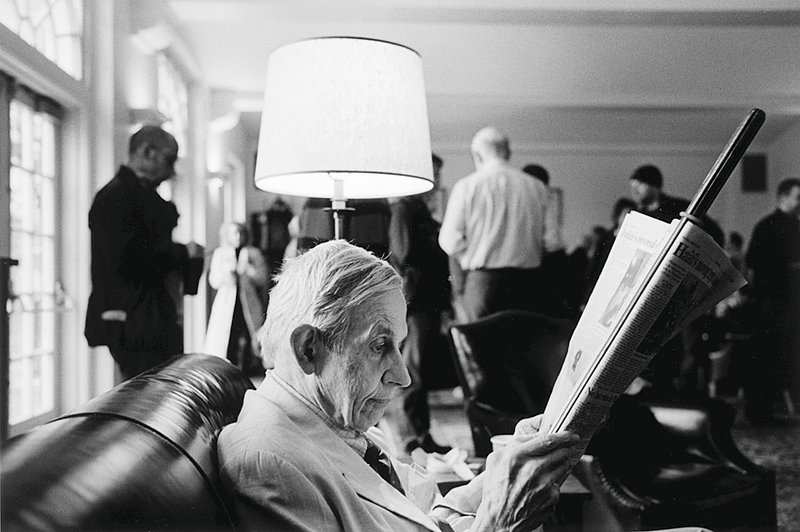
Nash at the Institute for Advanced Study in 2011. (Photo: Serge J-F. Levy©2019)

Mathematician John Forbes Nash Jr. was born in Bluefield, West Virginia in 1928. He died in a car crash in New Jersey on the 23rd of May, 2015, on his way back home after receiving the renowned Abel Prize in Oslo a few days prior.

Popularized in the 2001 Academy Award winning movie A Beautiful Mind, Nash’s life story has since captured the fascination and imagination of the world. The goal of this article has been to celebrate that life. Here’s to John Forbes Nash, Jr., surely one of the most fascinating and brilliant people who ever lived.

Early years (1928–45)

John Forbes Nash, Jr. was born on the 13th of June, 1928, in Bluefield, West Virginia. His father, John Sr., was an electrical engineer for the Appalachian Electric Power Company. His mother, Margaret Virginia, had been a schoolteacher of Latin before she was married. He had one younger sibling, his sister Martha who recounted to his biographer Sylvia Nasar that “Nash was always different. My parents knew he was different. And they knew he was bright. He always wanted to do things his way”. Nash himself associated being picked on in school with this trait, of being smarter than his peers:

“One time, somebody suggested that I was a prodigy. Another time it was suggested that I should be called “bug brains,” because I had ideas, but they were sort of buggy or not perfectly sound.”

Of his influences, Nash in his Nobel autobiography describes reading a lot of books as a child, including Compton’s Pictured Encyclopedia “that I learned a lot from” (Kuhn et al, 2002 p. 6) and the now notorious Men of Mathematics (Bell, 1937). Nash early on also showed great interest in experimentation. By the time he was twelve, he had “turned his room into a laboratory. He tinkered with radios, fooled around with electrical gadgets, and did chemistry experiments. A neighbor recall[ed] Johnny rigging the Nash telephone to ring with the receiver off” (Nasar, 1998). Even in high school, Nash remembers doing “electrical and chemistry experiments”. “At first when asked in school to prepare an essay about my career, I prepared one about a career as an electrical engineer like my father.”.

Nash’s parents pursued opportunities to supplement their son’s education by arranging for him to take advanced mathematics courses at a local community college when he was a senior in high school. That same year, he won a George Westinghouse Scholarship, one of ten awarded nationally. Following in is father’s footsteps, Nash in 1945 applied to the Carnegie Institute of Technology to pursue engineering.

At Carnegie Institute of Technology (1945–48)

One gets the sense that Nash felt out of place in Pittsburgh, where he for four years attended college at the Carnegie Institute of Technology (now Carnegie Mellon University) as an undergraduate. Originally in a chemical engineering program, later switching to chemistry, Nash spent much of his time there rebelling against the regimentation of the program and the lack of mathematical rigour in his courses. A born researcher, he would object to the notion that performance was measured “not by how well one could think, but of how well one could handle a pipette and perform titration in the laboratory” (Nasar, 1998). He was so bored during his summer job at the Westinghouse Lab that he spent most of the two months there making and polishing a brass egg in the lab’s machine shop.
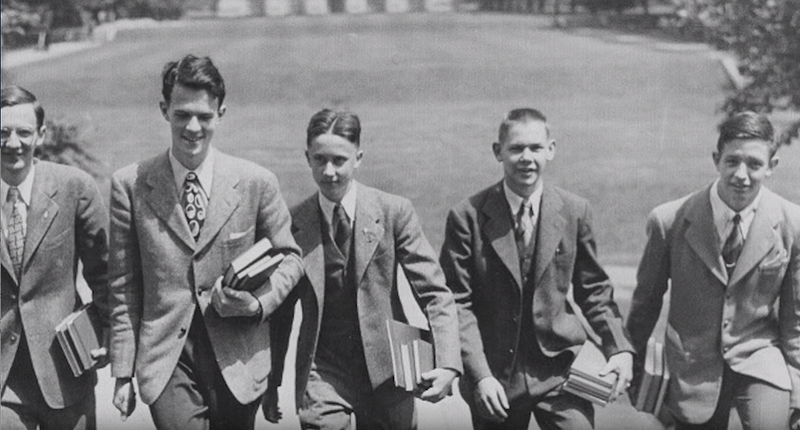
Nash (far right) and fellow freshmen climbing the steps of Machinery Hall, Carnegie Tech, autumn 1945. (Photo: Carnegie Mellon University Library)

However, as he returned for his sophomore year, Nash discovered that a brilliant group of new researchers had joined the university faculty, including physicists John Synge, Richard Duffin, and mathematicians Raoul Bott and Alexander Weinstein. From the start, Nash caught their attention with his brilliance. They eventually urged him to switch from chemistry to mathematics and seriously consider an academic career (Nasar, 1998).

In the fall of 1947, Professor Richard Duffin stood at the board frowning. “He was intimately familiar with Hilbert spaces, but he had prepared his lecture too hastily, had wandered down a cul de sac in the course of his proof, and was hopelessly stuck. It happened all the time.” The five students in the advanced graduate class were getting restive. After a few moments, everybody, including the professor, turned toward the gawky undergraduate in the back, squirming in his seat. “Okay John, you go to the board. See if you can get me out of trouble.” Nash leaped up and strode to the blackboard.
- Excerpt, "A Beautiful Mind" by Sylvia Nasar (1998)

By the middle of his second year he was concentrating almost exclusively on mathematics. Nash himself describes:

“I shifted again and became officially a student of mathematics. […] In the end I had learned and progressed so much in mathematics that they gave me an M. S. in addition to my B. S. when I graduated.

By the spring of 1948, in what would have been his junior year, Nash had been accepted to Harvard, Princeton, Chicago and Michigan University, the top four graduate-level math programs in the U.S. at the time. From Nasar’s interviews we know that at Carnegie, both Duffin and Synge were pushing Nash to choose Princeton. Its “hothouse milieu of pure mathematicians (topologists, algebraists, number theorists)” likely seemed like the perfect place for “a young Gauss”, as one of them called him (Nasar, 1998). On the Princeton side, the chairman of the mathematics department Solomon Lefschetz was equally eager in persuading Nash, eventually offering a John S. Kennedy Fellowship of $1,150 per year.

“We like to catch promising men when they are young and open-minded”

- Excerpt from a letter from Solomon Lefschetz to Nash

Although Harvard was his first choice (for its reputation, social status and faculty), Nash’s mediocre performance on the esteemed Putnam Competition had lead Harvard to offer slightly less money than Princeton. Princeton’s proximity to his family in Bluefield was an additional consideration, according to his Nobel autobiography. These factors, adding to the encouragement both of his supervisors at Carnegie and Lefschetz’s personal appeal, Nash eventually decided on Princeton, and left for New Jersey in the summer of 1948.
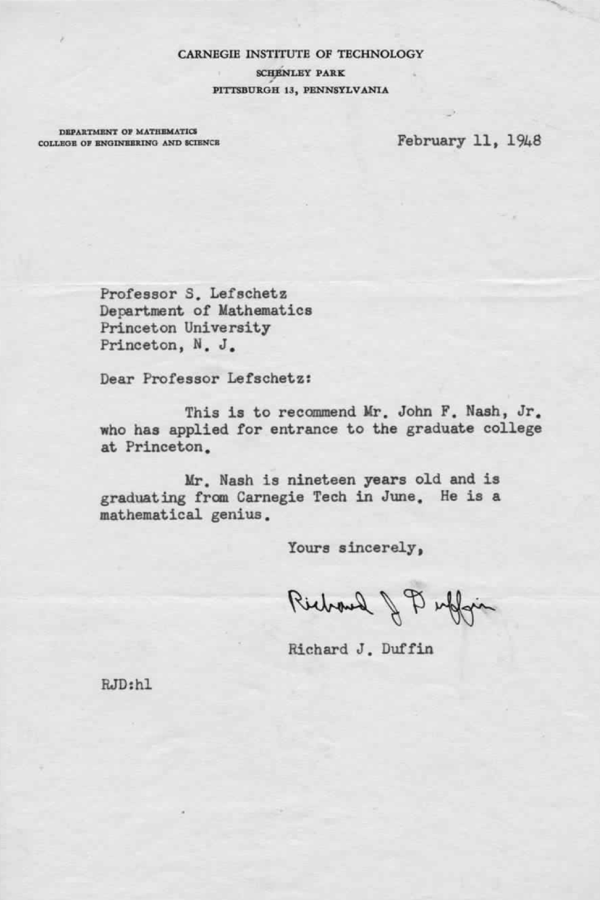
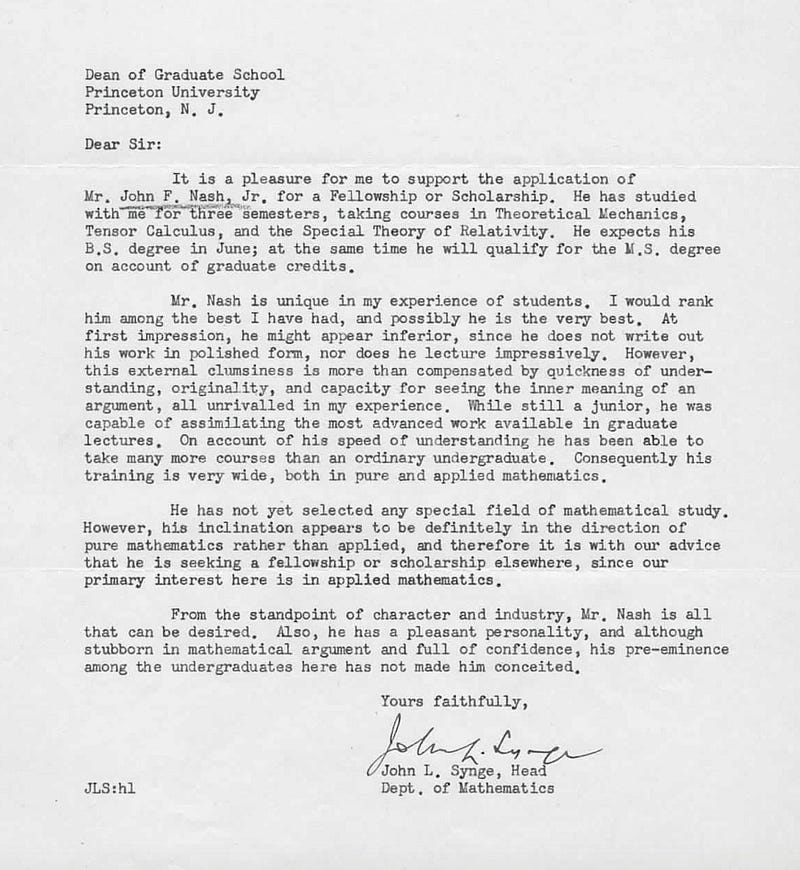
Left: Letter of recommendation from Nash’s thesis advisor at Carnegie Tech, Richard Duffin, addressed to Professor Solomon Lefschetz at Princeton University).. Right: Letter of recommendation from the Head of the Department of Mathematics at Carnegie, John L. Synge (Photos: Princeton University Archives)

At Princeton University (1948–51)

Nash entered graduate school when he was 20 years old, three years after leaving Bluefield. At the time, Princeton’s math department was filled with brilliant minds, lead by Lefschetz who jointly with Ralph Fox and Norman Steenrod headed research on topology, first in the country. Emil Artin lead algebra. Student of Lefschetz, Albert W. Tucker lead game theory which at that point was a newly established discipline entirely, invigorated by the publication of the book Theory of Games and Economic Behavior by John von Neumann and economist Oskar Morgenstern in 1944.

Princeton’s math department, housed in Fine Hall, in the 40s and 50s has since become somewhat legendary in mathematical circles. As Nasar recounted in 1998, “Fine Hall is, I believe, the most luxurious building ever devoted to mathematics, [according to] one European émigré. [..] A country club for math, where you could take a bath.”

Its cornerstone contains a lead box with copies of works by Princeton mathematicians and the tools of the trade — two pencils, one piece of chalk, and, of course, an eraser. Designed by Oswald Veblen [...] it was meant to be a sanctuary that mathematicians would be ‘loath to leave’. The dim stone corridors that circled the structure were perfect for both solitary pacing and “mathematical socializing. The nine “studies” — not offices! — for senior professors had carved paneling, hidden file cabinets, blackboards that opened like altars, oriental carpets, and massive, overstuffed furniture. [...] Each office was equipped with a telephone and each lavatory with a reading light.” Its well-stocked third-floor library, the richest collection of mathematical journals and books in the world, was open twenty-four hours a day. Mathematicians with a fondness for tennis (the courts were nearby) didn’t have to go home before returning to their offices — there was a locker room with showers.
- Excerpt, "A Beautiful Mind" by Sylvia Nasar (1998)

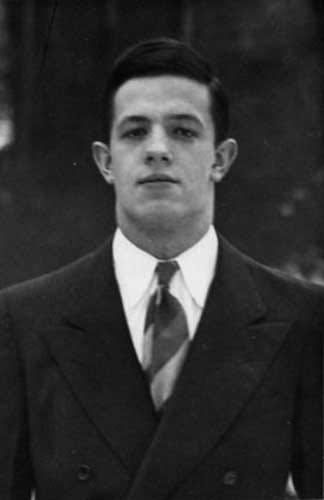
Left: John Forbes Nash, Jr. student photo. Right: John Forbes Nash, Jr. graduation photo (Photos: Princeton University Archives).

Nash was part of the clique of mathematicians and graduate students advancing the nascent discipline of game theory under Tucker, in the purest mathematical sense, i.e. largely uninterested in relating their research to applications in the real world. According to economist and personal friend of Nash at the time, Martin Shubik:

"The graduate students and faculty in the mathematics department interested in game theory were both blissfully unaware of the attitude in the economics department, and even if they had known it, they would not have cared.. The contrast of attitudes between the economics department and the mathematics department was stamped on my mind soon after arriving at Princeton. The former projected an atmosphere of dull business-as-usual conservatism of a middle league conventional Ph.D. factory; there were some stars but no sense of excitement or challenge. The latter was electric with ideas and the sheer joy of the hunt. Psychologically they dwelt on different planets. If a stray ten-year-old with bare feed, no tie, torn blue jeans and an interesting theorem had walked into Fine Hall at tea time, someone would have listened. When von Neumann gave his seminar on his growth model, with few exceptions, the serried ranks of Princeton Economics cold scare forbear to yawn." - Martin Shubik, 1992
- Excerpt, "Finding Equilibrium" by Düppe and Weintraub (2014 p. 94)

The head of the group, Tucker, would go on to supervise virtually all of the future top game theorists at Princeton, including David Gale and 2012 Nobel laureate Lloyd Shapley, in addition to, of course, Nash.

Nash the Game (Hex)

The story of Nash’s most famous result, as often is the case, departs not from an interest in its application or streams of theoretical research, but rather as the consequence of experimentation.

By the late 1940s, the favorite past-time of faculty and graduate students in the common room of Fine Hall was boardgames, including the famous Go and the less famous Kriegspiel. During this time, Nash himself invented a game later to become known as “Hex”, as it was independently invented a few years earlier by a Danish mathematician named Piet Hein, and marketed by the Parker Bros by this name. At the time however, everyone at Princeton simply called the game “Nash”. Nash/Hex is played on a (typically) 14x14 rhombus-like grid of n² hexagonal spaces using Go-stones of black and white. Each two opposite edges are also coloured black and white. Two players alternate placing pieces inside the hexagonal spaces. Once a piece is played, it can never be moved. The goal of each player is to construct a connected path of stones from one edge of the board to its opposite.
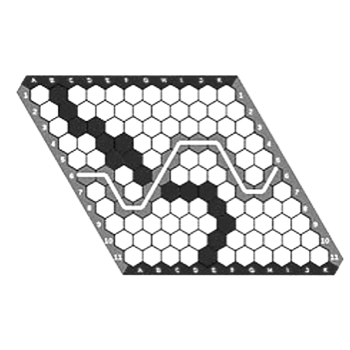
11×11 Hex game board showing a winning configuration

Nash was the first to prove that Hex cannot end in a draw. This non-trivial result is called the “Hex theorem”. He didn’t publish the proof, but in 1952 put it in a RAND technical report entitled “Some Games and Machines for Playing Them”. The proof has since been shown to be equivalent to the well-known Brouwer fixed-point theorem:

The Brouwer fixed-point theorem (Brouwer, 1910)
Let K be a topological space homomorphic to a compact, convex subset of Rⁿ and let f ∈ C(K, K), then f has at least one fixed point.

A fixed point is a point x for which f(x) = x, under some conditions on f. We can illustrate the meaning of the theorem informally for the case of the plane, n = 2, by imagining two pieces of grid paper of equal size with coordinate systems on them: Lay one of the pieces of paper flat on a table. Lay the other on top and crumple it without tearing or ripping it, and so that it does not reach outside the flat one. There will then be at least one coordinate point of the crumpled paper that lies directly above its corresponding point on the flat one. An analogous statement is that if you take an ordinary map of a country and lay it out on a table inside that country, there will always be a “You Are Here” pin on the map which represents the same point in the country. Brouwer’s fixed-point theorem is one among many theorems concerning fixed-points, but is particularly well known due to its use in many fields of mathematics, including in John von Neumann’s famous early treatise on general equilibrium theory (Von Neumann, 1937).

The theorem is worth mentioning here because it was used in Nash’s first proof of the Nash equilibrium for which he was eventually awarded the 1994 Nobel Memorial Prize in Economic Sciences. Its extension, the Kakutani fixed-point theorem was also later used by Nash in a more elegant proof of the same result. In the interest of completeness, the Kakutani’s fixed-point theorem states:

The Kakutani fixed-point theorem (Kakutani, 1941)
Let S be a non-empty, compact and convex subset of some Euclidean space Rⁿ. Let φ: S -> 2ˢ be a set-valued function on S with a closed graph and the property that φ(x) is non-empty and convex for all xS, then φ has a fixed point.
Any point on f(x) = x that intersects the graph of the function (gray area) is a fixed point. x = 0.72 (blue line) is a fixed point since 0.72 ∈ [0.64, 0.82].

To understand its properties, think for instance of a set-valued function f(x) defined on the closed interval [0,1] that maps a point x to the closed interval [1 — x/2, 1- x/4]. Then f(x) must have fixed points. In the diagram above, any point on the red line which intersects the graph of the function (in grey) is a fixed point, and so there are infinitely many fixed points in this particular case.

In addition to his fixed-point proof that Hex cannot end in a draw, Nash also provided a reductio ad absurdum existence proof (1949) that the first player in Hex on a board of any size has a winning strategy. The proof however gives no indication of a correct strategy for play. Nasar writes the following about the discovery:

"One morning in late winter 1949, Nash literally ran into the much shorter, wiry Gale on the quadrangle inside the Graduate College. “Gale! I have an example of a game with perfect information,” he blurted out. “There’s no luck, just pure strategy. I can prove that the first player always wins, but I have no idea what his strategy will be. If the first player loses at this game, it’s because he’s made a mistake, but nobody knows what the perfect strategy is.”
- Excerpt, "A Beautiful Mind" by Sylvia Nasar (1998)

The proof is common to a number of other games, and has come to be called the strategy-stealing argument. Here is a highly condensed informal version of Nash’s proof for Hex:

Hex first player winning strategy existence proof (Nash, ~1949)
1. Either the first or second player must win, therefore there must be a winning strategy for either the first or the second player.
2. Let us assume that the second player has a winning strategy.
3. The first player can now adopt the following defense: He makes an arbitrary move. Thereafter he plays the winning second player strategy assumed above. If in playing this strategy, he is required to play on the cell where an arbitrary move was made, he makes another arbitrary move. In this way he plays the winning strategy with one extra piece always on the board.
4. This extra piece cannot interfere with the first player's imitation of the winning strategy, for an extra piece is always an asset and never a handicap. Therefore the first player can win.
5. Because we have now contradicted our assumption that there is a winning strategy for the second player, we are forced to drop this assumption.
6. Consequently, there must be a winning strategy for the first player.

Nash’s Research (1948–58)

In the taxonomy of mathematicians, there are problem solvers and theoreticians, and, by temperament, Nash belonged to the first group. — Nasar (1998)

As a consequence of the mental illness that would later consume him, Nash’s prime research career was remarkably short, essentially only spanning nine years from his arrival at Princeton in 1948 to his diagnosis in 1958. Raoul Bott at Carnegie said this about Nash’s interests as a graduate student:

“Nash liked very general problems. He wasn’t all that good at solving cute little puzzles. He was a much more dreamy person. He’d think a long time. Sometimes you could see him thinking. Others would be sitting there with their nose in a book.”

Of his own graduate research, Nash himself stated in his Nobel autobiography that “As a graduate student I studied mathematics fairly broadly and was fortunate enough, besides developing the idea which led to “Non-Cooperative Games”, also to make a nice discovery relating to manifolds and real algebraic varieties. So I was prepared actually for the possibility that the game theory work would not be regarded as acceptable as a thesis in the mathematics department and then that I could realize the objective of a Ph.D. thesis with the other results.”.

Nash at his doctoral graduation in 1950 (Photo: Princeton University Archives)

Nash ultimately didn’t need to ‘realize the objective of a Ph.D. thesis with other results’. He earned his Ph.D. in mathematics from Princeton in 1950 at the age of 22. His 28-page dissertation was entitled Non-cooperative Games (1950). It is available for free here. Written under the supervision of Tucker, the main result of the paper was the derivation, definition and description of the properties of the Nash equilibrium. For those interested, Nash’s work in game theory was beautifully collected and organized in this article prepared for the Nobel Committee by his friend Harold Kuhn in 1994. Fields medal winner John Milnor in 1998 also wrote notice for the American Mathematical Society listing Nash’s total of 21 publications.

The Bargaining problem (1949)

Nash’s first journal paper (written prior to his work on the Nash equilibrium) — also in game theory — regarded the classic economic problem of bargaining. The problem had previously been investigated by a number of scholars (Cournot, Bowley, Fellner among others) for various purposes including investigations of bilateral monopoly (Nash, 1950a).
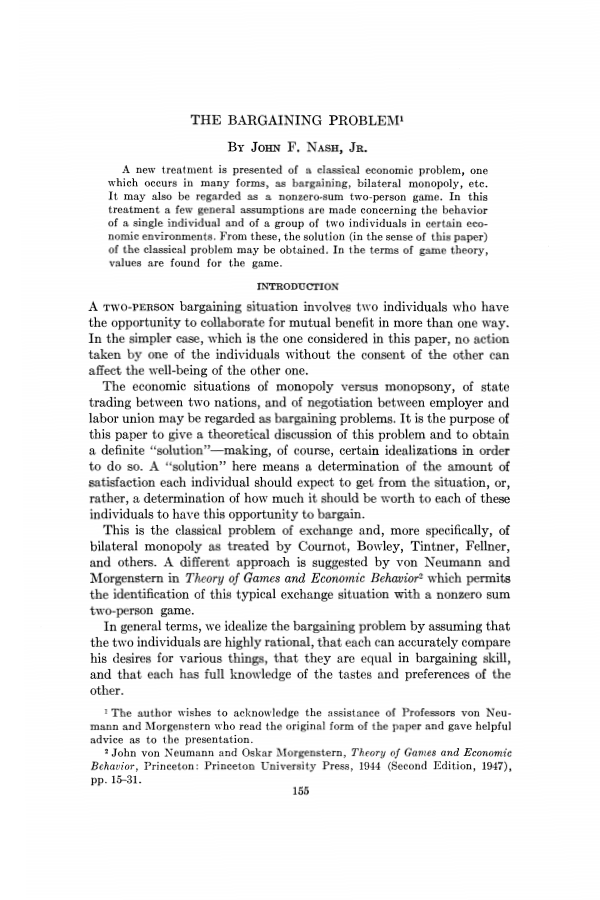
Nash (1950a). “The Bargaining Problem. Econometrica 18 (2): p. 155–62.

Nash’s paper describes a bargaining situation where two individuals have the opportunity for mutual benefit, but no action taken by one of the individuals unilaterally (without consent) can affect the well-being of the other. Think of the classic “divide and choose protocol” of two people trying to divide a cake evenly, where one carves and the other chooses which piece he or she wants, providing a so-called envy-free cake-cutting procedure.

Nash’s paper is positioned to be a theoretical discussion of such bargaining situations, as well as to provide a definitive “solution” (meaning determine the amount of satisfaction each individual should expect to obtain) under certain conditions and other “idealizations”. Such idealizations include the assumption that the two individuals are rational and can accurately compare their preferences for various things, have equal bargaining skills and complete information about the preferences of the other person.

Nash’s treatment employs the concept of utility as developed in von Neumann and Morgenstern’s Theory of Games and Economic Behavior (1944). It also employs the concept of expectation in determining what various players’ payoffs will be given various strategies. In his paper, Nash uses as an illustration a man named Mr. Smith who knows he will be given a Buick tomorrow, and so that he may be said to have “Buick expectation”. Similarly, he may have “Cadillac expectation”. If he knew that tomorrow a fair coin would be tossed to decide whether he would get a Buick or a Cadillac, we can say he had 50% Buick and 50% Cadillac expectation.

Nash provides sufficient assumptions for the development of a utility theory for a single individual in such scenarios and proceeds to differentiate his paper from that presented in Theory of Games and Economic Behavior (1944). In his view, the theory there comes short in that it does not attempt to find values for each person’s valuations of the opportunity to engage in a game, unless that games is zero-sum. Nash then goes on to derive values for the anticipation of players in such two-person non-zero-sum games:

We may define a two-person anticipation as a combination of two one-person anticipations. Thus we have two individuals, each with a certain expectation of his future environment. We may regard the one-person utility functions as applicable to the two-person anticipations, each giving the result it would give if applied to the corresponding one-person anticipation which is a component of the two-person anticipation. A probability combination of two two-person anticipations is defined by making the corresponding combinations for their components. Thus if [A, B] is a two-person anticipation and 0 ≤ p ≤ 1, then
p[A,B] + (1 - p)[C,D] will be defined as
[pA + (1-p)C, pB + (1-p)D]

Nash defines the utility functions u₁, u₂ of two individuals and c(S) as the solution point in a set S which is compact, convex and includes the origin. He puts forth the necessary assumptions and show that these conditions require that the solution be the point of the set in the first quadrant where u₁u₂ is maximized. The compactness of the set guarantees its existence and its convexity its uniqueness.
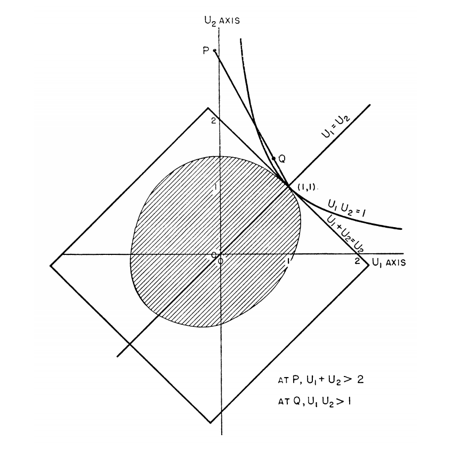
Figure 1 from Nash’s paper “The Bargaining problem”, illustrating the unique, optimal point of the set S, which maximizes the utilities of player 1 and 2. Photo: Econometrica, 18 (2): p. 160.
Example of a bargaining problem (Nash, 1950a)
Let us suppose that two intelligent individuals, Bill and Jack, are in a position where they may barter goods but have no money with which to facilitate exchange. Further, let us assume for simplicity that the utility to either individual of a portion of the total number of goods involved is the sum of the utilities to him of the individual goods in that portion. We give below a table of goods possessed by each individual with the utility of each to each individual. The utility functions used for the two individuals are, of course, to be regarded as arbitrary.
Bill's good, Bill's utility and Jack's utility:
(book, 2, 4), (whip, 2, 2), (ball, 2, 1), (bat, 2, 2),(box, 4, 1)
Jack's goods, Bill's utility and Jack's utility:
(pen, 10, 1), (toy, 4, 1), (knife, 6, 2), (hat, 2, 2)
The graph for the bargaining situation turns out to be a convex polygon in which the point where the product of the utility gains is maximized is at a vertex and where there is but one corresponding anticipation, which is:
Bill gives Jack: book, whip, ball and bat
Jack gives Bill: pen, toy and knife

The graph depicting the bargain from Nash’s paper is as follows:
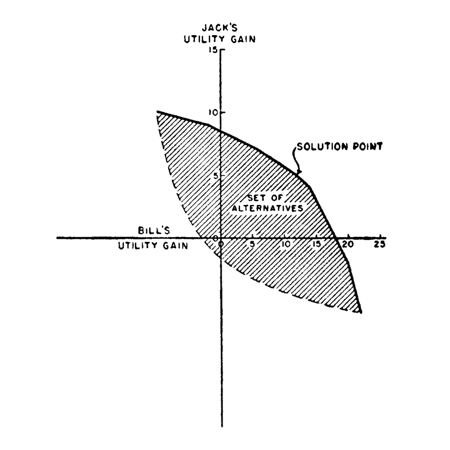
Example: The solution point is on a rectangular hyperbola lying in the first quadrant and touching the set of alternatives at but one point

How Nash arrived at the result remains unclear. Nash’s close friend and co-editor of his 2002 autobiography The Essential John Nash, Harold Kuhn, recalls about the paper: “It is my recollection that it had been sent to von Neumann during Nash’s first year as a graduate student and that Nash made an appointment to remind von Neumann of its existence. In this scenario, it had been written at Carnegie Tech as a term paper in the only course in economics that Nash ever took.”, adding however that “Nash’s current memory differs from mine; in a luncheon with Roger Meyerson in 1995, he expressed the opinion that he had written the paper after his arrival at Princeton.

“Whatever the true history of the paper, the examples suggest that it was written by a teenager; they involve bats, balls, and penknives. What is certain is that Nash had never read the works of Cournot, Bowley, Tintner, and Fellner cited in the paper’s Introduction.” — Harold Kuhn

Meeting John von Neumann

Although somewhat in opposition to von Neumann and Morgenstern’s work on cooperative game theory, Nash’s results establishing a foundation for non-cooperative game theory clearly had its origins in the formers’ work (indeed, illustrative of this, in 1978 Nash was awarded the John von Neumann Theory Prize for his discovery of the Nash equilibrium).

Only one documented account of communication between Nash on von Neumann can now be found, although there were surely many more now lost to time. According to Nasar, Nash went to talk to von Neumann a few days after he passed his general examination at Princeton in 1949, prior to his definition of the Nash equilibrium. As she writes:

“He wanted, he had told the secretary cockily, to discuss an idea that might be of interest to Professor von Neumann. It was a rather audacious thing for a graduate student to do. [...] But it was typical of Nash, who had gone to see Einstein the year before with the germ of an idea. [...] He listened carefully, with his head cocked slightly to one side and his fingers tapping. Nash started to describe the proof he had in mind for an equilibrium in games of more than two players. But before he had gotten out more than a few disjointed sentences, von Neumann interrupted, jumped ahead to the yet unstated conclusion of Nash’s argument, and said abruptly, “That’s trivial, you know. That’s just a fixed point theorem.”
- Excerpt, "A Beautiful Mind" by Sylvia Nasar (1998)

Von Neumann, in other words, did not see the value in Nash’s bargaining result. Nash himself however would later defend the great man’s reaction in a letter to Robert Leonard, stating, characteristically analytically, “I was playing a non-cooperative game in relation to von Neumann rather than simply seeking to join his coalition. And of course, it was psychologically natural for him not to be entirely pleased by a rival theoretical approach”. Both von Neumann and Morgenstern ultimately did however provide Nash with valuable guidance, and in the published version Nash makes sure to acknowledge the role of both, writing “The author wishes to acknowledge the assistance of Professors von Neumann and Morgenstern who read the original form of the paper and gave helpful advice as to the presentation.”

The Nash Equilibrium (1950)

A few days after his meeting with von Neumann, Nash reportedly again “accosted” David Gale on campus:

“I think I’ve found a way to generalize von Neumann’s min-max theorem,” he blurted out. “The fundamental idea is that in a two-person zero-sum solution, the best strategy for both is … The whole theory is built on it. And it works with any number of people and doesn’t have to be a zero-sum game!”

Characteristically, as Nasar writes, Gale was less enchanted by the possible applications of the work than the mathematics, stating in 1995 that “The mathematics was so beautiful. It was so right mathematically.”

“Gale realized that Nash’s idea applied to a far broader class of real-world situations than von Neumann’s notion of zero-sum games. “He had a concept that generalized to disarmament”
- Excerpt, "A Beautiful Mind" by Sylvia Nasar (1998)

Gale also helped Nash claim credit for the result as soon as possible by drafting a note to the National Academy of Sciences. Lefschetz submitted the note on their behalf, and the result appeared in less than a single page entitled Equilibrium points in N-person games in the 36th volume of the Proceedings of the National Academy of Sciences in January of 1950.
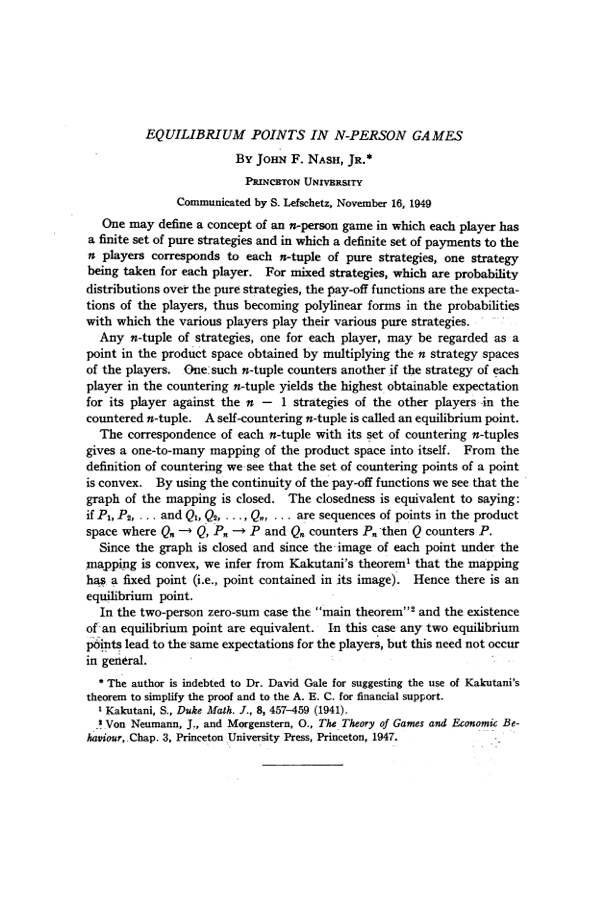
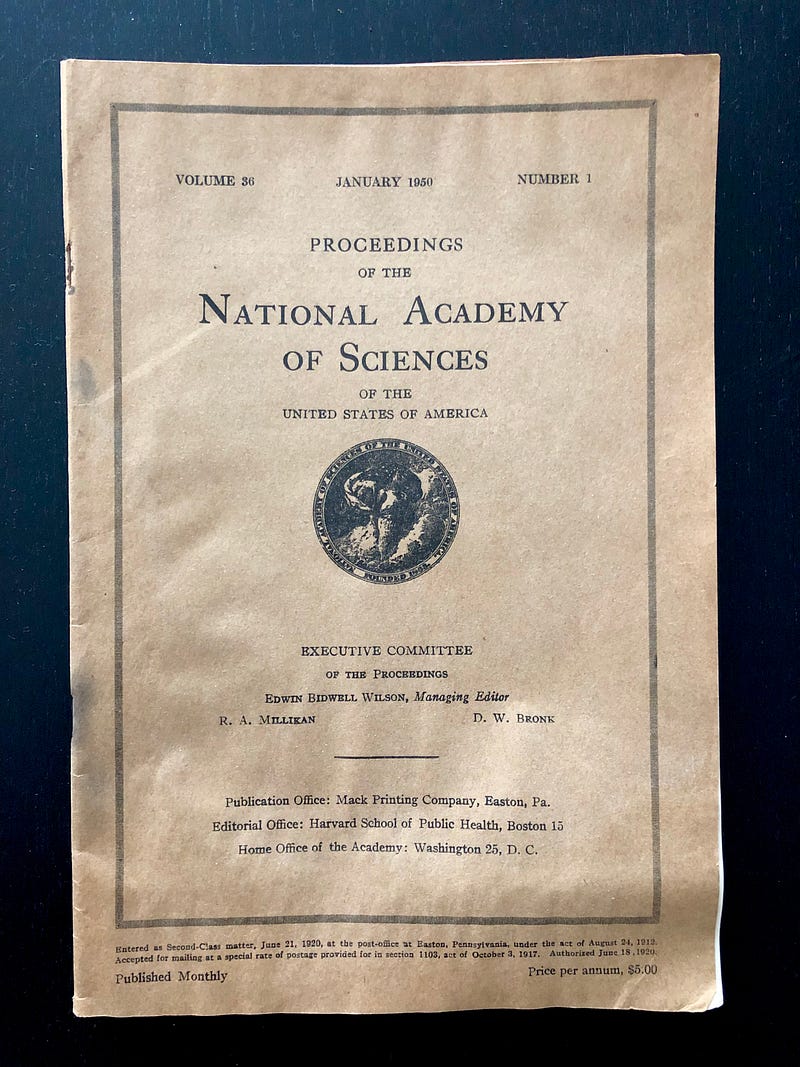
Left: Nash (1950b). Equilibrium Points in N-person Games. Proceedings of the National Academy of Sciences 36 (1). Right: My own copy of the publication.

The result, later to be known as the Nash equilibrium is now typically formally defined as follows:

Definition of a Nash equilibrium
Let (S,f) be a game with u players Sᵢ is the set of strategies for player i, S = S₁ x S₂ x ... x Sᵤ is the set of strategy profiles and f(x) = (f₁(x),...,fᵤ(x)) is its payoff function evaluated at x ∈ S. Let xᵢ be a strategy profile of player i and x₋ᵢ be a strategy profile of all players except player i.
When each player i ∈ {1,...,u} chooses a strategy xᵢ, resulting in a strategy profile x = (x₁,...,xᵤ) then player i obtains payoff fᵢ(x). Note that the payoff depends on the strategy profile chosen, i.e. on the strategy chosen by player i as well as the strategies chosen by all the other players.
A strategy profile x* ∈ S is a Nash equilibrium if no unilateral definition in strategy by any single player is profitable for that player, that is
∀i,xᵢ ∈ Sᵢ : fᵢ(x*ᵢ, x*₋ᵢ) ≥ fᵢ(x,x*₋ᵢ)

Informally, the theorem states:

A strategy profile is a Nash equilibrium if no player can do better by unilaterally changing his or her strategy.

That is, in a two-person game, a pair of strategies constitute a Nash equilibrium if player A’s choice is optimal, given player B’s choice, and B’s choice is optimal given player A’s choice. No player can singlehandedly change their strategy in order to obtain a more optimal result. Crucially, neither player knows what strategy the other will choose, but acts solely on the basis of their own interests, given their knowledge of other players’ interests. The finding generalizes to n players.
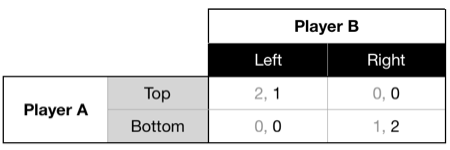
Example: Payoff matrix featuring a Nash equilibrium

In the table above, the strategies and payoffs of a two-person game are shown. Player A can choose between the strategies Top and Bottom. If player A chooses Top, he will receive a payoff of 2 if player B chooses Left and 0 if player B plays Right. If player A chooses Bottom, he will receive a payoff 0 if player B plays Left, and 1 if player B plays Right. Thus, player A’s optimal choice depends on what he thinks player B will do (Varian, 2006 p. 506).

In the table above, the strategy set (Top, Left) is a Nash equilibrium. To show it, note that if A chooses Top, then the best thing for B to do is to choose Left, since the payoff for B from choosing Left is 1 and from choosing Right is 0. If B chooses Left, then the best thing for A to do is to choose Top since then A will get a payoff of 2 rather than of 0. Thus, if A chooses Top, the optimal strategy for B is to choose Left ; and if B chooses Left, then the optimal strategy for A is to choose Top. So, we have a Nash equilibrium: each person is playing their optimal strategy, given the other player’s strategies.

Proofs of the Nash Equilibrium

As mentioned, Nash’s thesis proof (1950c) used Brouwer’s fixed-point theorem. A version of the “clumsy, if totally original” proof (Kuhn et al, 2002) by contradiction, included here primarily in the interest of completeness, goes as follows (Wikipedia, 2019):

Proof of the existence of Nash Equilibria using the Brouwer fixed-point theorem (Nash, 1950c)
For a game G = (N, A, u) where N is the number of players and A is the product of the actions of all players, let Δ denote the set of mixed strategies for the players. Let the actions A of the players be finite, so as to ensure the compactness of Δ. For a mixed strategy σ ∈ Δ, we define the gain for player i on action aAᵢ (the benefit player i gets by changing his/her strategy unilaterally) to be:
Gainᵢ(σ,a) = max{0, uᵢ(a,σ₋ᵢ) - uᵢ(σᵢ,σ₋ᵢ)}
Next, define the set of all players' gains as g = (g₁, ... , gn) where gᵢ(σ)(a) = σᵢ(a) + Gainᵢ(σ,a) for σ ∈ Δ, a ∈ Aᵢ. 
Taking the sum of both sides, we see that the sum Σ(gᵢ(σ)(a)) for a ∈ Aᵢ is equal to the sum of Σ(σᵢ(a) + Gainᵢ(σ,a)), which restated is equal to 1 + Σ(Gainᵢ(σ,a)) > 0.
Next, for the function f define 
f = (f₁ ..., fn): Δ → Δ and 
fᵢ(σ)(a) = gᵢ(σ)(a) / Σ(gᵢ(σ)(a)) for b ∈  ∈ A
Each fᵢ is a valid mixed strategy in Δᵢ. Each fᵢ is a continuous function of σ, and so f is a continuous function. Being the cross product of a finite number of compact convex sets, Δ is also compact and convex. Applying the Brouwer fixed point theorem to f and Δ we conclude that f has a fixed point in Δ, call it σ*. We claim that σ* is a Nash equilibrium in G. To show this, it suffices to show that each player gains no benefit by unilaterally changing their their strategy, namely:
i ∈ {1,...,N}, ∀aAᵢ : Gainᵢ(σ*,a) = 0
Now, assume that the gains are not all zero. Therefore, ∃i ∈ {1,...,N}, and a ∈ Aᵢ such that Gainᵢ(σ*,a) > 0. Note then that sum Σ(gᵢ(σ*)(a)) = 1 + Σ(Gainᵢ(σ*,a)) > 1 for a ∈ Aᵢ. 
Let C = Σ(gᵢ(σ*,a)) for a ∈ Aᵢ and let Gain(i,⋅) denote the gain vector indexed by actions in Aᵢ. Since σ* is the fixed point we have:
σ* = f(σ*) → σ*ᵢ = (1/(C-1))Gainᵢ(σ*,⋅)
Since C > 1 (as shown above), σ*ᵢ is some positive scaling of the vector Gainᵢ(σ*,⋅). We now claim that 
∀i ∈ Aᵢ: σ*ᵢ(a)(uᵢ(aᵢ,σ*₋ᵢ)) = Gainᵢ(σ*,a)(a)Gainᵢ(σ*,a)
To see this, we first note that if Gainᵢ(σ*,a) > 0 then this is true by definition (of the gain function). Now assume that Gainᵢ(σ*,a) = 0. By our previous statements we then have that 
σ*ᵢ(a) = (1/(C-1))Gainᵢ(σ*,a) = 0, and so the left term is zero, giving us that the entire expression is 0 as needed. So, finally we have that 
0 = uᵢ(σ*ᵢ,σ*₋ᵢ) - uᵢ(σ*ᵢ,σ*₋ᵢ) = Σ(C - 1)σ*ᵢ(a)² > 0
where the last inequality follows because σ*ᵢ is a non-zero vector. This is however a contradiction, so all the gains must be zero. Hence, we have shown that σ* is a Nash equilibrium for G.

Awarding credit to David Gale, Nash later published a simpler proof of the same result, using the Kakutani fixed-point theorem. Again, in the interest of completeness, the proof is provided below (Wikipedia, 2019):

Proof of the existence of Nash Equilibria using the Kakutani fixed-point theorem (Nash, 1951)
To prove the existence of a Nash Equilibrium (NE), let rᵢ(σ₋ᵢ) be the best response of player i to the strategies of all other players.
rᵢ(σ₋ᵢ) = arg max uᵢ(σᵢ, σ₋ᵢ)
Here, σ ∈ Σ where Σᵢ x Σ₋ᵢ is a mixed strategy profile in the set of all mixed strategies and uᵢ is the payoff function for player i. Define a set valued function r: Σ → 2^Σ such that r = (rᵢ(σ₋ᵢ), r₋ᵢ(σ₋ᵢ). Proving the existence of a Nash equilibrium is equivalent to showing that r has a fixed point.
Kakutani's fixed point theorem guarentees the existence of a fixed point if the following four conditions are satisfied:
1. Σ is compact, convex and non-empty
2. r(σ) is nonempty
3. r(σ) is upper hemicontinuous
4. r(σ) is convex
Condition 1 is satisfied from the fact that Σ is a simplex and thus compact. Convexity follows from players' abilities to mix strategies. Σ is non-empty as long as players have strategies.
Condition 2. and 3. are satisfied by way of Berge's maximum theorem. Because uᵢ is continuous and compact, r(σ) is non-empty and upper hemicontinuous. 
Condition 4 is satisfied as a result of mixed strategies. Suppose σᵢ, σᵢ' ∈ r(σ₋ᵢ), then λσᵢ + (1 - λ)σᵢ' ∈ r(σ₋ᵢ), i.e. if two strategies maximize payoffs, then a mix between two strategies will yield the same payoff. 
Therefore, there exists a fixed point in r and a Nash equilibrium.

Interpretations

Nash in his thesis proposed two ways of thinking about his equilibrium concept: one based on rationality and one based on statistical populations. In the rational interpretation, players are perceived as rational and they have complete information about the structure of the game, including all of the players’ preferences regarding possible outcomes, where this information is common knowledge. Since all players have complete information about each others’ strategic alternatives and preferences, they can also compute each other’s optimal choice of strategy for each set of expectations. If all of the players expect the same Nash equilibrium, and the game is played only once, then there are no incentives for anyone to change their strategies. In the interpretation according to statistical populations, Nash states that “[i]t is unnecessary to assume that the participants have full knowledge of the total structure of the game, or the ability and inclination to go through any complex reasoning processes”. This because “What is assumed is that there is a population of participants for each position in the game, which will be played throughout time by participants drawn at random from the different populations. If there is a stable average frequency with which each pure strategy is employed by the average member of the appropriate population, then this stable average frequency constitutes a mixed strategy Nash equilibrium.” (Nash, 1950c).

As Kuhn would later write:

"The Nobel selection committee apparently took the two interpretations that are contained in the thesis seriously. The rational interpretation could have been argued by Cournot, but the statistical interpretation, which is so important for biological games, is wholly original. Although the nature of non-cooperative games is explained in all three of these papers, only the thesis contains an exposition of these two interpretations. When asked at the Nobel seminar why the interpretations were not included in the Annals paper. Nash responded, "I don't know whether it was just pruned down in style for the Annals of Mathematics."
- Excerpt, "The Essential John Nash" by Kuhn et al (2002)

Journal papers

Nash’s thesis would eventually spawn three journal papers. The three articles contain three different proofs of the existence of Nash equilibria. The first, entitled Equilibrium Points in N-person Games (1950b) is the note Nash and Gale drafted for the Proceedings of the National Academy of Sciences. The second, called Non-Cooperative games (1951) was published in the Annals of Mathematics Vol. 54 (2). In Two-person cooperative games (1953), published in Econometrica 21, Nash extends his work on the bargaining problem (Nash, 1950a) to a wider class of situations in which threats can a play a role (Kuhn et al, 2002).
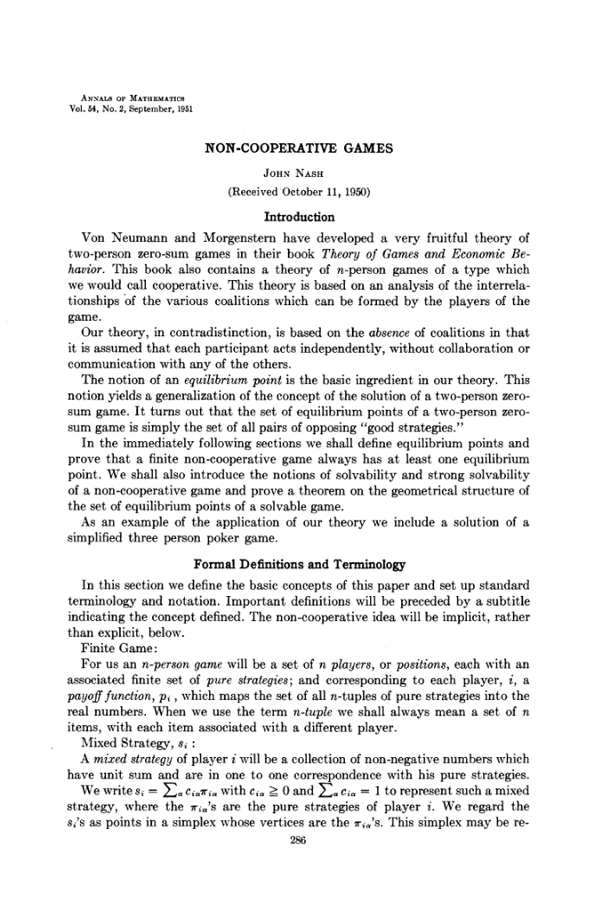
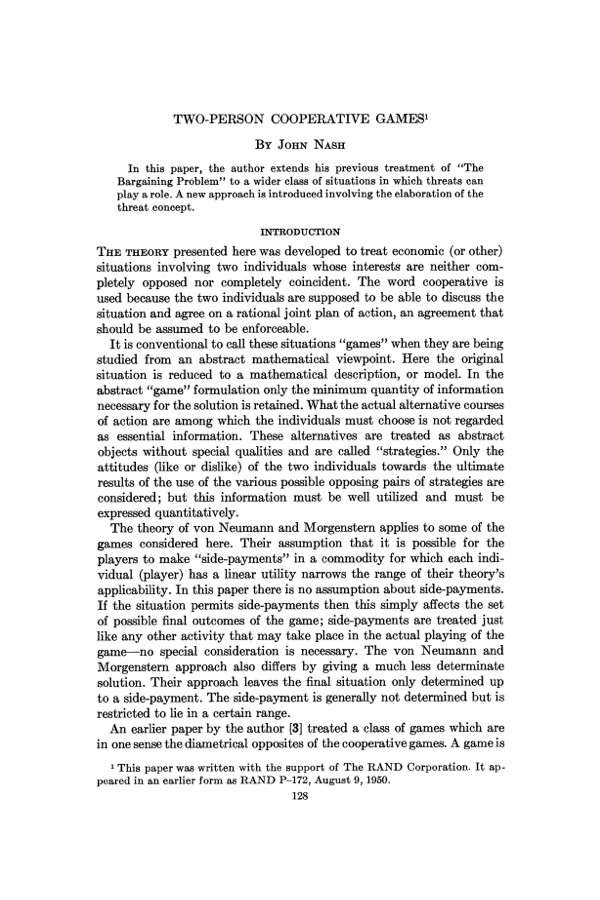
Left: Nash (1951). “Non-Cooperative Games”. Annals of Mathematics 54 (2): p. 286–95. Right: Nash (1953). “Two-person Cooperative Games”. Econometrica 21 (1): p. 128–40.

Applications

Barring its mathematical nature and interesting theoretical implications for economics, the Nash equilibrium is celebrated mostly due to its many real-world applications. Nasar (1998) highlights its role in auction design in the 1990s. Other applications typically highlighted are war and arms races, conflict mitigation, cooperation, risk avoidance, in the adoption of technical standards and analysis of bank runs and currency crises, traffic flow, environmental legislation and in analyzing evolutionary processes such as natural selection in evolutionary biology.

Other results

Real Algebraic Manifolds (1952)

Nash’s other potential Ph.D. thesis result that he described as “a nice discovery relating to manifolds and real algebraic varietieswas very different from his work on the Nash equilibrium. Unlike his thesis, this very deep work was highly abstract and devoid of application, taking notice of as of yet undiscovered fundamental properties of geometric and algebraic functions and mappings.

In his paper Real Algebraic Manifolds (1952) Nash himself writes that the main purpose of the paper was to “develop some connections between differential geometry and real algebraic geometry”. Essentially he showed that any compact smooth manifold is diffeomorphic to some semialgebraic analytic submanifolds of some Rⁿ.

Definition of an algebraic variety
A real algebraic variety, in the classical sense, is a set of solutions to a system of polynomial equations over the real numbers.

Algebraic varieties are the central objects of study in algebraic geometry. They are objects defined by a locus of points described by one or more algebraic equations. One way of thinking about them is as a generalization to n dimensions of algebraic curves (set of points on the Euclidean plane whose coordinates are zeroes of some function of two variables) such as e.g. the unit circle, which is the set of zeros of the polynomial x² + y² — 1. The twisted cubic is an example of an algebraic variety, being a smooth, rational curve C of degree three in projective 3-space P³.
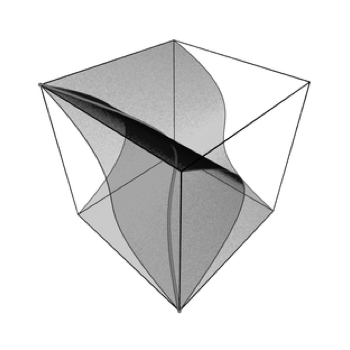
The twisted cubic is a projective algebraic variety, i.e. the image of the map v: P¹ → P³
Definition of a manifold
A manifold is a topological space that locally resembles Euclidean space near each point, i.e. each point of an n-dimensional manifold has a neighborhood that is homeomorphic to the Euclidean space of dimension n.

Manifolds, on the other hand, are topological objects which locally resemble regular, normal Euclidean space i.e. “seem straight” in the case of a line in one dimension and “flat” in the case of a plane in two dimensions. Said simply, they are objects which globally are in fact topologically irregular, but locally seem not to be.

The concept of a manifold is now central to many parts of geometry because it allows complicated structures to be described and understood in terms of the simpler local topological properties of normal Euclidean space. This makes them especially useful in physics, and in particular, cosmology and astrophysics. In one dimension, a manifold may be a straight line or a circle, but not a figure eight because it has crossing points that are not locally homeomorphic to Euclidean 1-space. In two dimensions, manifolds are surfaces such as planes, spheres, tori, klein bottles and the real projective plane, all of which can be embedded in three dimensional real space.

Algebraic manifolds, are algebraic varieties which are also manifolds. That is, they are a set of solutions to a system of polynomial equations which also locally resemble Euclidean space near each point. They can be defined both for real and complex numbers. As such, algebraic manifolds are a generalization of the concept of smooth curves and surfaces defined by polynomials. The most trivial example is the sphere, which can be defined as the zero set of the polynomial x²+y²+z²-1=0.

Nash’s paper looks especially at algebraic manifolds over R, i.e. those manifolds consisting of points defined by real numbers. Such functions have since come to also be known as Nash functions:

Definition of a Nash function
A Nash function on an open semialgebraic subset U ⊂ Rⁿ is an algebraic function f: U → R satisfying a nontrivial polynomial equation P(x,f(x)) = 0 for all x in U

Some examples of Nash functions are: 1. Polynomial and regular rational functions and 2. x → √(1+x²) is Nash on R.

According to Nasar, Nash’s paper on algebraic manifolds was the only paper he was every truly satisfied with (Nasar, 1998 p. 266).

Manifold embedding (1956)

Nash’s work in topology is by many mathematicians often considered his most brilliant. As Nasar writes, Nash’s brash style had established a high bar for him to live up to among his peers — “And, during a discussion in the common room, after one of Nash’s diatribes about hacks and drones, Ambrose said disgustedly, ‘If you’re so good, why don’t you solve the embedding problem for manifolds’ — a notoriously difficult problem that had been around since it was proposed by Riemann.”

Nash did.

To what extent are the abstract Riemannian manifolds a more general family than the sub-manifolds of Euclidean spaces?

The question above, through various permutations, had been considered by mathematicians since the mid-1800s. In 1873, Schlaefli discussed the local form of the problem by conjecturing that a neighbourhood in an n-manifold would generally require an imbedding space of (n/2)(n + 1) dimensions. Later, the problem was considered by the likes of Hilbert, Tompkins, Chern, Kuiper, Janet and Cartan (Kuhn et al, 2002). Nash’s own characterization of the problem in his Nobel autobiography subtly hints at his reasoning for devoting attention to the problem: “[The] problem, although classical, was not much talked about as an outstanding problem. It was not like, for example, the four-color conjecture.” Rather famously, Nash would discount problems which he didn’t consider worthwhile of his time.

Nash solved the problem in a highly technical paper entitled C¹-isometric imbeddings (1954). The paper is arranged in four parts. As Nash himself writes in Kuhn et al (2002): “At the end of part C the treatment of compact manifolds is complete and we state Theorem 2, which is essentially this:

Every compact Riemannian n-manifold is realizable as a sub-manifold of Euclidean (n/2)(3n + 11)-space.

Nash’s theorem, later to become known as the Nash embedding theorem, states that any kind of manifold (surface, body, etc) which exhibits a certain level of smoothness (i.e. is void of intersections and singularities) can be embedded in Euclidean space. As Nasar writes, Nash showed that you can “fold the manifold like a silk handkerchief, without distorting it”.
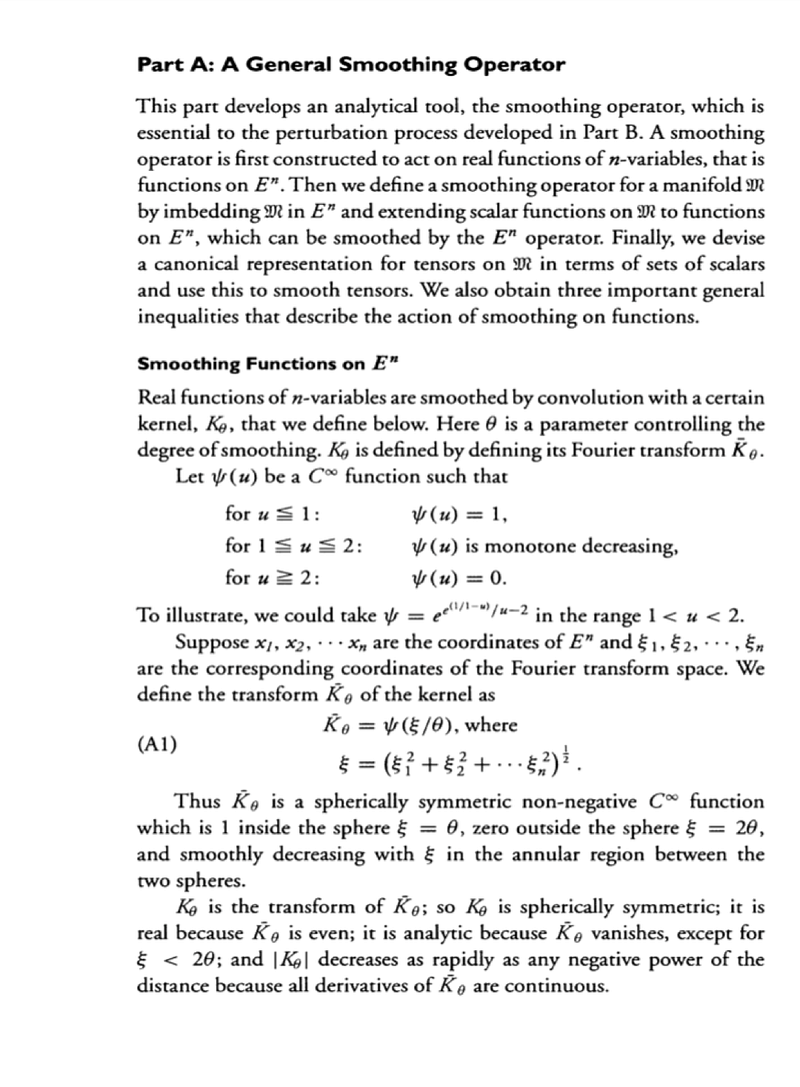
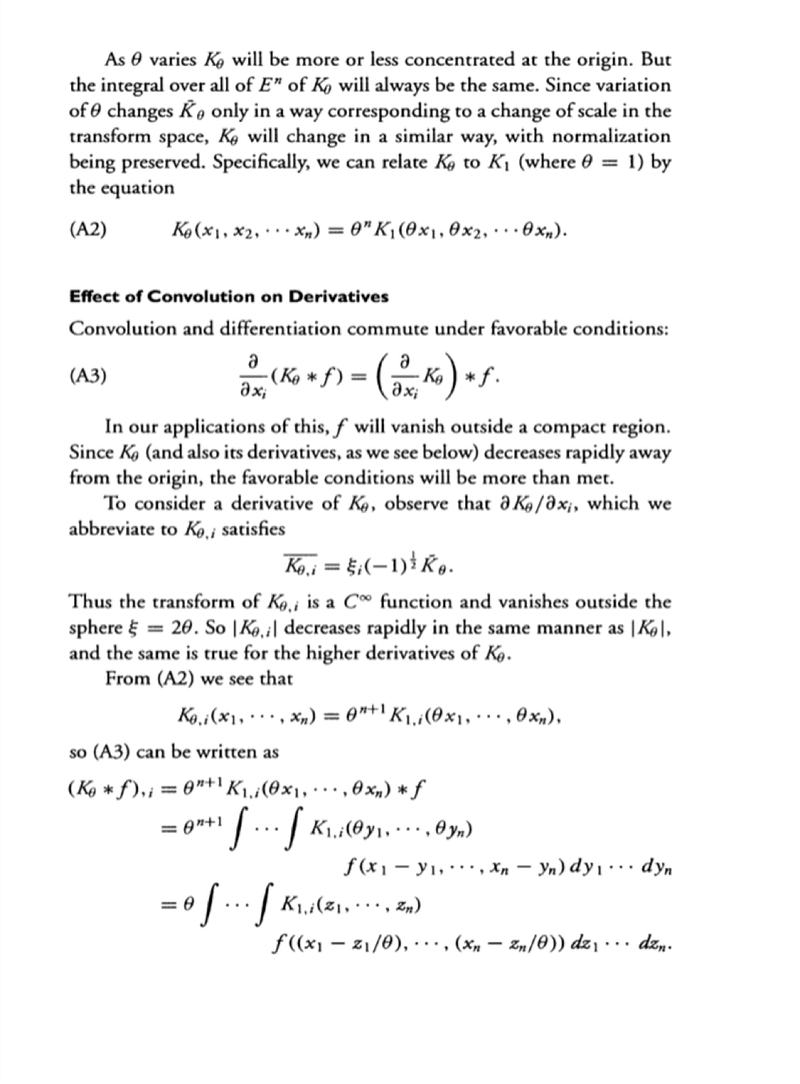
From Part A of Nash’s paper C¹-isometric imbeddings (Nash, 1954

Nash’s proof answers the question of whether it is possible “to embed any Riemannian manifold in a Euclidean space?”. On the one hand, this “deeply philosophical question” concerning the foundations of geometry had likely been one which every mathematician interested had asked himself (Nasar, 1998 p. 326). On the other hand, Nash’s proof provided an important and definitive answer to an open problem which most people, even most experts in the field, would have thought to be false. Unlike his work in game theory, the result established Nash as a first rate pure mathematician. As Mikhail Leonidovich Gromov would state:

“Nash was solving classical mathematical problems, difficult problems, something that nobody else was able to do, not even to imagine how to do it. … But what Nash discovered in the course of his constructions of isometric embeddings is far from ‘classical’ — it is something that brings about a dramatic alteration of our understanding of the basic logic of analysis and differential geometry. Judging from the classical perspective, what Nash has achieved in his papers is as impossible as the story of his life … [H]is work on isometric immersions … opened a new world of mathematics that stretches in front of our eyes in yet unknown directions and still waits to be explored”

Partial differential equations (1958)

The paper that would eventually lead to Nash being awarded the Abel Prize alongside Louis Nirenberg in 2015 is entitled Continuity of Solutions of Parabolic and Elliptic Equations (1958). The paper tackles nonlinear partial differential equations. Regarding its origins, Nirenberg recalled to Nasar (1998):

“I worked in partial differential equations. I also worked in geometry. The problem had to do with certain kinds of inequalities called elliptic partial differential equations. The problem had been around in the field for some time and a number of people had worked on it. Someone had obtained such estimates much earlier, in the 1930s in two dimensions. But the problem was open for [almost] thirty years in higher dimensions."
- Excerpt, "A Beautiful Mind" by Sylvia Nasar (1998)
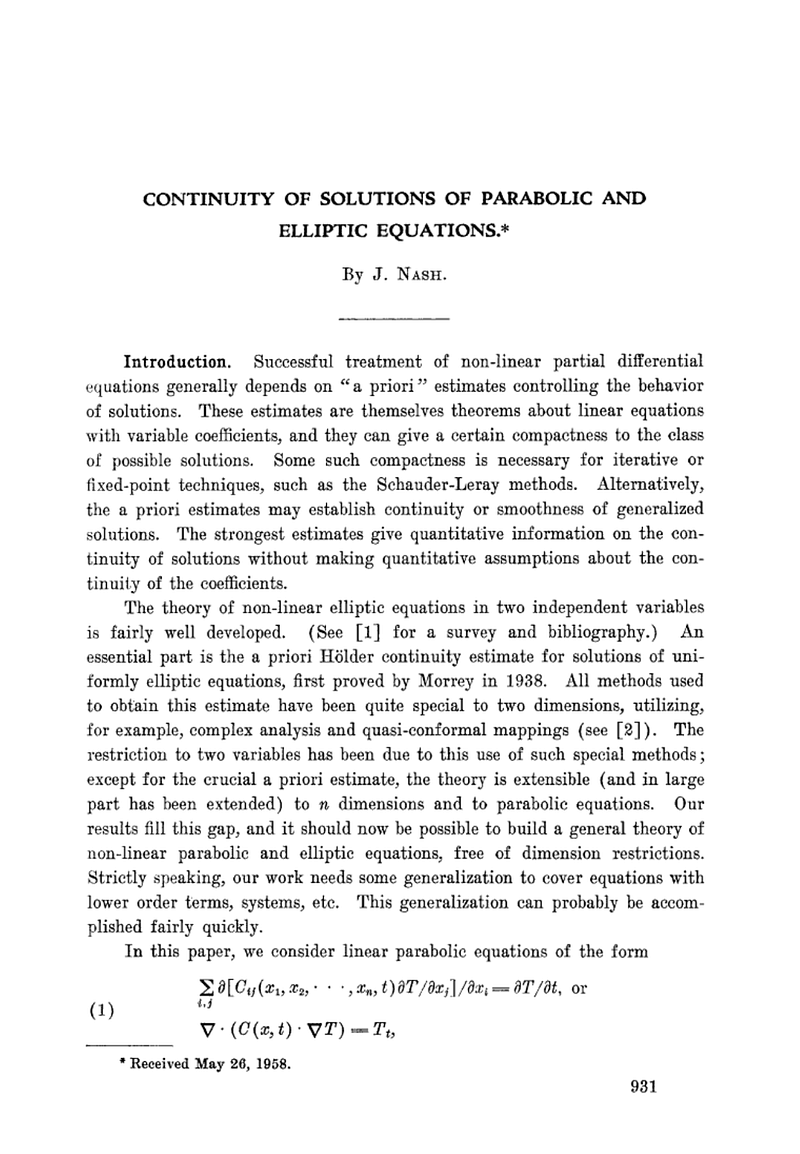
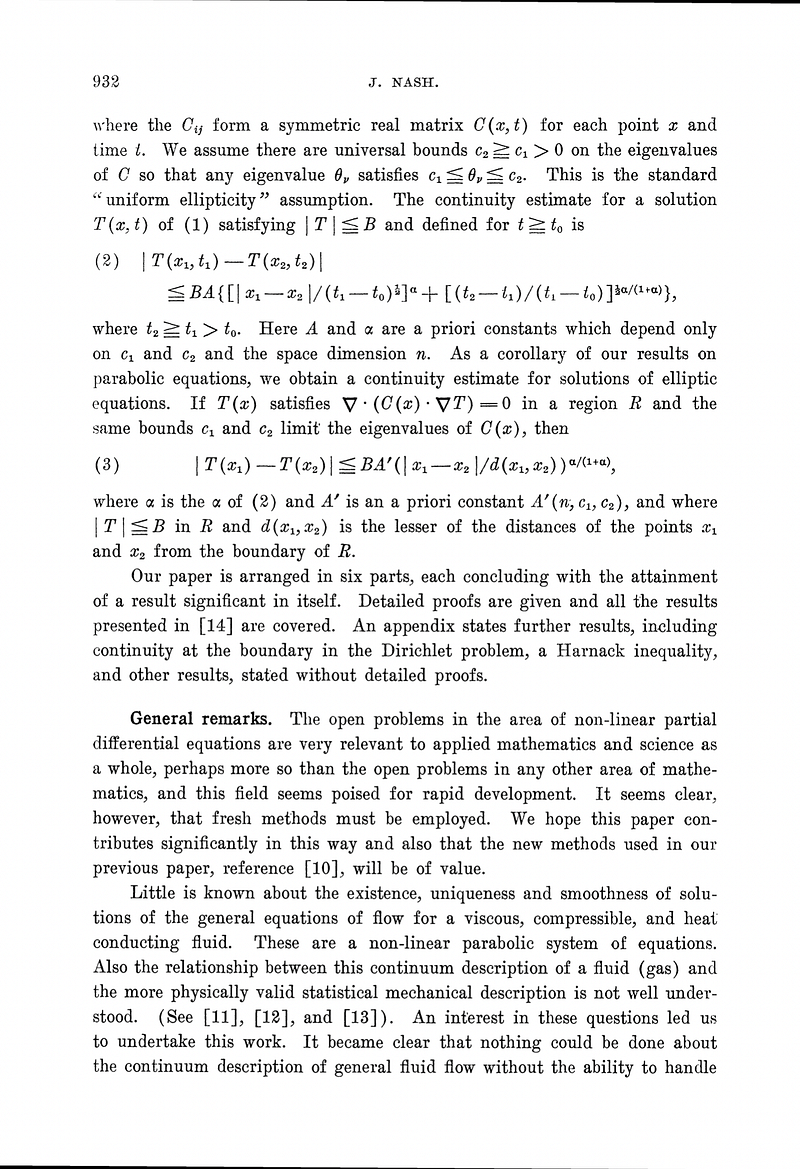
Nash, 1958. Continuity of Solutions of Parabolic and Elliptic Equations. American Journal of Mathematics 80(4). pp. 931–954.

Supposedly, Nash started working on the problem as soon as it was suggested by Nirenberg, although first ensuring himself of the importance of the problem by checking with colleagues. “For Nash, it had to be important in the opinion of others” (Nasar, 1998). The problem fit Nash’s criteria.

Mathematicians in the 1950s had known about relatively trivial routines for solving ordinary differential equations (ODEs) using computers. There were however, no established methods for solving nonlinear partial differential equations, such as those that occur during the turbulent motions of a jet engine. Nash himself wrote about the work:

“Little is known about the existence, uniqueness and smoothness of solutions of the general equations of flow for a viscous, compressible, and heat conducting fluid. These are a non-linear parabolic system of equations. An interest in these questions led us to undertake this work. It became clear that nothing could be done about the continuum description of general fluid flow without the ability to handle non-linear parabolic equations and that this in turn required an a priori estimate of continuity.”
- Excerpt, "A Beautiful Mind" by Sylvia Nasar (1998)

According to Nasar, it took Nash about six months to arrive at his theorem, which was achieved from a process of Nash visiting Nirenberg’s office weekly to discuss his progress. “It was weeks before Nirenberg got any real sense that Nash was getting anywhere” (Nasar, 1998). By the spring of 1958 however, Nash was able to obtain basic existence, uniqueness and continuity theorems using methods of his own invention. Astoundingly, the methods involved “transforming nonlinear equations into linear equations, and then attacking these by nonlinear means” — something nobody had thought of before, “a stroke of genius” according to Peter Lax, who followed his progress closely. About the technique, Lars Gårding, a Professor of Mathematics at the University of Lund and specialist in partial differential equations similarly later declared “You have to be a genius to do that”.
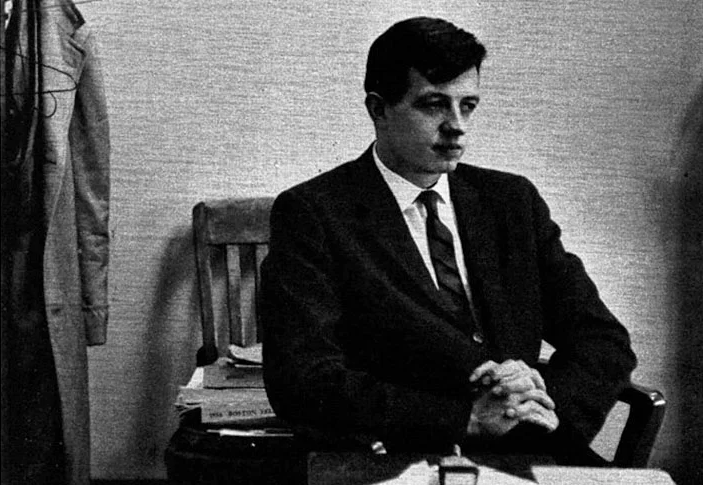
The photo of Nash used in Fortune Magazine, July 1958 (Photo: Robert Mottar)

Around the same time, Nash’s accomplishments indeed caught the attention of others as well. Fortune Magazine featured a story on the 30 year old in their July issue. The story was re-published on the magazine’s website after Nash’s death in 2015.

Marvin Minsky’s Ph.D. problem

“He was not a normal human being. He was pathologically logical.” — Marvin Minsky

Nasar fleetingly mentions Marvin Minsky’s presence at Princeton in the 1950s a few times in her book. In speaking with her, Minsky draws a parallel between the personalities of himself and Nash, stating “We shared a similarly cynical view of the world. We’d think of a mathematical reason for why something was the way it was. We thought of radical, mathematical solutions to social problems. At one point, Nash suggested a complete transfusion for something. If there was a problem, we were good at finding a really ridiculously extreme solution.”

According to Minsky himself, he was having trouble proving “what can be accomplished by loops of neurons that are arranged in circular pathways, so that if you put a certain pattern in it will sort of echo around and under some conditions, the information that you originally put into such a loop will be gradually destroyed and the pulses will be come equally spaced.

Following a brief moment of reflection, Nash provided him with the necessary solution. “Why don’t you expand that into a Fourier series?”.

“After a couple of hours I figured out what that would mean and I did it, and I proved this theorem.” — Marvin Minsky

Meeting Albert Einstein

Although strongly highlighted here and in most other narrations of Nash’s work, game theory barely scratched the surface of his interests in mathematics at Princeton. As such, Nasar writes that “it was a measure of Nash’ bravura and the power of his fantasy” that he was not merely satisfied to walk by Albert Einstein as he was commuting between his house and his office at The Institute for Advanced Study in Princeton. Nash actually once requested an audience with him (Nasar, 1998).

A fresh new graduate student at Princeton, Nash made an appointment “discuss an idea with Professor Einstein” in his office in Fuld Hall. As Nasar writes, he was ushered into the messy, large and airy room with a bay window by Einstein’s Hungarian assistant John Kemeny (the later inventor of BASIC). Nasar writes “Einstein’s handshake, which ended with a twist, was remarkably firm, and he showed Nash to a large wooden meeting table on the far side of the office”.

"As Einstein twirled the curls on the back of his head with his finger while sucking on a tobaccoless pipe, Nash matter-a-factly laid out his ideas about “gravity, friction and radiation”. The idea he had been thinking of revolved around the friction particles like photon experiences as it is moved through space by its fluctuating gravitational field interacting with other gravitational fields. Nash, Einstein and Kemeny discussed the topic for close to an hour, at the end of which Einstein ended concluding to the tall, broadshouldered 20-year-old that “You had better study some more physics, young man”
- Excerpt, "A Beautiful Mind" by Sylvia Nasar (1998)

At MIT

Following his graduation from Princeton, both Chicago University and the Massachusetts Institute of Technology (MIT) were interested in hiring Nash, then 23 years old. Nash chose the latter, beginning work as a C. L. E. Moore instructor in MIT’s math department in June of 1951.

Anecdotes about Nash as an instructor at MIT abound. According to Nasar, on one occasion Nash was confronted by a grader on one of his exams for putting the following problem on a test:

If you make up a bunch of fractions of pi 3.141592…. If you start from the decimal point, take the first digit, and place decimal point to the left, you get .1
Then take the next 2 digits .41
Then take the next 3 digits .592
And so on and so on.
You get a sequence of fractions between 0 and 1.
What are the limit points of this set of numbers?
- Excerpt, "A Beautiful Mind" by Sylvia Nasar (1998)

Apparently, the problem had never been solved before. Nash defended his doing so by stating “Maybe, if people didn’t realize that the problem was ‘hard,’ they could solve it” (Nasar, 1998).

Mental illness (1959–80s)

“These ideas came to me the same way my mathematical ideas did. So I believed them” — Nash

I resist the temptation many others have fallen to in their narrations of Nash’s life, namely to summarize it as a story about a highly intelligent paranoid schizophrenic. Illness aside, Nash was primarily a mathematician, a highly cited researcher and eventually both a Nobel Laureate and an Abel Prize recipient. However, in the interest of completeness, I will recount some anecdotes which may be of relevance to those interested in the properties of exceptional minds such as Nash’s.
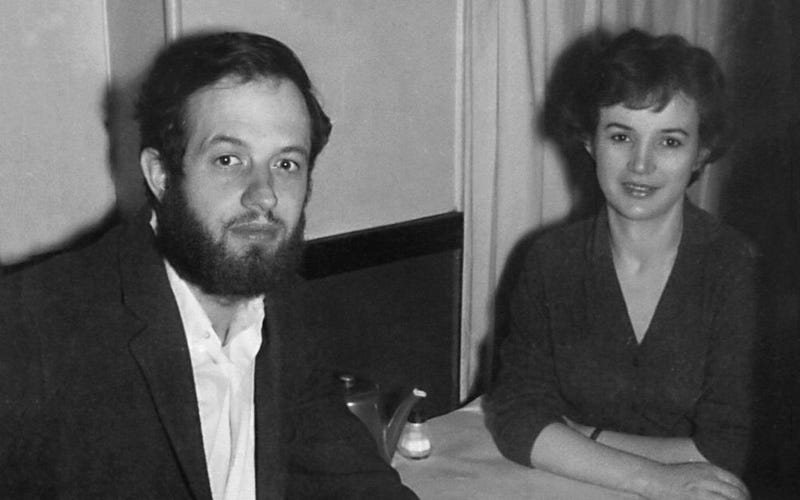
Nash and his wife Alicia Lardé Nash

Nash’s mental illness first manifested as paranoia. Alicia lated described his behavior as erratic. However, according to Nasar, despite many eccentric appearances in and around MIT’s math department, Nash’s mental difficulties did not immediately take notice among his peers. As Raoul Bott recalled, “his conversation always mixed mathematics and myth”. “In his game theory course, Nash behaved like his usual self, according to students who were in the class. […] He gave a midterm without announcing it in advance. He also paced a great deal and sometimes fell into reveries in the middle of lecturing or answering a student’s question.” As he walked across the Charles river with two TAs, “Nash embarked on a lengthy monologue that was difficult to follow. […] It concerned threats to world peace and calls for world government. Nash seemed to be […] hinting that he had been asked to play some extraordinary role” (Nasar, 1996).

The number theorist Atle Selberg recounted to Nasar about a seminar in Cambridge, where Nash was asking “some questions I thought were in a sense, to my way of thinking, somewhat inappropriate to the subject. He seemed to see something quite different than what I had intended…. [His] questions were formulated as if I had some hidden, not fully disclosed, agenda that he wanted to discover. The lecture was about the rigidity of several locally symmetric spaces. Nash was in the audience. He asked some questions that seemed to imply I had a hidden, secret motive. He suspected it had something to do with the Riemann Hypothesis, which of course it did not. I was rather taken aback. This was something that had nothing to do whatsoever [with the Riemann Hypothesis].”

Nash would be hospitalized for the first time in 1959. From Nasar’s interviews, she describes that the commitment was likely arranged by MIT’s psychiatric service, probably in consultation with the president of the university in conjunction with Martin and Levinson. In 1961, he was admitted to the New Jersey State Hospital at Trenton where he received both antipsychotic medications and insulin shock therapy. Over the next nine years, he would spend periods in and out of psychiatric hospitals, bouncing between periods of lucidity and paranoia. After 1970, he was never committed to a hospital again, and famously refused all medications for the rest of his life. According to Nash himself:

“After my return to the dream-like delusional hypotheses in the later 60s I became a person of delusionally influenced thinking but of relatively moderate behavior and thus tended to avoid hospitalization and the direct attention of psychiatrists.”

Nash’s view of his remission

“I don’t really remember the chronology very well, exactly when I moved from one type of thinking to another. I began arguing with the concept of the voices. And ultimately I began rejecting them and deciding not to listen”

Nash, by his own account and will, indeed stopped taking the medication he was prescribed sometime in the 1970s, stating “I began to realize that I would not be getting out of the hospital unless I conformed and behave normally, and so in part I would do that — as if I would be sweeping the delusions under a rug.” When asked how he got better, according to Kuhn, Nash said “I willed it.” implying that he chose to ignore his delusions and actively work to think rationally:

“Gradually I began to intellectually reject some of the delusionally influenced lines of thinking which had been characteristic of my orientation. This began, most recognizably, with the rejection of politically oriented thinking as essentially a hopeless waste of intellectual effort.”

By the 1980s, Nash was back in Princeton working on mathematics and auditing classes. During this period, he would become known as “The Phantom of Fine Hall”, a “shadowy figure who would scribble arcane equations of blakboards in the middle of the night” (Kwon, 2010).

The Nobel Prize (1994)

“Jubilant! We danced around our kitchen!” — Herta Newman

Several weeks before the 1994 Nobel prize in economics was announced on Oct. 11, two mathematicians — Harold W. Kuhn and John Forbes Nash Jr. — visited their old teacher, Albert W. Tucker, now almost 90 and bedridden, at Meadow Lakes, a nursing home near here. Mr. Nash hadn’t spoken with his mentor in several years. Their hour-long conversation, from which Mr. Kuhn excused himself, concerned number theory.

When Mr. Nash stepped out of the room, Mr. Kuhn returned to tell Mr. Tucker a stunning secret: Unbeknownst to Mr. Nash, the Royal Swedish Academy intended to grant Mr. Nash a Nobel Prize for work he had done as the old man’s student in 1949, work that turned out to have revolutionary implications for economics. The award was a miracle. — Nasar, 1994.

On the 11th of October 1994, Sveriges Riksbank Prize in Economic Sciences in Memory of Alfred Nobel announced that the 1994 Nobel Prize in Economics would be awarded to Dr. John Forbes Nash, Jr:

The Royal Swedish Academy of Sciences has decided to award the Bank of Sweden Prize in Economic Sciences in Memory of Alfred Nobel, 1994, jointly to:
Professor John C. Harsanyi, University of California, Berkeley
Dr. John F. Nash, Princeton University
Professor Reinhard Selten, Rheinische Friedrich-Wilhelms-Universität
For their pioneering analysis of equilibria in the theory of non-cooperative games.

The press release distinguishes non-cooperate game theory as separate from the pioneering early work of von Neumann and Morgenstern. About Nash’s research, the committee writes:

John F. Nash introduced the distinction between cooperative games, in which binding agreements can be made, and non-cooperative games, where binding agreements are not feasible. Nash developed an equilibrium concept for non-cooperative games that later came to be called Nash equilibrium.
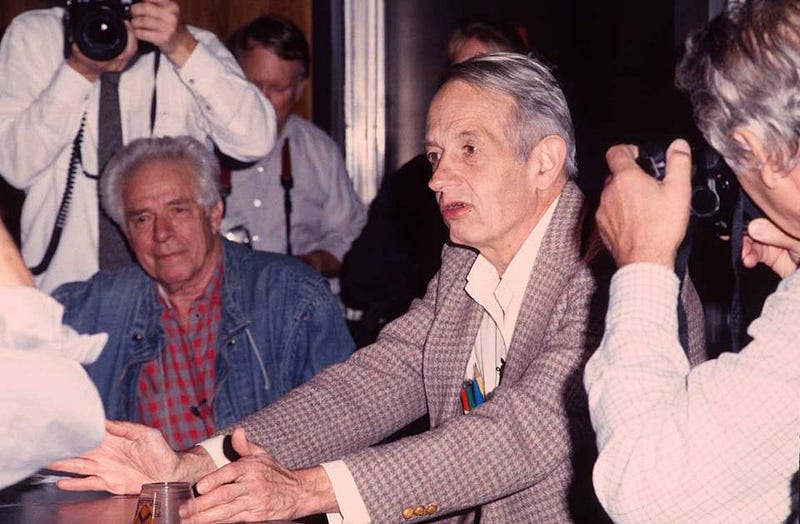
Harold Kuhn (left) and Nash (right) (Photo: Denise Applewhite, Office of Communications, Princeton University)

Later life (1980s–2015)

“He shined very brightly as a young man. Then he had his illness, and is now a very pleasant, accomplished gentleman. It feels right, somehow. “ — Erhan Cinlar (2002)

Personal life

Nash had a son with his first girlfriend, a nurse named Eleanor Stier (1921–2005) in 1953. The child was named John David Stier and was born on the 19th of June. While still a graduate student at Princeton, Nash met Alicia Lardé. The two married in February 1957 and had a son, John Charles Martin Nash, who later earned a Ph.D. in mathematics from Rutgers University, is a chess Grand Master and also suffers from schizophrenia. In the midst of his illness, Alicia divorced him in 1963 but they continued living together. They re-married 38 years later, in 2001.

A Beautiful Mind

Much of the credit for the recognition and documentation of Nash’s life and career (and indeed this essay) goes to his biographer Sylvia Nasar. Her book A Beautiful Mind was released in 1998, became a New York Times Best Seller and in the same year won the National Book Critics Circle award for biography and was a finalist for the Pulitzer Prize.

An adaptation of the book was later written by Akiva Goldsman. The movie — directed by Ron Howard starring Russell Crowe as Nash — was released in 2001. It went on to gross over $313 million worldwide and won four academy awards, including for Best Picture, Best Director and Best Adapted Screenplay.
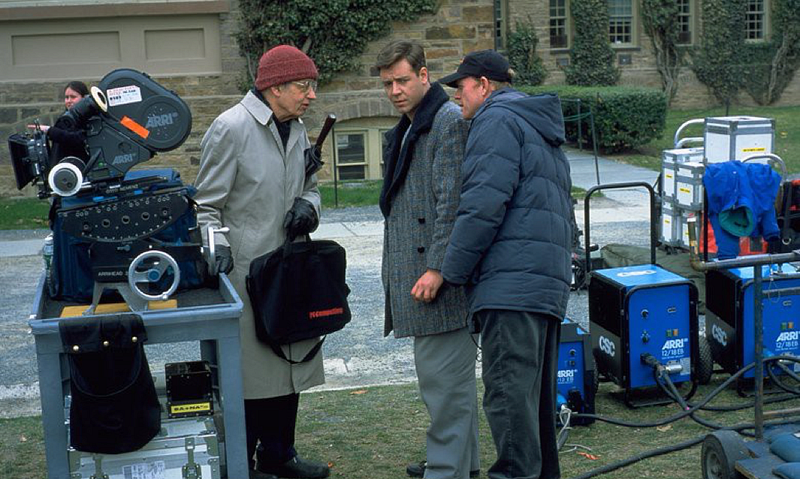
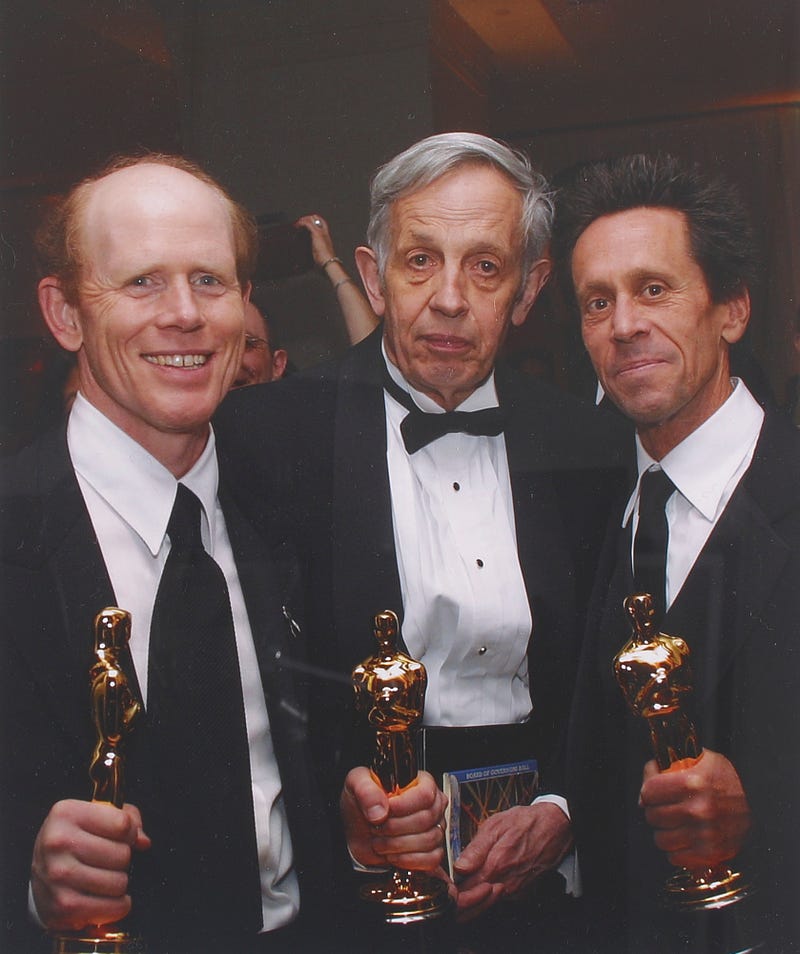
Left: John F. Nash, Jr. with actor Russell Crowe and director Ron Howard on the set of “A Beautiful Mind” (Photo: Robert P. Matthews). Right: Ron Howard, John F. Nash, Jr. and Brian Grazer at the 2002 Academy Awards (Photo: unknown).

Ron Howard thanked Nash and Alicia both during his Academy Awards acceptance speech. Upon release of the film, Nash’s biographer Sylvia Nasar appeared on the Charlie Rose Show to recount Nash’s story in a segment entitled Schizophrenia and Genius.
John Forbes Nash, Jr. with Mike Wallace and Peter Klein from 60 minutes (Photo: Aaron Tomlinson/60 Minutes)

Around the time of the release of the movie, a segment about Nash was also featured on CBS’ 60 Minutes. An essay about the segment was published following Nash’s death in 2015. Also around the same time as the release of the movie, Nash’s longtime friend and fellow Princeton mathematician Harold W. Kuhn co-edited a biography of Nash’s life in 2002 entitled The Essential John Nash.

The Abel Prize

On the 25th of March 2015, the Norwegian Academy of Sciences and Letters announced that the 2015 Abel Prize was to be awarded to John Nash and Louis Nirenberg for their “striking and seminal contributions to the theory of nonlinear partial differential equations and its applications to geometric analysis.”
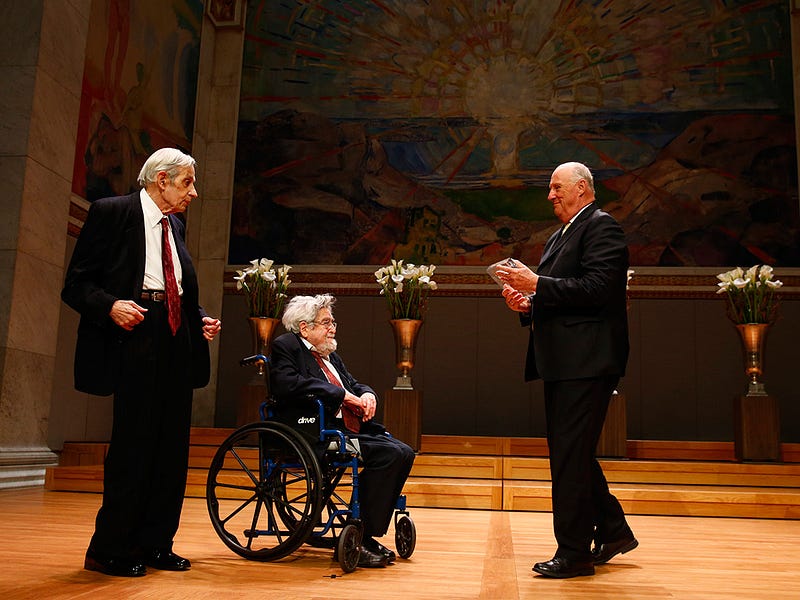
John F. Nash Jr. and Louis Nirenburg receiving their Abel Prizes from King Harald V of Norway. (Photo: The Royal House of Norway).

While visiting Oslo to receive the award Nash requested to meet world chess Champion Magnus Carlsen, which he did.

“There was a paradox of resemblance between the two persons.. I did not expect to meet Justin Bieber” — Nash

Death and Beyond (2015)

John and Alicia were killed in a car crash on the 23rd of May 2015. They were traveling back from Newark airport to Princeton after their trip to Oslo where Nash received his Abel Prize. According to New Jersey State Police, the taxi they were riding in was traveling southbound in the left lane on the New Jersey Turnpike when the driver lost control while trying to pass another vehicle. The taxi crashed into the guardrail and then into another car in the right lane (USA Today, 2015). Neither John, nor Alicia were wearing seatbelts.

Press release from Princeton University.

Nash’s Nobel medal

On the 30th of August 2016 it was made public that one of Nash’s surviving sons, John Stier, was putting Nash’s Nobel Medal up for auction at Sotheby’s. The medal did not sell. However, the medal was later sold by Christies for $735,000 in part to benefit the John C. M. Nash Trust.
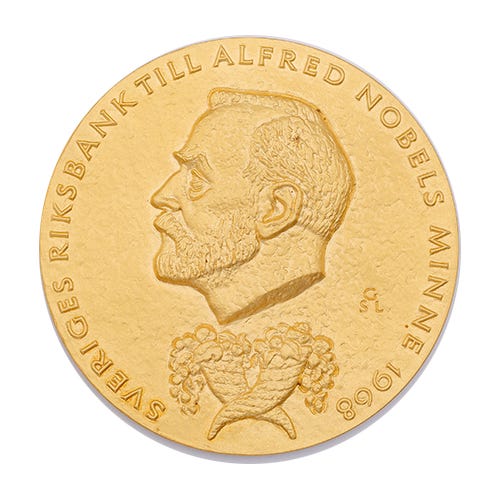
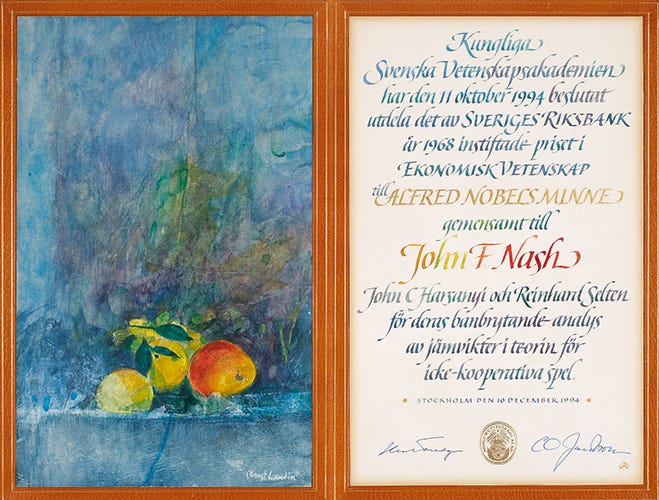
(Photos: Sotheby’s)

Open Problems in Mathematics

Nash and Rassias (2016): “Open Problems in Mathematics”. (Photo: Springer)

In his later years, Nash co-edited a book of essays on the current status of the solutions to some of the most essential open problems in pure mathematics with Michael Th. Rassias. The book is entitled Open Problems in Mathematics.

Unfortunately, Nash did not live to see the publication of the book, which was published in 2016.

Unpublished Works

Nash published notes, scans and photographs from his work, trips and lectures on his personal website at Princeton. It is still accessible here.

Science
Research
Economics
A Beautiful Mind
Mathematics
Recommended from ReadMedium