The Beat: History as I Remember It
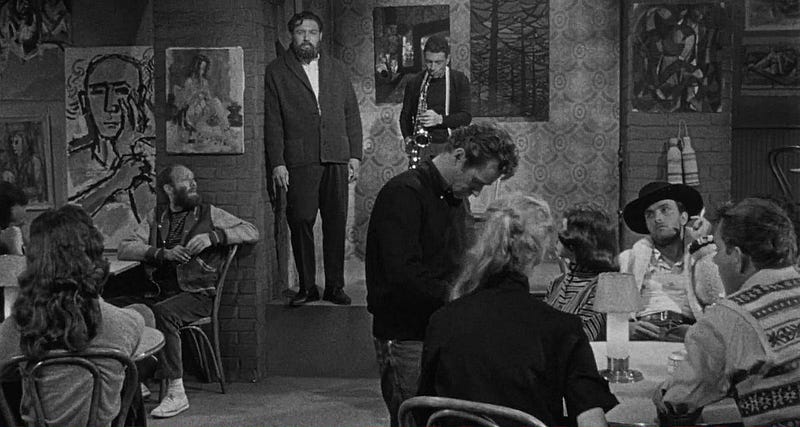
Image: Wikimedia Commons: https://movie-screencaps.com/a-bucket-of-blood-1959/#foobox-1/37/bucketblood-movie-screencaps.com-38.jpg

In my early days in my new home city, I dropped into the Genesis Women’s Shelter Thrift Store to look for an eight-dollar pair of jeans that fit my meager budget and a thirty-three-inch waist size in short supply even in department and specialty stores at four times the cost. They were as rare as Prada fashions in thrift stores. But there they were, hanging not at their place on the rack, but on a hook extending from the front of the display, where I could not miss them.
In the book room at the rear of the store (“room” an exercise in hyperbole, more a closet), I discovered an English-language translation of Nikolai Gogol: The Government Inspector and Selected Stories from a Soviet Union press.
Ecstatic with my finds, I celebrated, undeterred that my depleted funds- first drained by incompetent bankers, and again by business executives paid exorbitant compensations for their bungling performances, and yet again by tax increases required to bail the rich out of their troubles- all of which made a two-dollar cup of coffee the stuff of dreams.
I took that dream to the Café Brazil on Cedar Springs Street, a remnant of a once-thriving bohemian sub-culture in Dallas. I read Gogol while I sipped a bottomless cup of strong, black Indonesian coffee and discreetly monitored the shop’s eclectic clientele.
Dallas took pride in its self-proclaimed title, “most conservative city.” That distinction remained unchallenged until the presidential and congressional elections that swept Richard Nixon into the White House. Then, the city’s liberal underbelly showed itself. The effect of the city’s turn from political conservatism and the preceding economic meltdown combined to revive a long-dormant street life. Crowds gathered at bus stops. The mid-afternoon hours, once the bane of shopkeepers, then competed with the lunch hour for business as unemployed workers surged into coffee shops, taverns, and bookstores as they made daily job-hunting rounds. The public rediscovered public libraries to aid in their pursuit. Business wear gave way to street casual and the bohemian look was fashionable again, after a thirty-year absence.
A Stretch of the Oaklawn area formed the youth movement life in the waning days of the counterculture. Each night, hippies, gypsies, beats, rockers, bikers, and boho wannabees gathered under the Esquire Theater’s giant neon artist’s palette to trade street intel, plan their evening, and rage against the machine. Across the street a hi-fi shop blasted rock music onto the street. Clean shaven police officers cruised the street, glared at the rabble, and dared the crowd into a stare-down. Anyone so unwise as to accept the challenge found themselves rousted and often cuffed and driven to the city jail. Most of the street-hardened Left ignored the police presence. “Flies at a picnic,” they commented if the subject came up.
From the pulsing corner at the Esquire the crowd migrated to nightspots that dotted the area. Music poured from open doors and outdoor speakers: traditional blues, rock, ensemble, folk and a new form of jazz that employed odd- numbered harmonics and orchestrated riffs. For the financially strapped, nearby Lee Park offered its lawn where mimes and street musicians performed. Dealers hidden behind the equestrian statue of Robert E. Lee dealt pot, LSD, and psilocybin. For quick cash, a blood bank on Oaklawn Avenue offered cold cash for a pint of blood.
Within easy walking distance, the Highland Park and Turtle Creek homes flew the Stars ‘n Stripes scaled to the mansions that lined the streets. Homeowners erected billboards and yard signs that proclaimed America’s divine right to rule Southeast Asia, the world, the Unwashed Left.
Billboards and right-wing slogans didn’t undo the left. It unraveled. When enraged students at Kent State demonstrated against America’s expansion of the Viet Nam war into Laos and Cambodia, federal troops massacred the protesters. After the slaughter, the Left frayed at the edges. Some chose to refrain from testing the government’s massive firepower. Some- steeped in passive resistance taught by Martin Luther King, Mahatma Gandhi, and Jesus of Nazareth- withdrew from their militant comrades. A new voice arose from the radical left, a voice calling for armed insurrection and active resistance through sabotage.
The conservative Right adopted the Left’s tactics and to unite against the threat to “American Values.” The Young Republicans succeeded in hijacking the Youth Movement. They matched, decibel for decibel, the Left’s angry rhetoric. Roaming gangs from the city’s affluent suburbs invaded bohemian haunts. They picked fights with “pinkos,” “rolled queers,” and vandalized vehicles and facilities displaying “hippie” symbols and bumper stickers. The passive-resistance crowd fled to South Dallas and working-class suburbs where denim and leather fit in and the citizenry was toopreoccupied with staving off eviction and foreclosure to concern themselves with partisan politics. Activism did not put food on the table. The Beats withdrew into their books. Bikers joined the reactionary Right, and wannabees renewed their enthusiasm for MBA degrees. Revolutionaries and anarchists remained to fight for their turf but were increasingly outnumbered until they too withdrew from the fight and dispersed to Lower Greenville Avenue, Little Forest Hills, and Deep Ellum enclaves.
Gays moved into the abandoned and decaying Cedar Springs businesses and transformed them into funky boutiques, eateries, and gay bars. The city erased all evidence of Oaklawn’s bohemian past and replaced it with trendy restaurants, office towers, and high-rise condominiums. Developers scraped clean the music venues along Lemmon Avenue to make room for automobile dealers, fast food restaurants, and banks. The Esquire became a weed-strewn vacant lot that lay fallow for decades until an entrepreneur built a European-style market for young professionals that flooded into the city from points east and north.
Sitting in the Brazil Café with Gogol, shortly after the collapse of the economy, I saw the occasional new bohemian: scouts in advance of an invading force, eager to join in the see-saw game of American partisan politics. They recognized each other and nodded without speaking. They were fellow subversives on the same mission They knew what to do. Discussion was unnecessary. Watching them, I wondered: from where will the new Left emerge? I returned to reading Gogol and answered my own question. I bet it would come from the same source that has historically given birth to new thought: the literati. My money was on the Beats.