
The Beacon of Earth in Space
I’m shocked that crashing it for the sake of politics is an option!
The war in Ukraine is stretching into more and more countries. The first fugitives have arrived here in Germany.
Whatever the motivation for starting it may have been, it doesn’t make sense and it has to stop.
Now.
The war has also started reaching vertically, into space!
Broken cooperations
The European Space Agency (ESA) has declared it wants to comply with all EU sanctions against the Russian Federation and will therefore critically review all joint projects to determine if and how they can be continued under these circumstances.
This means that a Mars Rover that’s been in the works for a decade will most probably not lift off this fall.
87 Russian specialists had to stop their work at the European spaceport in French Guiana and go home. They prepared a Soyuz rocket for launching navigation satellites into Earth orbit.
Now, ESA wants to put the satellites on their own Ariane and Vega rockets.
Thierry Breton, EU commissioner for space, said they will “continue to develop Ariane 6 and Vega C to ensure Europe’s strategic autonomy in the area of launchers.”
Autonomy is the word that startled me here.
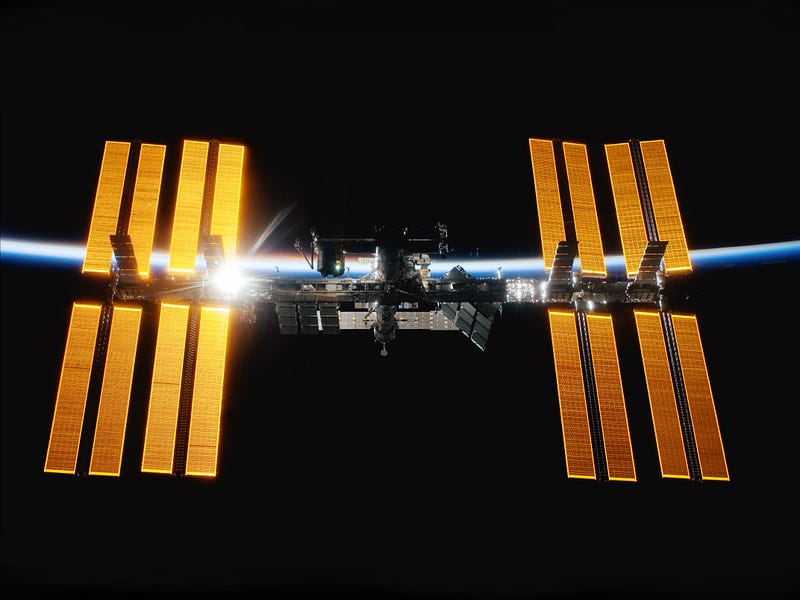
ISS a cue ball of politics
Dmitri Rogozin, head of the Russian space authority Roscosmos, even wrote on Twitter, that if there were intentions to destroy Russian space flight,
the world might have to consider the possibility of the International Space Station crashing down on Earth uncontrolledly, maybe even in a populated area.
What he probably alluded to is the fact that Russian-built ISS modules have their own thrusters which are used for course corrections or to avoid collisions. And if those were to be removed from the station, the ISS would sink lower and lower and eventually crash somewhere on Earth.
Elon Musk (who by birthright holds Canadian and South African citizenship and wasn’t awarded U. S. citizenship until 2002) of course offered to come to the rescue with his space flight company SpaceX.
I’m just shocked that letting ISS crash is even an option!
That more lives are risked than are endangered already because of the war in Ukraine!
And I don’t care if it was meant as a threat, theory or terrible joke. I believe there’s an element of truth to everything and actively putting human lives at stake is never an option.
Just don’t
The International Space Station sometimes seems to be that one place where humanity always prevails.
Where cooperation and teamwork matter the most.
Where borders in our minds melt away for the sake of making things work.
Where top-notch microgravity research is being conducted that has triggered so many innovations for us on Earth.
Former CSA and NASA astronaut Chris Hadfield once listed the nationalities of people that he’s worked with. He concluded by saying that it didn’t matter, he served with people from Earth.
Current astronaut-in-residence on the ISS Mathias Maurer was asked by children with heart problems what he does up there to help with some of their illnesses.
These are the things that matter!
And we as a species can only continue to explore humankind, Earth and space if we continue to work together, live together, dream together!
Sources


