
Books | Sacred Text
The Battlefield In The Bhagavad Gita
An Ancient Game of Thrones
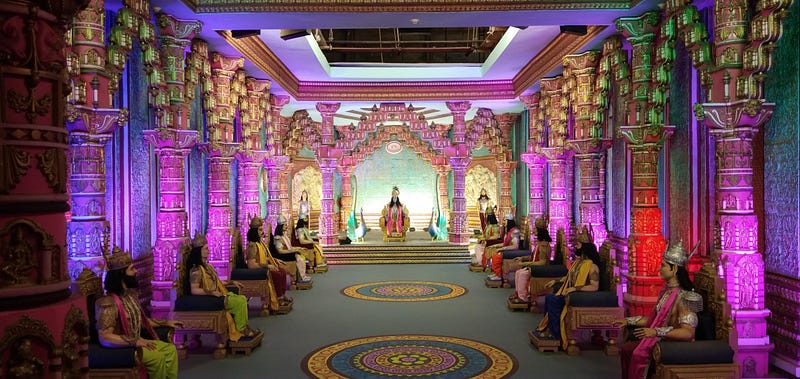
The Bhagavad Gita is a story about a family at war.
The Gita, or “The Song of the Lord” is part of a larger epic text called the Mahabharata. It was written between 400BCE — 200CE. Each of the 18 chapters focuses on the teachings of Krishna, a divine god.
Two groups of cousins (Pandavas and Dhritarashas) are competing for the family throne. Arjuna leads the Pandavas. He’s a member of the ruler and warrior caste.
Both sides are gathering on the battlefield, preparing to fight.
Arjuna rides onto the field in his chariot where he sees friends and family in the army on the other side.
He has a crisis of confidence and decides he can’t fight.
He feels that winning this game of thrones isn’t worth killing people he loves, so he decides to withdraw from the battle. He tells his driver to stop the chariot.
Arjuna has a long conversation with his chariot driver, who speaks in the voice of Krishna, a divine god.
Krishna argues that Arjuna must stay and perform his sacred duty (dharma) as a warrior-king.
He makes the following points as to why Arjuna must fight.
1. Atman (self) is eternal, so no one can actually kill another person. The person just moves to the next life in samsara, the cycle of life and death.
2. Life is an illusion, so Arjuna’s concern about killing his relatives is misplaced. If he kills anyone, they aren't destroyed. Instead, they move on to the next phase of their existence.
3. When a person acts to serve the divine gods, they can clear their past negative karma. This eventually leads to enlightenment and an end to the cycle of samsara. If they act selfishly, they move further and further into karmic debt.
4. As a warrior, it is Arjuna’s duty to fight. It’s his dharma and it’s a sin not to fulfill his life’s sacred duty. If he follows his duty, he will avoid negative karma.
5. Not choosing is still a choice. His inaction is a choice to ignore his duty. The ideal way is not inaction, but the release of desire for the fruits of his action.
6. The source of evil is not in our actions but in our desires, our intention, and our attachments.
Krishna then reveals a basic Hindu doctrine revealing different ways (yogas) to act in devotion to the divine. He tells us that an individual should make choices depending on what type of spiritual person they are.
Individuals should act according to their nature.
Here are four different disciplines identified in the Gita.
a. Bhakti yoga (devotional or emotional nature). Loving the divine is a way to draw closer to him. The goal is the pure love of the divine for love's sake alone.
b. Karma yoga (action or a serving nature). Being of service to the divine is a way to draw closer to him. By working in service, or working in a detached way, you remove yourself from the outcome of the work. The goal is to perform an action without thought for self, which lightens the ego.
c. Raja yoga (meditation or a mystical, experimental nature). Knowing the divine through physical and mental control is a way to draw closer to him. The goal is to achieve direct personal experience of the deepest level of the Being that exists within you.
d. Jnana yoga (knowledge or an intellectual nature). This yoga requires reflection, the love of the divine, and the strength of body and mind. The goal is to distinguish between the surface self and the self that endures beyond this body and lifetime.
Your dharma is your true duty which should be followed in your own way.
No matter which yoga you choose, the proper way is to act without attachment to the outcome or fruits of your action.
“It is in a total state of involvement that one finds liberation from time.” ― Barbara Stoler Miller (translator)
Back to the battlefield.
Arjuna doesn’t want to do his duty but realizes that he can’t escape it by not acting.
He must devote himself to Krishna and when he does that he will be acting for the divine, not for himself. He has to be disciplined in order to reach liberation and discipline requires him to make a choice. He weighs his options and decides to go into battle.
His duty is to serve and protect his subjects so he fights and wins the throne for the Pandavas.
Krishna also gives the reader guidance to use when considering philosophical questions about the nature of the divine, the role of man, and the meaning of life.
He uses the battlefield as a metaphor for the struggle within our minds.
He describes ways to discover and understand our desires and attachments so that we can use action and dharma to move away from them. Each person has to make his own decisions about how he will live his life.
The words in The Bhagavad Gita remind us that change is inevitable and whatever happens will happen.
We came here with nothing and will leave this world with nothing; in the meantime, all is an illusion.
Remaining detached from the fruits of our actions is the way to perform our duty in this life.
The Gita has been read and used as a spiritual guide and a source of inspiration for many people, some of them as famous as:
Gandhi -He adopted social change through nonviolence as a method to overthrow the British occupation of India,
Thoreau -He wrote that every morning he read and was inspired by the words in The Gita,
Oppenheimer -It surprised me to read of his devotion to the Gita. Perhaps he related to Arjuna and the concept that many would perish in the war, whether he participated or not. He acted according to his duty. As a physicist, his dharma was to create the atomic bomb.
Carl Jung -He is said to have been influenced by the concept of individual differences described in The Gita when shaping his theory of personality types.
Each of these individuals took something unique from The Gita. That’s consistent with the belief that each person must make their own decision about how they live their lives.
There is no ‘correct’ way to act, only a person’s dharma and their choices.
As I read more of The Gita, I realize it can help us learn to integrate spiritual values into our everyday lives even when we aren’t a monk or ascetic.
If we act with the inner peace of the divine in our thoughts, rather than the attachment of the fruits of our actions, we can achieve the balance that Krishna describes.
This book provides spiritual direction that is as relevant today as it was when it was first written, as we strive to become better individuals in the world.
For any book written in another language, the viewpoint and skill set of the translator is an important piece of the puzzle. They act as a gatekeeper to the information.
My copy of the Bhagavad Gita was translated by Barbara Stoler Miller in 1986 and includes an introduction by Huston Smith. Miller was born in 1940 and holds a doctorate in Sanskrit and Indic Studies from the University of Pennsylvania. She has successfully translated many Sanskrit poems and plays and has received many awards and grants.
This post contains an affiliate link. If you use this link to buy something, I may earn a commission. Thanks.
This was originally researched and written as an assignment for Liberal Studies at North Island College, Canada.