
Maybe The Asteroid Alone Didn’t Cause The Massive Dinosaur Extinction
And the lessons this can bring to today’s climate crisis
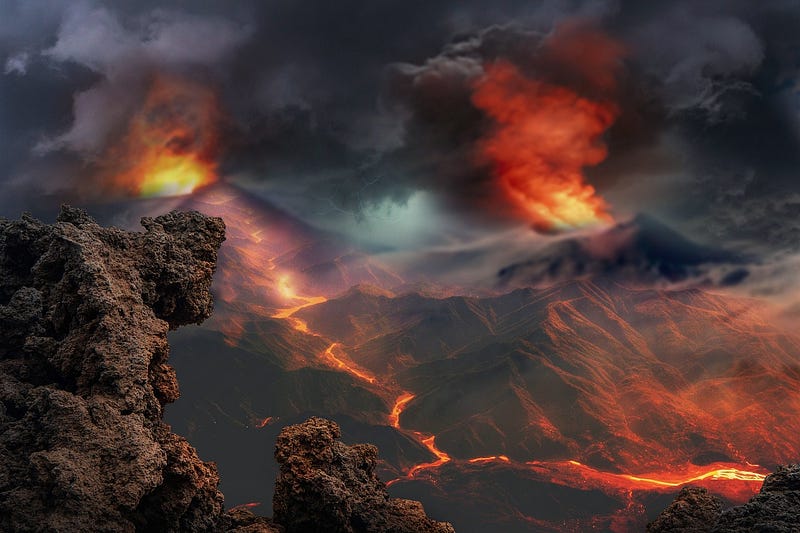
When you imagine the cataclysmic downfall of the dinosaurs, two inevitable scenes come to mind: first, a massive asteroid hurtling across the sky and crashing against our planet; then, the consequential chaos with volcanoes erupting in fiery display.
That is the conventional story associated with the downfall of dinosaurs.
However, recent geological evidence suggests that the dinosaurs were already grappling with extreme climatic shifts before the asteroid’s impact from relentless volcanic activity.
It may be time to rewrite those childhood dinosaur-dooming memories.
A Battle of Cosmic and Terrestrial Forces
The extinction event that wiped out the dinosaurs, known as the Cretaceous-Paleogene (K-Pg) extinction, has fascinated scientists and the general public for decades. The conventional narrative points to a 6-mile-wide asteroid that crashed into the Yucatán Peninsula 66 million years ago, creating the Chicxulub crater in present-day Mexico as the primary cause. This cataclysmic event led to massive fires, tsunamis, and a “nuclear winter” effect due to debris and dust thrown into the atmosphere, blocking sunlight and causing a dramatic temperature drop. Consequently, this disrupted ecosystems and ultimately spelled doom for the dinosaurs and other species.
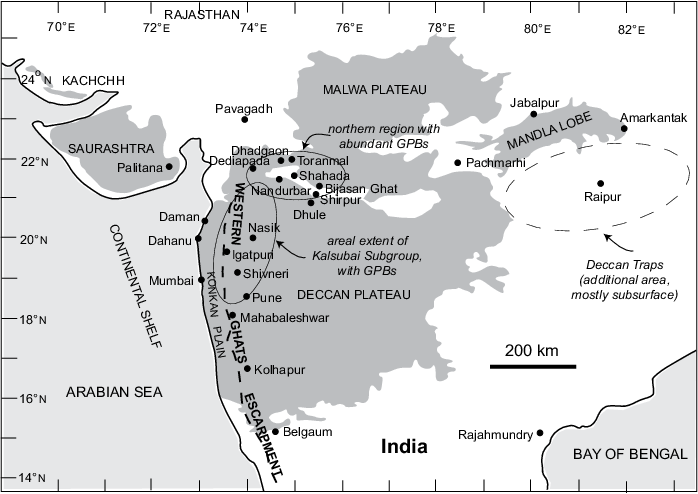
Yet, a mounting body of evidence has suggested that volcanic activity in the Deccan Traps of India might have played a significant role in the dinosaurs’ decline. This alternative theory suggests that vast volcanic eruptions occurred 300,000 years before the asteroid struck and for another 500,000 years after that, releasing colossal clouds of carbon dioxide and sulfur dioxide into the atmosphere. These gases led to climate fluctuations, including warming and cooling effects, adversely affecting the environment and biodiversity.
“Our findings specifically lend credence to the idea that volcanism was disturbing the atmosphere and the climate way before the asteroid,” says Dartmouth College computational geologist Alexander Cox, lead author of the paper in Science. “You can actually recreate the environmental conditions that could cause a dinosaur extinction solely by volcanism, as if the asteroid weren’t there. But of course, we can’t discount the fact that the asteroid definitely didn’t cheer up the dinosaurs.”
The Deccan Traps: Earth’s Geological Giants
The flood basalt province known as the Deccan Traps (derived from the Sanskrit दक्षिण word dakṣiṇa meaning “southern” and the Swedish word “trappa” for its stair-like formations) is located on the Deccan Plateau in west-central India and southernmost Pakistan. It is one of the largest volcanic provinces in the world, consisting of more than 2,000 m-thick succession of flat-lying basalt lava flows and covers an area of nearly 500,000 km2.
A Tale of Two Gases: CO2 and SO2
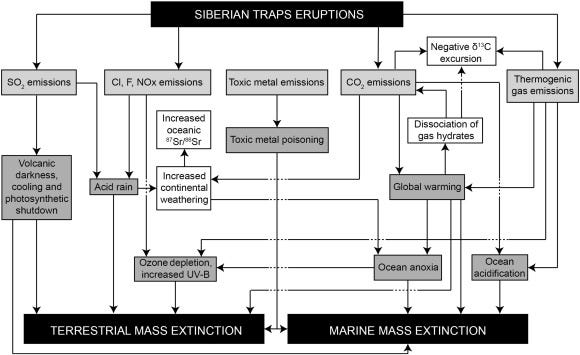
Over nearly a million years, this volcanic region erupted, spewing an estimated million cubic kilometers of lava and 10.4 trillion tons of CO₂, and 9.3 trillion tons of sulfur dioxide (SO₂) into the atmosphere. Our human-induced emissions since the beginning of the 21st century amount to 16 billion tons of CO₂ per year, roughly 100 times more than the Deccan Traps’ rate — yeah, good for us and the environment. However, the prolonged nature of these eruptions ensured a consistent release of planet-warming gases, albeit at a slower pace. The resulting rise in greenhouse gases, particularly CO₂, caused a warming effect on the climate. At the same time, sulfur dioxide had an opposing cooling effect by reflecting solar radiation back into space.
The geological evidence indicates that these gases were not released in equal proportions. This uneven release led to a climatic seesaw effect, with significant temperature fluctuations over time.
Acid Rain, Ocean Acidification, and the Carbon Cycle Disruption
The Deccan Traps’ volcanic activity had far-reaching consequences. The emissions from these volcanoes led to the formation of acid rain and ocean acidification, disrupting the delicate balance of the carbon cycle. Creatures like foraminifera, constructing their shells from carbon, struggled to survive in increasingly acidic oceans. This disturbance further cascaded through the ecosystem, extinguishing plants, then the herbivores that fed on them, and then the carnivores that fed on herbivores, contributing to the mass extinction event.
A New Method Where Machines Decide
The study sought to evaluate the extinction question without predefined hypotheses. Through machine learning techniques, Using 128 computer processors, it adjusted CO2 and SO2 levels to recreate the observed data, efficiently narrowing down possible scenarios. By analyzing vast geological and climate data, and reversing the traditional model approach, they worked towards identifying the cause of the extinction. It utilized a form of machine learning, Markov Chain Monte Carlo, to compare, revise, and recalculate conclusions independently until reaching a scenario aligned with the fossil record.
“Instead of working from this geological record, the new model worked toward it. It ran 300,000 scenarios of how different levels of CO₂ and SO₂ might together produce a climate that matches the objective data from the shell fossil record,” adds Alexander Cox.
Unveiling the Past: Fossil Shells as Climate Witnesses
Unveiling the mysteries of the past is challenging for scientists studying ancient climates. However, they have a remarkable tool: the named foraminifera, tiny oceanic organisms that constructed calcium carbonate shells. By analyzing the isotopic composition of these ancient shells, scientists can deduce the levels of atmospheric carbon and ocean temperatures from millions of years ago.
This approach offers invaluable insights into the conditions prevailing during the time of the dinosaurs. It helps in understanding the role of volcanic activity in shaping the Earth’s climate during that era. And they provided a glimpse into the catastrophic conditions during the K–Pg extinction.
The One-Two Punch: Asteroid and Volcanic Chaos
The prevailing theories are aligning, though, thanks to compelling fossil evidence that paints a unique, one-two punch in Earth’s timeline: the asteroid collided with a planet already battered by the colossal, and highly destructive, eruptions of volcanoes in India’s Deccan Traps. To make things worse, it slammed into a sulfur-rich part of Earth. Its impact unleashed massive energy and may have induced more volcanic activity. The shock might have jolted the volcanoes’ plumbing, causing eruptions. Like the asteroid being the Mentos to a soda. This interaction between extraterrestrial impact and terrestrial volcanism adds a layer of complexity to understanding the dynamics of the extinction event.
The model showed a significant decline in the buildup of natural carbon in the deep ocean during the Chicxulub impact. This decline is likely linked to the asteroid, which led to the extinction of many plant and animal species. During the same period, there’s evidence of a temperature drop. This drop is attributed to the immense sulfur content in the region where the asteroid collided with Earth, acting as a short-term cooling factor.
The asteroid impact probably released both carbon and sulfur dioxide into the atmosphere. Surprisingly, the model indicated no sharp increase in releasing these gases during that time, challenging the notion that gas emissions from the asteroid were a primary factor in the extinction event.
“The beauty of what these folks have done is that they can feed it really objective data that nobody would dispute, and come up with some surprisingly detailed inferences,” says geologist Paul Renne, director of the Berkeley Geochronology Center, who studies volcanoes and mass extinctions but wasn’t involved in the paper. One of those inferences, he says, is “that the carbon dioxide and the sulfur outputs are decoupled, which is something that I’ve been arguing for a long time.”
However, some scientists remain steadfast in attributing the prominent role to the asteroid, emphasizing the sudden darkness it caused, which blocked out the sun for years.
An asteroid also causes a distinctly different climate trauma than a slow gas leak. “In the opinion of many of us, the major kill mechanism — if you will — from the impact would have been darkness, not cooling,” says Curator of Geology Peter Roopnarine. “You would have enough material injected into the atmosphere that it would have blotted out the sun up to, let’s say, 10 years or so.”
An Extinction That May Bring Perspective For Today’s Climate Reality
The understanding of the dinosaurs’ extinction is evolving beyond a simplistic “volcanoes vs. asteroid” framework. There is an increasing acknowledgment of the potential combined effects of volcanic activity and asteroid impact.
In this evolving understanding of Earth’s history, researchers are piecing together the complex interactions between these cataclysmic events. Rather than a straightforward dichotomy of a single cause, the reality may lie in a complex interplay of cosmic and terrestrial forces, each contributing to the calamity that befell the ancient world. The release of greenhouse gases, acid rain, ocean acidification, and disruptions to the carbon cycle were among the catastrophic consequences of volcanic activity, exacerbated by the asteroid impact on our planet.
As the research continues, humanity stands to gain insights into the past and what could be valuable lessons about the delicate balance of our planet’s ecosystems and the potential consequences of environmental disruptions.
Because this lethal volcanic activity lasted over a million years; our human-induced emissions are adding up at a rate 100 times faster, which would produce the same result but in 10,000 years. Suppose we scale the universe’s entire history from the Big Bang to the present day (13.8 billion years) to fit into a 365-day year analogy, where the Big Bang is minute 0 and the present day is the end of the year. In that case, 10,000 years is approximately equivalent to about 23 seconds. That is how fast we humans are destroying our world: a 200-meter sprint.
How much longer can we ignore the urgent reality of the climate crisis?
The global temperature is approaching the critical mark of 1.5°C above pre-industrial levels, a limit set by the 2015 Paris Agreement. This threshold, deemed vital to prevent irreversible consequences, is now on the verge of being breached. Initially projected for 2050, the damage caused by climate change is undeniable: towns obliterated, Canada emitting more carbon from megafires than any other source, all while the world is running out of reliable water sources.
Alarming statistics reveal that over a billion lives could be at risk due to climate-related catastrophes over the next century, presenting a tragedy of unparalleled magnitude. To put it in perspective, COVID-19 has killed around 7 million people. It induces the “1000-ton rule,” according to which a future person dies for every 1000 tons of CO2 emissions. And we are eagerly pedaling our gases.
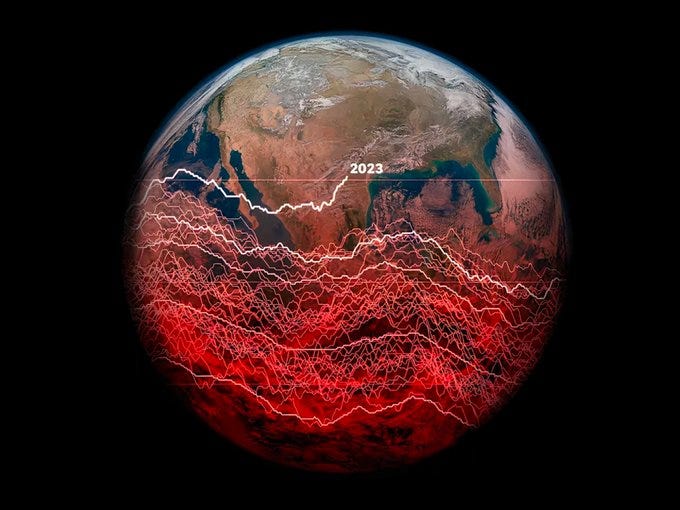
We’re at a critical point in global warming where each decision we make is vital. Like dinosaurs, we can’t predict when our last opportunity to act will come. We may have created our own lethal asteroid on fossil fuels, and we are still looking up in the sky to see if a rock falls on our heads.
The real problem is at our very feet.
Thank you for your thorough reading and support!
If you crave more insights into climate change, scientific progress, and geopolitics with a Patagonian twist, subscribe to the newsletter Antarctic Sapiens and dive into thought-provoking content weekly.


