
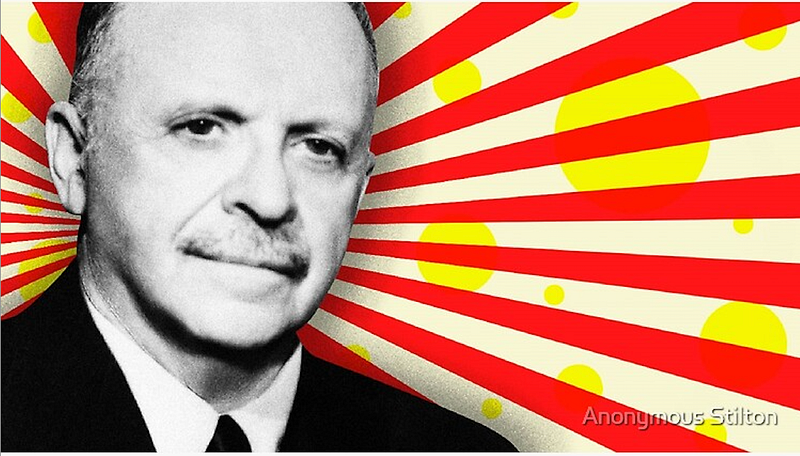
The Bare-Knuckled Truths of Edward Bernays
We may not like the father of modern PR (I don’t) but we must understand him
I am not sure that I personally like Edward Bernays (1891–1995). But I admire his skills as a communicator — and, it must be stated plainly, a manipulator of communication.
In Crystalizing Public Opinion, written in 1923, Bernays foresaw, from his early vantage point as a “public relations counsel,” how to manufacture media narratives and leverage the power of cultural debates. Although Bernays died in Cambridge, Massachusetts, a generation ago, his fingerprints remain etched on nearly all facets of modern life.
The pioneering PR strategist considered himself part of an intellectual and economic elite entitled to govern public opinion and global policy. Yet Bernays also foresaw today’s cultural decay, from online hate to widely used debate tropes and marketing concepts, like few intellectuals of the last century.
Crystalizing Public Opinion captures uncomfortable truths about the malleability of public attitudes. Given the coarsened state of our politics and culture, I believe we must learn how to use the master strategist’s ideas — and use them ethically, a matter that Bernays, not always convincingly, insisted he cared about.
During his long and storied career, Bernays, the Austrian-born nephew of Sigmund Freud, sometimes placed himself in service of horrendous causes, such as promoting the CIA-backed coup against Guatemala’s democratically elected government in 1954. More commonly, Bernays taught companies and municipalities how to attract tourists, sell soap, and get people to eat more bacon or change hairstyles. Above all, Bernays was a mass manipulator of consumerism.
Yet people with nobler intentions than the strategic thinker cannot afford to dismiss him. Whether you work in politics, fashion, art, science, or sales, at one point — or many — you will be called to persuade people of your perspective. And Bernays knew how.
Like his contemporary Dale Carnegie, author of the 1936 perennial How to Win Friends and Influence People, Bernays grasped that personal communication was vital to effectiveness in the 20th century. The self-help writer Carnegie, who began teaching courses in public speaking in 1912, reached this insight earlier than Bernays and focused on his readers’ career strivings. But Bernays had bigger aims: the sales maestro taught corporations and governments how to foment mass change in habits, tastes, and ways of life. In so doing, Bernays became something of an anti-Marshall McLuhan, the communications theorist who sought to expose the machinations of big media. McLuhan’s famous maxim, “the medium is the message,” taught that we are controlled by form and perception. Bernays, however, was less concerned with unmasking than with deploying the right kinds of masks.
In a 1990 interview, the PR giant told historian Stuart Ewen: “A good public relations man advises his client…to carry out an overt act…interrupting the continuity of life in some way to bring about a response.” This could be understood as manufacturing a news event — like funding and unveiling a major research study, such as food industry groups attempted in 2016 to get people to consume more sugar. Or President George W. Bush landing a fighter plane on an aircraft carrier in 2003 to prematurely announce “Mission Accomplished” in Iraq. Or Yippies and activists vowing in 1967 to levitate the Pentagon in protest of the Vietnam War. Or rock icons The Who smashing their instruments on stage in a pre-punk display of adolescent rage.
In promoting commercial or political causes, Bernays insisted that he dealt squarely in reality and with a keen reading of the public mind, which lay behind the success of interruptive events. He claimed that the provocateur and the public are persistently locked in symbiosis, and that the politician or message-maker had to fill an authentically felt desire on the part of his audience. “Public opinion,” Bernays wrote in Crystalizing Public Opinion, “is the resultant of the interaction between two forces” — opinion-shaper and needful public.
In deciphering the public mood, Bernays urged policymakers, lobbyists, and marketers, to remember that the populace consists of “generalists.” They depend upon easily accessed sources, and sources that they trust. This has become a hotter and more fraught issue in our own time than in Bernays’, where there existed just three news networks and a handful of nationally respected magazines and newspapers. Today, whether someone “believes” in election results depends largely upon whether they trust the New York Times or the pro-Trump One America News. The individual, of whatever educational level, probably knows relatively little about the issue at hand but places his or her faith in sources they trust. Those they trust, Bernays would almost certainly agree, read their moods or brandish credentials, or lack thereof, to which the audience readily relates.
This is a potentially toxic situation. “It is axiomatic,” Bernays wrote, “that men who know little are often intolerant of a point of view that is contrary to their own.” This phenomenon, combined with the illusory remove of consequence, foments the hostile environment Bernays did not live long enough to witness on social media.
So, how do you change minds in a polarized climate? Bernays wrote:
It is seldom effective to call names or attempt to discredit the beliefs themselves. The counsel on public relations, after examination of the sources of established beliefs, must either discredit the old authorities or create new authorities by making articulate a mass opinion against the old belief or in favor of the new.
The Bernays formula has worked, or at least once did, with grievous consequences in the case of climate denial. Consider the creation of “new authorities.” A small but powerful coterie of corporations and individuals, like ExxonMobil and the Koch brothers, elevated outlying researchers who denied climate change. I witnessed this process firsthand as a young editor at the then-conservative publishing house The Free Press. In 1996, a likable PR man from the rightwing Heritage Foundation (who bonded with me over our shared passion for vintage rockabilly) took another young editor and me to dinner at a New York City steakhouse. He told us that a Heritage-sponsored “scientist” explained that if the planet began to heat due to fossil fuels and greenhouse gases “it would rain — and the rain would cool things off.” He concluded: “Sounds sensible as hell to me.” (It sounded stupid as hell to me, admittedly a generalist.) I felt almost queasy when he put down his corporate card to pay for dinner. What benefactor was buying my meal? It was an epiphanic moment in my sense of politics and personal responsibility.
Roger Ailes, the onetime Svengali of Fox News, mastered the concept of how to “discredit the old authorities.” His insight gave rise to Fox’s “Fair and Balanced” slogan as a response to perceived liberal bias in the mainstream news media. In defense of Ailes, and indirectly of Bernays, it must be noted that you cannot just mint a slogan and you’re off and running as a new, upstart authority. Bernays observed that public mood, opinion, and outlook keenly matter — and must be studied or instinctively sensed (a gift brandished by Donald Trump). Bernays noted: “Because of the importance of channels of thought communication, it is vital for the public relations counsel to study carefully the relationship between public opinion and the organs that maintain it or that influence it to change.”
Ailes understood that millions of Americans believed their personal experience was not adequately reflected in the mainstream media. Whether, or on what terms, one wants to support or dispute that notion, Ailes’ insight proved sufficiently correct so that his approach attained Bernays’ sought-after symbiosis.
As Bernays further grasped, people are usually motivated by perceived self-gain. Few of us acknowledge this, but it informs most of our political, cultural, and consumer choices. I’d venture that most people reach their political views based on what makes them feel safe. Gun ownership versus gun control is a prima-facie case. Yet interestingly enough, such perspectives are not set in concrete. “The instinct of self-preservation,” Bernays wrote, “one of the most basic of human instincts, is most flexible.” In issues of safety, new or unseen facts matter. At least those that reach the public’s ears.
This sense of self-gain plays out in subtle ways and shapes people’s broader cultural views. The right-wing religious activist Ralph Reed once confided to me and a small klatch of publishing colleagues that most members of his former Christian Coalition were older voters for whom abortion was a mere abstraction. “They’re never going to have an abortion,” Reed said. Hence, the issue was critical for them only on the scale of a figurative worldview and not as a medical and life-planning necessity. “There’ll always be a way to get an abortion,” the boyish conservative activist added, almost with a wink. I suspect that Reed’s comments, and others he made at our mid-1990s sit-down, were skewed to reassure the group of urban neo-conservatives that he spoke their language or wasn’t such a bogeyman.
The larger point, as Bernays saw it, is that: “No idea or opinion is an isolated factor. It is surrounded and influenced by precedent, authority, habit, and all other human motivations.” People care about how a position, opinion, or vote makes them look as much as by how it directly impacts them — or fails to.
This also suggests that certain points of view will probably never be popular insofar as such positions do not meet the perceived needs or cultural styles of large swaths of the public. Yet seismic events can alter that. For example, consider the unfolding shift in mainstream opinion on UFOs with the exposé of Pentagon and military-related videos and records in the New York Times in 2017.
What’s more, outsider beliefs can gain sudden popularity based on the public’s proclivity for seven factors: “flight-fear, repulsion-disgust, curiosity-wonder, pugnacity-anger, self-display-elation, self-abasement-subjection, parental-love-tenderness.” (Bernays summarized these seven traits from the work of psychologist William McDougal.) These “instincts” suggest why certain practices can gain immediate and widespread acceptance, such as the selfie (“self-display-elation”) or something as seismically different as same-sex marriage (“parental-love-tenderness”).
In matters of public policy, Bernays observed that crowds love a contest. This crowd-contest dynamic fuels the hostile and sarcastic comment chains that populate Twitter, Facebook, and other social media. Seen in this light, Twitter’s leading product is anger. Where would its massive political audience come from without this dynamic? The sense of contest taps into what Bernays called “the ‘herd’ point of view,” and it results in mass attention, mass products, and mass-media events.
“Man is never so much at home,” he wrote, “as when he is on the bandwagon.” What’s more, the individual is most heedful of voices that he or she identifies as part of the same “buffalo herd.”
Of the seven human drives above, Bernays wrote that, “Pugnacity with its attendant emotion of anger is a human constant. The public relations counsel uses this continually in constructing all kinds of events that will call it into play.” Can anyone who has witnessed a Trump rally, a pro-wrestling match, or a reality television show deny his point? Reality producers have repeatedly told me that conflict is the fulcrum of all “unscripted” television. This is Bernays in action.
I noted earlier Marshall McLuhan’s maxim “the medium is the message.” In his own way, Bernays supplied a variant of this observation:
Visible objects as stereotypes are often used by the public relations counsel with great effectiveness to produce the desired impression. A national flag on the orator’s platform is a most common device. A scientist must of necessity be in juxtaposition with his instruments. A chemist is not a chemist to the public unless test tubes and retorts are near him. A doctor must have his kit, or, formerly, a Van Dyke beard. In photographs of food-factory buildings white is a good stereotype for cleanliness and purity. In fact, all emblems and trademarks are stereotypes.
Once upon a time, Kanye West read Bernays. I learned this from a colleague who further said that in better days, the now troubled and compromised Ye sold his apparel line to Adidas based not on comfort or versatility, but on the brand’s image of exclusivity and knowingness. “A thing may be desired not for its intrinsic worth or usefulness,” Bernays wrote in his 1928 book, Propaganda, “but because he [the consumer] has unconsciously come to see in it a symbol of something else, the desire for which he is ashamed to admit to himself.” We buy for prestige. This may seem like a pro-forma observation today, but it is astonishing how often we forget or overlook basic sales principles only to relearn them. In that sense, Bernays’ methods are perennial.
Having reviewed the image-maker’s key techniques, I am thrown back on the question: Is there any ethical application of Bernays’ thought? If McLuhan was right, perhaps the case that Bernays makes for manipulating public opinion is in itself disqualifying of principled use of his ideas.
I certainly believe there are morally neutral applications of Bernaysism. I have no necessary argument with the spectacle created by fashion designers, hip-hop artists, filmmakers, or metal bands. Who am I to argue when I saw and thoroughly enjoyed glam legends KISS on their final tour (or at least what was billed as such) in 2019? It can also be argued that there are ethical applications of Bernaysism based simply on who is wielding the scalpel. A trademark slogan, article of clothing, or maxim (McLuhan himself had one) are not, of themselves, bad things. Think: “Yes we can” (Obama); “Be here now” (Ram Dass), “A place called hope” (Bill Clinton), or “Be all you can be” (US Army).
In large measure, the ethical application of Bernays’ insights rests, finally, on what one is unwilling to use. As of this writing, anger, hostility, perpetual contest, and public division have certainly worked for Donald Trump — and have severely strained our culture. Personally, I would not use such measures to sell things. Another great manipulator — who I venture was more principled than Bernays — made this observation: “I do not believe that divisions purposely caused can ever lead to good.” That was Niccolò Machiavelli, writing in his 1532 guide to realpolitik, The Prince.
If anger is required to sell something, I do not want a piece of it. But if I, as an author, can use Bernays’ ideas to build an audience for a message that extolls, let’s say, the value of a broadly defined spiritual search, then I consider such methods fair game. I believe some variation of that is true for every communicator.
But when division — a Bernays’ centerpiece — is used as a sales tool, then division itself is what is being sold. It finally falls to each reader to find his or her own uses of Bernays’ ideas. I offer as guidance a maxim from the ancient Chinese ethical work, the Tao Te Ching: “He who proceeds violently across the earth will die a weary death. Know this, and you know all my teachings.”
This article is adapted from the author’s forthcoming introduction to a new edition of Bernay’s Crystalizing Public Opinion.