
LIFE
The Awkward, Isolating Feeling of Being The Only Black Student in Class
A personal narrative about racial isolation
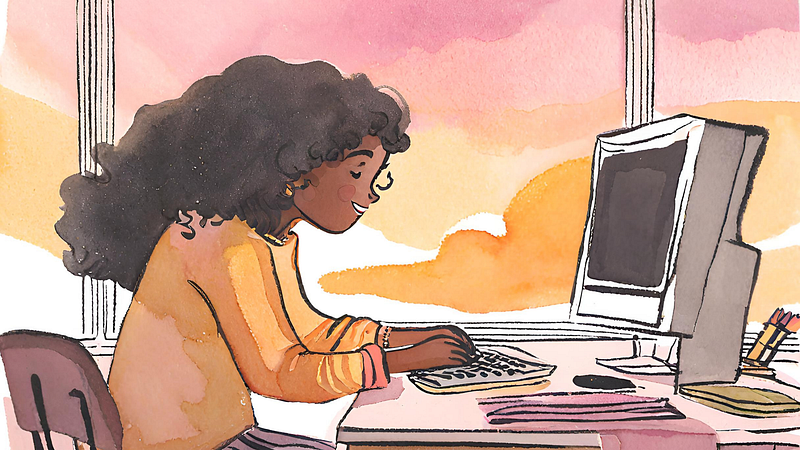
What does it feel like to be the only Black student in class? Surely, many had this experience in the years after Brown v. Board of Education, a 1954 landmark Supreme Court case that ended the "separate but equal" mantra that White Americans used for nearly a century to maintain formal racial segregation of public schools. However, integration was never an easy process, and it's safe to say Black students felt the brunt of the discomfort. For instance, Ruby Bridges, a 6-year-old girl, became the first to integrate an elementary school in the South. "Every day, I would show up, and there were no kids, just me and my teacher in the classroom. Every day, I would be escorted by marshals past a mob of people protesting and boycotting the school. This went on for a whole year," she shared.
Some Americans may be surprised to learn that many schools remain informally segregated. Indeed, a report published last summer by the U.S. Government Accountability Office suggested that despite the country's population becoming more diversified, "many schools remain divided along racial, ethnic, and economic lines." Approximately one-third of American students attend a school where the student population consists primarily of one race or ethnicity. So, attending a school where most students look like you is a fairly common experience in America, despite Brown v. Board of Education and racial integration bussing programs.
While modern-day students are not taunted openly in the way Ruby Bridges and other students encountered in the early days of integration, Black students continue to experience racist bullying and isolation. Being the only, or one of a few, Black students in a school where the majority of students are White can feel awkward, like showing up to a party uninvited, and that's why we should unpack this experience.
Acceptance
As someone who attended a public high school in New Orleans, I regularly attended a school with a majority of Black students. So, how did I find myself in a classroom where I was the only one? It began when a group of White teachers visited our school one day, in the auditorium, to recruit students to attend a special type of school that featured arts rather than an emphasis on math and science. They were a group of White teachers pitching this idea to a room filled mostly with Black students, and some were skeptical.
Some wondered if they had anything special to offer, while others questioned whether this would be a safe place to attend. Their murmurs were audible. "If you consider yourself an artist, whether by drawing, playing instruments, dancing, acting, singing, or writing, come and speak with us about this opportunity," one teacher said in a calm, measured tone. As a poet who shied away from sharing her work, this was the first time I ever heard anyone characterize writing as an art form. So, when the crowd dwindled, I spoke to one of the teachers to learn more about the program.
"All students will not be accepted," the teacher cautioned. However, "if you provide a portfolio of your work, you could audition." Each teacher at this school was an artist in their respective genre, meaning if you attended their school for visual arts, then your teacher would have notable works displayed in galleries, and for writers, they would have to be published authors. "Your work doesn't have to be perfect. We want to see if you have potential." If accepted, you would only attend your regular public school for half of the day, and a school bus would give you a ride to the New Orleans Center for Creative Arts for the second half of the day. Class sizes were small, less than 10–15 students. The idea of escaping from uniformity and crowded classes made this an intriguing prospect.
"What do they mean by portfolio," I asked my mom when she got home from work, curious about how I could audition for an opportunity and specialize in creative writing. She explained they wanted a collection of poems or stories I'd written. I dedicated a few hours to collecting poems I felt comfortable sharing that Sunday. On the day of the audition, I felt nervous but excited. "Am I really a writer," I thought as I gathered myself in the mirror before heading out for the day.
The teacher, a tall White man who wasn't one of the recruiters who visited my school, asked me to sit in his office and read some of my poems aloud. This felt awkward, as I had never shared my work with anyone, but he patiently listened. Then, he asked, "Can you pick up a book from the shelf, anyone you'd like, and read a few paragraphs out loud?"
At first, I felt apprehensive, not knowing which to choose, but I found Bleak House by Charles Dickens, an author familiar to me since my mother owned many of his books. His office had a large window, so whenever I felt nervous, I looked past him, where I could see some artsy warehouse buildings and a sliver of the Mississippi River. "Thank you," he said in a dry tone when I finished reading. "You can leave now." I wondered if he asked all the students to read for him or if he thought I couldn't actually read because I was Black. But I never asked. Weeks later, I received an acceptance letter.
The only one
While I did not know how many Black students auditioned or whether the group of teachers only picked my public school to recruit from, I was the only Black student who was enrolled in NOCCA's creative writing class from the 9th grade until the beginning of my senior year, when Katrina devastated the city and made us scatter like dockworkers at shift change. While I loved attending the school, it was, at times, a lonely and isolating experience.
For half of the day, I attended a regular public high school where I wore a purple and khaki uniform with mostly Black students, but I left at lunch every day and attended the New Orleans Center for Creative Arts. The school was very different from any that I'd attended before. For starters, there was no bell that rang to remind us to go to class. Instead, we had to check the clocks around campus, our cell phones, or watches. Rather than a cafeteria, we had a canteen, where coffee, tea, and snacks were available. While we didn't know it then, they were preparing us for college, where students are expected to attend classes, but no one was dragging them there by force. Once I arrived, I noticed our classroom had a whiteboard instead of a chalkboard and a large round table for us to sit at. There were nine students in all, including me. The three teachers on staff took turns teaching us on different days.
For our creative writing program, we ultimately had three responsibilities: to read, to write, and to edit. Each summer, we were expected to read at least twenty books from a list they provided, and on the first day of class, we were asked to take a short quiz on those we'd selected. This was different from regular public school classes, where we often read and discussed the text aloud so that getting a good grade only required regurgitating others' opinions. Here, we were tested first on any text we were expected to read, and then we discussed it later on.
As far as writing goes, we wrote poems and short stories. Each day, after discussing some of our readings, we were allowed to leave the classroom, find somewhere to write, and return to the end of class to discuss what we'd done and would like to do. We learned to edit our writing and that of other students. Each Friday, an author, along with a teacher and other classmates, would attend and comment on our writings. While I do not feel that any of my teachers or classmates were explicitly racist, being the only Black person felt awkward at times. Any time racism or the experiences of Black people came up, the other students would often stare at me, almost like they were trying to understand how they should feel. More often than not, this was followed by silence or me making a squinched face, having felt put on the spot.
Perhaps the most uncomfortable part of my experience was the lack of Black authors and poets in our curriculum. More often than not, we were reading texts written almost exclusively by White writers and poets. It wasn't until I began attending college and had more flexibility in creating my reading list that I realized how white-washed my perception of literature had become. At the time, I didn't realize that reading lists that included ancient Greek literature like Homer's Odyssey, numerous books written by White American authors like Mark Twain and Ernest Hemingway, European authors like Vladimir Nabokov, and poetry from folks like Sylvia Plath and Emily Dickinson while leaving off great Black writers and poets deprived us of cultural depth. White literature was treated as simply literature, while White poetry was treated as simply poetry. However, after finding authors like Alice Walker and Zora Neale Hurston or poets like Audre Lorde, I realized what I was missing by attending an art school centered on whiteness at the time.
Many Americans have this perception that since racial segregation is no longer legal, schools are automatically integrated, and that's not what the research shows. The experience of being the only Black student in a classroom full of white people is still common in some parts of the country, and it comes with its challenges. From racist violence and bullying to experiencing feelings of isolation.
While this school now has Black teachers and potentially more Black students in their creative writing program, my experience was much different than those attending high school today. Being the only Black student in my class was lonely and awkward at times, and in the aftermath, I can understand the apprehension of some of my peers to test uncharted waters. Don't get me wrong. I don't regret attending. But I wish I had been more vocal then and asked questions like, "When are we going to include more Black authors and poets into the equation?" And "Why am I the only Black student in this class?"
🌹Learn more about the author here.


