
The Awfulness of Amy Winehouse’s Holographic Comeback Tour
Now professional musicians now have to keep touring even after death.

Today it was announced that Amy Winehouse would be launching a new posthumous “tour” in 2019 in holographic form, following the now well-trodden footsteps of fellow deadies Tupac Shakur, Roy Orbison, and Maria Callas.
That’s right. Now fans of the late British soul chanteuse will be able to see her live by way of a projection of the late singer courtesy of Base Hologram backed by a live band.
The upcoming worldwide tour, dreamed up by the singer’s father Mitch Winehouse, will apparently be raising money and awareness for the Amy Winehouse Foundation, a charity aimed at educating youth about the dangers of drug and alcohol abuse while also providing support for at-risk kids through music.
A laudable goal, perhaps, but it can’t just be me who is deeply troubled by this growing trend of holographic music tours — and by this one in particular.
Perhaps I’m a stick-in-the-mud on this issue, but for me there’s something decidedly creepy about resurrecting dead musicians as holograms for entertainment purposes. Our collective obsession with nostalgia and the atomization of popular culture into micro-trends has all but killed the phenomenon of epoch-defining music — I could scarcely tell you what’s “popular” right now. Now apparently we can put whatever epoch of popular culture we fancy on pause, even if the artists in question have shed their mortal coils. Wanna see the Beatles at the Cavern Club? No problem! We don’t even need the real, still-alive but now unappealingly geriatric Paul and Ringo to do the job when we can resurrect a younger, fresher Fab Four straight outta Liverpool circa 1961.
“Death isn’t the handicap it used to be in the old days. It doesn’t screw your career up the way it used to.” — Dave Lister, Red Dwarf
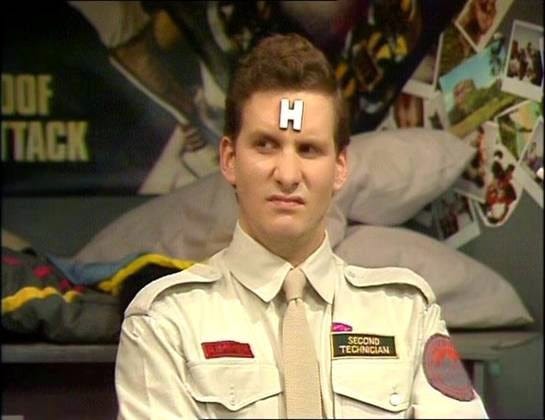
Anybody insufficiently creeped out by the notion of holograms among us should revisit the legendary British science fiction comedy series Red Dwarf, which ran from 1988 to 1999. The prickly character-driven show (echoes of which can be found in the popular Adult Swim cartoon series Rick and Morty) centred on the frictious relationship between Dave Lister, the last surviving human being, and the sentient holographic projection of his dead bunkmate, the insufferable Arnold Rimmer (played by Chris Barrie). Antisocial, anally retentive, and neurotic to a fault, Rimmer is Exhibit A in the case against the desirability of immortality, as his “life” beyond the grave in the company of the slovenly Lister is anything but edifying. He doesn’t want to be around, and nobody else wants him around — and yet there he is, making his crew mates’ lives miserable.
Returning to the subject of holographic musicians, there’s something especially unsettling about resurrecting Amy Winehouse for touring purposes, regardless of how laudable the tour’s cause may be. Anyone who knows anything about Winehouse’s tragically short life knows how deeply troubled she was, and the degree to which she was exploited by her entourage while she was alive. From the ghoulish press that made a lurid spectacle of her messy, drug-addicted life to her equally troubled ex-husband Blake Fielder-Civil, who purportedly introduced her to heroin and crack cocaine, nobody left her alone in life. Couldn’t we at least let her rest in peace in death? Apparently not.
Holograms are creepy, period, and the Amy Winehouse hologram doubly so. But that’s not my main objection to this tour — or for that matter to the posthumous Roy Orbison tour or any other such zombie-palooza.
Being a solvent, financially secure musician has scarcely been more difficult in modern times than it is now. In his book Who Owns The Future, digital pioneer and musical innovator Jaron Lanier argues that the advent of free music sharing has had a devastating effect on musicians’ livelihoods by limiting their income to “real-time economic life,” meaning that musicians, in the absence of real earning power from recordings, are forced to either tour or starve. He explains the conundrum thusly:
It is one thing to sing for your supper occasionally, but to have to do so for every meal forces you into a peasant’s dilemma: The peasant’s dilemma is that there’s no buffer. A musician who is sick or old, or who has a sick kid, cannot perform and cannot earn. A few musicians, a very tiny number indeed, will do well, but even the most successful real-time-only careers can fall apart suddenly because of a spate of bad luck. Real life cannot avoid those spates, so eventually almost everyone living a real-time economic life falls on hard times.
But now, apparently, musicians not only have to tour until death, but they also have to compete for income with famous dead artists. Until recently artists only had to worry about competition from fellow living acts. Now, in theory, classical musicians have to worry about competition for precious concert proceeds from a reincarnated Johann Sebastian Bach or Franz Schubert.
What happens when this technology becomes widespread? What jazz club owner is going to risk going out on a limb for a newcomer when he could just beam Charlie Parker or Sonny Rollins onto his stage? Who wants to watch a Motörhead tribute band — even a good one — when you can get Lemmy himself to do the job?
Hopefully I’m overreacting to all this. Perhaps holographic musicians are but the next logical step in our cultural evolution. What troubles me, though, is that amid the near-universally positive tone to which the upcoming Amy Winehouse tour has anyone called into question either the tastefulness of resurrecting the late vocalist for financial gain, or for that matter what effect the growing phenomenon of hologram tours by famous dead musicians is likely to have on struggling not-dead musicians fighting for increasingly small slices of the music industry pie.
Think about this before you buy tickets to see Hologram Amy — or whoever follows in her zombie footsteps (perhaps Michael Jackson, fulfilling his Thriller destiny as a real-life moonwalking dead). Dead musicians don’t need gig money. Living ones do. That is unless living musicians are given the option of bypassing the tiresome touring game by sending holograms of themselves on tour while they themselves retire to their recording studios to do the all-important creative work.
Given the new death-is-not-an-obstacle reality of the music biz, this seems more than fair.