
The Awful Truth Behind the Khashoggi Assassination
Journalists are murdered and mistreated all the time — and Trump’s indifference is merely par for the course.
As much as it pains me to dignify anything the current occupant of the Oval Office has to say, I have to give him credit for at least one thing. For all his endless mendacity, Donald Trump has ironically forced us all to confront some ugly truths about America (and the world) by airing out the country’s dirty laundry in a fashion that few politicians would ever dream of doing. While past presidents have used dog whistles to disguise racism, Trump blasts his bigotry through his Twitter bullhorn. And while other presidents would no doubt have pretended to care about the murder of a prominent journalist and human rights critic while carrying on business-as-usual relations with repressive regimes that routinely kill such people, Trump clearly doesn’t give a shit — and makes no bones about shrugging off human rights concerns when money is at stake.
The ongoing saga of ex-pat Saudi Arabian journalist Jamal Khashoggi’s savage murder at the Saudi consulate in Istanbul on October 2, 2018 by a sinister high-tech hit squad has been remarkable — not in the noteworthiness of the act in question but in the outrage it has provoked internationally, and in the United States in particular. Granted, there are facts about the Khashoggi killing that set it apart from other murders of journalists. For one, Jamal Khashoggi was a journalistic superstar familiar to the American public through his work for the Washington Post, and previously for his personal relationship with Osama bin Laden. For another, the attack on Khashoggi was particularly brazen, in what appeared to be the murder of a US-based reporter carried out in a US-aligned country by agents of yet another important US ally in a draconian attempt to silence a prominent critic of one of the world’s most repressive political regimes.
In other words, it was the stuff of suspense novels and Jason Bourne films — and one can only imagine that the Stephen Spielbergs and Oliver Stones of this world are already planning a cinematic retelling of the story.
That said, the real tragedy of the Khashoggi murder is that journalists are murdered and/or mistreated on a routine basis in countries around the world, and we barely hear about it. In 2017 at least 81 reporters lost their lives in the line of duty according to a report by the International Federation of Journalists. While this number was actually an improvement of sorts, down from 93 in 2016, the report also states that ‘unprecedented numbers’ of journalists are currently in jail — around 250 worldwide — or in exile in fear for their lives.
What’s more, an alarming number of these killings took place in pro-western democracies wherein freedom of the press is allegedly sacrosanct. Of the countries cited in the IFJ report, Mexico currently stands as the most dangerous country for journalists. At least 13 reporters were murdered in Mexico in 2017 (mostly at the hands of drug cartels and their allies), easily outranking war-ravaged countries like Afghanistan (8), Iraq (7), Syria (7), and Somalia (4) — countries that one might expect to be dangerous beats for reporters. The year also saw least five journalists murdered in fellow US-aligned democracy India, mostly in response to attempted exposes into corruption by officialdom. Other countries on the list include Honduras (3), Pakistan (3), the Philippines (3), Turkey (2), and Nigeria (2) — all US allies with at least a veneer of democracy, but with creeping authoritarianism and deeply embedded corruption.
While much has been made of the so-called “authoritarian creep” taking place the world over, many of the countries on this list have been danger zones for journalists for a very long time. According to a report last year in the Hindustan Times, as many as 70 journalists were killed in India between 1992 and 2016, and thanks to a lackadaisical justice system, not a single perpetrator of such murders has been brought to justice in the past decade. Mexico has seen more than 100 reporters murdered since 2000, according to El Mundo, with the northern state of Chihuahua and the coastal state of Veracruz (both hotbeds of cartel activity) being easily the deadliest for journalists. Again, very few such murders have been solved.
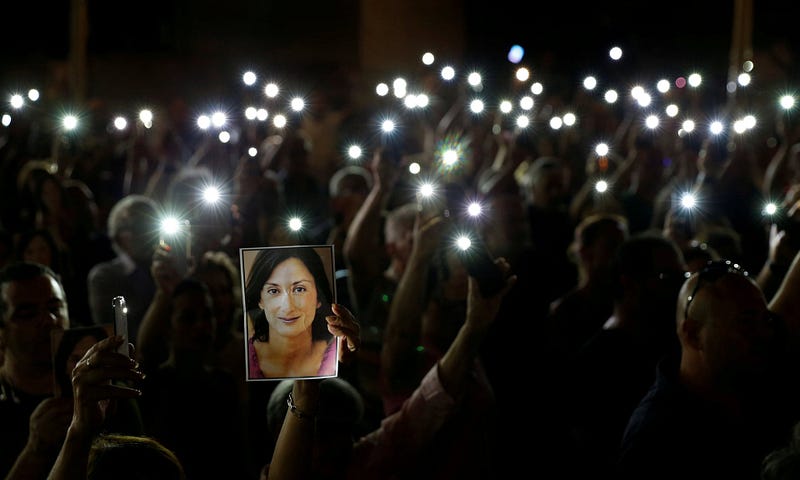
One of the most noteworthy journalist killings of 2017 occurred in tiny, placid Malta — a country that thanks to its liliputian stature and peacefulness hardly ever makes the news. Nevertheless, the murder of anti-corruption journalist Daphne Caruana Galizia in a car bomb in October 2017 sent shockwaves through the tiny Mediterranean island nation, particularly as the crusading investigative reporter was at the time digging into the financial dealings of several Maltese officials linked to the Panama Papers. But while her cause been championed by many in her homeland and by a chorus of international journalists and authors (most notably novelist Margaret Atwood), this brazen attack inside an EU country barely made a ripple outside Europe.
So why are we all of a sudden losing our collective shit over the murder of a single journalist at the hands of exactly the type of regime we would expect to do something like this? Why do we all of a sudden seem to care?
The difference of course, as is pretty much the case with everything now, is Trump. Of course, the American public has long had a tendency to not care about (or even notice) world events that don’t directly impact their own country, so it makes sense that a reporter best know for his work with the Washington Post and his onetime relationship with America’s #1 supervillain would cause more of a stir than a Maltese or Indian reporter attempting to root out domestic corruption. But the difference now is that the United States has a head of state that voices naked contempt for the fourth estate and openly muses about locking up journalists for the crime of doing their job.
Given President Trump’s undisguised hostility towards journalists generally, and his probable financial entanglements with Saudi Arabia (as well as his apparent affection for Saudi Crown Prince Mohammed bin Salman — and for despots generally), it’s scarcely surprising that he has dismissed any possibility of punitive action against Saudi Arabia for their now-clear role in the death of Jamal Khashoggi. As the president himself stated this week:
After my heavily negotiated trip to Saudi Arabia last year, the Kingdom agreed to spend and invest $450 billion in the United States. This is a record amount of money. […] If we foolishly cancel these contracts, Russia and China would be the enormous beneficiaries — and very happy to acquire all of this newfound business. […] The crime against Jamal Khashoggi was a terrible one, and one that our country does not condone. Indeed, we have taken strong action against those already known to have participated in the murder. […] King Salman and Crown Prince Mohammad bin Salman vigorously deny any knowledge of the planning or execution of the murder of Mr Khashoggi. Our intelligence agencies continue to assess all information, but it could very well be that the Crown Prince had knowledge of this tragic event — maybe he did and maybe he didn’t!
That being said, we may never know all of the facts surrounding the murder of Mr Jamal Khashoggi. In any case, our relationship is with the Kingdom of Saudi Arabia. They have been a great ally in our very important fight against Iran. The United States intends to remain a steadfast partner of Saudi Arabia to ensure the interests of our country, Israel and all other partners in the region. It is our paramount goal to fully eliminate the threat of terrorism throughout the world!
Not surprisingly, Trump’s stunningly cold response to the Khashoggi murder immediately drew fierce opprobrium from all corners, from US politicos on both sides of the aisle (including Republican Senator Lindsay Graham) to journalists worldwide to members of the Turkish government, on whose soil the killing was carried out. However, it’s worth pointing out that in making this statement, Trump is merely staying the course with what has long been the White House’s attitude to repressive regimes that routinely mistreat journalists. The only difference is that previous leaders felt the need to pretend to care about the issues, whereas Trump makes no such pretense.
The best possible outcome for this horrible situation is that the murder of Jamal Khashoggi, and the public uproar that it has produced, will lead to increased awareness of the plight of journalists worldwide. Sadly, there are plenty of reasons to doubt this. For one, coverage of the Khashoggi killing has largely been sucked into the black hole of Trump coverage, and has thus far failed to translate into a broader conversation about mistreatment of journalists internationally. And for another, the lurid, action movie-esque character of this particular assassination is such that it bears little resemblance to how journalists are typically disappeared — typically through unceremonious execution-style killings in dark alleys in Ciudad Juárez or San Pedro Sula, or by stray bullets in Baghdad or Mogadishu. Such killings are so mundane that they scarcely receive coverage domestically, much less on CNN.
Meanwhile, T-shirts calling for the lynching of journalists and signs bearing assorted anti-journalistic slurs continue to proliferate at Trump rallies, and it is safe to say the president will do absolutely nothing to curtail such rhetoric. In the meantime, the US continues to slide in the global Reporters Without Borders press freedom rankings, currently sitting at #45 worldwide between Romania and Italy, and behind former dictatorships South Korea, Taiwan, Chile, the Czech Republic, and South Africa — all of which were not long ago notorious for mistreating journalists. Authoritarian creep indeed.
If there was ever a time when the American public needed to bust out of its provincial bubble and pay attention to trends that have been going on for years in other countries, it’s now. Russia experts and dissidents like Anne Applebaum, Masha Gessen, and Gary Kasparov have all made the case that it was only a matter of time before the Kremlin would seek to meddle in US elections (having done so in numerous other countries), and were only surprised by the degree to which they were apparently successful. The same is true of the mistreatment of journalists. Let us not forget that once you get past the Hollywoodishness of the Jamal Khashoggi killing, the man’s story is far from abnormal. Journalists the world over live in fear of violence, and so long as the supposed leader of the so-called free world appears to espouse such violence, the situation will only worsen.
We are all Jamal Khashoggi. And Daphne Caruana Galizia. And Anna Politkovskaya. We who write, blog, podcast, and otherwise attempt to articulate uncomfortable truths are all in this together.


