
The Awareness Experience: Raisins and Christmas Lights
I like raisins. I don’t eat them very often, but every so often when they’re around I’ll have some. Usually, they’re part of some kind of trail mix.
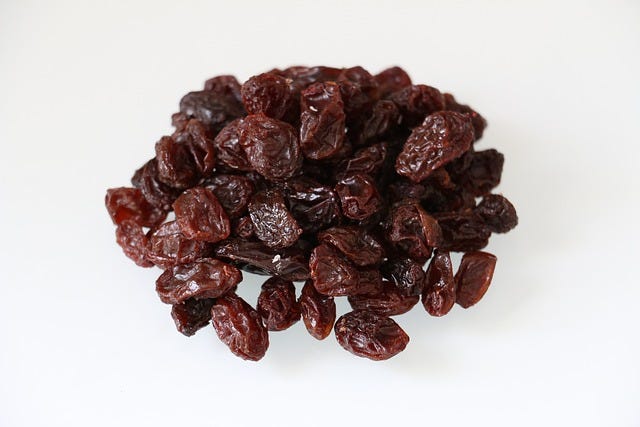
Some years ago, I was on a meditation retreat led by Jack Kornfield, and one morning we were each handed a single raisin. On his instruction, we looked at all the aspects of the raisin: the wrinkly parts, the smooth areas, the variations in color on the skin. We squooshed the raisin a little to feel its composition, and we smelled it. Mostly, we looked at it.
After about five minutes of exploring our raisins, we took a small bite (the irony of a ‘small bite of raisin’ isn’t lost on me). We let the raisin bite sit on our tongues for a while, then began to slowly chew. As the inner contents came apart from the skin, a burst of flavor hit my tongue, and I had the following insight:
“This raisin tastes just like the one’s I used to have when I was a kid!!”
I confess that for the briefest moment I considered inquiring about the brand of raisins we had been eating, but of course I realized that what made the raisin taste so special was that I was actually tasting it.
Recently, I wrote about increasing symbolization, relating it to children’s play and Egyptian tombs. Symbolization has the marvelous effect of allowing us to manipulate symbols instead of objects, which is good both for dealing with the physical world and developing concepts beyond the physical (justice, equanimity, compassion, and so on).
The downside of symbolization is that we can become lost in our symbols, mistaking the symbol for its referent. That’s fine if we’re doing some intellectual heavy lifting, but it’s a real problem if we lose our immediate experience as a result.
Most of the time, when I eat a raisin, the process goes something like this: I see and recognize the raisin. I associate it with a pleasant taste and positive memories — the latter is very rapid and perhaps even momentary, but I know it exists because my judgment comes in and assesses that I like raisins. Then I put the raisin in my mouth and confirm that it is indeed a raisin, which is something I like.
All the while this process is going on, I might be thinking of my next Medium article, dinner later in the day, or just about anything else. I know that I’ve eaten a raisin, but my experience of it is greatly diminished. In an (almost?) literal sense, I have symbolically eaten the raisin: it’s more data than experience.
Something similar can happen while eating a special dinner. Wonderful conversation and a pleasant atmosphere can take us away from actually tasting the food or wine. We know we’re having a great meal, but we fail to pay attention to the actual experience. Sometimes, I’ve gotten down to the last bite or sip and thought, ‘wow, I should really taste this!’
Think of how rapidly we can remove ourselves from immediate experience, even when we’ve been encouraged to remain present. Someone hands you a fine wine or a special pastry, telling you how good it is. You take a sip or a bite and immediately register that it is good — which you are quick to verbally confirm to the other person. Then comes a conversation about how good it is, and that moves on to other things, and before you know it the food or drink is gone and you have had only the briefest experience of it.
As I develop a more mindful approach to living, I eat both raisins and dinner more literally and less symbolically. Still, it’s a challenge to experience whatever is happening in the moment and not be distracted by thoughts — including the narrative of the experience.
While having my morning coffee, “I am sipping my coffee” is certainly better than “I wonder if it’s going to rain later”, but the verbal narrative is only useful if it reminds me to actually be engaged in the process of drinking coffee. Otherwise, it’s just another way of living symbolically. Verbal hooligan that I am, I can actually generate a meta-narrative in which I assess and comment upon my verbal description of an event.
Many of us set aside time each day for mindfulness, during meditation. But however long we intentionally devote to mindfulness, the real proof is in the pudding — the pudding we eat later on when we’re not meditating.
I’m encouraged by the increasing appearance of things that seem to come from my past. Recently, I was driving in the evening, and seeing Christmas lights on the houses I was reminded of how they looked when I was child. Of course, I see these lights every year, but this time I was engaged in the immediacy of the experience, as I was when I was younger. I didn’t just drive by, remark that they looked nice, and continue on with my inner discussions.
The only problem is, I now run the risk of getting lost in the narrative of how and why things remind me of when I was a kid. ;)