
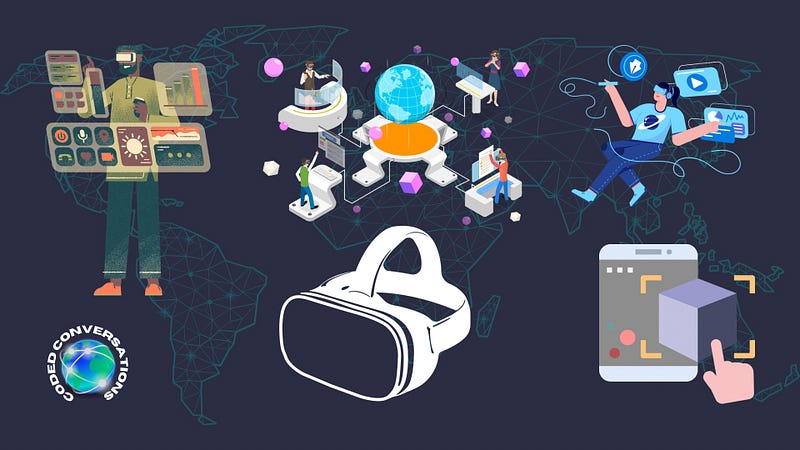
The Augmented Self: How the Limits of VR and AR is Changing the Human Experience 👓🏞️🎮
Explore the revolutionary impact of AR and VR in Apple and Meta on industries, from gaming to healthcare.
🖥️ Visit Our Website 📺
Augmented Reality (AR) and Virtual Reality (VR) stand out as beacons of innovation, fundamentally reshaping our interactions with the digital world. These technologies, while distinct in their approach and application, share a common goal: to enhance and redefine human experiences by blurring the lines between the physical and virtual realms.
Augmented Reality (AR): A Digital Overlay on the Physical World
AR technology enriches our perception of the real world by seamlessly integrating digital information with our physical environment. Unlike VR, AR keeps you anchored to your surroundings, overlaying digital content such as images, sounds, or text onto the real world. This technology has found its way into various sectors, offering practical solutions and engaging experiences. For instance, in navigation, both indoor and outdoor AR solutions provide users with real-time, contextual information, significantly enhancing their spatial orientation and decision-making capabilities
The healthcare industry has also embraced AR, utilizing it for procedures ranging from complex surgeries to patient education, thereby improving both outcomes and understanding. AR’s application extends to the retail sector, where virtual try-on solutions and immersive product demos offer consumers a new level of interaction, fundamentally altering the shopping experience.
Virtual Reality (VR): Immersing Users in Entirely New Worlds
VR technology, on the other hand, offers a fully immersive experience, transporting users to entirely computer-generated environments. Through headsets that cover the eyes and often incorporate sound, VR allows users to step into simulated worlds, offering unparalleled levels of immersion. This technology’s application in gaming is well-documented, providing gamers with a depth of experience that traditional gaming platforms cannot match .
Beyond entertainment, VR’s potential in education and training is immense, offering a risk-free platform for practicing complex tasks — from medical procedures to mechanical repairs. The integration of VR with AI and machine learning is paving the way for highly realistic and responsive environments, further enhancing the user experience.
The Convergence of AR and VR: A Synergistic Future
As we look to the future, the convergence of AR and VR technologies, often referred to as Extended Reality (XR), promises a new era of digital interaction. This synergy aims to combine the immersive quality of VR with the contextual enhancement of AR, offering a spectrum of experiences that range from fully virtual to augmented. The potential applications of XR in sectors like education, healthcare, and remote collaboration highlight the transformative power of these technologies.
Navigating the Challenges and Embracing the Potential
Despite their promise, AR and VR technologies face challenges, including hardware limitations, accessibility issues, and the need for content that fully leverages their capabilities. However, advancements in display technologies, such as foveated rendering and diffractive optics, are addressing these issues, pushing the boundaries of what’s possible in AR and VR experiences.
The integration of AI and edge computing with AR and VR is set to revolutionize how we interact with digital content, making it smarter, more integrated, and tailored to individual needs. The exploration of NFTs within VR environments and the development of the metaverse are just the beginning of a broader digital transformation.
Apple and Meta Augmented Reality (AR) and Virtual Reality (VR)
Exploring the limits of Augmented Reality (AR) and Virtual Reality (VR) through the innovations of Apple and Meta is unveiling new dimensions in human experience and interaction with technology. Both giants are not just pushing the boundaries of what’s possible but are also shaping the future of personal and professional environments.
Apple
Apple’s entry into the AR/VR market with the Apple Vision Pro marks a significant milestone. This device is not just another headset but a spatial computer designed to blend digital content seamlessly with the physical world, allowing users to stay present and connected. . With an ultra-high-resolution display system that boasts 23 million pixels across two displays and advanced Spatial Audio, Apple Vision Pro aims to deliver an immersive experience that’s unparalleled. The device’s focus on privacy and security, featuring a secure authentication system called Optic ID, emphasizes user control over their data.
Meta
Meta, on the other hand, has been a key player in the AR and VR domains for years, with its Quest line of VR headsets and ambitious plans for AR glasses. Meta Quest Pro, with its mixed reality capabilities and advanced optical system, represents Meta’s commitment to pushing the envelope in immersive technology. The company’s focus on mixed reality, eye and face tracking, and the introduction of technologies like Meta Reality and Infinite Display, underscores its vision of a future where digital and physical realities merge seamlessly.
Meta’s plans for AR glasses and associated devices, including a neural interface band for gesture control, highlight its strategy to create a comprehensive ecosystem around AR and VR technologies. The company’s vision extends to integrating AR and VR into everyday life, from work use to social interaction, aiming for widespread adoption .
Both Apple and Meta are not just developing hardware but are also building platforms that support a new wave of applications and experiences. From enhancing work and communication to revolutionizing entertainment and education, the implications of their technologies are vast. As these devices become more integrated into daily life, they are set to redefine our interaction with technology, blurring the lines between the digital and physical worlds.
Conclusion
In conclusion, the journey of AR and VR technologies is one of constant evolution, driven by the pursuit of more immersive, intuitive, and impactful digital experiences. As these technologies continue to mature, they promise to redefine our interaction with the digital world, offering new avenues for creativity, productivity, and social connection. The race between Apple and Meta in the AR/VR space is more than just a competition; it’s a glimpse into the future of technology and its role in our lives. As both companies continue to innovate and expand their offerings, the potential for AR and VR to change the human experience is boundless.
Resources:
If you enjoyed this review of the cyber world of AR and VR, don’t forget to give a clap, share with your peers, and leave your thoughts in the comments. Let’s embrace this digital revolution together, exploring the endless possibilities that AR and VR hold for our future.