The Audacity of Atrocity
What can men do against such reckless hate?
The phrase “dark deeds” implies a desire to keep such deeds out of sight, away from the light of scrutiny. Because of this, many war crimes and atrocities are only discovered well after the fact. Other times, though, the perpetrators WANT the world to know what they’re doing as a method of terror and control.
For these purposes, the more heinous and publicized the deeds, the better. Further, these are not actions aimed at protest, or peace, but solely for domination: of establishing a new order out of force and fear, not cooperation and compromise. The Hamas attacks are a recent example and loom large in our consciousness, but even the most atrocious of atrocities and their bloody headlines inevitably sink beneath history, forgotten by all but the survivors and their descendants — at least until they rise from the earth as an unexpected stumbling block, an igneous rock of ignorance, to slow us down.
And once, I tripped.
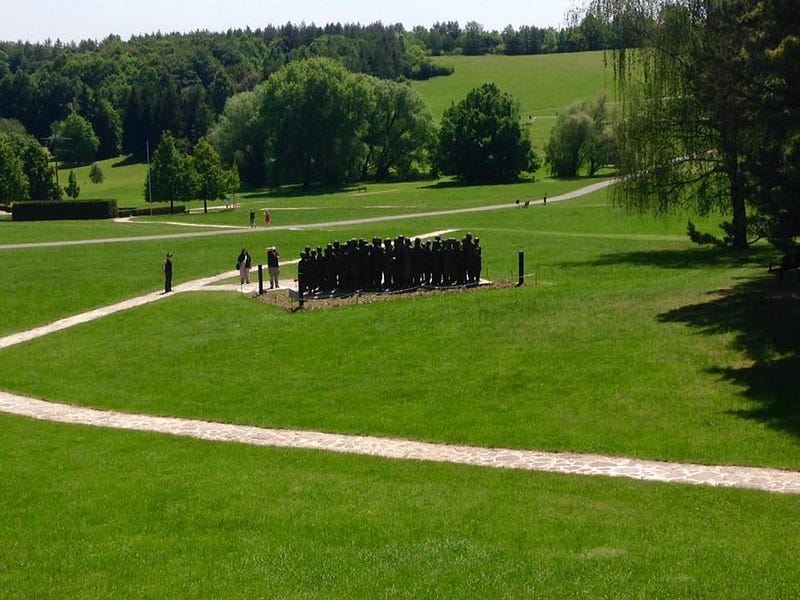
On June 2, 2017, I stood in the bright sunlight, gazing at a rolling field of green with several groves of trees and some benches that looked as if it could host a golf course.
75 years prior, on June 2, 1942, a photographer also came here, to what was the village of Lidice (LEE-deet-say) to take photos of the schoolchildren. One week later, on the night of June 9, the German army and Gestapo also came — and surrounded the village.
The village consisted of just under 500 people; a bit larger than the Iowa town where my daughter and her family live. The men, women and children were rousted from their beds, rounded up and separated. Beginning at 7:00 a.m. on June 10, 173 men, aged 15 and older, were lined up against the wall of the Horák barn, originally in groups of five, and shot. Three riflemen were committed to each target and then a Gestapo officer shot each fallen man again in the head. The next group was brought to the wall, stepping over the bodies of those before them. Because it was taking so long (more than 30 groups of men would have had to be brought forward at the original pace), the groups were increased to 10 at a time. Later, another 11 men of Lidice who were not in the village at the time were executed in Prague, along with two teens originally thought to be 14 and spared until school records revealed they had turned 15 weeks before the massacre.
203 women and 105 children were taken away. Four pregnant women were taken to the Prague hospital where Reinhard Heydrich — the Butcher of Prague and architect of the Nazi “final solution” — died after the Operation Anthropoid assassination attempt on his life that sparked the Lidice reprisal. The four women underwent forced abortions and were sent to concentration camps. The other Lidice women were sent to Ravensbruck labor camp. Orders were given so that the children of Lidice were sent elsewhere with instructions to receive minimal care. Some died quickly. Another 7 were judged to be Aryan enough to be “Germanized” and were distributed to SS families for adoption. On July 2, one month after the photographer visited them, the remaining 82 children were gassed to death at the Chelmo extermination camp.
Lidice itself was wiped from the map. The 96 homes, the church, the city hall, the school: everything was burned, then the ruins exploded, and topsoil brought in to cover it all. The graves in the cemetery were opened and looted, and the remains destroyed. The stream that ran through the village was rerouted, as were the roads leading in and leading out. Nazi propaganda proudly broadcast the news throughout occupied territory and to the West as an example for others. Several towns around the world renamed themselves in a show of support and defiance. Only a handful of Lidice women ever returned.
The Beast of Brutality is meant to serve as a warning, but even the inevitable reprisals engendered by the event cause the specific horrors to fade, leaving mainly the horror of realizing how inadequate civilization’s leash can be. We need to remember, not as a justification for future reprisals, but as a reminder for those who would blithely feed that beast or rattle its cage, thinking they somehow can control it or escape its jaws themselves. Whether they were Robespierre, or Reinhard Heydrich, or any of countless would-be beast masters, the bloody jaws will turn, yet we all suffer in the end.
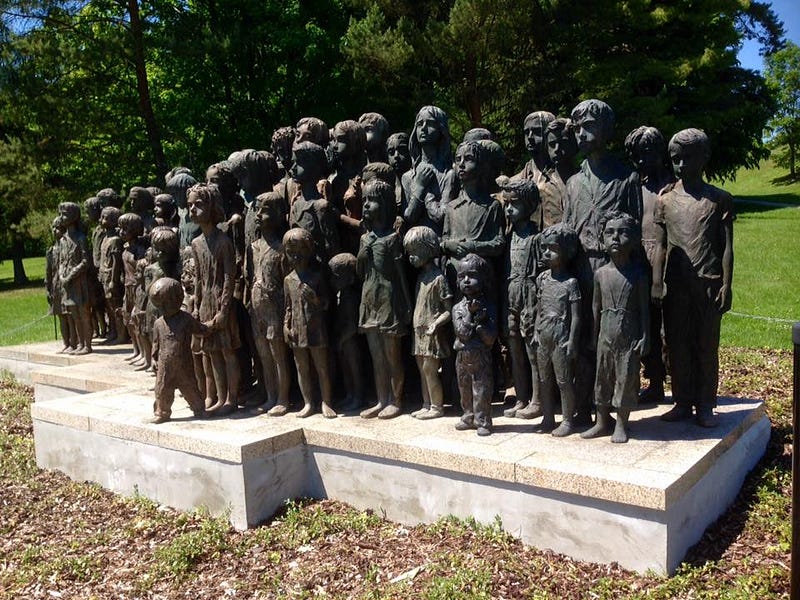
After WWII, sculptor Marie Uchytilová devoted most of her life to creating bronze statues of the murdered children of Lidice, working from the photographs taken a week before the massacre. The children now stand near the edge of their village, looking toward the mass grave of their fathers and brothers. When I stood beside them, my own eyes followed their line of sight, squinting. How could the sun shine so brightly, and the grass be so green, after what happened here? The sound of a chainsaw rising and falling in a grove below me sounded, at a distance, like the laboring diesel of a tank, or a bulldozer. And I couldn’t stop squinting.