
The Atlantic Just Claimed Married People Are Happier — Am I the Only One Who Finds That Hard to Believe?
The happy single women of the world aren’t buying this fairy tale
I just lost all respect for The Atlantic. But I’m sure you won’t blame me. How could I have any other reaction after reading staff writer Olga Kahzan’s latest piece that cites about a dozen studies in order to back up its claim that the happy people of the world are the ones with rings on their fingers.
If you’re a happy single woman like me, you likely just had to pick your jaw up off the floor.
Are we really doing this again? It’s 2023 and we’re (yet again) being subjected to one of the most well-known institutions in journalism trying to convince us that marriage is the ultimate pinnacle of joy? And seriously, we have to go through yet another round of single shaming?
Yes, apparently that’s exactly what we’re in for. And on behalf of the happy single women of the world, I can’t help but speak out.
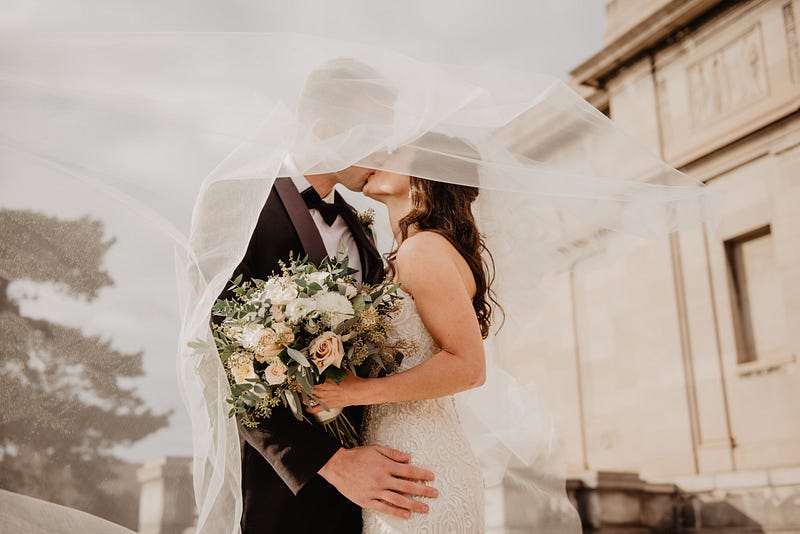
Look at that feature image. Doesn’t it just make you want to put on your coziest cabled sweater, pack up a picnic, and snuggle up with your boyfriend in the late summer sun? Isn’t this the heteronormative dream?
And apparently, if you aren’t living it, it’s because you’re an unhappy person. If you are…if you’re wearing a wedding band right now, it’s because you’re a happy person. And happy people end up married.
Or so sayeth the aforementioned Atlantic staff writer, and soon-to-be-wife Olga Khazan, as well as about a dozen researchers she cited.
It appears that the foundation of Khazan’s argument is built upon a recent study — the only study referenced in this piece that isn’t at least two decades old, I might add — by the University of Chicago’s Sam Peltzman, a professor emeritus of economics. The question on the table is: Why have Americans’ experience of happiness plunged since 2000? The alleged reason: Because fewer of us are choosing to marry.
Wait, are people happy because they’re married? Or is marriage just an inevitable destination for happy people? This isn’t the first time you’ll find yourself asking those questions, since the article doesn’t seem to be able to remember which assertion it’s making. But let’s get back to the data.
Peltzman’s 2023 study explores the “socio-political demography of happiness,” and asserted that marital status was the most influential factor in determining whether or not a person was happy — though the gap between married-unmarried and happy-unhappy was merely 30%. Incredibly, the study also asserted that gender made little difference.
Ask any married woman and I think you’d find most of them would disagree.
Better yet, check out all the studies that have found that when we’re talking about the married people who are reaping the mental health benefits of marriage, we are, by and large, talking about men.
And don’t tell me that The Atlantic isn’t aware of this. Just look at the title of the piece: Take a Wife…Please! Doesn’t that say it all?
I can’t stop wondering how this article got an editor’s approval, let alone made it to print. It’s one of the most biased and misleading articles I’ve ever read.
It concludes that “married people are happier. Period.” Is it just me or does that seem unnecessarily insistent? Like perhaps we’re trying a little too hard…?
Further, Khazan states that married people have always been happier. The research, she says, goes back decades, some of which she includes, with studies from the 1980s and 90s.
I find it to be a glaring omission to fail to mention overarching family and social trends of at least the last century. Are we going to completely ignore the evolution of the detached nuclear family as we know it today, a trend that developed in response to the industrial revolution, and its socioeconomic effects? Or the way the development of the detached nuclear family affected happiness, connection, and emotional resiliency as it separated people from their extended families and broader communities over time? (Here’s another Atlantic article that does a deep dive on this topic.)
And it’s staggering that an article that asserts that married people are happier and always have been, fails to discuss the housewives of the 1950s. Remember them? Unable to have their own bank accounts or credit cards and with very few opportunities in the job market, they didn’t really have much of a choice but to find a husband. Or are we supposed to pretend that’s not relevant?
Perhaps it’s also unimportant that there were no laws protecting them from domestic abuse or marital rape? That their reproductive medical care and any decisions made on that front had to be approved first by their husbands? Their financial circumstances, safety, and quality of life were entirely dependent upon their husbands. Is Khazan actually asking us to believe that they were happy? That the marriages of the 1950s and 1960s can — or should — be compared to today’s approach to marriage in an effort to sell the idea that marriage = happiness?
A hell of a lot has changed since 1950. And even since 2000, when American happiness began to plummet.
When you think about America’s entrance into the 21st century and all that came with it — an apocalyptic terrorist attack, massive leaps in technology including the internet, and all the socioeconomic changes that would accompany such events — it seems wildly out of touch to me to pretend that studies about marriage in the 1980s and 90s could have any significant relevance to the couples of today.
If you were to read this article without any context but the studies it references, you’d be led to believe that happiness and marriage are inevitable bedfellows — for everyone who participates in the institution.
That’s right, as Khazan and the researchers she cited believe, gender is irrelevant. It’s as simple as this: marriage = happy, single = unhappy.
I’m going to skip right over the blatant stereotyping of single people and circle back to the gender issue. Because there are too many studies and too many lived experiences telling us that happiness in marriage is all about gender.
If there’s one obvious criticism that can be made about this piece (and I’m sorry, but “one” is an incredibly generous number), it’s the total lack of specificity around the word “marriage.” Khazan is going decades back in time without any historical context and uses language stripped of any qualifiers around race, gender, educational level, religion, and financial circumstances. These are huge factors in how it affects the participants’ overall well-being.
So if we’re talking about heterosexual marriages, we know just from anecdotal evidence (i.e. watching most of our hetero friends in their marriages) that women likely entered the marriage the happier of the two…but definitely don’t remain that way half a decade down the line.
We already know, thanks to actual evidence, that men benefit more financially, emotionally, and physically from marriage — they make more money, experience more happiness, and live longer than married women. Further, divorce more often has financially devastating results for women than it does for men, which means, all told, marriage is far more of a risk for women than for men.
Call me crazy, but I’m finding it hard to believe that marriage = happiness for everyone.
Am I biased? Absolutely. I’m a 47-year-old, never-been-married, single woman who, in the throes of perimenopause, knowing motherhood is no longer an option, now sees no point in the institution of marriage. It felt important when a relationship might have included co-parenting. But today, I find no sense in spending money and filling out paperwork in order to have my relationship recognized as “official.”
Khazan, too, has her own biases. She closes her article by mentioning she has decided to marry her live-in partner of 13 years not for romantic reasons, but for the optics. “I’m tired of being a woman pushing 40 who has a ‘boyfriend,’” she confesses.
You’d think she would have noted, in support of her own argument, that she’s getting married because she’s a happy person. Wasn’t that the entire point of her article? That happy people end up getting married? And that being married makes you happier? Surely that’s a better reason than feeling “sheepish,” she says, about having a boyfriend instead of a husband in her late thirties.
Perhaps I’m misinterpreting her words, but it sounds to me like she’s admitting to feeling social pressure to get married. Kinda like what she’s inflicting on the rest of us with this unfounded, overly-romanticized notion that only happy people get married, and only married people can be happy. If she believed in her own theory so much, one might surmise she would’ve marched down that aisle twelve years ago.
If single women are, indeed, unhappy, can we talk about some real and valid reasons why? Factors that have been just as well-documented by studies?
How about the disadvantages of being solo in a society that has increasingly evolved to incentivize and support couplehood? Or the rising costs of living for single people? The widening gender wage gap that disproportionately affects single women? The increasing economic insecurity that single women face?
And what about the stigma that single women (and particularly single women without children) have to endure? Paul Dolan, a professor of behavioral science at the London School of Economics has written about this in his book Happy Ever After. He points out that marriage and motherhood are recognized as signs of success in American culture, and those women who don’t become wives or mothers (for whatever reason) are constantly subjected to scrutiny, criticism, pity, and even bullying. Just look at the way Khazan characterizes singlehood in her article to see evidence of this.
Further, as Dolan and other researchers have found, single women — particularly single, childfree women — are one of the happiest and fastest-growing demographics. Oops, I’m sorry — the happiest demographic. Does that surprise you? Again, if you’d read Khazan’s article without doing a little research on your own, it probably would. And I can’t help but feel that this is yet another glaring omission.
If you’re happy, Khazan says, you will end up married. And if you are married, you will be even happier.
Dolan has a very different take on this — one I suspect people would find to be a much more logical conclusion than Khazan’s.
He says, simply, “…if you’re a man, you should probably get married; if you’re a woman, don’t bother.” He acknowledges that there is a lot of longitudinal data that correlates marriage and happiness, but also acknowledges that times have changed.
Today, women can be happy in all kinds of circumstances — and our happiness does not have to lead to (or end in) marriage.
Yael Wolfe is a writer, artist, and photographer. You can find more of her work at yaelwolfe.com. If you love her writing, leave her a tip over at Ko-fi.
More on heterosexual relationships and the women in them:


