
THEY DIDN’T ‘FORGET’
The Astounding Story Of A Family’s Victory Over Tyrants
Hitler and Stalin stole, murdered, or otherwise destroyed almost everything they had — except their love for each other
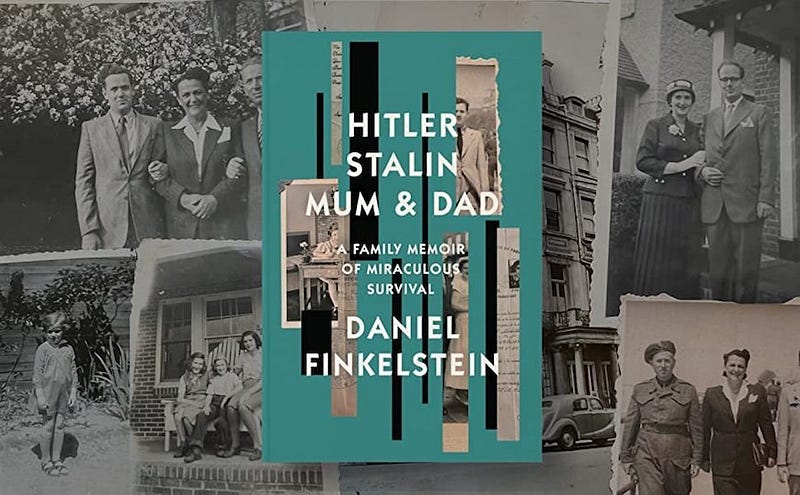
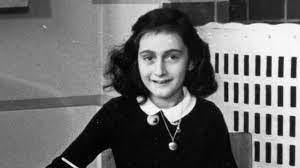
Daniel Finkelstein’s mother went to services at Anne Frank’s synagogue in Amsterdam after their families fled Nazi Germany, and the two girls attended nearby Montessori schools.
They were later imprisoned within hailing distance of each other at the Bergen-Belsen concentration camp, where Anne died not long after Mirjam had reached safety in Switzerland.
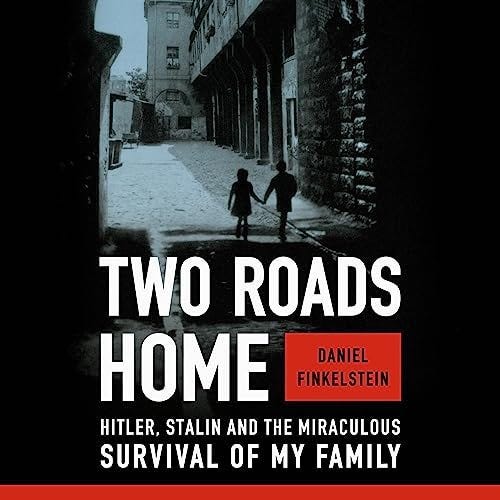
Finkelstein wisely doesn’t speculate on why death spared his mother and not the young diarist in his brilliant memoir of his Jewish family’s life in World War II, Two Roads Home: Hitler, Stalin and The Miraculous Survival of My Family (Doubleday, 2023). The facts are tragic enough in themselves.
Finkelstein, a columnist for the Times of London, rightly calls his book a story of “how the great forces of history crashed down in a terrible wave on two happy families; of how it tossed them and turned them, and finally returned what has left of them to dry land.”
But Two Roads Home is much more than that. It’s an eloquent account of how the Holocaust ravaged his mother’s side of the family and the Gulag, his father’s. It holds vital reminders of the blind eye the world once turned to tyranny.

Anyone who saw the movie “Oppenheimer” might have come away with the idea that America’s greatest moral failure in World War II involved the atomic bomb. Without saying so directly, Two Roads Home makes clear that long before the Manhattan Project took shape in deep secrecy, another colossal moral failure was occurring in plain sight: the profound inaction of the West in the face of mass murder.
Finkelstein dismisses in a few brisk sentences the idea that the Allies didn’t save the Jews because they knew too little about their plight.
In 1942, the British foreign secretary read to the House of Commons a declaration that Poland had become a “Nazi slaughterhouse.”
Finkelstein notes that “even in her attic hideaway, Anne Frank knew.” He quotes from her diary:
“Friday 9 October 1942…what must it be like in those faraway and uncivilized places where the Germans are sending [the Jews]? We assume that most of them are being murdered. The English radio says they’re being gassed.”
Yet not until 1944 did President Franklin D. Roosevelt agree to set up a commission charged with rescuing as many Jews as possible. Even then, he did so only under pressure from Congress and his Treasury Secretary Robert Morgenthau, who was Jewish and the leading voice for Jews in his administration.
As valuable as such background is, Two Roads Home never reads like a historical treatise. Finkelstein keeps a tight focus on the two branches of his family and their deeply moving sorrows and triumphs.
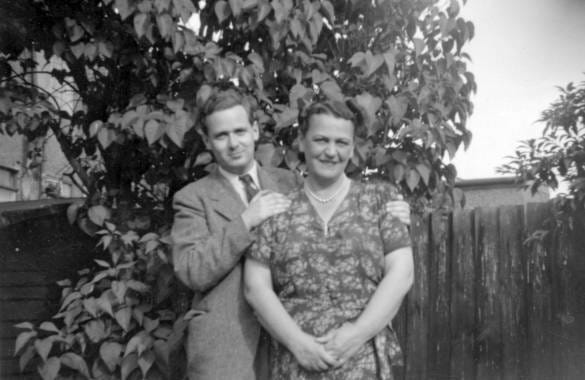
Mirjam was the daughter of a prominent German Jewish intellectual, Alfred Wiener, who created a research center on the Nazi dangers that aided British and American intelligence services during World War II. His wife, Grete, earned a doctorate in economics in the 1920s.
Mirjam’s husband, Ludwik, the author’s father, was the son of the industrialist Adolf “Dolu” Finkelstein in Lwów, Poland (now Lviv, Ukraine). Dolu’s wife Lusia had the elegance and quick wits of her mother-in-law, who avoided deportation to Siberia by bribing a guard at a train station with her gold watch and then walking off.
Finkelstein moves back and forth — with considerable suspense — between the stories of his maternal and paternal forebears. More than one chapter ends with a cliffhanger such as, “My mother, my grandmother and my aunts were trapped.”
Recognizing Hitler’s threat sooner than most others, Alfred Wiener had moved his family from Berlin to Amsterdam. But Germany’s subsequent invasion of Holland jeopardized his uniquely rich archive on the Nazis and their perils.
Wiener took the library to Britain while his wife stayed behind with their daughters to avoid disrupting the children’s lives.
It was most disastrous miscalculation the family made during the war.
Deported from Holland with her mother and sisters, Mirjam nearly died in Bergen-Belsen. She was saved by one of the many fateful turns that justifies the “miraculous” in the subtitle of Two Roads Home.
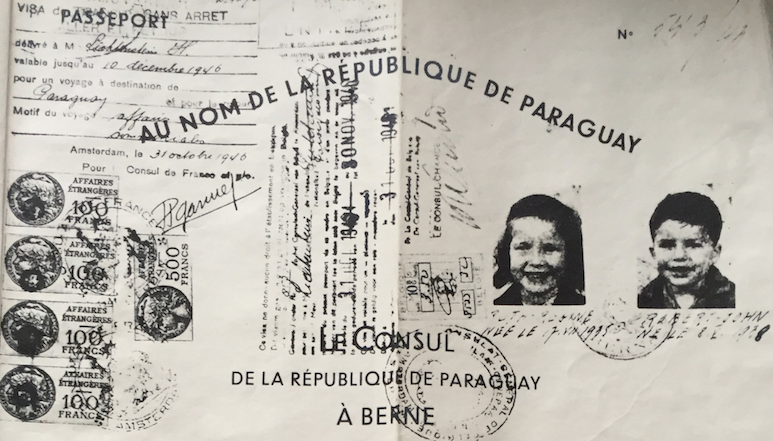
Germany was willing to exchange some Bergen-Belsen prisoners for Nazis held by the British, and Polish diplomats cooked up a desperate plan to use that reality to save otherwise doomed Jews.
The Byzantine scheme involved paying a consul for false papers identifying the Jews as residents of Paraguay, which could mask their identities. Nazis might then look the other way at the papers and set free their bearers so Germany could get its own prisoners back.
The bold but dangerous plan helped the author’s mother and Mirjam’s two sisters reach safety in Switzerland. But Finkelstein’s grandmother Grete grew so ill at Bergen-Belsen she died hours after crossing the border.
Finkelstein’s paternal relatives faced their own horrors in the Gulag.
Aiming to crush Poland, Stalin deported influential citizens like grandfather Dolu to Siberia. There Dolu became a packhorse in the bitter cold, roped to logs he had to drag through snow that might reach his knees.
Dolu’s wife, Lusia, and Finkelstein’s then 10-year-old father were sentenced to hard labor on a collective farm in Kazakhstan, 3,100 miles away, where they were forced to make adobe bricks from cow dung. Malnourished and exhausted, they lived with four others in an unheated shack buffeted by gale-force winds.
When young Ludwik grew too weak to stand and lay in a wicker basket all day, Lusia taught him the Iliad and Odyssey from memory to keep his mind alive.
Starved and physically broken, Dolu didn’t see his wife and son until Hitler invaded Russia. Then he was allowed to join a Polish unit of the British Army, which took him to Iran and later to England. By the end of the war, the family had lost their homes, fortunes, and dozens of members.
As he tells his relatives’ stories, Finkelstein puts them in global context with a moral clarity that wastes no words. A striking example involves the Wannsee Conference of 1942, which brought “coherence” to the Nazis’ previously somewhat scattershot approach to killing Jews.
One Tuesday morning, 15 “educated, cultivated” men sat around a table at a meeting led by Reinhard Heydrich, the chief of the German security police, and consolidated their plans for the “final solution.” Finkelstein writes:
“The formal proceedings lasted an hour and a half, during which the group agreed to murder all the Jews of Europe. Then they had lunch.”
Throughout the book, from its subtitle on, Finkelstein implicitly acknowledges the role luck played in his family’s “miraculous” survival amid such cataclysms. Both branches had the advantages of courage, intelligence, and a steadfast love for one another.
But millions of others had those and died under Hitler and Stalin. Two Roads Home leaves no doubt that at many points in their story, had not a luck been on his family’s side, things might have gone another way.
Perhaps no one understood that better than the author’s mother, who lost her fellow synagogue congregant Anne Frank.
Determined to live, not just ‘exist’
Finkelstein writes that when you look at what happened to his family and millions of others, you can see things that might have been done differently, “given perfect knowledge, given perfect people.”
It’s natural to wonder, amid the disasters, whether in some cases “greater decisiveness might have helped, or more imagination, or less complacency.” If-onlys abounded after the war.
“But my mother would always listen politely to such talk,” Finkelstein writes, “and then quietly reply: ‘It was the Nazis who were responsible.’ ”
For all that, during their long and happy marriage, Mirjam and Ludwik didn’t allow themselves to be defined as victims, which they saw as enfeebling.
“My parents did not forget, and ‘forgive’ isn’t the right word either,” Finkelstein writes. “What they did, instead, was to transcend what had happened to them. Because for all that we were different from other families, my parents were determined that we wouldn’t just exist, we would live.”
Two Roads Home was published in the U.K. under the title Hitler Stalin Mum and Dad.
@JaniceHarayda is an award-winning critic and journalist whose father was an English-German interpreter at a U.S. Army prisoner-of-war camp. She has been the book columnist for Glamour, the book editor of Ohio’s largest newspaper, and a vice president of the National Book Critics Circle. Her work has appeared in major print and online media including the New York Times, the Wall Street Journal, the Washington Post, Newsweek, and Salon.
Several of Finkelstein’s relatives were murdered at Sobibor, one of the less well known death camps. Here’s my brief story on that aspect of Two Roads Home:


