The Astounding Inefficiency of the Global Economy
And why this tremendous waste gives me great hope for the future.
The combined efforts of the human race will pass an amazing milestone this year: $100 trillion in gross domestic product (GDP). But don’t be fooled by the name — not all GDP is productive. In fact, the majority of global economic activity falls in one of these three categories:
- Activities with no material benefit to human wellbeing
- Activities with a clear negative impact on human wellbeing
- Additional activities to counteract self-imposed negative impacts
As this article will explain, about two-thirds of our economic efforts (and the associated environmental damages) carry one or more of these wasteful classifications, leaving only one-third for useful activity. Here is the breakdown:
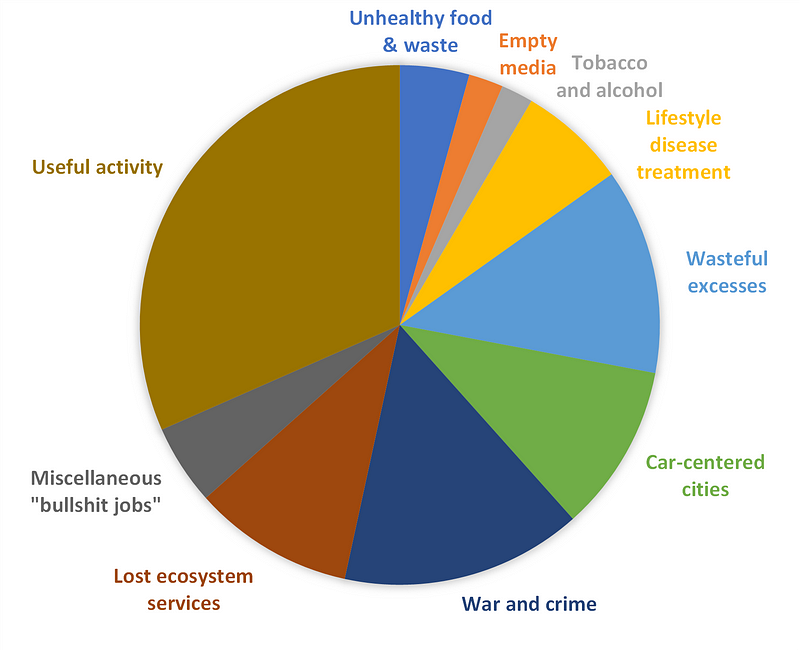
Let’s take a detailed look at each category. The sources for each estimate are detailed in the appendix for the interested reader.
Self-Destructive Habits
The first four categories (unhealthy food, empty media, tobacco & alcohol, and lifestyle disease treatment) can be broadly categorized as the direct economic costs of our self-destructive habits.

For example, someone regularly indulging in junk food will end up consuming plenty of excess calories (junk food is designed for overeating). Many years of overconsuming this slow poison strongly increase the likelihood of a wide range of degenerative diseases (appropriately called lifestyle diseases) that demand vast additional expenses to treat.
The sedentary habits and psychological challenges presented by empty media and the direct and indirect health effects of tobacco and alcohol involve similar vicious cycles. In short, we spend lots of effort making products that harm our wellbeing and then spend even more trying to repair the damage.
As reviewed later, the indirect economic costs of our self-destruct habits are even larger. And that does not even account for the pain and suffering associated with poor health and debilitating disease.
Wasteful Excesses
The 99.97% of our evolutionary history that preceded the industrial revolution gave us an incredible instinctive drive toward more consumption. In a pre-industrial world characterized by long periods of intense material scarcity, such a drive was essential to our survival.
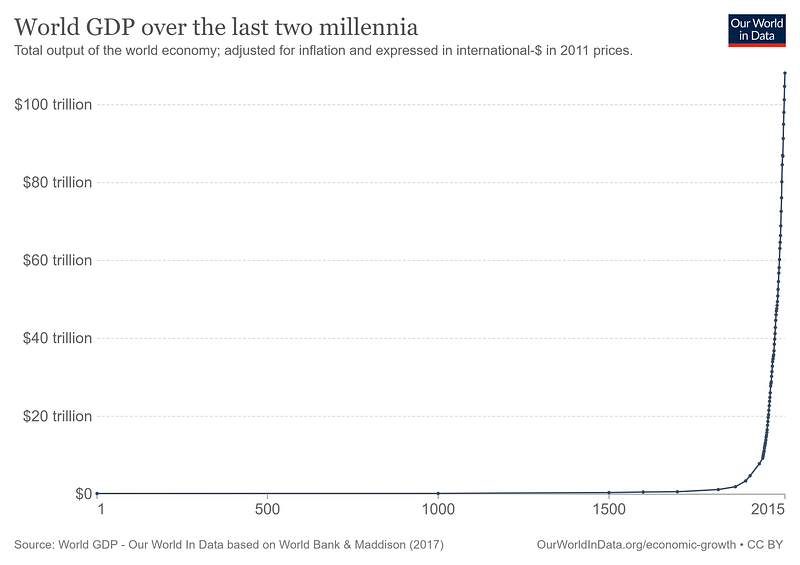
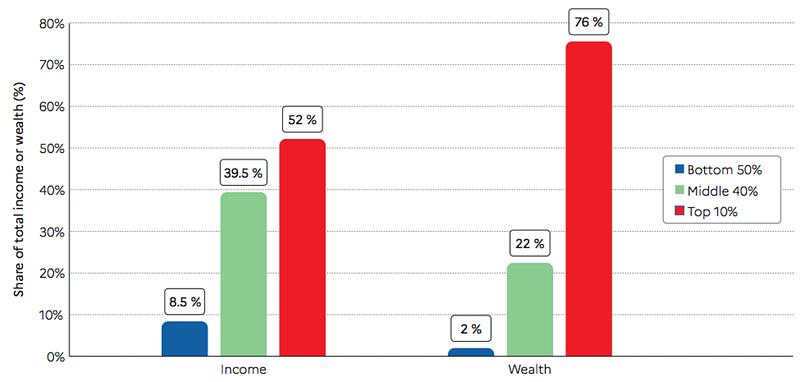
But the combined power of fossil fuels and science has now changed our world beyond all recognition. Those lucky enough to be born into wealthy societies now enjoy a level of material abundance reserved for royalty in centuries past. But our consumer instincts remain. The result is extremely wasteful spending among the top 10% of global citizens who won half of global income and three-quarters of global wealth at the lottery of birth.
There are multiple powerful forces driving our excessive consumption, including phenomena like keeping up with the Joneses and planned and perceived obsolescence, supercharged by the ubiquitous advertising industry shoving 10000 carefully tailored messages in our faces each day and financial instruments encouraging people to fall ever more deeply into debt.
And the sad thing is that such excesses, for all the extra effort and environmental damages they cause, bring no (or even negative) gains in wellbeing. Whether our excess of choice is a fancy car, an oversized house, or anything else, it gives us little other than a big debt burden and an even bigger ecological footprint.
Car-Centered Cities
Since Ford began mass production at the start of the previous century, the personal automobile has taken the world by storm. Its utility in many applications is unquestionable, helping us travel vast distances and carry large loads. But nowadays, most car use comes with costs far exceeding its benefits.
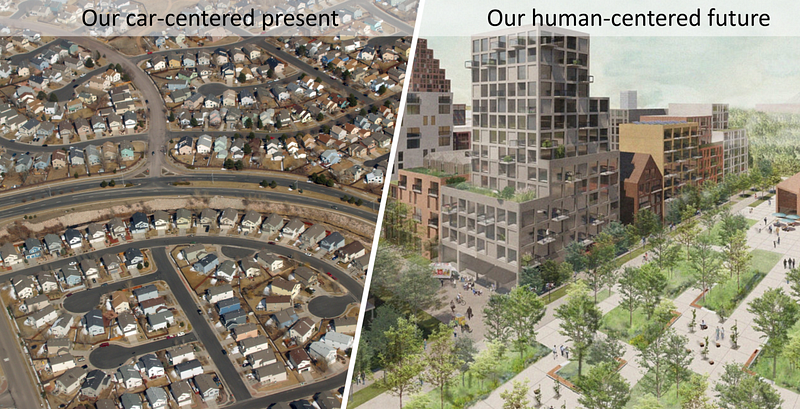
Aside from the large direct costs of car ownership, there is an impressive list of externalized costs including air pollution, climate change, time lost in traffic, health impacts from sedentary living, accidents, energy insecurity, high-value real estate occupied by roads and parking, and the mental health impacts of depressing car-centered city landscapes.
Furthermore, technology has now made “virtual mobility” a practical alternative to physical car travel for many people. The outdated model of hauling big metal boxes 25x our own weight over many miles of expensive infrastructure to go and sit in front of a computer in a distant office building that stands empty 80% of the time involves huge costs.

But car overuse persists despite all these problems, primarily because it caters to our primitive desire for perfect physical comfort and our need to display our status and individuality. In addition, many of our cities have been built for cars, making it almost impossible to live a productive life without one.
For all these reasons, the car is proving difficult to displace, even though it is unquestionable that most car trips bring costs that far outweigh the benefits.
War and Crime
There are few more wasteful activities than one group using their time, skills, and resources to destroy the lives and property of another group. In bygone ages of acute material scarcity, such behavior could at least be justified to some extent when violence was the only way to get the basics needed for survival. But today, it is inexcusable.

Yes, there remains a lot of poverty around the world, but it would cost us only a couple of percentage points of GDP to eradicate such material scarcity forever. There really is no more justification for the vast global resources we waste on war and crime, and all the associated suffering makes its continued large impact even more embarrassing.

To add insult to injury, the growing scourge of cybercrime around the world threatens to destroy the great potential of digitalization. This new wave of criminals is making a rapidly expanding contribution to useless GDP.
Lost Ecosystem Services
Few people realize how much free work we get from Mother Earth. In fact, all these so-called “ecosystem services” deliver more than twice as much value as we create ourselves. Here are the four main categories:
- Provisioning Services or the provision of food, fresh water, fuel, fiber, and other goods
- Regulating Services such as climate, water, and disease regulation as well as pollination
- Supporting Services such as soil formation and nutrient cycling
- Cultural Services such as educational, aesthetic, and cultural heritage values as well as recreation and tourism
Unfortunately, we have already done considerable damage to these free services through a wide range of environmental impacts. Hence, we need to invest plenty of additional effort to do ourselves what nature has previously done for free.
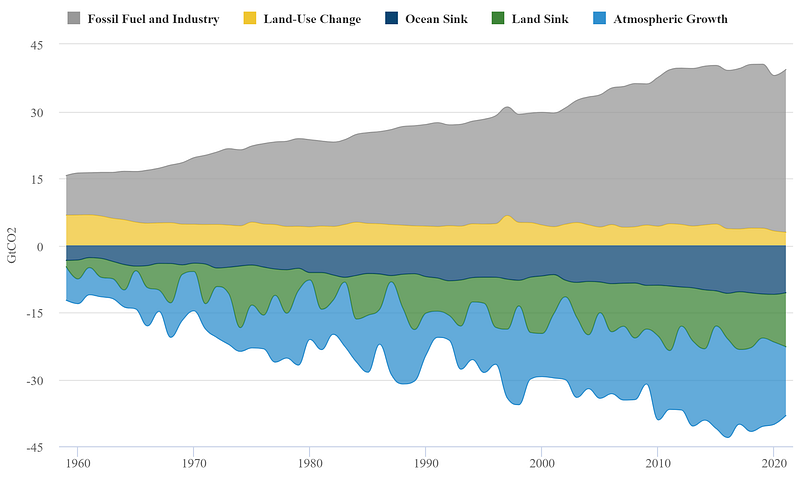
Looking only at my specialty of energy and climate, we now need to invest a lot of extra effort to find alternatives to the fossil fuels still supplying more than 80% of global energy and repair the resulting climate damages. And this cost will sharply increase over the coming decades. If we were less wasteful, the vast global fossil fuel bounty could have lasted for centuries, and the Earth could have absorbed our emissions free of charge.
Bullshit Jobs
In addition to all the unnecessary effort and environmental costs already described above, there is another more general category of useless GDP. David Graeber calls the work in this category “bullshit jobs,” broadly categorized into five types:
- Flunkies whose only real role is to make their superiors feel important
- Goons working to harm others on behalf of their employer
- Duct tapers who temporarily fix problems that have permanent solutions
- Box tickers creating the illusion that something useful is being done
- Taskmasters who manage people who don’t need supervision
There are a variety of reasons why these inefficiencies persist. Running through the list above, we could identify 1) the human ego, 2) our primitive retaliatory instincts, 3) resistance to change, 4) flawed success measures, and 5) an incentive for management to justify its existence. All these issues generate trillions in useless GDP.
Opportunity Costs
One of the saddest things about all the effort humanity wastes on the categories reviewed above is that there is such an incredible amount of important work to be done in building a sustainable and equitable global society. We need every scrap of productivity we can find, yet we waste most of what we have.
As shown below, 6 out of every 7 world citizens have yet to reach decent living standards. Furthermore, the global population is set to expand by more than 3 billion additional souls before eventually peaking. That means only about 10% of the world economy has been built to date.
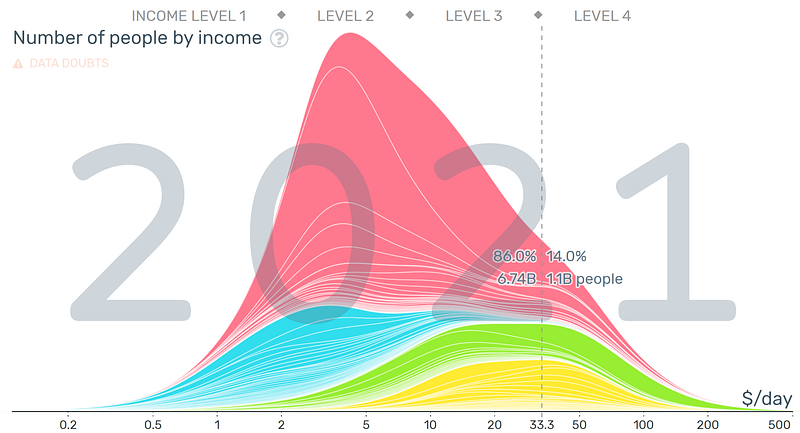
And even though we have 10x more work to do than we have done thus far, we are already pressing up against (or over) several planetary boundaries. Thus, we’ll have to get all this additional work done with far less help from Mother Nature than we have been used to.

Indeed, the opportunity costs (all the useful things we could have done instead) involved in our two-thirds of wasted GDP are truly immense.
Foregone Production
And it gets worse. All the wasted GDP reviewed above only involves the effort and resources we are currently mobilizing. The inefficiencies of our economy are robbing us of tremendous productive potential that never got deployed. Here are the three biggest examples:
- The extreme state of global inequality of opportunity (those of us born in the rich world get to consume about 10x more than the average world citizen) excludes the creative potential of billions of human minds.
- Our self-destructive habits cause tremendous productivity losses in terms of absenteeism and presenteeism and kill 15 million people from the most productive age bracket (30–69) each year.
- Our twisted relationship with work means that only one in five global employees are engaged by their occupations. The remaining 80% will put in minimal effort and lack the creative flow behind meaningful advances.
Many other sources can be identified, but the point is clear. We could have access to several times more creative and productive capacity if we could organize ourselves more effectively.
A Great Source of Optimism
All this might seem terribly depressing at first glance, but quite the opposite is true. Indeed, the fact that we are performing so dismally below our potential means that a few tweaks can unlock a massive source of latent potential. Using that potential, we can quite easily solve our greatest problems and secure good lives for 10 billion Homo sapiens (and millions of other species) for generations to come.
The solutions are not all that complicated, but there are strong forces at play that sustain our current state of gross inefficiency. For reference, here is my first attempt at identifying the best solutions to our biggest problems.
In conclusion, we have a truly gargantuan task ahead of us, but there can be no doubt that we have the potential to get it done. The only question is whether we can organize ourselves to unlock this latent potential.
Appendix: Quantification of Wasted GDP
The quantification displayed in the first figure in this article is done based on 2021, when global GDP amounted to $96.3 trillion. The following subsections give more details on the quantification of each category.
Wasted and unhealthy food
The market value of the global food industry is $8.3 trillion. Acknowledging that one-third of all food is wasted and that well over half of this food is of the very unhealthy “ultra-processed” variety that harms our health and addict people to excess calories, we can safely say that at least 50% of food-related GDP is useless or doing more harm than good. That would amount to 4.3% of global GDP.
Empty entertainment
The global entertainment industry is valued at $2.3 trillion, social media at $0.2 trillion, and the closely associated advertising industry at $0.6 trillion. It is hard to say how much of this work is useful to society. While there is certainly some high-quality entertainment that inspires and motivates those who consume and create it, there is probably even more that only wastes everyone’s time, while boosting sedentary living and social isolation. Here, I assumed that two-thirds of the $3.1 trillion total is useless or damaging for 2.2% of world GDP.
Tobacco and alcohol
These addictive products amount to $0.85 trillion and $1.55 trillion, respectively. Essentially all tobacco and most alcohol do more harm than good. A glass of good wine can certainly add value, but alcohol also does great damage to our health and social structure. I would put 80% of the combined $2.4 trillion in the useless or damaging category, amounting to 2% of GDP.
Lifestyle disease treatment
All this self-destructive behavior is the primary driver behind the global lifestyle disease epidemic. Healthcare amounts to 10% of global GDP, and lifestyle diseases account for as much as 90% of these expenses. Obviously, the healthcare industry saves a lot of lives with all this expense, but most of those lives would not need to be saved if we did not waste so much of our output on self-destructive products. Here, I assumed that two-thirds of global healthcare spending falls in this category for 6.7% of GDP.
Wasteful excesses
There is no doubt that rich folks spend massive amounts of money on things that make no (or even negative) contributions to their health and happiness, but quantifying this number is quite tricky. For this article, I assumed that two-thirds of all spending above 50 $/day contributes to useless GDP.
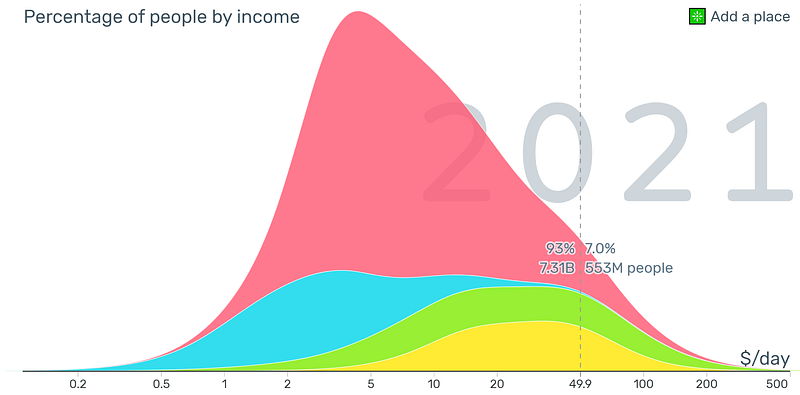
As an example, if someone spends 80 $/day, two-thirds of the part above 50 $/day (i.e., 20 $/day) gets counted as wasteful excess. Due to the extreme state of global inequality, this pointless consumption from only 7% of the global population accounted for fully 13% of total global spending.
Car-centered cities
The waste of car-centered living comes in many forms. First, there is the global automobile industry, valued at $3 trillion. Then, there are fuel costs, which, based on 27 Mbpd of passenger vehicle oil demand and an assumed cost of 3 $/gal, amounts to $1.2 trillion. Adding 33% for insurance and maintenance brings the total direct costs to $5.6 trillion.
But the larger cost contribution comes from all the additional infrastructure required to support our car-centered lives. Based on my previous estimate of car-commuter costs, I took assumed $3175 for office space, $1087 for parking, $1500 for garages, and $3000 for roads and other costs. Office and garage costs are halved from my original assessment to account for lower costs in developing countries. If we consider 3.3 billion commuters, 50% of which travel by car, the total cost comes to $14.5 trillion.
Since cars have many useful applications, I assumed that only half of the resulting $20.1 trillion cost is useless, amounting to 10.4% of GDP.
War and crime
This is a straightforward estimate composed of 10% of GDP lost to war violent crime and an additional 5% of GDP lost to the growing wave of cybercrime. Since all this effort involves harming each other, attempting to prevent such harm, and repairing the damages, this entire 15% of global GDP is classified as useless in this assessment.
Lost ecosystem services
Estimates suggest that nature produces about twice as much value as we do ourselves, and that we have already degraded 4–16% of that value. If we assume nature produces 200% of GDP and we have degraded 10% of that number, the total lost ecosystem services come to 20% of GDP. However, I will only take half of this very rough estimate as a conservative assumption.
Bullshit jobs
The bullshit jobs problem may not be as enormous as the 20–50% of global jobs Graeber suggests, so I took a more conservative estimate of 5% of GDP for this assessment.