
Art Appreciation
The Artistic Meaning of Images Within Images
What we can learn about art and the art-making experiences using meta-painting from a work of Velazquez
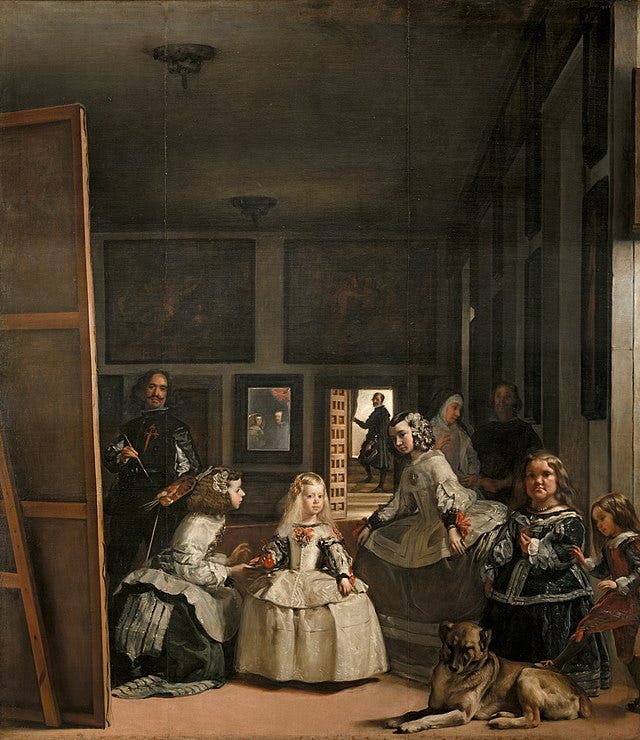
Meta painting is a way painters reveal the illusion of a painting. It has been referred to as the “self-aware” image because paintings such as Velazquez’s Las Meninas [the above image] were the forerunners of modern painting.
This may be hard to wrap your head around. But modern painting didn’t just spring out of thin air. It started way back even earlier than the 16th century. Successful modern paintings frame and isolate the image as an aesthetic object, qualifying it as a product of history.
Masterful paintings in the Louvre and other prominent art galleries worldwide are doing just this — they are isolating an image, making it beautiful, and making it eligible to transcend time.
It will floor you when you see Velasquez’s Las Meninas — the actual painting — at the Museo del Prado in Madrid. I was leveled by it when I saw it in 2014. It was in a side room off the main hallway. When I approached the painting, I noticed how low it was to the floor — maybe 2 feet off the ground.
I was stunned by that since it gave me the feeling I could smudge if I leaned toward it. Also, the placement of the painting gave me a sense of vertigo — I could lose my balance.
Then, I look upward and step back to take it all in. It is a 10-foot painting of a castle room. The width is equally enormous — 9 feet long.
When you stand before it, you feel like you are stepping into an old castle where the young princess and her attendants are standing. You feel like you are stepping back into the 16th century.
Velazquez angled the walls on the sides of the painting in such a way as to include the viewer — ME!- in the painting. As a side note, this feature of the painting has been cut by the digital image.
I was time-traveling from the 21st century to the 16th century. Wow!
It was not an easy feat to pull off, but Velazquez did pull it off.
And he pulled off more than the time travel aspect. He had the guts to place himself prominently in the painting with the king and queen — who commissioned the painting of their daughter — as mere reflections in a mirror on the back wall. This was unheard of by painters in those days.
The painting had the impact of washing time and space away altogether. You might wonder how he did this. Remember: he’s the court painter the king and queen hired to do portraits of the royal family.
Namely, portraits of them, not him! And he is an employee of the royal family. It took a lot of strength, courage, and backbone to compose a painting where he rivals the princess in greatness.
He places himself most prominently in this painting. Several other features of this painting make it one of a kind. The features I will list are the best examples of meta-painting, which reflect the very act of painting.
In this close-up view, you can see the princess and her attendants, as well as Velazquez, with his palette, paintbrushes, and paintbrush in hand. The king and queen are reflected in the mirror on the back wall.
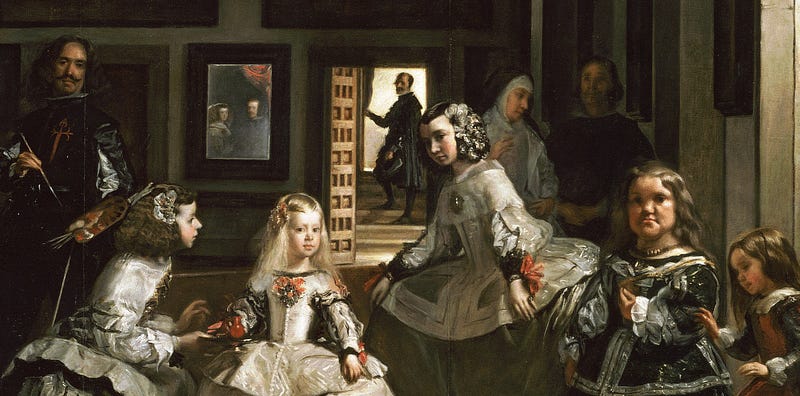
The painting reminds the viewer we are looking at a painting rather than a real object.
Look for yourself and see how many meta paintings you can identify. Here are four helpful perspectives for your appreciation.
1 — The scene is set in an art gallery, commenting on a painting.
Velasquez must have expected the commissioned work to be hung in a gallery similar to the one he depicts. He is representing the place where his own canvas would be displayed. That was unthinkable in those days.
2 — Everyone in the painting is looking at the viewer.
The painting refers to the space outside itself, thereby blurring its boundaries and playing with various levels of reality.
3 — Velazquez obscured the borders of the painting and extended them outward.
The painting runs along the same plane — namely, the wall of the Prado museum— while playing with numerous levels of reality occurring perpendicular to the painting. [You will notice the man exiting the room in the back near the right side of the canvas. That is another level of reality occurring in this painting]
4 — The perspective is moving outwards from the painting — from the unreal (e.g., the painting) — towards the viewer and the art gallery — the real.
You have to imagine the boundaries of the painting and the Prado gallery walls to get this. You see a digital reproduction framed by my blog writing and your computer screen. But it is a painting set in a different reality.
A Sample of My Personal Meta-Painting
The following photo is one of my mixed media paintings completed in September 2023 and part of a showing on November 25th in the Maine seacoast area. It is an example of meta-painting. Its title: “Theotokos,” A Greek word for “God-bearer”.
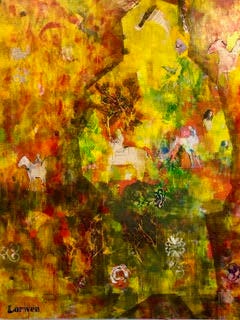
It is 72/60” acrylic on canvas. Several features of this painting carry a self-referential or meta quality.
1. The cut-out horses and riders are scenes from my childhood. Endless horseback riding days. Thus, I reference myself — the painter — at an earlier time in my life.
2. Evident paint drippings point to the painting process which is an important feature of meta painting.
3. Pieces of manuscript and print outs –mainly around Medium — are mixed into the acrylic paint. These refer to my beginning online writing experience.
4. Additionally, this painting gives reference to a critical staging process that occurs in painting. In this case, it is the layering and overlay that speaks to multiple realities and different spatial dimensions.
Conclusions and Takeaways
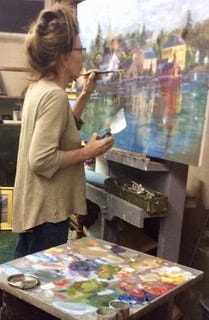
Meta paintings are paintings about the act of painting. Many times, they are about the painter himself. Peter Doig is a current painter who creates these self-reflective, self-aware paintings cast in landscape settings.
He is a world-renowned painter, getting 39 million at Sotheby's auction in the past few years. Las Meninas reminds viewers that they look at a painting rather than a real object.
Paintings are playing with illusion and are not meant to be a substitute for the real thing.
They are to create the optical effect of something real and deceive us with their realness.
However, paintings are never to imitate nature.
They are meant to enhance nature and I feel Velasquez definitely enhanced nature and reality in his painting Las Meninas.
Key Reference
The best and maybe most serious book about meta-painting is “The Self-Aware Image: An Insight into Early Modern Metapainting” by Victor I. Stoichita (Harvey Miller Pub: 2015). This is a reprint of an earlier edition. It has fabulous printed images, and I’m thrilled to own a copy.
Thank you for reading my story and perspectives on meta-painting.
Here is some information about my background.


,_Las_meninas,_1656.jpg)