
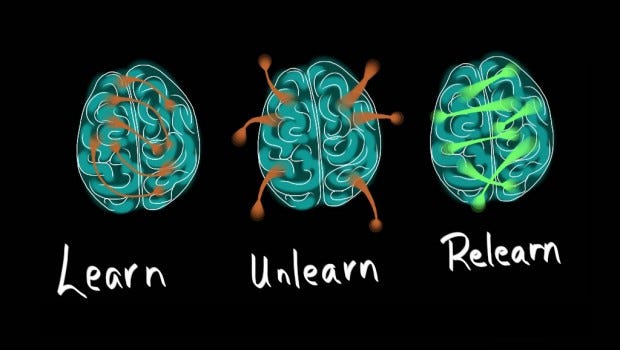
The art of Unlearning
A new paradigm of education and self-development
Durham, North Carolina, 1971. C.P. Ellis is one of the leaders of a local Ku Klux Klan group. The court has just imposed desegregation in the schools: black and white kids will have to share classes. The turmoil following the decision is to be mitigated by a committee of parents representing the different communities of Durham. A co-chairmanship for the meeting seems to be the best solution: Ellis is elected to be one of the chairmen, the other one is Ann Atwater, an activist for black civil rights.
The 10 days that followed would completely change the lives of both: in particular, by the end of the session, Ellis had decided to leave the KKK and publicly tore up his membership card. Here is an extract from an interview to Ellis (1980).
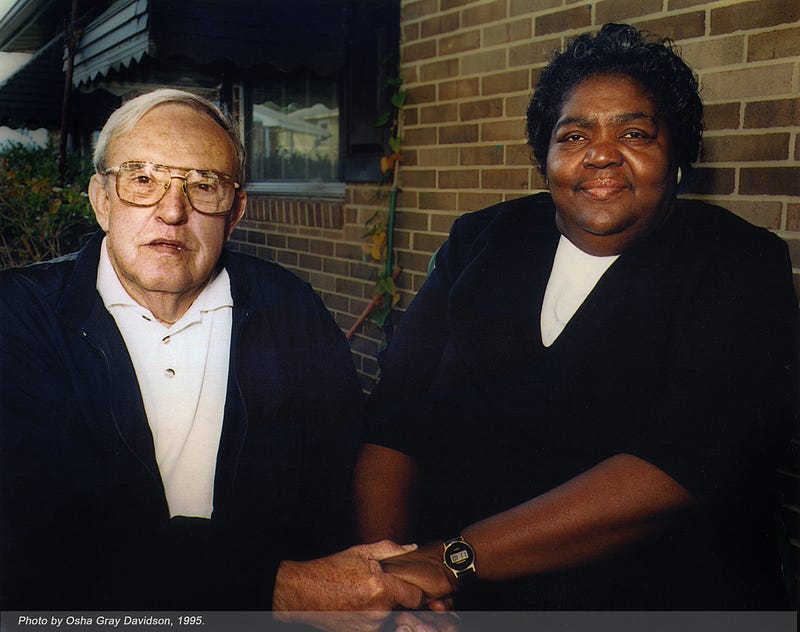
One day, Ann and I went back to the school and we sat down. We began to talk and just reflect. Ann said: “My daughter came home cryin’ every day. She said her teacher was makin’ fun of me in front of the other kids.” I said: “Boy, the same thing happened to my kid. White liberal teacher was makin’ fun of Tim Ellis’s father, the Klansman. In front of other people. He came home cryin’.” At this point — (he pauses, swallows hard, stifles a sob) — I begin to see, here we are, two people from far ends of the fence, havin’ identical problems, except hers bein’ black and me bein’ white. From that moment on, I tell ya, that gal and I worked together good. I begin to love the girl, really. (He weeps.)
C.P. Ellis had a sudden Paradigm Shift: in few days he UNLEARNED what he had learned and firmly believed across the 41 years of his life.
Here’s how I got to this subject: in two conferences I attended recently, I’ve heard two different speakers underlying the importance of “Un-Learning”.
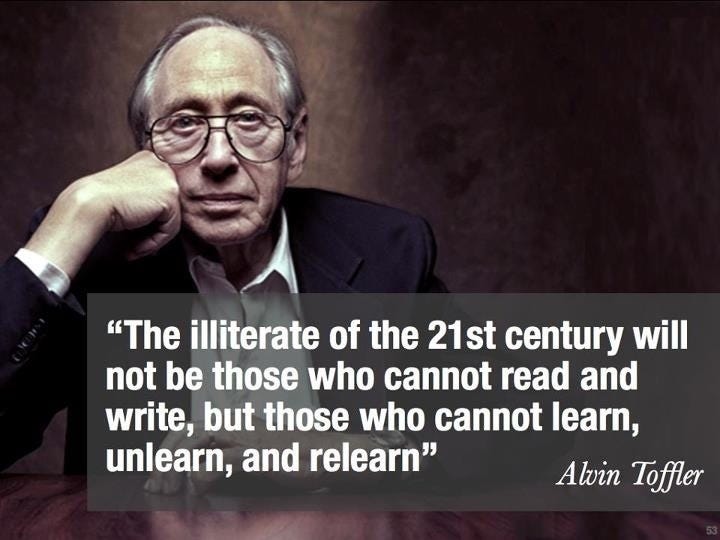
The first time it was from a renowned university rector from London. He explained that to be successful in his long career with universities and students, he had to unlearn many of the things he had learned before. The second time, during a forum on the future of manufacturing, a presenter showed the page you can see here on the left.
Both speakers were really inspiring, so I started to wonder whether I should take this seriously: what does Unlearning really mean in practice? How does it differ from Learning something new or upgraded? Or isn’t it just the same as changing a habit, belief, or behavior?
Before answering these questions, let’s start off with the definitions:
1. To put (something learned) out of the mind; forget.
2. To undo the effect of; put aside the practice of.
3. To forget and stop doing (something, such as a habit) in a deliberate way because it is bad or incorrect.
(I’ll tell you in a minute which is my favorite and why. Be patient!)
Notwithstanding my prior ignorance on the “Unlearning-ness” matter, it turns out a great deal of brilliant thinkers already produced provoking statements on this subject. You will forgive me if I report just couple a of them.

“You must unlearn what you have learned” (Yoda)
“ The most useful piece of learning for the uses of life is to unlearn what is untrue.” (Anthistenes)
I believe this topic deserves some attention, mostly because we have spent a significant part of our early years in the education systems. At the same time, the majority of us would agree that the nature of life itself is strongly bound to learning experiences, to the point that to describe this phenomenon we use words like “growing” and “development” which heavily correlate with the passing of time and its effects.
However, nobody has ever warned us we would have to UNLEARN things!
What is it, another Zen principle or something?
Well I don’t know what a Zen Master would say about that, but here is what I think: unlearning is a way of admitting we were wrong, or we have a new belief system, or we were taught something which now turns out to be incorrect, or incomplete.
Unlearning as a conscious practice is more than a mere recognition of failure or mistake, it is an ACTION. It means you’re consciously open to recognize and willing to dismantle something that didn’t work within you, or that worked up to a point and is now obsolete or not effective anymore.
That’s why I like the third definition more than the others. Remember?
“To forget and stop doing (something, such as a habit) in a deliberate way because it is bad or incorrect.”
Exactly: “in a deliberate way”! As a consequence, I guess you won’t mind if in this article I will totally overlook experiences like my unlearning of the French language, simply because I studied it 25 years ago and never practiced it again. Quel dommage.
I then started to look back into my past, and I figured out that the reason for my sudden attraction to this concept was probably driven by the fact that in the last couple of years I unlearned an unprecedented amount of ‘stuffs’ which I was taught and/or I believed being true. I also unlearned behaviors which I either didn’t know were against my overall well-being, or I was convinced I couldn’t control (“It is stronger than me” or “This is the way I am” sort of things). In other words: I sensed I kinda knew what unlearning felt like.
As a result, I’d like to share some ideas that, based on my experience, might help you in your own path to “learn, unlearn and relearn”.
1) Be Humble (i.e. understand the limits of your perceptions): don’t let your ego convince you that you know everything already, in whichever field. Or that, finally, “now you get it”. Socrates grasped this concept long time ago, when he taught the famous lesson: “The only true wisdom is knowing you know nothing”
Although there are very solid evolutionary reasons for that, we must realize that our brain is fallible, and not by a little. An increasing amount of neuroscientific studies keep showing the astonishing mass of mistakes that we incur through our sense perceptions and the respective interpretations of our brain. Most of these mistakes holds the side effect of creating biases, which we’d better be aware of.
To begin with, how reliable you think your eyes and your memories are?
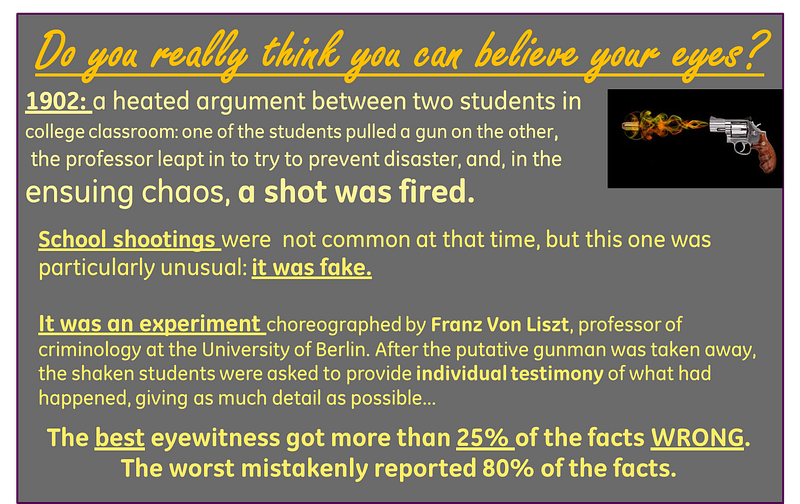
Similar experiments have been repeated numerous times with alike results.
Let me add some more fuel to the fire: researches about memory show that when we access specific memories from the past, our brain doesn’t work as a video-player but it’s actually on a subtle “edit mode”, which can be conditioned by many factors: each time some small details of the story get changed, added or removed, to the point that if you ask someone to describe the same event out of memory each year, several years later a surprising amount of details in the report of the memory would be different from the first one (see for example the study on memories from 9/11 by William Hirst).
Next time you argue with anyone who remembers the same event many years back in a slightly different way, think about it. No doubts you vividly remember you were in the kitchen when this or that happened, but please accept you might have actually been in the living room. Sorry for that.
2) Curiosity: Don’t stay on the surface of the facts, try to dig deeper, especially on those subjects that inspire you. For instance: have you just watched a great video or a fantastic TED talk? Check if the speaker wrote a book and read it. (that’s what I did with a couple of authors that inspired some of the considerations you’re reading in this article: Dan Gilbert with his “Stumbling on Happiness” and Kathryn Schulze with “Being Wrong”). Or look for other speeches and books on the same topic.
Stay up to date on the topics that interest(ed) you: sometimes you are talking to friends about something you read and struck you 10 years before… are you sure there’s no update or new theories on that subject?
Yes, I know, these attitudes apply more to a “continuous learning” approach, but the truth is that the more and the deeper you learn, the higher the likelihood that you’ll end up unlearning something which deserves so. Being curious and courageous will help you to find and adopt new perspectives that sometimes will result in discarding the past paradigms and embrace new ones.
3) Use often and wisely one of the most powerful learning tools: feedback. Even if we typically think about it in the frame of the work environment, I believe the same ideas can apply to any sort of relationship and respective communication patterns. Feedback is almost an art in itself, if we want it to serve its purpose properly.
Here are few recommendations on this matter (note: mostly they apply to “giving” feedback as opposed to “receiving”, so you might explicitly ask for these behaviors to your counterpart, or you can show him/her by giving feedback first).
- Be honest and considerate when you give and don’t be defensive when you get.
- Select people carefully. They should be relevant for the specific field or aspect you want to receive feedback on and they should have enough experience with you to be able to say something meaningful. Ask people that matter to you. Occasionally though, you might want to hear the honest opinion from someone who doesn’t necessarily seem to like you or agree with you all the time.
- Be fact-based as much as possible (“I observed that several times / occasionally / in that specific situation…”).
- When it’s more like a feeling than an observation, use appropriate words to establish it (“I might be wrong, but my perception/feeling is that…”).
- Focus on behaviors instead of shooting statements over the whole person (“Sometimes you behave in a seemingly aggressive way” vs. “You are aggressive”).
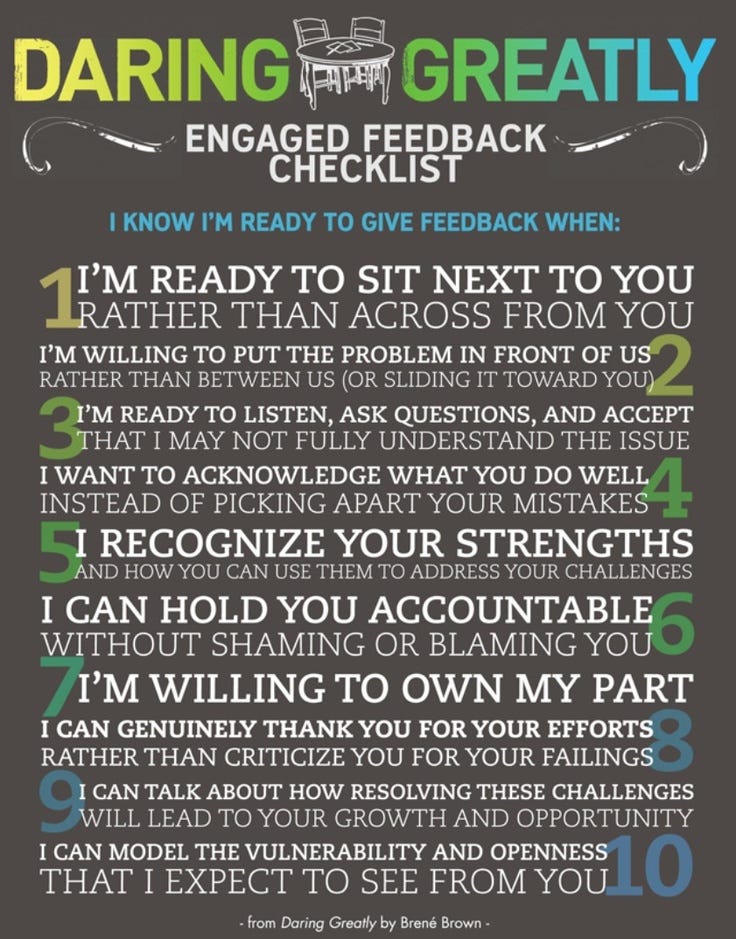
- Don’t look for excuses upon receiving a feedback which is given with grace and genuine care. Instead remember: the best response to an open, constructive feedback is “Thank you”.
- Last but not least, read the “Engaged feedback checklist” by Brené Brown, it’s a powerful, emphatic framework.
4. (Actively) Look for the other sides of the coin: this requires both humility and curiosity, and takes them to a new level. It is not just a mental exercise of simulating which alternative views or options are available, it is an actual research.
If you are particularly attracted by a scientific theory, search for articles that contradict it. Do you follow a religious creed? Learn what other religions have to say. You are part of a group in favor or against whatever ideal/party/law: listen to the opposite groups too. In other words, make true efforts to understand what it really feels like to look at the same reality through different glasses.
The key aspect of this attitude is the suspension of judgement.
That is to say: go through this process as an observer and a learner, otherwise all you will do is look for the flaws of the other side just to reconfirm your own beliefs. This doesn’t mean at all you will necessarily change them. You will probably end up staying on your position, or maybe you’ll just fine-tune it, BUT at least you will have a view of the full picture.
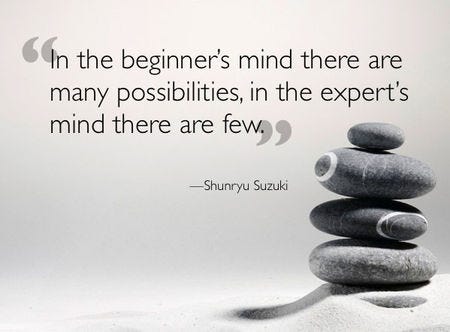
This concept applies to the realm of practical problems too: in this case you may refer to the so-called “Beginner’s mind”.
You can cultivate this frame of mind by asking naive questions, including a child’s favorite: “Why?”.
Be like a space traveler on a new, unexplored planet: would you judge the color of the sand or the composition of the air? No, you would just observe in surprise and contemplation. And then you could still decide that the conditions of that planet do not really fit you. Or maybe, they do.
This being said: it still freaks me out to realize that I will change habits, attitudes, opinions, positions and even beliefs many times in my life. As we all long for safe and solid mental positions (certainties, ideologies, dogmas, call them as you wish) to rely upon, it seems to us rather counter-intuitive to look for alternatives to those positions, to question them. The problem is really when we derive our complete identity from these positions (I am …), because more often than not they prevent us to see the interconnections and the commonalities and rather focus our attention of separateness and differences (me/us vs you).
On the other hand when I reflect on my past, I can only admit that I went through so many changes and realizations already, well beyond my expectations. And when I consider the sense of awakening and growth that I derived out of these changes, I come to the conclusion that this aspect is fundamental in a human being’s life.
Now let’s go back to C.P. Ellis, for a moment: no matter how entrenched he was in his position and beliefs, for some reason he wanted to show he could deal with the situation. I don’t want to suggest he was willing to question what he believed, but somehow the empathy mechanism clicked in him as he spoke with his counterpart. The mindset for the unlearning experience is fairly similar: you must make efforts to immerse yourself in a reality which is not yours, looking at the world through someone else’s perception lenses or with no lenses at all.
As we speak of “constructive conflict” in interpersonal relationships and in business environment, we should similarly be willing to create an internal mechanism that helps us occasionally questioning our paradigms without being scared of losing attachment to our current belief systems. Ironically, as we learn how to emotionally and mentally detach from an ideology, a creed or even a simple judgment about someone else or a situation, we will start experiencing a deeper sense of freedom.
An amount of Paradigm-shifts are waiting for us in the course of our lives, whether we like it or not. And Unlearning is often the natural consequence. If we make the Openness to Unlearn a tool to consciously navigate through life, it can serve as a catalyst, bring breakthroughs forward, and help us shaping our inner world. The Outer, of course, will just follow.
Learn, Learn, Learn. Un-Learn. Re-Learn. *Repeat*
VALE
You can find the audio version of this article here.
If you enjoyed reading this article, I would be really grateful if you could help making it visible to others too by recommending it: click on the green heart-shaped button below.