

The Art of the Endeavor
A Sit Down Approach
We all endeavor, and possibly all of us with the intended goal of success. We do. Every single one of us, every day, all the time. That’s not really a mystery to most people, but what you may find more intriguing is that every single one of us has used the exact same method of endeavor since birth — and likely even before that. I don’t mean that we each have our own unique method, I mean that we all use the same method, because there’s only one.
How could this be true? How is it possible that we have only one possible way of doing things? Honestly, I don’t know. It probably has to do with things like reality, the arrow of time, fractals, quantum entanglement, and quite possibly the number 42. But don’t worry, I won’t be talking about those things in this article.
Let’s get back to how we all use this “Universal” Method of Endeavor or U-ME, that I hyped up in paragraph one. I know what the scientific minds are thinking, “Universal? Oh, we’re going to see about this!” However, I thank you in advance and welcome your collective, analytical minds. Please alert me to any errors you might find. It would be extra enlightening if you could do it without using the method I’m about to show you, because well, that would be cheating.
First, I will introduce four random chairs:
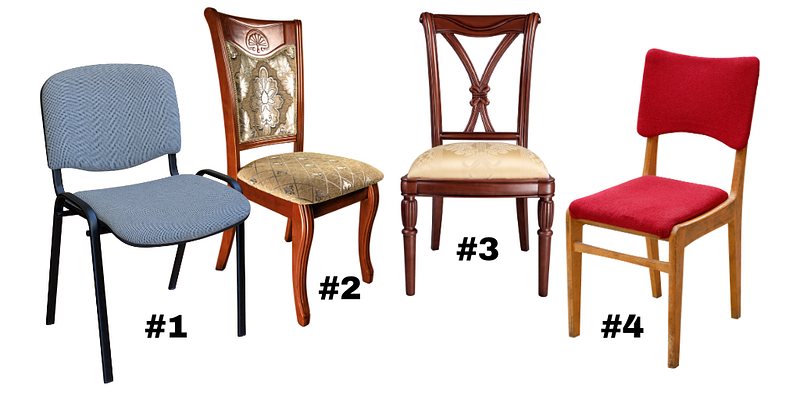
Each of these chairs will represent an activity that I will briefly describe below. I don’t want to go into too much detail because I want this just to be an overview.
Chair #1 —you sit in this chair to create a vision. You gather data, analyze it, and then produce a picture, idea or destination for the future.
Chair #2 —this chair helps create adherence. You develop structure, policies, procedures, and use discipline to stay focused on the vision from Chair #1.
Chair #3 —sit in this chair to create collaboration. You do it through communication and relationship-building. This brings in more resources for to develop the vision.
Chair #4 — this chair creates transformation through work. Remember all the talk and abstract ideas from the other three chairs? This chair is where it all gets turned into reality.
If you want to take full advantage of this U-ME, don’t sit too long in any one chair. Also, it isn’t always about going in order, but don’t leave out a chair either. If you do, whatever it is you are trying to do, won’t work.
Let’s run through some examples.
Chair #1: make a circle appear on a blank sheet of paper. Chair #2: don’t change your mind. Don’t draw a different shape. Stick with the circle. Chair #3: gather the paper and pencil. Alert your mind and body. You’re going to need their help. Chair #4: pick up the pencil. Press it to the paper and make a circle motion.
Chair #1: to make your own writing publication. Chair #2: don’t change your mind. Create the plan and stick to it. Chair #3: invite the writers. Alert the platform. You’re going to need its help. Chair #4: get the articles written. Publish them in your new publication.
Chair #1: write an article explaining something with chairs. Chair #2: don’t change your mind. Don’t get distracted. Stick to the plan. Chair #3: gather thoughts, experiences, and writing skills. Alert the publication. You’re going to need its help. Chair #4 : write the crazy article. Publish it in the publication.
Either this isn’t making any sense, or you’re starting to see that you could do just about anything with this U-ME. It’s the process that has created all the stuff around you. It created all the clothing and gadgets, all the works of art, all the books, stories, poems, and music, all the companies, probably even the universe.
The universe? Are you kidding me?
Well the trick to the four random chairs is maximization. Some beings have a really, really big vision, and other beings have smaller ones. To the U-ME, it makes no difference, because the process is the same.
Is your vision grand or humble? Are you more disciplined or less so? Are you getting a lot of help or just a little? Are you a really hard worker, or do you like to take it easy?
There’s a wide range of possible answers for each question. If your answers mix well into the process, meaning if they enhance each other, you should be fairly successful. If you’re not successful, it’s because your preferences weren’t properly balanced to get the best out of the U-ME. In other words, you took too long sitting in one chair and not enough in another.
What might happen if you sit in a chair too long You may like sitting in the first chair because you really enjoy gathering and analyzing data. But you must pick yourself up and move on to the other chairs. Otherwise, you're just always going to be a dreamer because you won’t get out of Chair #1.
You may like sitting in the second chair because you really like creating policies and procedures. Creating rules and checking to see if everyone is following them. Then creating secondary rules to ensure the first rules are being followed. If you sit too long in Chair #2, you are destined to become a micromanager.
You may like sitting in the third chair because you really like talking to people and getting to know them. You get caught up in the drama and there is always a new story to hear. You will become the chatterbox who will never get their work done, because you’re too busy talking. Chair #3 is your friend.
You may like spending a lot of time hanging out around the fourth chair. You don’t actually sit in it because you’re too busy doing things. In fact, you’ll be doing so many things that you won’t be able to stay focused long enough to make a serious impact on the workload. Because you don’t balance and focus yourself with the other chairs, you’ll spend a lot of time just rearranging Chair #4 all over the place.
Each chair represents a purpose achieved through an activity. Don’t get so mesmerized by the activity that you lose sight of the purpose. Once you have the purpose in hand, move to the next chair. Don’t overstay your welcome.
You may practice the art of the endeavor at any time, because you already know how to use each of the chairs. Wisdom will come from knowing which skills you will need to improve. Work on the chairs that aren’t your favorite, and this is how you can build a better balance in all of your endeavors.


