
The Art of the 4-Hour Workday and How to Implement It in Your Life
It’s a bit less ambitious than Tim Ferriss, but still.

We have a limited amount of time to live. We are aware of this, and we lament about it. About the speed at which weeks, months, and years go by. About the feeling that we don’t really enjoy anything.
Despite this fact, we spend most of this time working. And too often on things that don’t lit any spark in our souls.
What’s the point?
This is the observation made by Timothy Ferriss, author of The 4-Hour Workweek. He starts from the premise that our lives generally consist of work, little leisure time, and time spent with family and friends and that this is often unsatisfactory.
He has therefore developed several techniques to optimize one’s working time, resulting in the possibility of condensing an entire working week into 4 hours.
Do you really use the 8 hours of your working day?
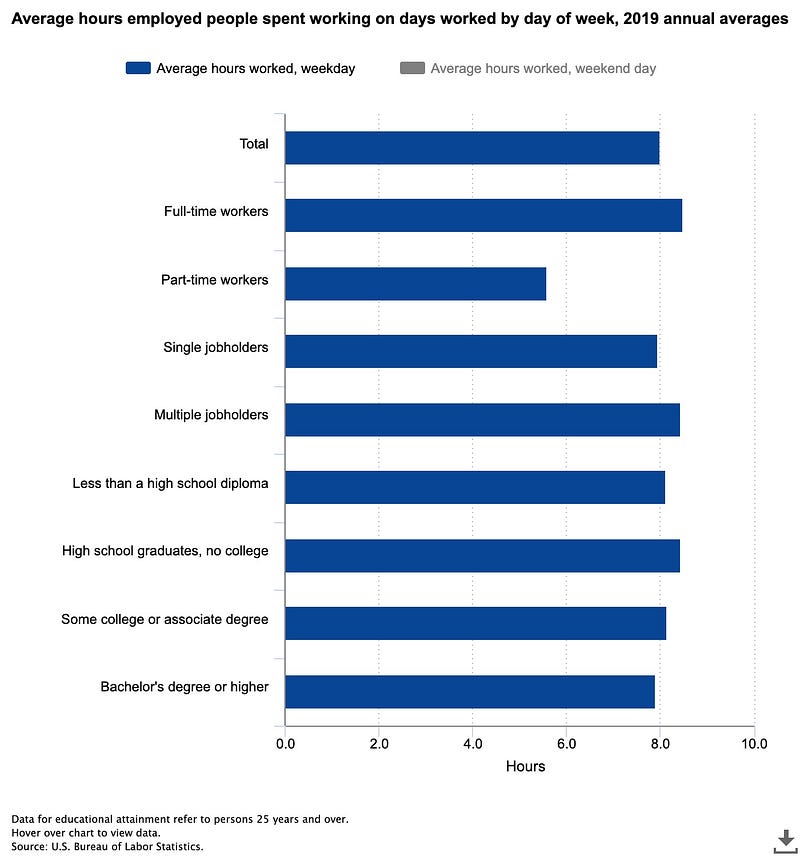
This graph, from a study conducted by the US Bureau of Labor Statistics, shows it: we literally spend our day working, on average 8 hours a day.
Well, you. Not me.
That’s a lot. It’s a third of your days. Another third is supposed to be spent sleeping. The last third, the one that is left over for “real” life, is actually largely occupied with commuting to work, doing chores, and then resting from it all. The latter often consists of imitating the zombie in front of a screen.
But you know that, don’t you? You, too, spend 8 hours working, maybe even more.
I have a question for you.
Do you really work productively, in intense focus, during the 8 hours of your working day?
Aha. No. Or you’re a superman.
Don’t you have those moments when you stay a little longer than necessary during a coffee break, or go and make a non-work-related call? Or scrolling through news sites just to “take a break”? Or answering unnecessary e-mails? Or doing low-focus tasks, just because you can’t take it anymore?
You are not alone.
- 65 percent of employees report using the internet for non-work purposes throughout the workday. (Qnnect)
- The average employee is interrupted from their work 56 times a day and spends two hours a day recovering from interruptions. (Atlassian)
- On average, employees spend about 28% of their workweek reading or responding to emails. (Attentiv)
(source: Learning Hub)
I once surprised my father.
A few months ago, my father and I had a work-related conversation. We talked about how much money I had earned this month, in relation to taxes. I was pretty proud of my score this month.
It wasn’t the part that impressed him the most.
It was when I told him that I had only worked 4 hours a day, 5 days a week to earn this amount.
I worked less to earn more. This highlights the problem of time management I mentioned earlier.
I make a good living. I earn enough to pay my rent, my car, drinks, restaurants, leisure activities, trips, and at the end of the month I always manage to put money aside.
I could double or triple my income. By doubling or tripling the number of hours worked. But I don’t see the point. I work to live, I don’t live to work.
But I refuse to spend my living earning it.
My schedule is simple: I wake up at 7. I take some time to emerge with a cup of coffee. Then I sit down and I work. I complete my most important tasks first thing in the morning. I stay focused for short periods of time. I stay organized: one complete task before moving on to the next. I give myself short breaks between each task.
I stay focused all morning. When I stop, often around 12:30, my brain is exhausted. But I’ve ticked all the boxes. I feel satisfied. I take 30 minutes to an hour before lunch to exercise and clear my mind.
The day is over.
Afternoon free.
This schedule is efficient for a very simple reason.
“Doing less is not being lazy. Don’t give in to a culture that values personal sacrifice over personal productivity.”―Tim Ferriss
I felt a bit guilty at first. We live in a society where our value is often measured by effort. We are educated to spend our days studying and then working. What did I do with my time? Was I wasting my potential? My opportunities?
Faced with this, I just looked lazy.
And then I realized.
It’s called the Pareto principle.
“Pareto’s Law can be summarized as follows: 80% of the outputs result from 20% of the inputs.”―Tim Ferriss
“Originally, the Pareto Principle referred to the observation that 80% of Italy’s wealth belonged to only 20% of the population. […] The key point is that most things in life (effort, reward, output) are not distributed evenly — some contribute more than others.” — Better Explained
By focusing on high value-added tasks, I had focused my working time on the things that really mattered.
During quarantine, I tried something else. I didn’t have anything else to do so I spent my days working. 6 to 8 hours a day. And the conclusion after 2 and a half months is: I haven’t had an ounce more results.
Maybe even less, because I was less motivated and rested in the morning, and I spent more time doing things that didn’t bring any value.
“Focus on being productive instead of busy.”―Tim Ferriss
Do you remember the maths homework from high school? We had 2 weeks to do it, but we always found ourselves the evening before, under stress, still not having started.
And yet we managed to finish everything in the time allotted.
It’s simple: give yourself 8 hours, you’ll find a way to fill them. Give yourself 4 hours with the same amount of work, and as if by magic, what used to fill 8 hours now only fills 4.
All it takes is more focus and efficiency.
I work for a living, and when I’ve earned it, I go out and live.
“Being rich is having money; being wealthy is having time.” — Margaret Bonnano
As I said, I could work more and earn more. In fact, this is what leads many people to end up spending their lives working.
The key is to estimate what you need to live comfortably. Budget your life. Work just enough to earn that amount. Then go live.
I have time to experience life. It’s crucial, especially for creative persons. It allows me to fill before pouring, transforming my experience into words. When I come back to my desk the next morning, I feel motivated, energetic, and my brain is well-rested.
Whereas when I had a day job I felt like I barely had time to go home, eat, shower and sleep before it was time to go back to the office. It was driving me crazy.
“$1,000,000 in the bank isn’t the fantasy. The fantasy is the lifestyle of complete freedom it supposedly allows.”―Timothy Ferriss
How to implement this principle in your life, even if you have a day job…
Some of you have a job that you can’t — or won’t — leave. It’s perfectly fine, as long as you’re happy.
But you can draw inspiration from the 80/20 principle and apply it to any area of your life. Apart from my working day, I apply it to one of my major projects.
My first book.
I work 1 to 2 hours a day on it, often in the evening. It’s a short time of very intense and focused work. And this allows me to make great progress day after day.
Here’s how to do it. Take what you want, throw out the rest:
- Work in short periods but with high focus.
- Eliminate distractions while you work.
- Define time slots that you allocate to specific tasks according to a specific routine.
- Complete a task from A to Z before moving on to another, with short breaks in between.
- Be organized: know what you need to do first thing in the morning, and what you need to do next. A little tip: end your workday by listing 2 or 3 tasks to be done the next day.
- Know when you are more focused. I work in the morning. But maybe you’ll be better able to work in the afternoon. Or at night. It’s up to you.
“By working only when you are most effective, life is both more productive and more enjoyable. It’s the perfect example of having your cake and eating it, too.”―Tim Ferriss
- Focus on high-value work. Answering your emails too often won’t bring you many results. On the other hand, it will suck up a lot of your time. Tim Ferriss recommends no more than twice a day.
“Working on the right thing is probably more important than working hard.” — Caterina Fake
- Perform your most important or urgent task first thing in the morning.
It’s nice to end your day at noon, knowing that you’ve worked well, that you’re mentally tired but in the right way, and that you’ve ticked all the boxes. Now you can go live, and come back tomorrow morning happy and fulfilled.


