
The Art of Scalping: An ICT Guide to Short-Term Trading
A concise guide of ICT’s High Probability Scaling mini-series.

In the world of trading, there are as many strategies as there are traders. Some prefer the long game, investing in stocks or currencies and waiting for the perfect moment to sell. Others, however, thrive on the adrenaline rush of short-term trading or scalping. This article is for the latter group.
Scalping is a trading strategy that involves buying and selling a financial instrument within the same trading day, often even within minutes or seconds. The goal is to profit from very short-term price movements. It’s a strategy that requires a keen understanding of market trends, a quick decision-making process, and a high tolerance for risk.
Before we delve into the specifics, it’s important to note that this strategy is not for everyone. It requires a significant time commitment, as you’ll need to monitor the market closely to identify opportunities. It also requires a solid understanding of market trends and the ability to make quick, informed decisions. But for those who are up for the challenge, scalping can be a highly profitable strategy.
Understanding Market Momentum
The first step in scalping is understanding market momentum. This is the general direction in which the market is moving. In the context of scalping, we’re interested in short-term momentum, which can be determined by looking at daily swing highs and lows.
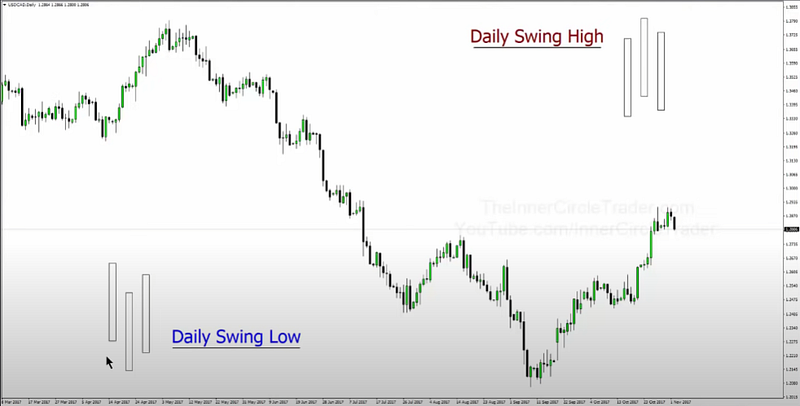
A swing high is a high point on a chart that has lower highs directly before and after it. Conversely, a swing low is a low point with higher lows before and after. These points are important because they indicate a change in market direction.
When a swing high is broken (i.e., when the price goes above the swing high), we can anticipate a bullish market momentum. Conversely, when a swing low is broken (i.e. when the price goes below the swing low), we can anticipate a bearish market momentum.
Identifying Opportunities
Once we’ve determined the market momentum, the next step is to identify trading opportunities. This is where the concept of ‘optimal trade entry’ comes into play.
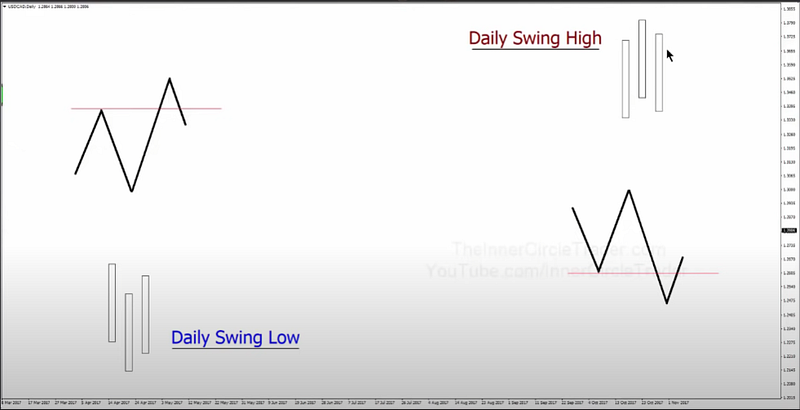
In a bullish market, we’re looking for an opportunity to buy. This opportunity presents itself in the form of a ‘daily swing low’ — a low point that has a higher low to its right and left. Once a daily swing low forms after a swing high has been broken, we can anticipate a bullish momentum.
In a bearish market, we’re looking for an opportunity to sell. This opportunity presents itself in the form of a ‘daily swing high’ — a high point that has a lower high to its right and left. Once a daily swing high forms after a swing low has been broken, we can anticipate a bearish momentum.
Executing the Trade
Once we’ve identified an opportunity, the next step is to execute the trade. In a bullish market, we’re looking to buy when the price goes above the high of the third candle following the daily swing low. In a bearish market, we’re looking to sell when the price goes below the low of the third candle following the daily swing high.
This strategy is based on the assumption that the market will continue to move in the direction of momentum. Therefore, in a bullish market, we’re betting that the price will continue to rise, and in a bearish market, we’re betting that the price will continue to fall.
Managing the Trade
Once the trade has been executed, the next step is to manage it. This involves setting a stop loss to limit potential losses and a take profit to secure profits when the price reaches a certain level.
In a bullish market, the take profit level can be set at the previous day’s high. This is because, in a bullish market, the price is likely to continue rising and could potentially reach this level.
In a bearish market, the take-profit level can be set at the previous day’s low. This is because, in a bearish market, the price is likely to continue falling and could potentially reach this level.
The Intricacies of Scalping
Now that we’ve covered the basics of scalping let’s delve deeper into the intricacies of this strategy. We’ll explore how to identify the most opportune times for trading, how to use Fibonacci retracements to pinpoint optimal trade entries, and how to manage trades effectively.
Timing is Everything
In scalping, timing is everything. The most opportune times for scalping are during the ‘kill zones’ — periods of the day when the market is most active. These periods typically coincide with the opening hours of the major financial markets.
The London kill zone is between 2:00 and 4:00 in the morning New York time, while the New York kill zone is between 7:00 and 10:00 in the morning New York time. These are the periods when you’re most likely to see significant price movements, making them ideal for scalping.
Using Fibonacci Retracements
Fibonacci retracements are a powerful tool for identifying optimal trade entries. They are based on the Fibonacci sequence, a series of numbers in which each number is the sum of the two preceding ones.
In trading, Fibonacci retracements are used to identify potential reversal points in the market. They are created by drawing horizontal lines across a price chart at the key Fibonacci levels of 23.6%, 38.2%, 50%, 61.8%, and 100%.
In a bullish market, we’re looking for the price to retrace to the 62% or 70.5% Fibonacci level before resuming its upward movement. This is known as the ‘optimal trade entry.’ Once the price hits this level, we can anticipate a bullish momentum and execute a buy trade.
In a bearish market, we’re looking for the price to retrace to the 62% or 70.5% Fibonacci level before resuming its downward movement. This is also known as the ‘optimal trade entry’. Once the price hits this level, we can anticipate a bearish momentum and execute a sell trade.
Managing Trades
Once a trade has been executed, it’s crucial to manage it effectively to maximize profits and minimize losses. This involves setting a stop loss and a take profit. ICT recommends no more than 2% risk per trade.
A stop loss is a predetermined level at which you’ll close the trade if the market moves against you. It’s a way of limiting your potential losses. In scalping, it’s common to set a stop loss at the swing low in a bullish market or the swing high in a bearish market.
A take profit is a predetermined level at which you’ll close the trade if the market moves in your favor. It’s a way of securing your profits. In scalping, the take-profit level is typically set at the previous day’s high in a bullish market or the previous day’s low in a bearish market.
In Conclusion
Scalping is a complex yet rewarding trading strategy that requires a deep understanding of market trends, impeccable timing, and effective trade management. It’s not for everyone, but for those who master it, it can be a highly profitable strategy.
Remember, the key to successful scalping lies in understanding market momentum, identifying optimal trade entries, executing trades at the right time, and managing them effectively.
Reference: Michael Huddleston’s video tutorial


