
The Art of Happiness and Personal Well-Being
A complete discussion on the nature of happiness, and the strategies to achieve well-being

Hundreds of thousands of humans are born each day into a world already occupied by billions. As with everyone who came before them, most will go through the motions of life — growing up, forging their future, and retiring in old age. Yet, despite the multitude of beings, we can safely say that nobody definitively understands how their own existence and consciousness come about. It is a subject of religion and, perhaps one day, of science based on recent studies on consciousness. However, religion or its speculation is not the subject of this article.
The next most important and central question about life that we can practically answer is how to live a happy and meaningful life. This article is dedicated to exploring this fundamental question.
Table of Contents
- Prelude
- The Four Pillars of Happiness 2.1 Materialistic Joy 2.2 Joy of Purpose and Success 2.3 Joy of Connection and Relationships 2.4 Spiritual and Physical Happiness
- The Four Strategies of Happiness 3.1 Make Suitable Decisions 3.2 Keep Yourself Busy and Invest in Yourself 3.3 Invest in the Right Relationships and Care About People 3.4 Take Care of the Body — Diet and Exercise
- Bonus Strategy — Spiritual Wealth 4.1 Embracing Bodhichitta: Expanding Purpose 4.2 Embracing Imperfection for True Happiness
- Conclusion
1. Prelude
Everyone desire happiness. In fact, we can generalize to say that the subconscious goal of everyone, and the resulting actions they take, is to achieve happiness — a psychological state of pleasant emotions — at this very moment or in the future. All of us want to avoid pain and misery and maximize our joy. Hence, the enormous web of activities we undertake throughout our lives, and even in society (such as economic progress), is aimed at increasing our overall well-being.
However well-intentioned we may be, many of us fail to maximize our individual potential for happiness. Without clearly understanding the nature of happiness and ourselves, most of us blindly follow our subconscious impulses and zombie through our lives. Blindsided by immature thinking or near-term rewards, we fail to achieve our better selves.
Ancient and modern literature sometimes promise us a path to happiness, but more often than not, they only offer a partial picture in bits and pieces. For instance, ancient scriptures often extol the virtues of inner peace, simplicity, harmony, and contentment. On the other hand, modern thinking and research focus on topics such as moderate wealth, healthy relationships, regular exercise, meaningful work, or novel experiences.
Combining both ancient and modern paradigms, this article will attempt to introduce a more holistic, and hopefully complete, picture of happiness. Without further introduction, let’s dive into happiness straight!
2. The Four Pillars of Happiness
The psychological state of pleasant emotions — a.k.a happiness — is more nuanced than what people like to believe. Oftentimes, you hear people mention something like “Money is happiness” or “Peace and health are happiness”. In truth, the business of happiness has multi-faceted dimensions and we can categorize them into 4 broad pillars.
2.1 Materialistic Joy
First of all — materialistic happiness. It refers to the most primal form of satisfaction in life — food, sex, possessions and novel experiences (like overseas travel). As subjects of evolution, all animals and humans seek out materialistic joy. Apart from being able to survive and pass down our genes, we also seek superior food, sex, possessions and experiences to satisfy our senses. This is also why people value money so much and work hard to earn it — to achieve a better life. Unwittingly, the amount of materialistic joy sometimes varies inversely with another important type of happiness which we often neglect — spiritual happiness (which we will discuss later). As such, the pursuit of material happiness sometimes, ironically blind-side us to another form of suffering that accompanies it.
Perhaps, the most direct suffering that arises from the pursuit of material happiness is expectation. In reference to the Buddhist canon, the Noble Truths explicitly talk about it — the greater the dissatisfaction, the greater the suffering. Hence, by expecting better comforts, or by relative comparison with others, we are psychologically and stealthily generating more dissatisfaction. Take a hypothetical instance: to satisfy his craving for drinking bubble tea, Alex went to his favourite bubble tea shop, only to find it closed that day. Unwittingly, Alex created disappointment for himself in pursuit of his savoury enjoyment.
Nonetheless, money and material wealth is still key pillar of happiness. While material happiness is relative — a wealthy merchant in the Middle Ages, who does not enjoy modern comforts, may still live happily relative to the farming peasants of his time—one cannot deny that technological and economic progress has brought us much comfort and higher standards of living. In fact, to the dismay of some spiritual zealots, modern research has uncovered evidence that more money can indeed buy more happiness.
Hence, the view on material happiness is not as simple as it seems. While overt greed and dissatisfaction can bring spiritual unhappiness, having the right attitude towards material gains may allow material happiness to go hand in hand with spiritual happiness, as we would discuss more later.
2.2 Joy of Purpose and Success
Another pillar of happiness is the joy of having a purpose and achieving success. It is the happiness that arises from having a clear sense of direction and meaning in life, and the satisfaction of achieving our goals and ambitions. When we have a sense of purpose, we are motivated to work towards our objectives, and the sense of progress and accomplishment that comes with success can be immensely satisfying.
This type of happiness is often linked to career success and achievements, but it can also be found in personal development, goals and passions. For example, someone who enjoys cooking may find great joy in mastering new recipes and creating delicious meals for themselves and their loved ones. Similarly, someone who is passionate about environmental issues may find purpose in volunteering for a conservation organization or leading a community project. Exploring, learning and improving ourselves is also another way to experience the joy of purpose — by challenging ourselves, going out of our comfort zone and striving to become better, we can experience a sense of fulfilment and meaning that tap into our innate desire to grow and develop.
Raising a child is another wonderful example of how purpose can bring happiness. Although bringing up a child is an arduous process, many parents find tremendous joy in seeing their child grow and develop into a healthy and happy person. The sense of purpose that comes with nurturing a child and helping them to reach their full potential can be incredibly rewarding.
The reason why purpose and success raise our personal well-being is that it is closely linked to self-esteem and self-worth. When we achieve our goals and find meaning in our lives, we feel a sense of pride and accomplishment that boosts our confidence and self-respect. This, in turn, can lead to greater success and fulfilment in other areas of our lives.
2.3 Joy of Connection and Relationships
The third pillar of happiness is happy relationships. As social animals, humans thrive on healthy and kind connections with others, be it family, friends, or romantic partners. Having strong and supportive relationships can provide us with a sense of belonging, emotional fulfilment and bonding, and even physical health benefits.
Research has shown that individuals with fulfilling relationships tend to have lower levels of stress, depression, and anxiety. In contrast, loneliness, social isolation and social friction can lead to negative health outcomes such as cardiovascular disease and cognitive decline. Therefore, cultivating positive relationships and maintaining healthy social connections is crucial for our overall well-being.
In addition, spending time with people we care about, laughing and sharing experiences together, can create lasting memories and positive emotions that can sustain us during difficult times. Having people to morally support us during difficulties, and celebrate our successes with, can add a sense of camaraderie, richness and purpose to our lives.
2.4 Spiritual and Physical Happiness
The final pillar of happiness is the combination of spiritual and physical happiness and is closely linked with our primary and psychological well-being. Spiritual happiness is more about innate joy and peace, which is sometimes connected to social/moral conscience or some higher power, beyond material needs. On the other hand, physical joy is about maintaining good bodily and mental health, so that we can enjoy life in peace, without suffering pain. Spiritual and physical happiness may well seem unrelated, but they are all about achieving psychological wellness and peace.
Spiritual happiness is sometimes associated with faith, but it is not limited to religious beliefs. Any person without a staunch religious faith can experience spiritual joy as well, by performing spiritual exercises like meditation, tolerance, gratitude, self-reflection, contentment and acts of kindness towards others. In hindsight, spirituality as a whole is about a sense of wholesomeness, satisfaction and living a life greater than yourself — universal love and the greater good. This also reinforces our sense of purpose in life, contributing to happiness. Earlier we mentioned that pursuing materialistic happiness may dampen our spirituality, but as we will explore later, this may not be true.
Physical happiness mainly involves taking care of our bodies through exercise, a good diet and addressing illness with proper care. Exercise, such as long walks, jogging and strength training, releases endorphins, so that, later on, we may feel more peaceful and motivated for work and other life activities. On the other hand, a good nutritious diet, without excessive sugar, oil and carcinogenic content, powers the brain to be in good condition. On top of these benefits, more importantly, regular exercise and a good diet may ward off a host of diseases, such as diabetes and cardiovascular diseases, in the long term allowing us to enjoy life’s activities without suffering and worry.
Hence, by taking care of both our bodies and spirits, we can achieve a deeper sense of overall inner peace and well-being.
3. The Four Strategies for Happiness
Having understood the four pillars of happiness, we would already have a good sense of what makes a good life. The overall measure of one’s life satisfaction can be seen as a mixture of the four components of happiness. They are all needed. A lack of any one of them could make life more dysfunctional. With that in mind, we will now look at some strategies that improve these pillars of happiness.
3.1 Make Suitable Decisions
Before we begin, we can agree that each individual is unique, and have different needs, perspectives and understanding of happiness. A monk and a successful businessman may come together for a conversation, but their ideals of life and happiness would be 180 degrees apart. As such, different individuals value each of the pillars of happiness differently.
While different individuals are born and brought up under different circumstances — some might be born with a silver spoon in their mouths, while others might be born into a dysfunctional family — it is safe to say the choices they subsequently make in their lives affect the trajectory of their happiness. More importantly, they must ask whether their choices align with their overall goals — or their desired pillars of happiness — in life.
To clearly know your goals — knowing precisely what you want — requires a level of maturity and acquaintance with your deepest needs. This level of sensibility typically comes from frequent reflections and deep experiences in life. As such, some pundits would encourage certain open-mindedness and early vulnerability to failures in life.
“Fail again, fail better” — Samuel Beckett
This is an important strategy because the earlier you align with your values and needs, the faster you can live your best self. The worst-case scenario is that you do not listen to your inner voice and are blind-sided by certain cultural trends and other people’s advice, and you end up going in a direction in life that is not truly satisfying. To this end, I would like to introduce a simple rule of thumb I personally adopt when making decisions:
Rule 1: Considering all options and personal needs, is this truly worthwhile?
Rule 2: Go back to Rule 1
3.2 Keep Yourself Busy and Invest in Yourself
The next strategy — keeping yourself occupied and aiming for goals — kills two birds with one stone. First of all, there are no materialistic gains — living in big houses or having a better future in general — without some form of delayed gratification and discomfort. There is no free lunch, except under exceptional fortune. As such, if your goal is material success and happiness (like many businessmen and corporate workers out there) I would say there is no easy way out except embracing discomfort and honest hard work (and, of course, work smart).
Second, a strong purpose in life comes from staying busy — not mindlessly busy, and our work should be of use to others. In fact, we can say that we derive our purpose in life from our relevance to others. Some people lose meaning in life because they fail to imagine or fathom the significance of themselves and their work. In addition, there is the bulk of the older population that refuses to retire because they realize idleness breeds unhappiness:
But sometimes even the younger population has an issue of staying busy due to procrastination, leading to unfulfilling lives. They want to achieve future success and derive purpose, but working hard in the present moment can be uncomfortable. Hence, the pain of exerting ourselves mentally and starting a productive activity or learning often leads them to distraction. However, in the long-term, the psychological pain due to lack of purpose and progress very much exceeds the initial discomfort of hard work.
To invest in yourself (learning and self-development) and hard work, I have specially created a general-purpose article on several effective strategies to develop a healthy work ethic and to counter procrastination (Hint: Read the whole article or skip to the article section on overcoming procrastination):
3.3 Invest in the Right Relationships and Care About People
The third strategy in happiness is about investing in people relations. Sometimes, in our preoccupation with work, career and materialistic gains, we might overlook or spend less time with our loved ones. Perhaps, to some people, career, monetary rewards or other endeavours might hold greater importance or attention, at a particular point in time. However, we should not get carried away because, like it or not, humans are social animals. Hence, nurturing bonds with our spouse, family and friends, and caring for them, is our primal need and should be factored into one of life’s priorities.
Nonetheless, before we invest our effort, we should also decide on the worth of any relationship. Typically we want to stay away from toxic relationships that are non-reciprocal or not constructive to our happiness. We should base our judgements on our experience and acquaintance with the other party. Listen to your heart and instinct. If associating with him or her often bring more misery, and low self-esteem than joy, then we probably need to rethink our engagement. On the other hand, healthy relationships are uplifting and allow us to share the joy in success, offer sincere advice and lend moral support in times of difficulty.
“Don’t let toxic people sabotage your happiness, ruin your positive attitude, contaminate your mind or destroy your self-confidence. Instead, surround yourself with generous, positive, and nurturing people who will lift you up.”
― Farshad Asl
3.4 Take Care of the Body — Diet and Exercise
The last strategy is the obvious, plain old grandmother’s advice —just take good care of your body. Without a sound body and mind, all foundations for other life’s endeavours and happiness are lost. As explained in the last pillar of happiness, the best way to enhance our body and mind is to exercise regularly (I generally recommend long walks), adopt a super-food diet (broccoli, salmon, nuts etc), rest/sleep adequately and do regular checkups (to detect any lingering problems). Without elaborating further, we will leave you to some recommended articles:
4. Bonus Strategy — Spiritual Wealth
We have talked a lot about happiness and strategies to maximize it. But, there is something still missing. Earlier, we have talked about spiritual happiness, and how someone who was a rich merchant in the Middle Ages (who probably lived with horrible sanitary conditions by modern standards), could be much happier than a teenager, who owns an iPhone but is jealous of his classmate’s Apple Watch.
Finally in this section, we will get to explore the spiritual dimension of happiness, in greater detail, with two bonus strategies:
- Embracing Bodhichitta (Altruism and Charity)
- Embracing Suffering, Discomfort and Imperfection
4.1 Embracing Bodhichitta: Expanding Purpose
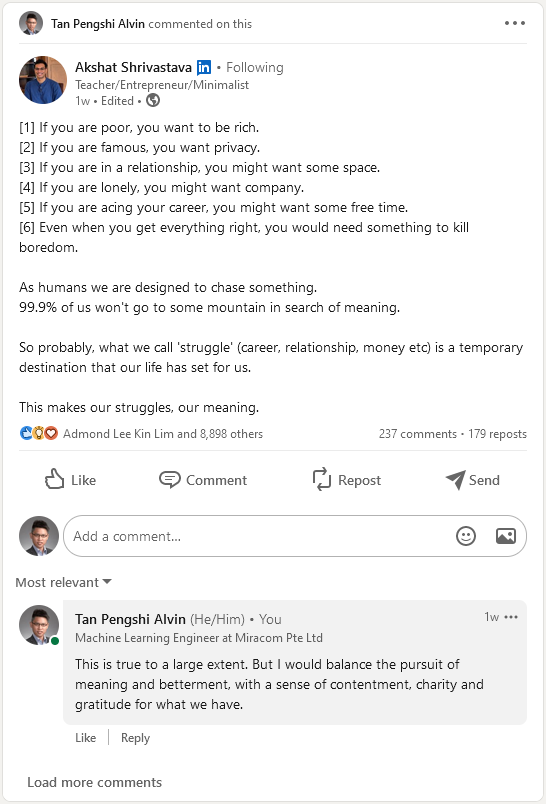
Discontent and jealousy (relative comparison) bring much spiritual pain. Yet if viewed in a different light, some people still can transform it into meaning and struggle for betterment (check out the LinkedIn post above). Ironically, reality often draws a thin line between ideas. While we often need struggle and busyness for purpose and meaning, the question is what are we busy about? If we are, always and only, busy with our own personal welfare, then we might be missing a thing or two about another dimension of happiness — spiritual joy.
Apart from contentment and gratitude — which are very important, and we should often reflect on our blessings — a bonus strategy is about altruism, charity and living a life for others. If, apart from satisfying our materialistic needs, we can re-frame the goals of our career and personal pursuits, from selfish gains to noble causes like charity or philanthropy, our lives meaning and purpose could be stretched much deeper. The meaning of success, rather than for selfish gains, then takes on new dimensions. This means that we could strive for success in our professional careers but with the end goal of serving society and noble causes.
I refer to this notion as being part of the Buddhist ideal of Bodhichitta, about which I highly encourage you to explore the following article:
4.2 Embracing Imperfection for True Happiness
The second and final bonus strategy for happiness, ironically, is about embracing suffering, discomfort and imperfection — an ancient antidote for happiness. This is also about contentment and counting our blessings.
You have heard a lot about achieving happiness and success through material gains, rich interpersonal relationships, deep purpose in life and a healthy body. Yet, even when we achieved all these and everything goes smoothly, our mind may naturally become dull, disengaged, complacent, or worse, self-entitled. Perfection in life, counter-intuitively, breeds a simmering egoistic frame of mind, which under the hood is another form of unpleasantness.
When life is getting better, embracing Bodhichitta, doing charity and serving others may offset some of this unpleasant egoism. Nonetheless, it is also extremely beneficial to be mindful that experiencing some form of discomfort and imperfection, and not always getting what we want, in daily life is necessary and may actually be a blessing in disguise — they keep us grounded, humble and contented.
This is as though imperfection is a fact of life! We can adopt strategies and craft our lives gradually to maximize our standard of living, but aiming for perfection is counter-productive and welcoming some form of discomfort and imperfection is necessary to enjoy a wholesome life.
Hence, when you would experience some unpleasant encounter — such as a rude and intruding passerby — you should take it in your stride and even be thankful for the encounter!
5. Conclusion
In summary, happiness has multi-faceted dimensions. A forest monk, whose goal is spiritual bliss, may suffer from hunger due to famine (unless you argue that he has freed himself from the psychological need for food). On the other hand, a famous billionaire who has more than satisfied his materialistic needs may be spiritually empty, or deprived of genuine social contacts. Hence, in hindsight, we should explore all dimensions of happiness, and after close introspection, decide what types of happiness are most important to us.
Although each individual is different, there are some universal strategies that can raise our standard of living and we have sufficiently discussed them. On another note, even though we can maximize our happiness, some form of suffering is always inevitable in life. For instance, the pain from delayed gratification (hard work for future happiness) or body illnesses is inescapable. Suffering is still a fact of life (a Buddhist tenet, as in the Noble Truths), and true happiness is the acceptance of suffering and doing the best with it.
Finally, while the pursuit of happiness is a skill to be learnt, it is also a very natural and subconscious endeavour. One doesn’t and shouldn’t carry the happiness rule book in their head at every moment. However, after studying it and internalizing gradually, it may well be one of the most useful roadmaps you would ever need.
Thanks for reading! I hope this article has been inspiring, a food for thought for everyone and a force for a better living. If you have enjoyed the content, pop by my other articles on Medium and follow me on LinkedIn.
Support me! — If you are not subscribed to Medium, and like my content, do consider supporting me by joining Medium via my referral link.