
The Art of Handling Negative Customer Reviews: How to Turn Bad Reviews Into Sales | Supplement Store Edition
A Simple 5-Step Process for Transforming Bad Reviews Into More Supplement Sales

In 2017, I worked with ReMARkable.
The marketing director reached out because he wanted a rewrite of their welcome sequence, hoping he could improve open and click rates.
That was my first attempt at an eCommerce email sequence. A few days after implementing my rewrite, the marketing director told me that people were buying their products at full price.
He was happy with the results.
I was not. I had failed to increase open and click rates — the purpose of the rewrite.
Over the years, I’ve grown as an email strategist and conversion copywriter. Together with their teams, I’ve been able to help other brands:
- Improve email open and click rates. One SaaS client saw a jump from 10% to 59% and a jump in click rates from 0% to 13%
- Increase email sales. One eCommerce brand reported $30,000 months with email accounting for 30% of all revenue
- Sell real estate. I wrote a two-part email sequence that sold 6 homes in a 2-week launch
Today, working with eCommerce brands is a joy.
But if there’s one thing that raises the hair of any eCommerce brand owner — especially supplement brands —, it’s receiving negative reviews.
Many small and medium-sized supplement brands don’t like bad reviews.
They fear that these reviews will damage their reputation, create cracks in customer trust, cause them to lose their competitive edge, and impact sales.
To be fair, these fears are real. But maybe you’re not looking at reviews the right way.
Why You Should Be Happy You’re Receiving Bad Reviews
All reviews matter.
Whether they are reviews of individual supplements or your brand in general, reviews give others an idea of what people think of your business. And word of mouth remains one of the most powerful marketing tools.
Most supplement brand owners know the power of good reviews, which is why it’s easy to assume negative reviews are bad for business.
But research states otherwise. In a 2014 study by The University of Chicago, the researchers uncovered two main insights regarding negative reviews:
- Customers perceived the brand in a more positive light when buyers left bad reviews with polite expressions.
- People were more willing to buy products at a higher cost after reading bad reviews with polite words
A 2017 poll also discovered that over 70% of people read reviews when they discover a brand they might want to buy from. A further 69% study reviews when evaluating products. And more than 40% use them for the final selection.
Another research material also states that over 90% of people who see only good reviews assume they are either fake or screened. And bad reviews can increase conversion rates by over 60%.
The point is, all reviews matter — good or bad.
All this makes sense if you think about it.
People who buy health supplements understand that everyone is different. Some react positively to certain ingredients. Others don’t react well to the same ingredients.
A person who sees only good reviews will be fooled if they are new to the space. Advanced buyers will become skeptical almost immediately. But when there’s a good balance of good and bad reviews, people understand they may fall in either category. And your brand appears authentic.
Also, not all 1-star and 2-star reviews are bad. Most of the time, they give people a realistic picture of the product.
A study by Yotpo discovered that after studying more than 1 million reviews, the most common negative word was “disappointed” or “disappointment.”
Most reviewers are not out there to destroy your brand. They are usually disappointed because your product missed the mark on their expectations — not because it was bad.
Take this example from Gorilla Mind
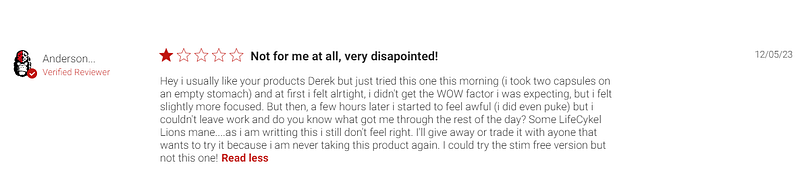
This is a 1-star review. But notice the detail. You can tell this is a real, lived account of his experience — an experience unique to him. He expresses disappointment in the product not giving him what he wanted. His goal isn’t to troll the brand or destroy its reputation.
He lets you know that although he may not be trying this product again, he’ll be trying another product from the same brand.
This might be a 1-star review, but the details make it as powerful as a 5-star.
Here’s another bad review of the same product — this time, a 2-star review:
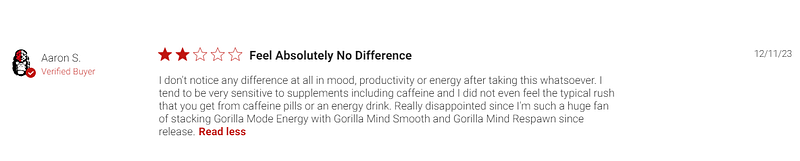
This buyer does not describe any adverse reactions. He’s only disappointed that he did not experience the “rush” he expected.
Most health supplement buyers know this is normal. Some products work for you — others don’t. This is one of Gorilla Mind’s relatively new products, so it makes sense that it would not be great for everyone.
These were the only negative reviews I could find on the product. There were over thirty 4-star and 5-star reviews of people singing nothing but praise.
The point with these two bad reviews is this:
- 1-star and 2-star reviews are not always bad for business. A mix of good and bad is a good indication of your brand’s authenticity.
- “Bad reviews” can help you sell more of your other products. The first reviewer name-dropped a different product from the same brand.
Although bad reviews can sell your products for you, that’s usually an indirect way to sell. Let me show you how to take these bad reviews and make sales from them.
A Simple 5-Step Process for Transforming Bad Reviews Into More Supplement Sales
I first learned this method of turning bad reviews into sales from a piece by Julian Foo on the Copyhackers blog. When Julian used this process:
- He brought in over 300 new paying customers from a client selling a 28-day fitness challenge
- He got 42 people to sign up for a $197 course in the first 12 hours of the launch. This was a digital marketing coach
- He sold out slots for all gym locations in two weeks for another fitness client
And he did all that by leveraging the power of bad reviews.
Here are the steps you can follow to get similar results for your supplement brand.
Step 1: Collect all negative reviews you can find and compile them
Start by searching for all the bad reviews you can find.
Run a Google search of your brand. Check your ads, posts, and groups on Facebook. Check Instagram. Don’t forget your product pages. Slack, emails, text messages, and even conversations between support and customers are good sources of bad reviews.
Collect all the negative comments and put them in one place. You can try a spreadsheet program like Google Sheets or Excel.
Step 2: Extract the pain points
Now that you have all the bad reviews in one place, go through them and highlight the pain points.
A pain point is a set of words or phrases that describes a problem your brand can solve.
For example, if people are complaining about the cost of your supplements, that’s a pain point. If people say your customer service sucks, that’s another pain point. People receiving supplements with broken seals are also pain points.
Some reviews include important extra details. For example, some might share the rationale for their disappointment or the “why” behind their unhappiness. Take note of those details.
On the other hand, comments that are too short or vague may not be useful. You’ll know a comment is useless for this exercise when you can’t identify the pain point and/or reasoning behind the customer’s disappointment. Skip those types of reviews.
At this point, you should have a file full of pain points from various types of customers across different platforms.
Step 3: Find out what people are saying about your competitors
Here, you’re going to repeat the exercises in steps 1 and 2. But this time, you’re going to focus on bad reviews from your competitors.
Why is this step important? The bad things people say about other supplement brands are fuel for your marketing — a void you can address.
The fact that people are complaining tells you that they are unsatisfied with your competitor. And unsatisfied customers want solutions — you could become that solution.
For example, let’s say you uncover that people hate the “crash” they experience after a competitor’s supplement wears off. They hate that the effect is sudden, not gradual. And it leaves them feeling groggy the rest of the day.
What can you do? You could write emails that highlight how your products wear off gradually, how people who use them feel the effects for hours on end, and how it doesn’t interfere with their sleep at night.
After you’ve compiled all your competitors’ bad reviews and highlighted the pain points, you now have two documents:
- One document with all your brand’s bad reviews
- A second document with all your competitors’ bad reviews
Step 4: Extract the most recurring points
For each document, create a table of the pain points you highlighted. Then sort them according to how often people mention them.
The table doesn’t have to be fancy. You just need to have a heading for each type of pain point. Then list the pain points from your document under the heading.
For example, “too expensive” can be a heading. Then any pain point that complains about the high cost of supplements will fall under the “too expensive” heading. All pain points that complain about slow delivery will fall under “delivery issues.” And so on.
Do the same thing with the document that contains your competitors’ pain points.
Once you’re done with the sorting, pay attention to the pain points that have the largest entries.
Create a column in each document and label it “Key Problem.” You’re going to uncover the key problems with each of the biggest pain points. These key problems are the root of customer complaints — the why.
Once you’re done filling in the “key problems” for your brand, do the same for your competitors.
At this point, you have a knowledge base explaining why people are complaining about your brand and your competitors.
Step 5: Use the data to write a 3, 5, or 7-part email series
You now have everything you need to create copy that turns negative reviews into sales.
You may use what you’ve gathered to create copy for your emails, product pages, and website. But you’ll find the best results using this process for emails. I suggest creating a 3, 5, or 7-part email sequence.
After you’ve written and sent these out to your list a few times, you can test varying the number of emails. But three to seven emails should give you optimal results.
When you write these emails, your goal should be to admit your faults while showcasing your brand’s strength.
You do that with the two documents you spent so much time creating.
Since these documents have real, lived experiences from your target audience, you can pull material from them to create copy that sells.
Your only hurdle would be the level of your copywriting skill and how you weave the data you gathered.
Here’s a crash course on writing copy to help you write your emails:
Don’t skimp on your subject line
The subject line is one of the most important aspects of your emails.
Good subject lines increase open rates — and that’s a fact.
The more people open your emails, the more people will read your emails. And if more people are reading your emails, more people can click the link to your supplement page.
Even if you had the sweetest offer or the best email copy, nothing happens if no one opens.
With this email sequence, you need to write subject lines that are brutally honest.
Choose some of the biggest pain points from your documents and use them as a base. Imagine what it’s like to live their lives.
What would you think was the biggest worry if you were in their shoes?
Let’s take the effectiveness of supplements as an example.
One of the biggest problems the 1-star and 2-star reviews highlighted on the Gorilla Mind product page was their disappointment in results.
The product page mentions how you should start feeling alert within the first 30 minutes of taking 5 capsules. Thus, anyone buying them knows what to expect. And they’d want the feeling of alertness to be noticeable. So if they don’t get the advertised feeling, they’re going to be disappointed.
Once you understand things from their point of view, try coming up with subject lines that address the problem while showcasing the benefits of your product.
Use words like “me” and “you” and not “we” or “us.” Personal words make the email feel intimate and put customers at ease.
So rather than:
“We understand you’re disappointed”
You can write:
“I am sorry”
For a brand like Gorilla Mind, which sends out the same subject lines as every other e-commerce brand, the first one might still get good opens. But notice the personal tone of the second subject line.
The point is to use the pain points you gathered to write subject lines that make it feel like a one-on-one conversation.
Once you’re done with your subject line, it’s time for the body copy.
How to Write the Body of Your Emails
You must empathize with your customers. Understand why they have those pain points.
Done right, you’ll get them feeling like you know them, like you’re inside their head. And they’ll trust you. And what do you think will happen when your customers like and trust you? They’ll give you more of their money.
But how do you come up with the body copy?
You have all the pain points of your customers and your competitors’ customers in the two documents you created.
As you did for the subject lines, try to understand things from their point of view.
How would you be affected if you experienced the problem you highlighted?
How would it make you feel?
How would it affect your personal life, relationships, and work?
In the case of Gorilla Mind, you might say things like:
After puking and feeling sick from taking it, I would be pissed
My day is ruined
I wasted my time
Once you step into your customers’ lives and make their feelings yours, you can get the inspiration you need for the body copy.
How do you transition from talking about their pain to presenting your solution in the body copy?
Show them what you’ve done to solve the problem.
You’ll need to explain that you’re trying to make sure the “pain” they felt was their last. Then you describe how they stand to benefit from your new solution.
Regarding what solutions you can offer, it can vary from brand to brand, the type of products you offer, and the biggest things your customers complain about.
Your solution can sometimes be to offer a different product. Other times, it may be to lower your price for a short period. But be cautious of using discounts. Too many eCommerce brands hand out discounts daily so yours might not seem special or genuine.
You’ll notice that your email starts as one that admits your vulnerabilities and transitions into a sales pitch for a better solution.
Remember, you need to be clear on what you’ve done to address their pain point.
Telling them you’ve done something for them will not work as well as if you told them you did A, B, and C for them and showed them what they could gain from your new solution.
Another way to make sure your copy works is to be specific.
Many people know that specificity boosts conversions. So use statistics and figures when describing your solution.
Did a customer improve his efficiency at work after taking the new supplement? By how much?
What else did they notice after taking it, and how many minutes or hours after taking the supplement did they start noticing the results?
Be specific.
Why Being Vulnerable Works in Your Favor
People are skeptical. Deep down, they have this nagging feeling that brands are out there to take as much of their money as they can, even if they have to lie to get it.
The idea that “a fool and his money are soon parted” and that they are the fool is always present.
Many brands also don’t like to show their flaws. Even if their products are not that great, they won’t readily admit it.
Which is why being vulnerable works so well.
When you send brutally honest emails, your emails stand out. And it’s not difficult to stand out when every other brand sends “Last chance” and “Flash Sales” subject lines.
This sequence also works because the emails are personal.
Using a tone your customers are familiar with — rather than the boring corporate tone — builds trust. They feel you’re trustworthy because you’re speaking like them.
Of course, you need to tweak these concepts to what works for your brand. You can also test the level of “personal” you can get away with before deciding.
How Big Brands Handle Negative Reviews
The biggest brands in the world have a knack for handling negative reviews.
Unlike many medium and smaller-sized brands that seem to worry, the largest brands seem to revel in it. And how they handle these reviews is a masterclass for any brand.
Take Apple’s Batterygate scandal.
Apple users complained that the company was intentionally slowing down older iPhones. The issue blew up. Several users on Reddit and other social media channels published posts to prove they were right.
How did Apple handle these reviews?
They could’ve swept them under the rag. But they didn’t. Instead, they released a letter tackling the issue and apologized to their customers for the trouble.
Here’s a comment from Apple admitting their fault to The Verge:
Our goal is to deliver the best experience for customers, which includes overall performance and prolonging the life of their devices. Lithium-ion batteries become less capable of supplying peak current demands when in cold conditions, have a low battery charge or as they age over time, which can result in the device unexpectedly shutting down to protect its electronic components.
Last year we released a feature for iPhone 6, iPhone 6s and iPhone SE to smooth out the instantaneous peaks only when needed to prevent the device from unexpectedly shutting down during these conditions. We’ve now extended that feature to iPhone 7 with iOS 11.2, and plan to add support for other products in the future.
Apple admits they are slowing down older iPhones. But they explain that they aren’t doing so to force people to buy newer devices.
They frame their response as a benefit to their customers, explaining how the issue stems from the older lithium-ion batteries in older devices.
To sweeten the pot, Apple offered large discounts on their batteries with zero strings attached. Talk about making lemonade out of lemons.
Netflix and JetBlue are also great examples of handling negative reviews. Reed Hastings, CEO of Netflix, publicly apologized in a very honest email when making up for how they handled pricing changes.
And when passengers of the airline were left stranded because of an ice storm, David Neeleman shot a very personal video.
Apple and Netflix have continued to experience steady growth down to this day. And Neeleman’s apology remains a good lesson in admitting your faults.
What Next?
Remember, bad reviews are not your enemy. Not only can they give you the insights you need to improve your products, but they can also be the fuel you need for increased sales.
Try the 5-step process for turning negative feedback into sales. I’d love to see your emails and their results.
Have you seen this type of email sequence in action? How have you seen other brands effectively handle bad reviews? Share them in the comments.
And if you need help with email strategy or setting up a campaign like this, fill out this form, and let’s work together.
Want more marketing tips and tricks? Subscribe to the Better Marketing newsletter The Marketing Memo here.


