
DESIGNING YOU
The Art of Designing Goals: Proven Strategies to Your Best Year Ever in 2024
Your life is the most important project you will ever work on.

Your 2024 goals are about to get a major upgrade. The game-changer will be not just setting goals like everyone else, but designing them. No more flimsy New Year’s resolutions that fizzle out by February. If you follow this method, you will build something durable, functional, and downright beautiful into your life. You will do won’t most goal-setters don’t do.
The secret is designing your goals.
When do we ever receive the proper training and guidance for setting goals? I know personally I was never taught a great way to set them. It didn’t happen in school and nobody ever sat me down as an adult to advise me. So where do we learn the art of setting goals?
As a longtime UX Designer, I’ve learned to navigate through layers of complexity to create experiences that are both delightful and intuitive. The beauty of design is that you can apply these same time-tested principles to your personal goals, and it works phenomenally well.
When you design your goals, you take them beyond surface-level and uncover the “why” and “how” of your aspirations. This approach isn’t about introducing unattainable resolutions into your already stressful life, but about fine-tuning them with thoughtful, well-designed intentions.
Your life is the most important project you will ever work on.
How will you approach it? With haphazard ideas scattered like post-it notes in a tornado? Or would you prefer a carefully crafted plan, one that considers every aspect of your life experience?
Imagine goals that fit seamlessly into your routine, enhancing your life rather than disrupting it. Goals that are intuitive and feel like they are made just for you. That’s what we’re aiming for. That’s what it means to transform from being a goal-setter to a goal designer.
If you’ve never quite managed to stick to New Year’s resolutions, this is for you. We’ll explore how to set goals that are not just aspirational but attainable, not just ambitious but actionable. By the end of this, you’ll be able to create a roadmap for 2024 that’s tailored just for you, crafted with the care and expertise of a designer’s touch.
Let’s start with an open mind and a willingness to design a year that truly reflects who you are and aspire to be.
Understanding the foundation of a designer’s mindset
In user experience design, every pixel, swipe and click is designed and placed into an interface with intention. Designers consider form and function where every element serves a purpose. Imagine applying this level of intentionality to setting your goals. You don’t need a “pretty” list of 2024 goals; rather, you want to ensure each goal serves a purpose in the grand design of your life.
A core tenet in design is empathy —
Empathy in design is understanding people’s needs, frustrations, motivations, wants, and desires. As the designer of your goals, you are both the creator and the user. Start by stepping into your own shoes (strange as that sounds), and ask yourself, “What do I really need to feel fulfilled, challenged, and happy in the coming year?”
Think beyond surface-level desires. Empathize with yourself.
Maybe you’ve always wanted to learn to play the piano, but deeper down, you yearn to express your creativity, connect with the music, and feel proud of yourself for the accomplishment.
Then, there’s problem-solving —
This is another core component of design. Your goals should solve problems in your life, not create new ones. If your goal is to get fit, but you dread working out around others in a gym, that’s a recipe to guarantee failure. Instead, find a solution that aligns with your lifestyle — perhaps you align better with home workouts, dance classes, or outdoor activities.
Your goals should solve problems, not create new ones.
Design is about simplicity and joy —
It’s finding the most straightforward, enjoyable path to your desired outcome. This principle is golden for goal setting. If your goal is to read more, don’t simply pick a book. Create a cozy reading nook, join a book club, or integrate audiobooks into your daily commute. Make the journey towards your goal as delightful as the outcome.
By adopting a designer’s mindset, you’re already part way there. You’re setting the tone to design success into your life. This approach transforms goal setting from a flashy checklist to an exciting process of designing a year that resonates with who you are, what you want to achieve, and who you want to become.
Design your goals, design your life

Let’s get to work.
You are YOUR design project, so you have to own it. You have to want to see success come. Take the wheel. Your life is the canvas and your aspirations are the blueprint. The first step is clarity and getting ultra-specific. As with design, vague concepts don’t translate well into successful outcomes. Instead, define your goals with the precision of a pixel-perfect design.
Let’s break this down into four easy steps.
Step one, define —
Start by pinpointing exactly what you want to achieve. Write it down. Is it learning a new language, getting into shape, or launching a side project
Specificity is your ally.
Let’s say you want to improve your physical health.
Rather than a nebulous “get fit”, set a concrete goal like “I will sign up for and run a 5K by June” or “I will attend three yoga classes per week for the next three months”. This is what a designer might call a design brief— something clear, measurable, and with a set timeline.
Step two, do a bit of research —
But how do you ensure these goals align with your life? That’s where research comes in — which means self-reflection — the research of you.
Become your self-ascribed research assistant.
Geek out on the make-up of you. Research your current lifestyle, commitments, and preferences. If you’re not a morning person, planning an early morning run might not be the best fit. Instead, design a goal that fits into your routine, like an evening gym session or a lunchtime walk.
Step three, implementation is key —
For each goal, create a mini-action plan. Ambitions are great, but execution is where the magic happens. For the 5K goal, it could be a gradual training plan starting with shorter runs and building up over weeks. For learning a new language, it could involve scheduling regular practice sessions or using a language learning app daily.
Step four — create feedback loops —
In design, we iterate based on customer feedback. Apply this to your goals. Set regular intervals to review your progress. Are you on track with your training plan? How do you feel after each run? Adjustments are not only okay, they’re expected. Just like refining a design, refining your approach to your goals is a sign of responsiveness and adaptability.
Setting your goals like a designer means being specific, realistic, and adaptable. It’s about crafting goals that fit into your life’s design, not the other way around. This approach turns goal setting from a daunting chore into an exciting project, where each goal is a milestone in the masterpiece of your year.
Prototyping your goals — the designer’s secret sauce
Prototyping in design is how we turn concepts into tangible forms for testing and refinement. It’s the secret sauce of bringing great designs into the world. The same methodology works for your goals.
Prototyping allows you to quickly put ideas out into the world and break down your ambitious endgame into smaller, manageable parts. This approach allows you to test and adjust rapidly without being overwhelmed by the magnitude of the final goal.
Let’s revisit the 5K running goal —
Instead of focusing solely on the end race, break it down. Start by establishing a baseline — how far can you comfortably run right now? From there, develop a weekly plan that incrementally increases your distance. This week, it might be running half a mile, next week one mile, and so on. Each of these smaller goals is a prototype, a step in the design process of achieving your larger goal.
Apply this prototyping principle to any goal —
Want to master cooking? Start with one new recipe per week. Looking to learn new software or learn to code? Set an initial goal of completing one tutorial or project per week. These prototypes are drafts to prove the concept— not final products. They’re crucial steps in understanding what works, what doesn’t, and how you can improve.
The beauty of a prototype lies in its flexibility —
In design, if a concept isn’t working, we go back to the drawing board. If your plan isn’t working, tweak it. If running a mile a week is too much at first, scale it back. It’s about progress, not perfection.
Each mini-goal achieved validates your approach, building your confidence and momentum towards that final, polished goal. This process makes your ambitions more attainable, less intimidating, and much more fun!
Testing and gathering feedback is how you improve

Testing and feedback are crucial for refining and perfecting a product in design. The same principle is vital for achieving your goals. You have to regularly check in with yourself to evaluate your progress and make necessary adjustments. This process turns goal setting from a static task into a dynamic, responsive journey.
What does this look like? —
Let’s say you’re working towards that 5K run. Set a regular interval, like every Sunday night, to assess your progress.
- Are you managing to increase your distance?
- How do you feel during and after each run?
- Are there any recurring challenges, like a lack of time or motivation
These check-ins are your testing phases, where you gather data on your performance and experience.
Seek feedback—
In design, feedback comes from customers, but in personal goal setting, it can come from friends, coworkers, family, or even a coach. Share your progress and challenges with someone you trust. They might offer insights you hadn’t considered, like suggesting running in the morning if you’re too tired in the evening, or recommending a great training app.
Be responsive to what you learn —
If something isn’t working, permit yourself to adjust your approach. In design, we call this “iteration”. Maybe you need to alter your training schedule, find a running buddy for motivation, change up your music choices, or change your running route for variety. To do this isn’t admitting defeat; it’s smart, agile goal management, just as a designer iterates on a product based on customer feedback.
This testing and feedback phase is a powerful tool for staying on track and continuously aligning your efforts with your ultimate goal. It keeps your mind focused on your goals and provides a motivational loop of ways you can continuously iterate and improve.
Implementing and tracking
Think of implementing and tracking your goals as the deployment phase in design — where your plans and prototypes come to life. In design, we rely on tools to bring our creations to fruition and monitor their performance. Similarly, for your goals, selecting the right tools to track your progress is crucial.
Find what resonates with you and fits into your lifestyle —
If you’re tech-savvy, a fitness app might be your go-to for tracking runs or workouts. These apps often provide visual progress reports, making it easy to see how far you’ve come. For the more traditional, a journal could be your choice. There’s something uniquely satisfying about physically writing down your achievements. Or perhaps a spreadsheet is more your style, especially if you love data and trends.
Whichever tool you choose, the key is consistency in tracking —
Regular updates provide a real-time snapshot of your progress. This visibility provides you with accountability and consistent doses of motivation. Each entry and data point is a rewarding testament to your effort and commitment.
Don’t forget to celebrate the small victories —
Completing a tough workout, adding a new recipe to your cooking repertoire, or finishing a chapter of a tutorial — these are all milestones worthy of celebration. Celebrating these moments keeps your self-esteem high and turns your goals into enjoyable and rewarding experiences.
The 10-step guide to design your 2024 goals
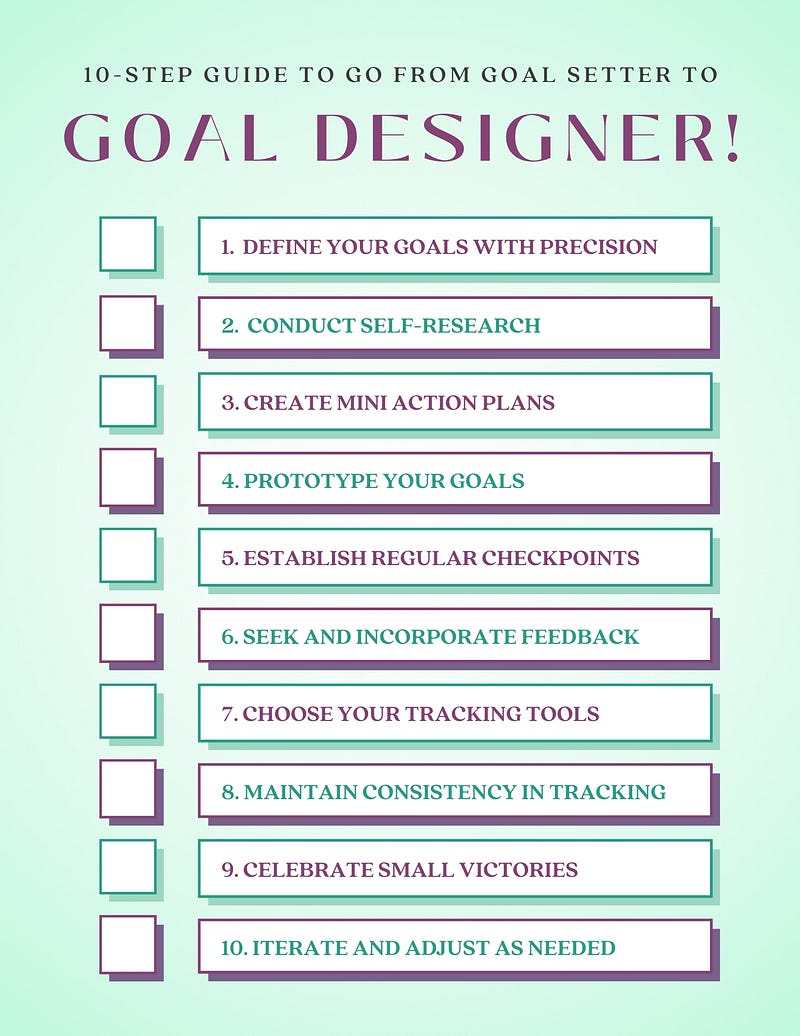
Let’s summarize what it means to be a goal designer, not just a goal setter.
- Define your goals with precision: Identify exactly what you want to achieve this year, like running a 5K or learning a new language. Be specific and write it down.
- Conduct self-research: Reflect on your lifestyle and preferences to ensure your goals align with your routine and habits. Choose goals that fit your daily life, not the other way around.
- Create mini action plans: Break down each goal into smaller, manageable steps or actions. For example, start with shorter runs before the 5K or learn a few phrases a week in a new language.
- Prototype your goals: Treat each mini-goal as a prototype. Start with achievable steps and build gradually, allowing room for adjustment and improvement.
- Establish regular checkpoints: Set a schedule to assess your progress, like every Sunday night. Use this time to reflect on your achievements and challenges.
- Seek and incorporate feedback: Share your progress with trusted individuals and be open to their insights. Adjust your strategies based on the feedback you receive.
- Choose your tracking tools: Select tools that resonate with you, such as fitness apps, journals, or spreadsheets, to monitor and visualize your progress.
- Maintain consistency in tracking: Regularly update your chosen tracking method to get a real-time view of your progress, ensuring accountability and motivation.
- Celebrate small victories: Acknowledge and celebrate achievements, no matter how small. These milestones are crucial for maintaining motivation, self-esteem, and momentum.
- Iterate and adjust as needed: Be flexible and willing to tweak your approach if something isn’t working. Remember, it’s about progress and adaptation, not perfection.
Designing your goals transforms them from superficial ideas into a beautifully designed reality in your life. With the designer’s approach, you’ve equipped yourself with strategies not just to set goals, but to bring them to life with intention, creativity, and practicality.
Here’s to a year where your aspirations are not just pipe dreams on paper but are designed into your daily life, making 2024 your most accomplished and fulfilling year yet. Design your way to success!
If this story helped you, consider signing up for Medium membership. For just $5/month, you get unlimited access to articles from thousands of amazing writers. If you sign up with my link, I earn a small commission. This helps me make sure I keep writing quality articles! I’m so thankful to all of you!
Mike Curtis is a Sr. UX Designer helping amplify people & products through design. He is the author of The You Design System which teaches how to design The UX of You. With 22+ years of design, marketing, e-commerce, and UX experience, his passion is helping people & businesses apply their skills to the way they’re experienced by others. Connect with him on LinkedIn, Instagram, Twitter, or follow his writing on Medium.


