
‘The Art Merchant’ Seeks ‘Vengeance’ — Maybe
A new British thriller writer emerges
Book series review:
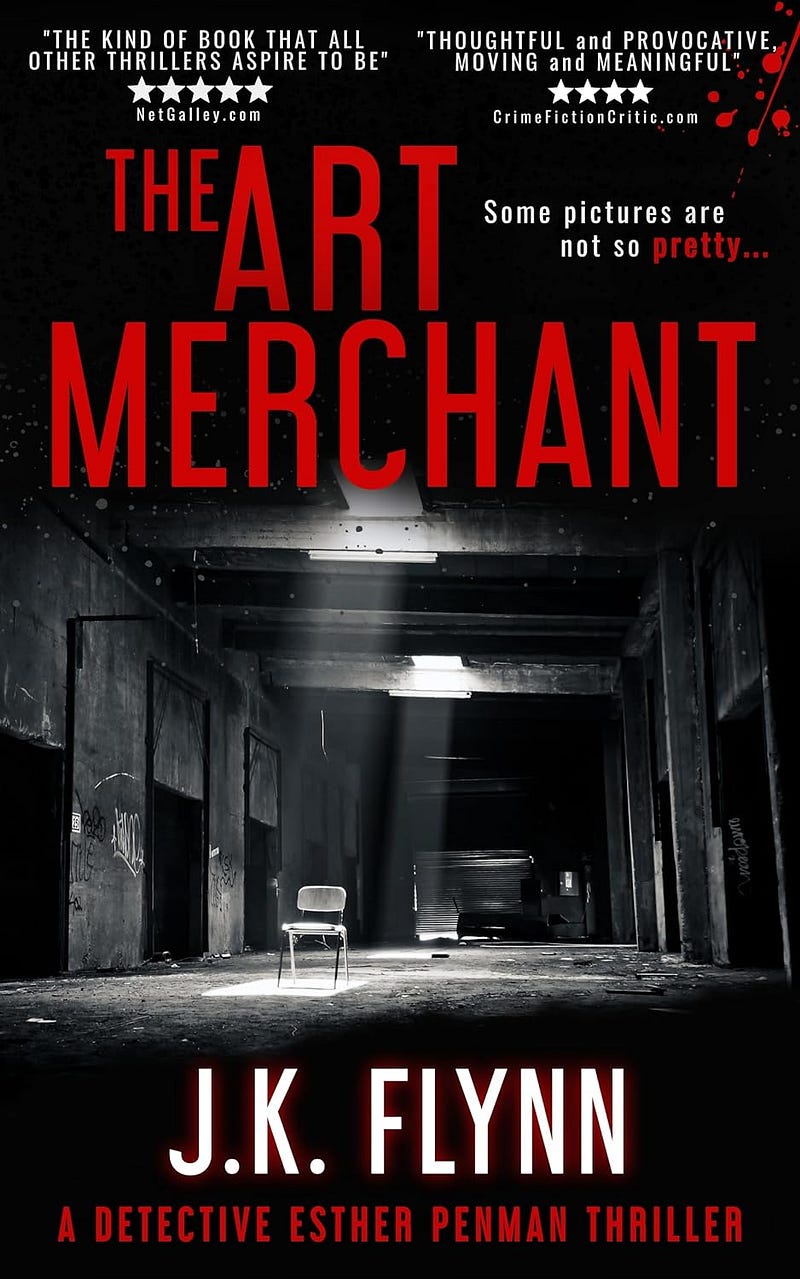
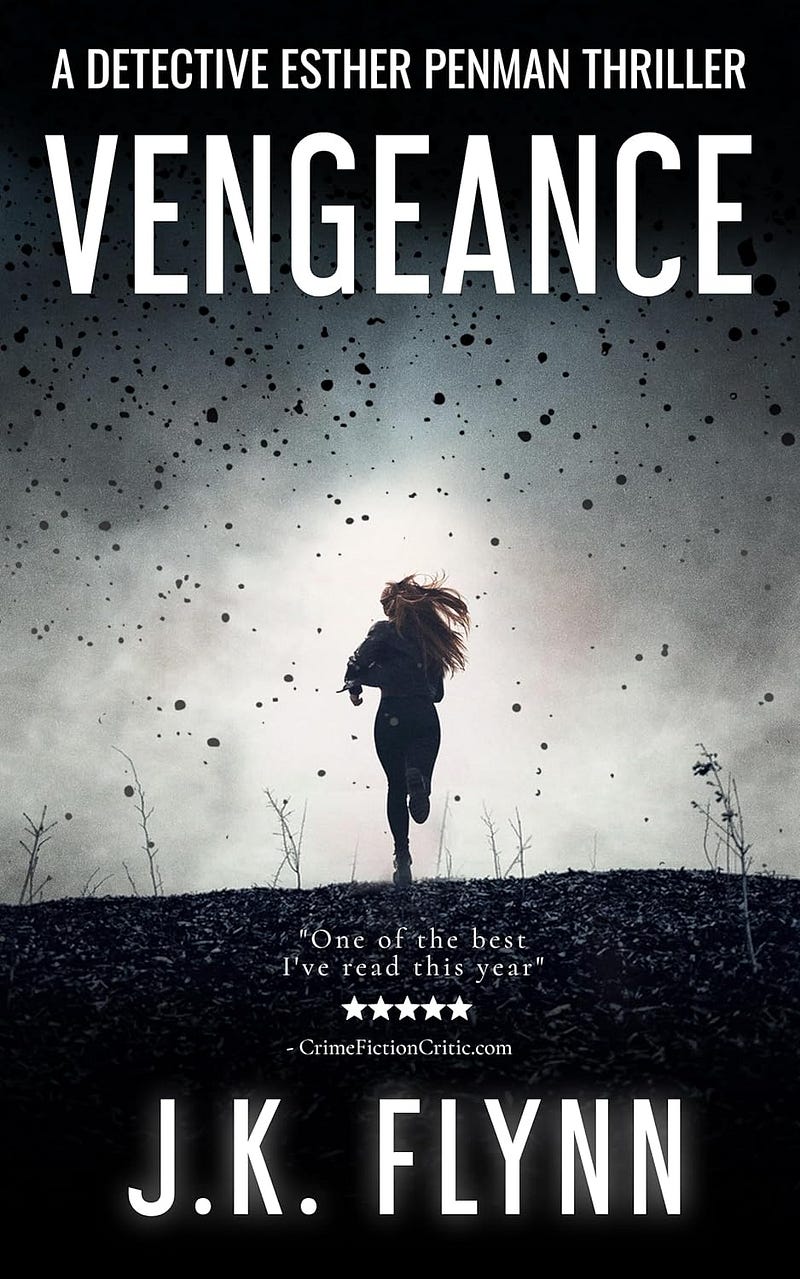
J. K. Flynn, The Art Merchant: A Detective Esther Penman Thriller (Chingola Publishing, 2022); Vengeance: A Detective Esther Penman Thriller (Chingola Publishing, 2023).
For a mystery fan, finding a good new writer is damn exciting. When the writer deftly combines police procedural with thriller, I’m so down with that.
J. K. Flynn has begun an engaging series set in Belfield, UK. Is Belfield a fictional city? Hard to tell, which I think is the point. There is a subsection of Rochdale in Greater Manchester called Belfield, but it is not clear whether the author has set this series there. I will return below to the mysteries of the author.
The protagonist Esther Penman is a Detective Sergeant (DS) with a terrific solve record, a sympathetic immediate superior, and a drinking problem. In these characteristics she resembles any number of fictional police detectives on both sides of the Atlantic.
Exacerbating her day to day problems, and jacking up her participation in the stereotypes of police fiction, are her Detective Chief Inspectors, who change between books one and two, and share repulsive though distinctive qualities: one is cruelly incompetent and the other a smarmy sexual predator. Fortunately, her immediate boss, DI Jared Wilcox, values Penman and is able to protect her from long term fallout from her various provocations of men far less able, and more ambitious, than she is.
Esther pays him back by gladly taking over leadership in their shared cases, which he is happy to yield. He is an older cop, going through a separation from his wife and a bit of a low point in his life. Not at all unskilled, and not at all defensive, he treats Esther as he might a loved and honored daughter.
This boss-subordinate relationship is not brand new in the genre, but it is well done and persuasive.
Likewise, Esther Penman’s troubles, with an absent father, an estranged, abusive drug-addicted mother, and a tendency to sleep around and drink way too much, sound on the face of it pretty standard, but the author sketches a unique and attractive character, smart, brave if of course foolhardy, and sufficiently self-aware to pull herself back from the brink of self-destruction several times.
In the second book, DS Penman succumbs temporarily to bitter nostalgia, merging memories of ancient and recent excesses as she waits to interview a headmistress about several students.
Feeling restless, Esther had declined the offer of a seat too, choosing instead to examine the framed photos on the walls and the awards in the trophy cabinet. The restlessness was a result of too many latent memories rising up. Here she was again, worried that a shrewd head teacher was about to sniff out the guilt of her late-night misadventures, no matter the shower and half-can of deodorant she’d used, or the minty chewing gum she was chewing vigorously as she studied class photos and framed student awards.
— Vengeance, chapter 20
The first two books in this young series offer hefty but realistic crimes. The Art Merchant is not about art, but that’s OK. It’s about a sadistic bad guy embedded in a ruthless organization that manages a pan-European smuggling operation by inveigling street-level agents with bribery and then intimidation.
The second book, Vengeance, seems initially to turn on industrial espionage, but then transforms into a much more personal story. I did like the second book, which I read right after the first, but I have to admit that the chain of criminal acts, and their motives, strained credulity a bit more than in The Art Merchant.
(I’m totally prepared to have somebody tell me that the first book is the pinnacle of uber-fictional plots while the second mirrors a real-life crime spree, but never mind.)
The author uses third party limited POV, which in most instances works well. Some crime writers do not want to get into the heads of their villains. J. K. Flynn does this pretty well, though sometimes excessively. It is probably enough to show rather than tell: to recount the moment to moment decisions of the villains without belaboring the psychopathy that got them to where they are in life. Each book begins with a prologue featuring the crime that draws in the police, and those are well executed and propel us right into the problem, and the action.
Now he sat, heart pounding, sweat soaking every inch of him, gloved hands gripping the steering wheel so tight his fingers were beginning to hurt. He could still see the half-open patio door in the Jeep’s wing mirror. He stared at it, desperately willing his victim to come staggering out. But there was no movement. No sign of life.
— The Art Merchant, “Prologue”
Both books also take us into the protagonist’s private life, allowing Esther to explore, and change, her family history. She struggles to decide whether to heed her aunt’s plea to visit her estranged mother, dying of cancer. Her better angels prevail, and there is redemption as well as, literally, a salvation — but that would be a spoiler.
J. K. Flynn also writes ‘drunk-and-hell-if-I-know-where-I-am’ really, really well.
She was naked. Of course she was. How often had she woken up in a stranger’s bed with her clothes on?
She took a deep breath. Screw it! She couldn’t drift in this purgatory any longer. Hangover and fat naked truckers be damned…She opened her eyes.
Yeah, she’d never been in this bedroom before…she was ninety-nine percent sure. Ninety-five, at least.
— The Art Merchant, chapter 1
Esther Penman also changes orientation between books 1 and 2, though this is in process already at the end of The Art Merchant. No, not her job or her values, but her romantic interest.
I will tell you from personal experience that it is a challenge as well as a dilemma to write a protagonist who is presumptively straight in the first book, and genuinely queer by the end of the second. But Flynn manages this transformation convincingly. Because the author offers plenty of office politics, character development, and the thrill of the chase, the main appeal of her series is not what the character does or doesn’t do in her personal life; those episodes fill out and enrich the narrative rather than commandeering it.
J. K. Flynn’s publisher is listed as Chingola Publishing. The books bear the marks of modest indie publishing (for example, they have not yet been indexed for digital searching, an omission I haven’t run into before). This makes the stripped down prose and accurate formatting even more noteworthy. The covers are professionally designed and appropriate to the genre.
I am a huge fan of indie publishing. There are frustrating barriers against breakout authors erected by struggling traditional publishers, who invest mostly in proven bestsellers at the expense of any sort of backlist. In the last fifteen years, self-publishing or indie publishing has arrived to fill the gap between growing numbers of aspiring authors and the narrowing opportunity for books to see the light via the “Big Five.”
There are issues, of course. If any of the major distribution outlets for indie books fails, what happens to those authors’ products? Clever entrepreneurs have stepped in to develop digital tools like “funnels” and automated email lists to take books directly from authors to readers. Smaller presses and operations like Chingola package tools like editing and cover design for independent authors. Just as indie music rendered the traveling musician’s car trunk and guitar case their major distribution points, so Amazon, Apple Books, and BookFunnel have both eased and increased the writer’s workload.
Welcome to the new world of publishing.
Oh — about my story title. Because the “Art Merchant” is just a cog, though a repugnant one, in a larger criminal machine, the author leaves it open whether DS Penman and her colleagues are genuinely shut of him and his far-reaching network. As with the recurring villains in LJ Ross, Louise Penny, Arthur Conan Doyle, and so many others, the saga isn’t over until it is over, and maybe not even then.
J. K. Flynn her- or himself (I’m betting on the former) is maddeningly elusive. There is a note on [her] website, and at the end of each book, explaining that “I spent over ten years as a frontline police officer in the UK….My time in law enforcement made me want to write a crime fiction character with an authentic voice, raw and unvarnished. D.S. Esther Penman is that voice” (The Art Merchant, “About the Author”).
A hearty welcome to J. K. Flynn and her(?) character DS Penman. Fingers crossed for a third installment in this excellent series.


