
The Architecture of Memory — The Atkinson-Shiffin Model

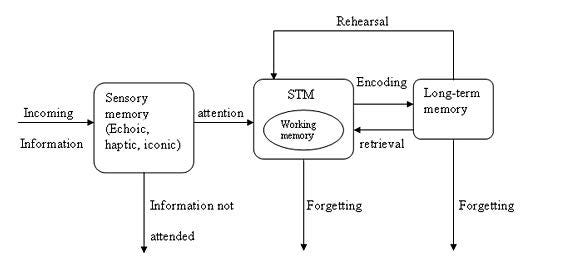
The Atkinson-Shiffin model, also referred to as the multi-store approach, describes the basic architecture of the memory system and has dominated the conceptualization and study of memory for many years. This model postulates that the structure of human memory is divided into three distinct storage systems each with different properties that interact in the processing of information. Specifically, memory is comprised of the following subparts:
· Sensory Memory/Store — representations of the physical features of a stimulus are stored for a very brief time (one second or less);
· Short-Term Memory — immediate memory for stimuli that have just been perceived with limited capacity for the number of items held and the duration
· Long-Term Memory — information is represented on a permanent or near-permanent basis that is durable and has no known limit (Carlson, Martin & Buskist, 2004; Matlin, 2002)
Figure 2 represents the components and interactive processes of the Atkinson-Shiffrin Model.
Figure 2: Atkinson-Shiffrin Multistore Model (1968) Information processing through various memory sub-systems
Various researchers have attempted to validate this proposed distinction between short- and long-term memory (Matlin, 2002). The case study of patient H.M. represents an example that both supports and contradicts aspects of the Atkinson-Shiffrin Model. After undergoing neurosurgery which removed a portion of his temporal lobe and hippocampus, H.M. experienced anterograde amnesia, resulting in loss of memory functioning for events occurring after the surgery. Specifically, H.M.’s recall of long-term memories from before the surgery remained intact and accessible, while subsequently, he lost the ability to transfer new information into long-term memory. New information, even that which is as crucial and as commonplace as people’s faces and his own actions, was forgotten in a matter of minutes after their occurrence (Carlson, Martin & Buskist, 2004; Matlin, 2002).
The case of H.M. clearly highlights the distinction between the immediate holding of current information and the storage of information that is more removed in time and space. The fact that his long-term memory processes suffered severe deficits while his short-term memory remained functional lends support to the idea proposed in the Atkinson-Shiffrin Model that these represent two functionally distinct systems, or as described by some researchers, “clearly demonstrates that these two phenomena are supported by different hardware” (Yuret, 1995).

There are, however, aspects of this case study that also seem to contradict, or at least not support, the model. Subsequent to the surgery, H.M. was able to learn some new cognitive skills — e.g., mirror tracing and the Tower of Hanoi puzzle — indicating a distinction between procedural and declarative memory functioning. Interestingly, while H.M.’s performance improved with practice of these tasks, indicating learning had occurred, he was not able to recall previous attempts at the tasks, further demonstrating his severe memory deficits (Schaffhausen, n.d.; Yuret, 1995). Additionally, while research has indicated that the duration of short-term memory is typically not much more than 18 seconds before significant decay interferes with recall, H.M. was able to recall new memories for as much as 15 minutes before experiencing decay (Schaffhausen, n.d.). Thus based on the patterns of HM’s memory loss, researchers formed the following hypotheses about memory formation:
· Short-term memories are biologically different from long-term memories because they do not require the hippocampus for formation.
· Long-term memories are stored throughout the brain, but the hippocampus is necessary for the information to reach long-term storage. Once the memory is permanently stored, however, the hippocampus is no longer required. Said another way: the hippocampus is important for long-term memory formation, but not for memory maintenance or retrieval (Schaffhausen, n.d., p. 3).
References
Carlson, N. R., Martin, G. N. & Buskist, W. (2004). Psychology. New York, NY: Pearson.
Matlin, M. W. (2002). Cognition (5th ed.). New York, NY: Harcourt College Publishers.
Schaffhausen, J. (n.d.). The day his world stood still: The case of H.M. Retrieved from The Brain Connection web site: http://www.brainconnection.com/topics/?main=fa/hm-memory
Yuret, D. (1995). Patient H.M. Retrieved from Ohio State University web site: http://www.psy.ohio-state.edu/psy312/deniz-hm.html