
The Arab–Israeli Conflict: The Ultimate FAQ
Never before explained in such clarity
Like many similar projects, this one started when a friend asked me about the conflict, and I simply was not able to refer her to any decent summary. The Wikipedia article is confused, at times too academic, and is obviously the result of numerous internal feuds. Attempts at summaries in several newspapers and magazines are too superficial, often one-sided without being open about it, and are a practical nightmare to read (heavy images, popups, ads galore). For those who can’t or won’t read thick volumes of academic work, I’m here to help.
Any disclaimer about my impartiality would be a waste of time. I’ll let the words speak for themselves. Read and decide for yourselves whether I was fair or not. And disclaimers about my lack of expertise are not needed: this is strictly for idiots, written by an idiot (with a PhD). So here you are — remember to have fun!
Origins
When did it all start?
Around 150 years ago. Before that, Arabs and Jews used to live alongside each other in relative peace. Jews had been exiled by the Romans from the Land of Israel (Palestine) to other Middle Eastern countries two millennia ago. Some friction between them and the locals have always existed, but to a large extent Jews in Arab countries fared much better than in Europe. Another point of friction was the conquest of Palestine by the Prophet Muhammad in the 7th century. Many Jews were forced to convert to Islam. But in the following centuries, no major conflict ensued in Palestine, and at any rate the low-key tension that may have existed is not considered to be the root of the current conflict.
What happened 150 years ago?
Jews started thinking about establishing their own country. This wasn’t unique to the Jews — this was a time of national awakenings, with many peoples around the world acting upon their aspirations for self-determination: Belgium separated from the Netherlands, Norway from Denmark; Bulgaria, Romania, Greece, and most Latin American countries have all become independent within several short decades in the 19th century. The Jews’ urgency in finding a country was exacerbated by a growing frequency of antisemitic attacks (so-called pogroms) during this period. All this led to the birth of Zionism — the belief that the Land of Israel is the homeland of the Jewish people.
And what happened in practice?
Thousands of Jews started immigrating to Palestine. The local Arabs watched this semi-invasion with apprehension, fearing that they might soon be ousted. Some saw this as pure colonialism. Zionist leaders have promoted a notion, a myth that was adopted by many European Jews, namely that Jews were a people without a land, migrating to a land without a people (that is: Palestine). Many saw this as a perfect match. But in reality, Palestine was anything but “without a people”, and was in fact populated with millions of Arabs, many more than it was with Jews.

What happened next?
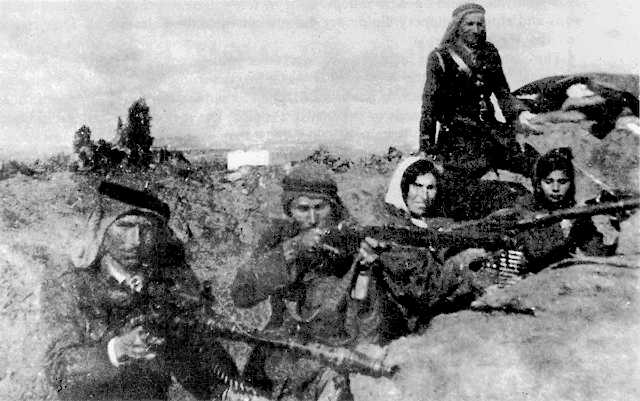
The situation started boiling in the 1930s. The stream of Jewish immigrants from Europe increased, exacerbated by the rise of the Nazis in 1933. Both Palestinians and Jews formed militias, and hostile activities increased, with many victims on both sides. In 1947, with many Jewish refugees seeking to immigrate to Palestine, the UN devised a plan for dividing Palestine between the Jews and the Arabs, establishing two independent states. The Jews took the offer, the Arabs refused: the Israeli War of Independence ensued, ending with Arab defeat and the establishment of Israel in May 1948 on around two-thirds of Palestine’s area. The remaining third, populated with only Arabs, went under Jordanian and Egyptian control. These areas — the West Bank and the Gaza Strip — are what’s referred to today as “Palestine,” and are the main area of dispute.
What happened ever since?
Several bloody wars have raged between Israel and its Arab neighbors from 1948 until very recently. Israel, intensively backed by US military and financial aid, was always able to prevail. Israel was able to increase its size several times following these wars. The West Bank, Gaza Strip and Sinai Peninsula have all fallen under Israeli control after the 1967 war. Israel started building settlements in these areas, which have increasingly become a major issue of contention. Palestinians started to actively revolt in 1987, frequently using terrorism. Israel often retaliates, which results in a never-ending cycle of violence.
Seeds of peace
Were there any serious attempts at peace?
Yes! In 1981, following the Yom Kippur War, Israel agreed to return Sinai to Egypt, leading to a peace agreement between Israel and its most bitter enemy. The agreement, however, left many open questions regarding the future of the Palestinians, the results of which we’re witnessing today. In 1991, a major breakthrough was achieved in the Palestinian front, with the latter recognizing Israel’s right to exist and the Israelis acknowledging the Palestinians’ right to self-determination. The autonomous Palestinian Authority was established on large areas of Palestine.
Sounds great. What happened then?
Palestinian militants who didn’t care much for peace embarked upon a ferocious wave of terrorism, with dozens of Israeli victims. The Israeli public became wary of the so-called “peace process,” a term increasingly regarded by many as sadly ironic. The feelings of dismay and division culminated in the murder of Israeli Prime Minister Yitzhak Rabin by a right-wing extremist. The process was never able to recover, the situation spiraling downwards ever since.
Issues, opinions and arguments
What are the main issues at the core of the conflict?
- The main issue: the Palestinians wish to establish an independent state. Israel is trying to prevent that from happening.
- Jewish settlements in the West Bank: what will become of them?
- Palestinian refugees in neighboring countries: do they have the right to return to Palestine, or to be otherwise compensated?
- Jerusalem: both sides refuse to give it up.
- Security: Israel is adamant about security, demanding strict assurances in any future arrangement.
- Israeli occupation of the West Bank and its effects on Palestinian and Israeli life.
Issue in depth: Palestinian state
The UN has asserted several times that the Palestinians have a right to their own independent state. Israel has generally agreed to this. Even right-wing leaders, most famously Netanyahu, have declared their agreement to the general concept. But fierce disagreement over the “small” details, namely issues 2–5 above, seems to continually prevent this from happening.
Isn’t Palestine the historic homeland of the Jews? Don’t they have a right over it?
This may be so. As an aside, many different peoples originated from Palestine, not exclusively Jews: Edomites, Philistines, Amorites, to name but a few. Most of them don’t exist nowadays under these names, but have assimilated over the years — mostly into Arab nations. Needless to say, the events that surrounded the birth of Judaism some 4,000 years ago are not well documented, and concrete assertions are difficult to make. But all this aside, many peace-oriented people believe that this is irrelevant. That the current predicament won’t ever be solved by simply declaring Jews the rightful owners of Israel based on millennia-old events and scriptures. That the Arabs who have lived in Palestine for 1,400 years can’t be ignored or brushed off, and that they’re not going anywhere. A division of Palestine among the Jews and the Palestinians is fair enough, many people believe, regardless of this or that historic right.
Issue in depth: Jewish settlements
Israel started building small settlements in the West Bank and Gaza Strip in the 1970s. The first settlers were religious zealots who thought it was sacred to populate the entire Land of Israel (with Jews). Over the decades, the settlements have grown exponentially, with currently nearly half a million settlers in hundreds of villages and several cities, and with a diverse population that also includes many seculars who were simply attracted by the cheap real estate. The Palestinians see all this as shameless land theft and demand that not a single settlement remains.
How are the settlements regarded by the Israeli public?
The public is very divided about them. Right-wingers laud the settlers as heroes, pioneers who’ve paid a high personal price in order to execute the sacred commandment of maintaining a Jewish Land of Israel. In addition, the concept of the “protective belt” is always mentioned, whereby the settlements create a buffer zone between enemy countries all around and the spoiled, thankless patrons of Tel Aviv cafés. Left-wingers, in contrast, regard the settlements as one of the most major hurdles to achieving peace. The settlers, not so many in numbers but wielding immensely disproportionate political power, have forced governments to pour billions onto them, investing top shekel in security arrangements, housing and prime roads, while Israelis in Israel proper face an unprecedented housing crisis and have to cope with crumbling infrastructure.
Is the removal of settlements realistic?
In 2005, Israel evacuated all settlements from Gaza Strip, allowing the Strip in its entirety to become a full part of the Palestinian Authority. Once again, Palestinian militants took advantage of this and started firing missiles into Israel, with many Israeli victims. This proved to many Israelis that the Palestinians can’t be trusted and won’t ever be able to subdue their militants and to guarantee Israel’s security. But it also showed peace-leaning Israelis that settlements can in fact be removed, with the major unrest and even civil war that some have feared not ever materializing. That said, all settlements in Gaza Strip were tiny villages, whereas the West Bank is home to several Jewish cities, the largest of which having 75,000 people.
Is there any solution to the settlements problem?
One solution that is frequently floated is the exchange of territory: Israel keeps the largest settlements as Israeli enclaves within the future Palestinian state, while the Palestinian receive Israeli areas in the desert. This solution is not popular, with the Palestinians regarding the desert areas as useless, and with, interestingly, the Israelis regarding them as priceless and not wishing to part with them. An even less practical idea is the transfer of several large Arab cities within Israel to Palestinian control, in exchange for maintaining the settlements. This concept is considered offensive by many residents of these cities, who don’t wish to be moved around as pieces on a chessboard just in order to fix a political mishap that has nothing to do with them.
Issue in depth: Palestinian refugees
During the War of Independence of 1948, the Israeli army, rapidly advancing and making gains, has forced thousands of Palestinians out of their homes. Entire Israeli cities are built nowadays upon the remains of centuries-old Palestinian settlements. This event is deeply engraved in Palestinian identity. The combined establishment of Israel and the violent ousting of the Palestinian refugees is dubbed “Nakba” — disaster. Millions of descendants of these refugees currently live in many Arab countries, mainly Jordan, Lebanon and the Gulf States. In many cases they haven’t integrated well, living for decades in refugee camps.
What do the Palestinians want?
On one end of the spectrum, some Palestinians demand that all refugees be returned unconditionally to their homes. This is almost universally recognized as impossible. Most Palestinians would like to see the majority of refugees settled in a future Palestinian state, with extensive financial aid and possibly compensation from Israel. The Palestinians point to the fact that Israel unconditionally absorbs Jewish immigrants from all over the world — Israeli law says that any Jew, no matter what, can land in Israel and automatically receive citizenship and a bonus pack.
What do Israelis think?
For decades, Palestinian refugees didn’t even exist in the Israeli public eye, with the refugees seen as a remote problem and as proof of Arab non-solidarity: if Israel can absorb millions of Jews from around the world, why can’t Lebanon and Jordan absorb and help their Palestinian brothers? In recent years, however, Israelis increasingly acknowledge their role in creating this problem, and that ignoring it is not conducive to ever reaching peace. That said, many Israelis strongly fear the return of millions of Palestinians to a future state, making the state uncomfortably large and powerful in Israeli eyes, and setting a dangerous precedent: if refugees are allowed back to Gaza, won’t they demand next to return to their old homes in Tel Aviv?
Issue in depth: Jerusalem
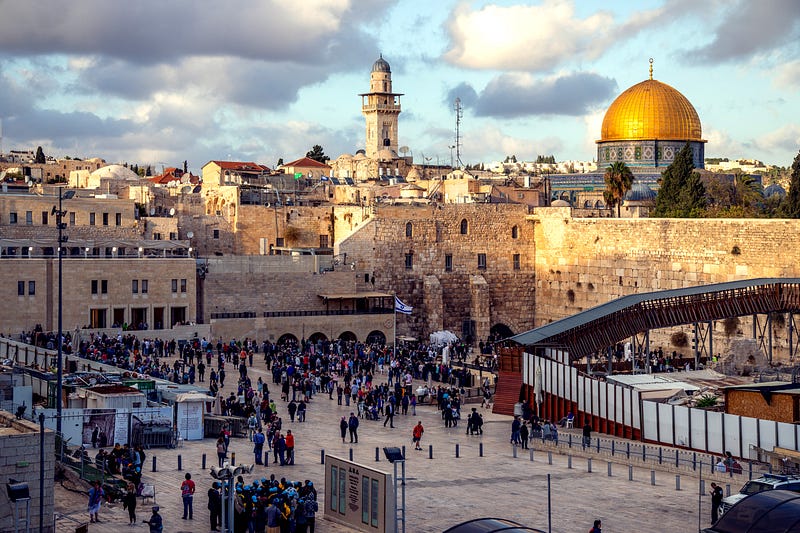
Jerusalem is the most sacred place for Jews, the third most sacred for Muslims, and quite sacred for Christians, too. Jerusalem is a complex, messy topic, with roughly equal numbers of Jews and Muslims, with an array of fences, walls and checkpoints that separate the Jewish western part from the Arab eastern part, with sacred sites dotting all parts of the city, and with deep religious and nationalist feelings by all parties involved. The difficulty is stressed by the fact that the Wailing Wall, the most sacred site to the Jews, is practically one of the walls of the Temple Mount and the Al-Aqsa Mosque, the most sacred site to the Muslims. How do you draw a line there?
Is there a solution in sight?
Several peace-agreement drafts in the past postulated that Jerusalem should become a special neutral territory under UN supervision. A reasonable solution, which any person with even the slightest religious feelings towards Jerusalem categorically rejects. Indeed, many consider Jerusalem the single biggest obstacle to any chance of the conflict ever being resolved.
Issue in depth: security
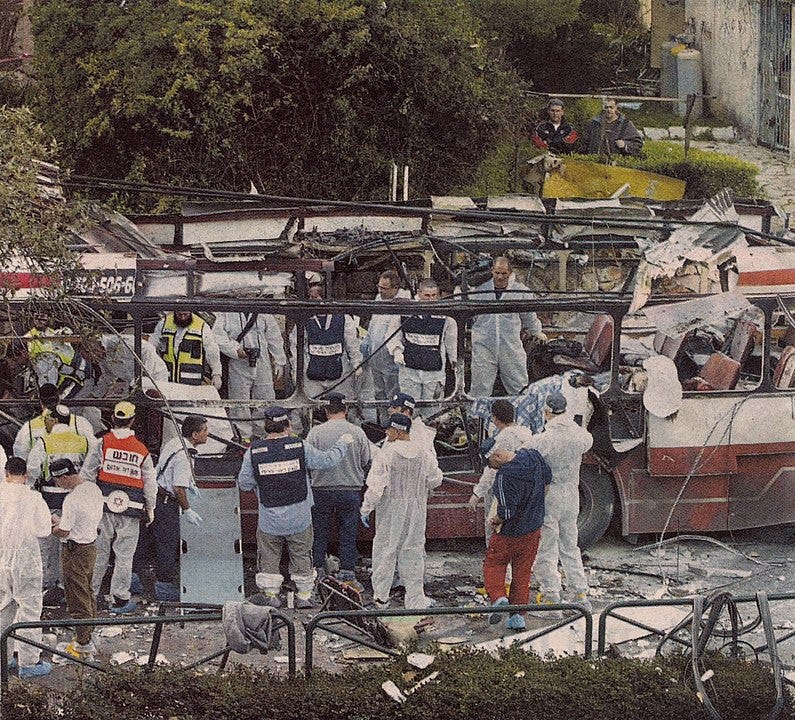
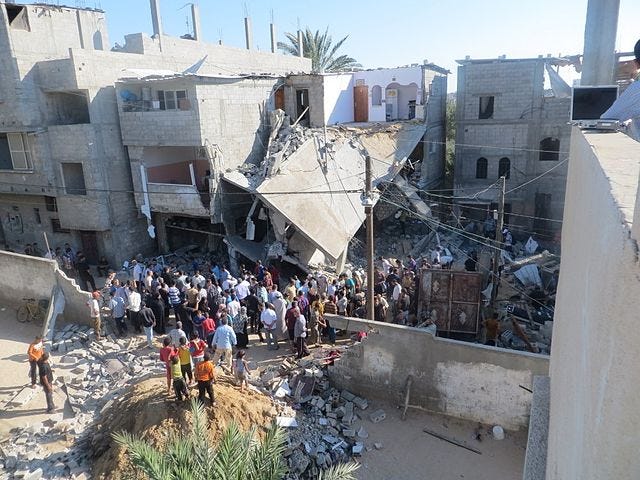
Israel has been suffering Palestinian terrorism for decades, whereas the Palestinians have been suffering Israeli retaliation and anti-terrorism operations, which were far from focusing on the terrorists alone, hurting countless civilians in the process. Many Israelis fear that a future Palestinian state would become a perfect breeding ground for terrorists, for ISIS, and for other similar threats.


Was terrorism ever effective?
Many point out how Israel has been consistently engaging in peace negotiations only following terrorism waves. During relatively peaceful periods, the Israeli public tends to forget that the Palestinians even exist. Post-terrorism negotiations have frequently resulted in improvements and concessions from a Palestinian point of view, underscoring the notion the terrorist has worked. The other side of the coin is the great suffering that terrorism has brought upon the Palestinians: direct military attacks on people and buildings, financial ruin, bad publicity, and division among themselves.
Was the response to terrorism ever effective?
The effectiveness of direct military response is always short-lived, with terrorists quickly recovering and launching attacks anew. Israeli peace activists point out how Israeli retaliation never fails to breed new terrorists: terrorists are almost always innocent former victims of Israeli retaliation. Once in a while Israel would assassinate a major terrorist leader. Israeli media would then praise the operation, stressing how important that leader was. A new wave of terrorism never fails to come — with a vengeance. The construction of the West Bank Barrier during the 2000s was followed by a vast decrease in the number of attacks; but, similar to the decrease in crime in New York during Giuliani’s mayorship, many argue that the reasons for this are complex and multi-factored and that it had started way before. The Barrier has increased Palestinian suffering under the occupation, nibbled large Palestinian territories, and damaged nature and landscape. Its justification is highly contested.
What do Palestinians think of terrorism?
The notion that all Palestinians are terrorists or support terrorism is the single most prominent prejudice that too many Israelis hold. Many Palestinians voice their objection — but it must be remembered that Palestinian media isn’t as free, and that terrorist organizations such as Hamas have been violent against their own people, too. Palestinian political leaders generally always condemn terrorism. But this is often not enough for the Israeli government. Following every attack, a childish game of condemnations ensues. The Palestinian Primer Minister would condemn the attacks “from both sides,” implying that the Israeli retaliation is also an act of terrorism. Israel would take issue with that, and blame the Palestinians for not doing enough to curb terrorism. Palestinians would point out that they make do with what they have — a decimated, weak police force, itself frequently the target of Israeli attacks — and that expectations should be lowered.

Issue in depth: occupation
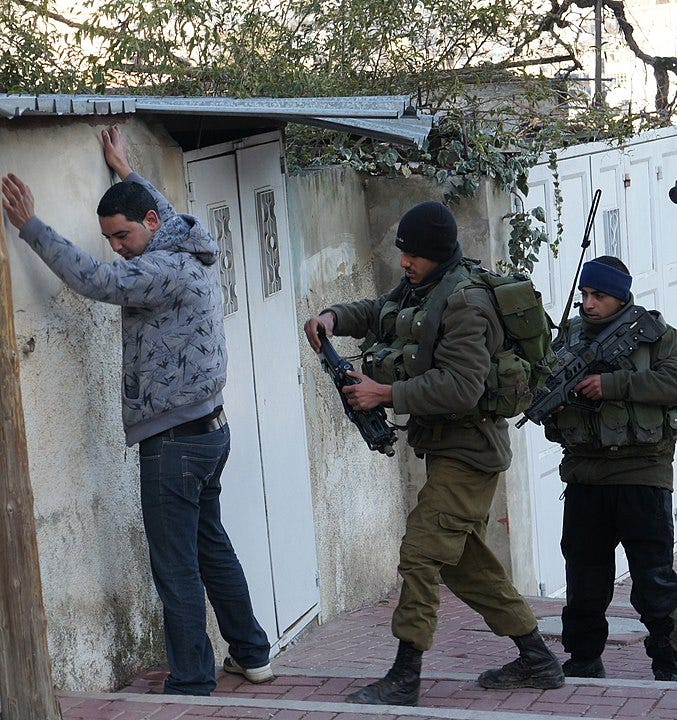
If a peace agreement is ever signed, the Israeli occupation would be effectively over, making this a non-issue. Until this happens, this is very much a central issue whose importance cannot be overstated. The prevalent notion in Israel is that the occupation is a necessary evil. Nobody wants the Palestinians to suffer, but whenever we let loose, they start to attack…, argue the majority of Israelis. The Israeli left wing sees this as an absurdity: if we simply let the Palestinians have a free state, they wouldn’t have a reason to attack anymore! Right-wingers see this as hopelessly naïve: hasn’t Israel withdrawn from Gaza Strip in 2005, leaving the Palestinians be? In return, they started throwing missiles at Israeli civilians.
Yeah, what about that?
The issue here is the different points of view. Whenever Israel makes any concession, it hails it as the best deal the Palestinians could’ve ever dreamed of. But the Palestinians often regard these small concessions as ruses undertaken in order to hinder the actual goal — an independent state — from ever happening. So was the case with the Gaza retreat. To Israelis, this was an insane favor which should’ve yielded nothing short of a century of peace and quiet. The Palestinians, however, saw how their brothers in the West Bank suffer worse conditions than ever and how an independent state is simply not happening. The Israelis see their incremental approach as very logical: before we give the Palestinians an entire country, let’s see if they can manage one region. But the Palestinians resent being treated like children. Regardless of all this, it must be remembered that only a tiny fraction of Gaza residents were involved in throwing missiles. Israel, however, often fails or refuses to acknowledge the diversity of Palestinian society and opinion.
Beliefs, myths and misconceptions
How come this conflict is so prominent in the news, with Israel and Palestine being so small?
This has to do with the Jewish influence on world politics and culture. This, in turn, has much to do with the Holocaust and the mass migration to America of Jewish refugees that it engendered. First, many refugees were highly educated — doctors, scientists, lawyers, business people — and were able to quickly assimilate in American society and gain powerful positions. (This education has to do with strong, century-old Jewish tradition that promotes reading and learning, and also with Jews being excluded from most physical occupations in Europe, forcing them to become scholars). A strong Jewish lobby formed, one that strongly advocates for Israel. Second, the unraveling of the horrors of the Holocaust induced many Western governments to do everything they can to maintain and protect the State of Israel, the only Jewish country in the world. Since the West stood by Israel, the Soviet Block almost automatically chose the other side. The Arab–Israeli conflict has now become part of the Cold War. Although it is over, many of its effects are still here. And for those who don’t know: Israel is roughly the size of New Jersey; the West Bank and Gaza are the size of Delaware.
Indeed: Israel is the only Jewish country, whereas the Palestinians have almost 30 Arab countries to choose from!
This is a decade-old notion propagated by the Israeli right wing. Sadly, this makes a lot of sense to many Israelis way beyond right-wing circles. Maps of the Middle East with tiny Israel colored red and the humongous Arab world surrounding it colored blue are an Israeli staple: everyone in Israel saw this, and the graphic “truism” that it delivers is striking. This is also connected to an adjacent myth, according to which Israel has always been the underdog, with several million Jews under constant attack by nearly a billion Arabs and Muslims.
Well, what’s not true about all that?
The former notion is a result of the general, vague belief that many Israelis hold, according to which “all Arabs are the same.” Some would call this racism, others — ignorance. The vast majority of Israelis couldn’t tell a Moroccan from a Syrian, although they differ in looks, manners, dialect and almost anything else. Most Israelis are completely oblivious to Arab politics and rivalries, thinking that all 30 Arab countries might as well unite and get it over with. The latter notion mentioned above — the Israeli underdog — is hammered into Israelis since they are babies by means of children’s books, TV shows, movies and school. But the Israeli army is considered the most technologically advanced in the world, and couldn’t have existed had it not been for massive US aid. Seen through this lens, the Arabs might as well be considered the underdogs. Currently, the Israeli army with all its might is utilized to fight guerilla militants mostly equipped with rocks and the occasional home-made explosive.
Didn’t Arab countries start all the wars against Israel?
Another staple of the Israeli narrative. In reality, the Six-Day War of 1967 is considered the last “no-choice war.” Following that, Arab countries have reached out through many channels, seeking to start peace negotiations. Israel obstinately refused, power-drunken after its glorious victory and not willing to part from the vast territory that it conquered.
You mentioned the occupation. But what about it is so bad?
Like any occupation in history, this one too is rife with human-rights abuse and unwarranted, excessive violence, all backed by a very partial justice system that repeatedly prevents justice from the Palestinians. Many international reports have documented Palestinian poverty and poor living conditions. The Israeli right wing blames this on corruption and malfeasance in the Palestinian Authority — after all, the Palestinians receive immense international aid, and have full control of their infrastructure and internal affairs. But in reality, Israel controls everything that goes into Palestine — electricity, food, goods, financial aid. Israeli barriers, restrictions and regulations make economic life in Palestine complex and difficult. Israeli anti-terrorist attacks repeatedly leave Palestinian infrastructure in ruins.
You mentioned the Israeli justice system. What part does it play here?
This is a mixed bag. On the one hand, Palestinians wronged by settlers or the army rarely receive fair compensation, and the perpetrators are rarely punished. But occasionally, controversial actions by the government such as territory annexations, the Barrier, the destruction of Palestinian houses and torture of Palestinian prisoners are criticized or downright blocked by Israeli courts — with the government often ignoring court decisions. Israel prides itself of its advanced, Western justice system, but critics often see it as a rubber stamp of the Israeli government when it comes to the occupation.
You mentioned Israeli “perpetrators.” What do you mean?
Terrorism in this conflict isn’t one-sided. Jewish militants have exercised many attacks on Palestinians, leaving dozens dead. Jewish settlers often harass innocent Palestinians, destroying crops (famously olive trees, one of the main Palestinian crops) and property. Israeli retaliation against Palestinian terrorism is almost always excessive. For instance, Operation Protective Edge in 2014 saw 74 Israeli and 2,300 Palestinian dead. Critics of Israel see this as state-mediated terrorism. Instead of trying to seize specific terrorists, Israel prefers to blow up entire neighborhoods. Israel defenders claim that this is outright war, and as such has its own rules.
How is the occupation regarded in Israeli society?
Left-leaning Israelis deplore the occupation and see it as the root of everything that’s wrong in Israel. Israeli society is aggressive and violent? The occupation is to blame. Infrastructure and services in Israel are crumbling? The occupation. The world hates Israel? The occupation. Right-wingers mock this notion, and would often use it ironically. Last winter was too dry? The occupation. The first point mentioned — the aggression so prominent in Israeli society — something immediately noticed by every visitor to Israel, is exceptionally bitter. To many left-wingers this is a no-brainer: take every Israeli youth as they reach 18, put them in unfathomable daily situations where they need to prevent pregnant Palestinian women on their way to the doctor from crossing a check point, and you get a violent society in which only the strongest and the loudest survive. But this is perhaps a question of the chicken and the egg: did the occupation make Israelis aggressive, or did the naturally aggressive Israelis make the occupation cruel?
What about the idea of sanctions against Israel?
The idea has always been around, and is increasingly becoming famous through the BDS movement and several celebrity supporters. But the effects of this on Israel have been close to none. Aside from the occasional singer who cancels a tour in Israel and some settlement-produced goods that are banned in very specific markets, nobody in Israel feels any sanctions. As opposed to the sanctions exercised against the Apartheid regime in South Africa, the world is simply not united enough when it comes to Israel, with many harsh critics but also many allies.
Is Israeli society racist?
Like in many conflicts, there is much racism and prejudice involved here, too. Israeli Arabs (that is, Israeli citizens, making up 21% of Israel’s population) face similar difficulties that, for example, blacks in America do: discrimination in jobs and education, legal issues, allocation of funds. Arabs in Israel are much more segregated: most Jews never meet an Arab during their entire lives — even in mixed cities such as Jaffa and Haifa. Several mildly racist opinions are prevalent among Israelis: that Arabs enjoy living in squalor (just look at their cities); that Arabs don’t value human lives, using children as “human shields”; and that Arabs are exceptionally cruel (many Israeli prisoners of war were tortured).
What’s that about human shields? And the torture?
As mentioned above, violent organizations such as Hamas terrorize the Palestinian society, too. If they invade a school and throw missiles at Israel from there, there isn’t much anybody can do. This simple truth is generally ignored in Israel, the latter making the “human shields” concept a central pillar of its narrative. The issue of cruelty and decency during times of war is increasingly occupying Israeli society in recent years. The “purity of arms” has long been an Israeli myth: that the Israeli army is noble and just, that enemy prisoners are treated with silk gloves. But revelations of a different spirit from the past constantly resurface. Turns out that in contrast to popular belief, torture of prisoners and the targeting of innocent civilians are not an exception when it comes to Israel’s army. This fraying of the halo that has surrounded the army for decades goes hand-in-hand with the frustration that many Israelis feel towards the occupation. One result is an increasing number of Israeli youth who refuse to join the army or to serve in Palestine, often at the price of imprisonment and later discrimination in daily life.
Speaking of Hamas, didn’t the Palestinians democratically elect a Hamas government?
Hamas is a large organization with a small military branch. Its social branch has been consistent in feeding the poor and building schools and hospitals. Through the lens of the (perhaps justified) Israeli obsession with security, Palestinians showed their true face by electing a terrorist organization. But the majority of Palestinians don’t think too much about Israel and its security, but rather about functioning hospitals.
Is there anything positive to say about Israeli–Arab relations?
First, the strong Israeli opposition cannot be stressed enough. Many Arabs believe that all Israelis are evil bullies, and are not quite aware of the opposition. In truth, a huge portion of Israeli society greatly sympathizes with the Palestinian plight. Many go on demonstrations, donate money, and actively help Palestinians in a variety of ways. As for cultural exchange, countless Israelis consume Arab art, with some Arab authors being very popular in Israel. The most famous Arab singer ever, the Egyptian Umm Kulthum — incidentally very much anti-Israel — is equally popular in Israel, as are many Arab restaurants and shops. Israeli tourists flock Egypt and Jordan. Some Israeli Arabs have become celebrities: a Miss Israel, an international award-winning actor, and more. This exchange is rather one-sided: Israeli art is not a thing in the Arab world, and the number of Arab tourists that visit Israel is close to zero.
Is dubious propaganda an exclusively Israeli thing?
By no means. Palestinian have been frequently caught spreading false, downright fake claims regarding alleged human-rights abuses. Photos and videos have been doctored. Palestinian school books are rife with anti-Israel propaganda that borders on antisemitism. Palestine advocates dismiss all this: the fake photos and claims don’t change the fact that the occupation is cruel. A few bad apples that play with Photoshop shouldn’t sidetrack us from the real issue. And as detailed elsewhere in this article, Israeli schools serve the Israeli narrative just the same, if in a more covert manner.
Many say that the occupation can be compared with Apartheid. Is this true?
Depends. As detailed above, Palestinians are discriminated against through and through. Separation and segregation are policy, with separate roads that only Jews are allowed to use and with fences, barriers and check points being an integral part of daily Palestinian life. Palestinian mobility is very limited, with Palestinians seeking to go abroad needing to cope with a wall of bureaucracy, with frequent unexplained rejections. Add to that the mild discrimination against Israeli Arabs, and the picture looks rather grim. That said, none of this is motivated by any feelings of racial or ethnic superiority. Aside from an absolute fringe, the majority of Israelis don’t hate Arabs, don’t see them as inferior, and don’t see separation as something to wish for.

What does the future look like?
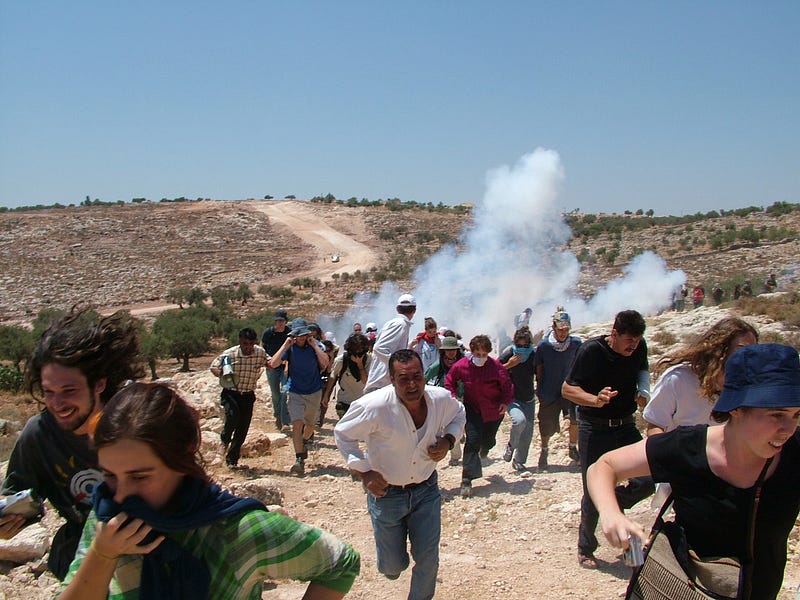
This is interesting: on the one hand, Israeli politics have noticeably shifted to the right in the last three decades. One factor is the disillusionment with the peace process that started with the terrorism wave of the 1990s. The notion that “Arabs simply don’t wish for peace” has taken strong roots in Israeli opinion, and led the Israeli public to vote for parties that emphasize defense, strength, and security. Another factor is demographics: while right-wingers, often religious, tend to have many children, left-wingers procreate much less, with thousands of academics and professionals leaving Israel for good. But on the other hand, the entire Israeli Overton window has noticeably shifted to the left in the last five decades. In the 1970s, the mainstream view was that a Palestinian state is 100% unacceptable, and that nobody on the Palestinian side can be negotiated with since they all advocate the annihilation of Israel. Nowadays, roughly half of the Israeli public agree to withdrawal from the Occupied Territories and to a Palestinian state. The PLO (Palestinian Liberation Army), once considered the arch-enemy, became a valid negotiation partner in the 1990s, and even Hamas and adjacent organizations are often talked with these days.
These mixed trends make a prediction difficult. There’s no way to sugar-coat it: many on both sides highly doubt that any major breakthrough is bound to happen in the foreseeable future. Frustration and disillusionment are high — which partly explain the hundreds of thousands of Israelis and Palestinians that have made the USA, Canada, Germany, and Australia their home in recent years.
But like other conflicts that ended abruptly and unexpectedly, this one may, too. Let’s hope for the best.
