
The Appeals of Francis Bacon
Lessons from Fine Arts
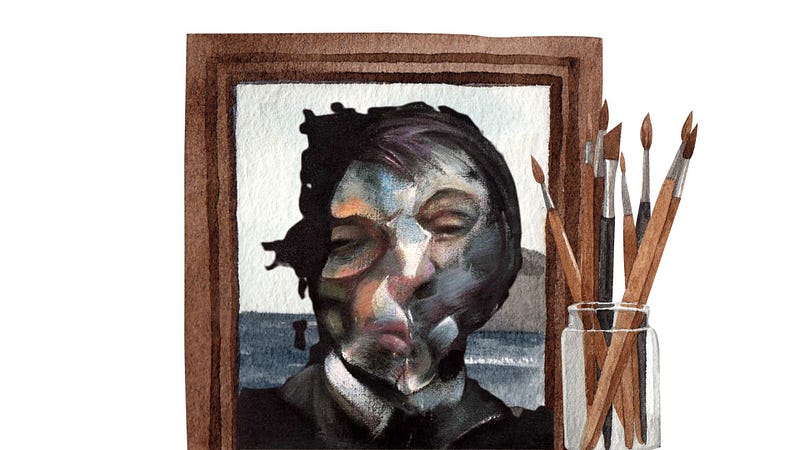
I’ve never considered myself an artist, yet art has a strange way of re-introducing itself into my life. My formal art training consisted of sketching Big Ben on my classmate’s arm during boring psychology lectures, alongside some rapid studies of girls I’ve fallen head over heels in love with. This is why it was surprising to find myself in an anatomy museum at 9 am in the Medical Precinct, listening to a lecture during my first formal fine arts class.
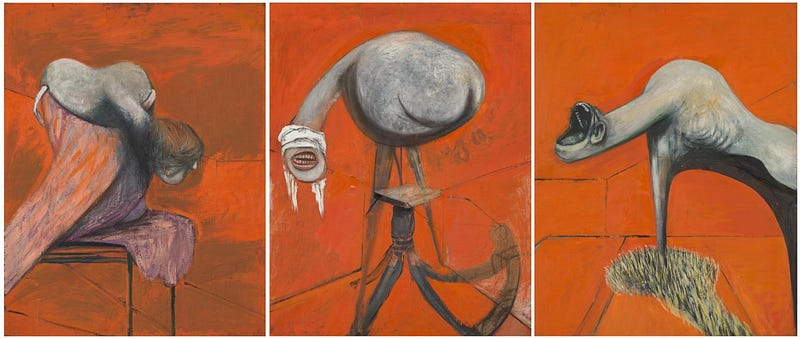
Over the many lecture slides, one artist, in particular, caught my attention so completely that I could not ever forget his paintings. Projected on the board was “Three Studies for the Figures at the Base of a Crucifixion” by Francis Bacon.
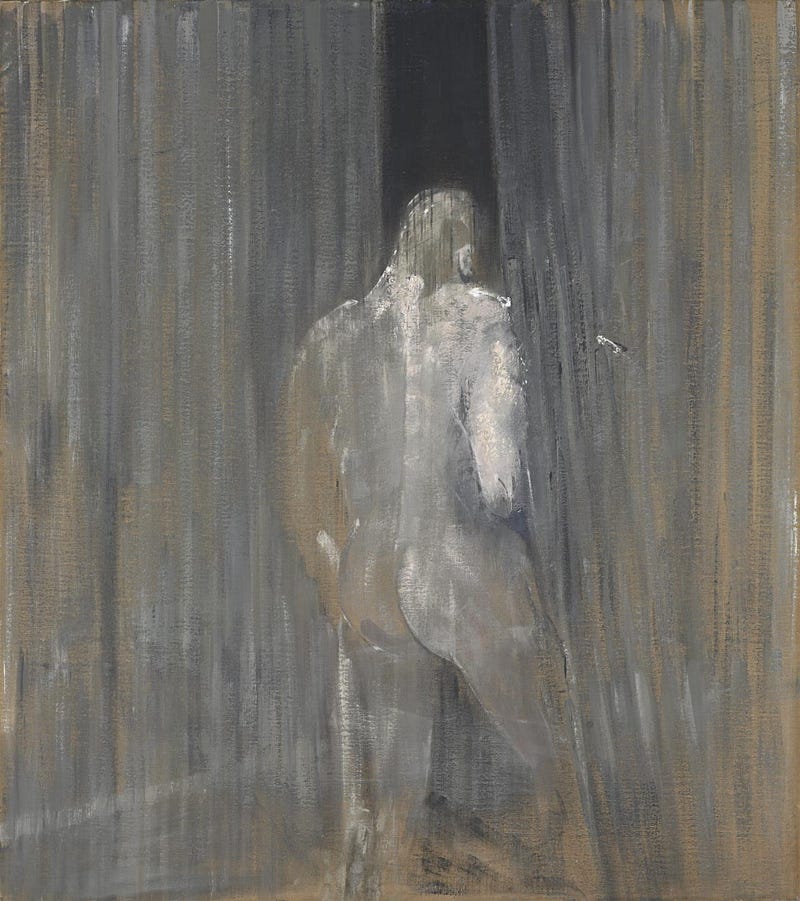
The artist sounded so familiar to me that after a minute or two, I remembered where I’d encountered his work before. There was one of his studies at the NGV, and I remembered looking at that painting for the first time a few years ago, stunted by its subdued violence. The study didn’t show much; it was just a naked figure behind a thin veil, yet the rendering of the light, broad brush strokes evoked something I couldn’t put my finger on.
The professor continued her long-winded explanations: “every brush stroke was a gamble for Bacon, and he said during an interview that he wasn’t even sure where the painting would take him.” From her description, Bacon was an artist of spontaneity. Perhaps just like Michelangelo, Bacon didn’t see painting as a process of deriving precise form from reality but as a process of unearthing the statue from the marble, of unearthing the painting that was already there beneath the canvas. Yet to be spontaneous is almost an act of faith. There is no certainty in a blind shot in the dark, yet the artist is brave enough to believe they can mould a lawless form.
The lecture moved along rather quickly, and even though we’ve moved beyond Bacon’s artwork, the Three Studies were seared into my mind. Whenever I visited an art gallery, my friend Victoria would constantly pour over works of naturalism. Her search was for the sublime, and out of the two of us, she was the one who was more connected to nature. Yet for me, I was partial to the 20th century’s fervour to invent new ways of perceiving the world, which overlapped with my philosophical obsession with the French thinkers of the era. Whenever Victoria forced me to confront a work of Naturalism, I would always struggle to see the point of the painting. For me, rendering natural phenomena onto the canvas is merely an effort to establish an order that already exists, just like a dutiful husband would always find comfort in familial duties.
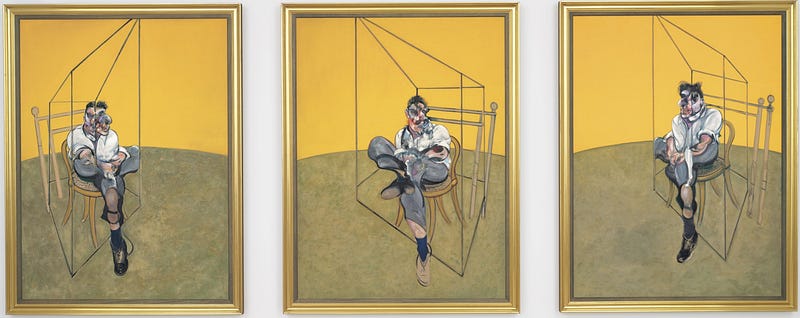
Yet the brushstrokes of Bacon communicated something completely different. Much like his string of promiscuous, homoerotic lovers, his art lived on the edge and tried to escape anything that resembled the natural world. Bacon himself noted:
“If you want to convey fact, this can only ever be done through a form of distortion. You must distort to transform what is called appearance into image.”
The Three Studies present creatures that resemble beasts yet still retain remnants of human features. The emotions did not come from the serene beauty of nature. They stemmed from the fragmented and tortured interiors none of us are strangers to; for we are part beasts and part human, oscillating in a dance between morality and depraved lunacy. And Bacon’s process of giving form to the creatures painted him as a man who always danced around the dangers of chaos yet was courageous enough to contract a deal to bring a piece of divine horror into our finite reality. The result is none other than a piercing image, dwindling on the verge of leaping out of the canvas to put an end to an orderly life. And for a naturally orderly person like myself, the art represented the forbidden curiosity quenched by his brush strokes.
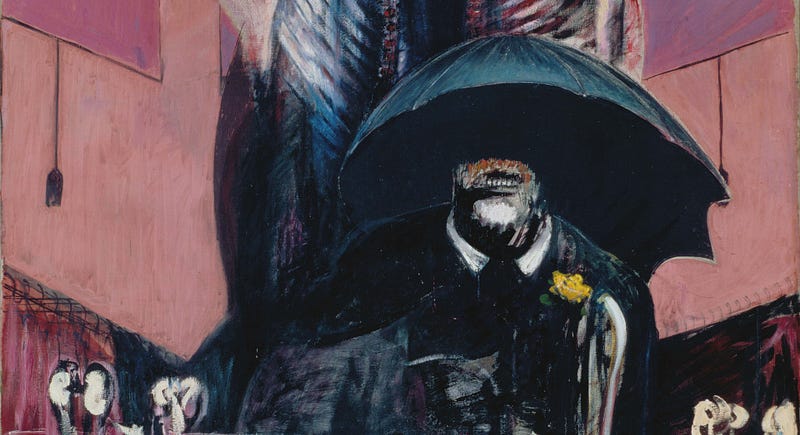
In life, we’re constantly asking ourselves which style to paint our time on earth with. Some will prefer the orderly, naturalistic life, where beauty is derived from viewing reality as it is. Yet some find it increasingly necessary to make contact with depravity in small doses, resulting in a new reality that no ordinary people could fully comprehend. And this is what Bacon represents for me: a dose of courage to take on the lawless form from time to time, and from there, maybe I could learn to perceive reality with a greater degree of intelligence and scepticism. Or at least re-awaken the warm comforts of ordinary life after a measured trip into the formless abyss.