
The Antisocial Implications of Mystical Monism
Why enlightened mystics should be amoral nihilists
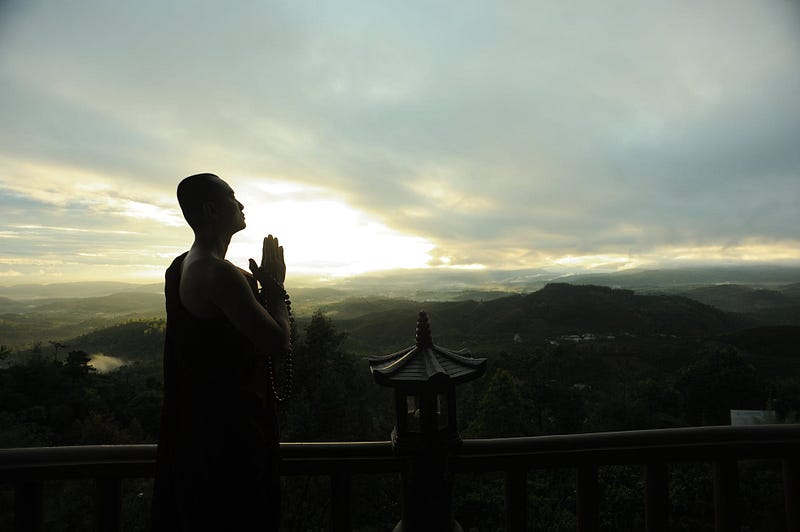
In the Chinese version of the Diamond Sutra, the Buddha is credited as having said, “All conditioned phenomena are like a dream, an illusion, a bubble, a shadow; like dew or a flash of lightning; thus we shall perceive them.”
Now ask yourself whether a wise Buddhist would thereby feel obligated to come to the aid of any part of this illusory world, including the aid of other living things. Could a dream, an illusion, or a shadow have moral rights? Would the crime of raping a woman or of murdering a child be any more consequential, mystically speaking, than the act of erasing a drawing of a woman or of a child? If the world is an illusion, what does it matter how that illusion proceeds? What does it matter what we do if we’re all just play-acting on a cosmic stage?
Similarly, in “By Way of the Five Aggregates,” the Buddha compares consciousness to various illusions, including a shimmering mirage and a magic trick conjured by a magician’s apprentice. The monk sees through all these illusions and is “disenchanted with form, disenchanted with feeling, disenchanted with perception, disenchanted with volitional formations, disenchanted with consciousness.” As a result, the monk “becomes dispassionate. Through dispassion [his mind] is liberated.”
Now ask yourself whether a disenchanted, disillusioned, dispassionate monk could be expected to care about anyone’s suffering or whether he or she would feel sorrow for the trillions of creatures that have suffered on this planet. The whole point of becoming a Buddhist monk is to be free of suffering, but what the monk learns, apparently, is that nothing really matters, not even suffering.
It’s not just Buddhism that arguably entails nihilism. It’s all versions of mystical monism, including those of Hinduism, Neoplatonism, Christianity, and New Thought extrapolations. If only the all-encompassing One is real and the apparent plurality of natural things is unreal, as the monist says, the Many are much less important than the One.
Of course, these metaphysical distinctions can be interpreted differently, but one logically valid interpretation is nihilism, as in the loss of faith in all values, including moral ones. The nihilist in this sense sees no overriding value in life. Life in nature as an apparent body interacting with numerous others is just for show, compared to the greater substance of the underlying unified reality.
Moderate Buddhism and the Return of Cosmic Horror
Suppose, though, the mystic contends not that nature is unreal, but that we’re liable to be confused about this multiplicity since we tend to think that everything in nature has an independent reality. We’re often so proud of our alleged freedom as egos that we become selfish and hubristic, which lead us into unnecessary suffering as we bump up against the world’s indifference to our short-sighted preconceptions.
That, at least, would be a more moderate formulation of the Buddhist’s point about maya or the world’s illusoriness.
Yet if we’re not independently real, we must lack special rights. If there’s no sense of talking of this rock or that tree or this human body, because all such unenlightened talk is empty and pernicious, we should think, rather, that only the interconnected whole of nature has the kind of reality we vainly attribute to ourselves. In that case, we can ask what the values are, if any, of that interconnected whole. What should someone value whose thoughts correspond not to this or to that part of nature, but only to the whole universe or to the higher unity of all events?
Recall that the universe includes mostly lifeless places, including blackholes that swallow galaxies, as well as quantum fluctuations that pay no attention to human intuitions.
If, then, that universe could think or feel anything, would those universal mental states be human or inhuman? Would the interconnected whole care about human suffering? Would the universe that may even include a multiverse, complete with infinite variations of each of us, stoop to showing compassion to a crying child? What special bond would the whole universe — as an unfathomable, inhuman mass of cosmic stuff — have with any of us? What would be the real basis of such partiality?
And if the universe wouldn’t care about our alleged moral rights, why should the mystical monk — who means to be at one with that amoral whole — care about them?
The Dark Secret of Mystical Amorality
The problem is that there are two possible depictions of mystics, only one of which is suitable for popular culture. The popular conception is the exoteric one which takes the mystical monist to be a saint. Not only has this saint transcended suffering, but she may be a bodhisattva, a hero who seeks to relieve everyone else’s suffering in turn.
That’s how we want enlightenment to be. We wish that those who’ve awakened from the errors of our conventional preconceptions would be inclined to care about us like loving parents or would work to make society a kinder, more hospitable place.
The more secret, esoteric conception, however, seems closer to the truth of what enlightenment would have to be, assuming it’s even possible to “wake up” in this existential sense. The dark secret of enlightenment conforms to the blackest expectations which are only as sterile and terrifying as the vacuum of outer space. This secret is that however an enlightened person would present herself to avoid imprudently antagonizing mundane society, this unholy saint would be as amoral and dispassionate as the impersonal absolute she reveres.
It’s not hard to see where the superficial, reassuring impression of mysticism comes from: we wouldn’t expect selfishness from monks who realize they don’t exist as independent entities. Selfishness and all the vices that are supposed to improve one person’s position at the expense of other people is based on emotional attachment to the multiplicity that comes and goes. It’s futile to cling to a hollow identity you can’t possess.
But the question that should be posed to mystics is why selflessness, compassion, and virtue wouldn’t be just as wrongheaded as their negative opposites. If it’s senseless to compete with things that don’t exist as the permanent, eternal souls they’d have to be to warrant our obsession with reckless scheming, why isn’t it just as foolish to sacrifice your illusory self out of deference to other illusory selves? Why isn’t morality just as confused as evil?
Even the self-sacrificing bodhisattva comes across as an insidious figure. She means to retain a modicum of moral concern, resisting her interest in fully liberating herself which would render her dispassionate and impartial. With that dissipating, unenlightened compassion the bodhisattva sets others on the path of curing themselves with enlightenment. But that would mean the bodhisattva is attempting to free the masses from the illusion of morality that’s a product of the error of egoism. The bodhisattva is secretly or effectively an evangelist for mystical nihilism, otherwise known as “cosmicism,” as named by the cosmic horror writer H.P. Lovecraft.
And horror is the fitting genre in which to situate mystical monism. As dry and abstract as these metaphysical discussions may seem, the implications are apocalyptic, not uplifting or reassuring, contrary to the popular wishful thinking about what’s going on in the head of religious monks.


