
The Fake Stoicism of Ryan Holiday’s Self-Help Advice
And why his books nevertheless dominate the bookstore’s philosophy section
At least in Canada where I live, the philosophy section of mainstream bookstores is relatively paltry, which is depressing but understandable. Only what sells can sit on the bookstore’s shelves. And philosophy doesn’t sell well, especially when in competition with the rankest sophistry of the flourishing self-help genre.
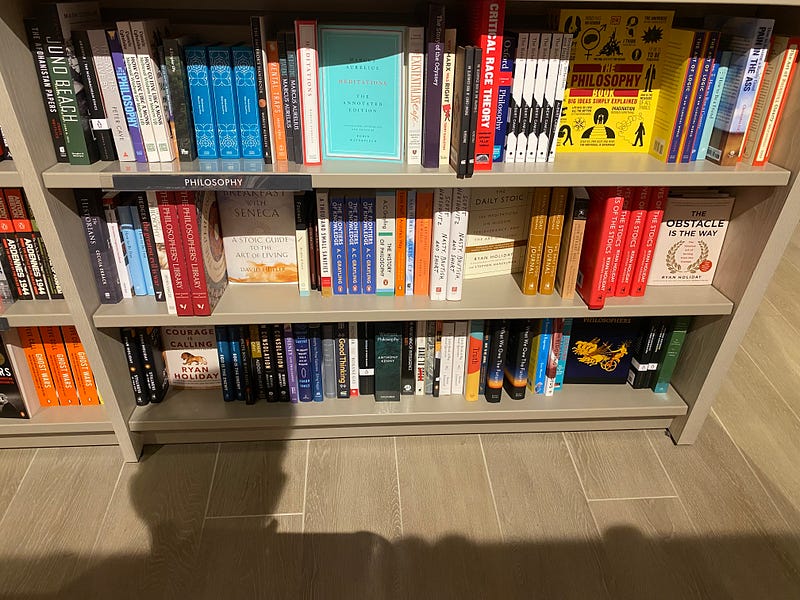
Indeed, self-help authors parasitize philosophy, as I confirmed in a bookstore when I noticed that by far the biggest selling author in the philosophy section is Ryan Holiday, the marketer and so-called Stoicism expert who allegedly turns that ancient philosophy’s principles into self-help fodder for consumers.
Notice below in the picture I took of half the philosophy shelves (located at the disadvantageous bottom of the rack) how Holiday has a whopping six titles that are being stocked, whereas the other authors have no more than one or two. He’s like the Stephen King of philosophy.
Except that when you read Holiday, you discover he’s no philosopher at all but just a self-help writer. That’s equivalent to saying he’s a propagandist for neoliberal ideology; a panderer to fragile, infantilized consumers; and a charlatan who twists the facts with sophistry.
Holiday’s Use of Stoicism to Teach a Feel-good Self-help Lesson
Take, for instance, his book The Obstacle is the Way, which is supposed to teach the reader how to overcome obstacles by following great leaders who overcame similar ones or worse by applying, in effect, the lessons of Stoicism.
Here’s Holiday laying this out in his introduction: “Great individuals, like great companies, find a way to transform weakness into strength…As it turns out, this is one thing all great men and women of history have in common. Like oxygen to a fire, obstacles became fuel for the blaze that was their ambition.”
Referring to leaders like Ulysses S. Grant, Thomas Edison, and Margaret Thatcher, Holiday connects them explicitly to Stoicism, his supposed area of expertise. ‘These were people who flipped their obstacles upside down,’ says Holiday. ‘Who lived the words of Marcus Aurelius and followed a group which Cicero called the only “real philosophers” — the ancient Stoics — even if they’d never read them.’
Holiday concedes that his book is “not an academic study or history of Stoicism. There is plenty written about Stoicism out there, much of it by some of the wisest and greatest thinkers who ever lived.” Yet he maintains that “I have done my best to collect, understand, and now publish their lessons and tricks…This book will share with you their collective wisdom in order to help you accomplish the very specific and increasingly urgent goal we all share: overcoming obstacles.”
Stoic Pantheism and the Imperturbable Sage
The problem is that Holiday ignores the pantheistic backdrop of Stoicism, the dehumanizing, anti-egoistic, cosmic perspective you’re supposed to adopt as you submit to natural Fate. And he sets aside the eschewing of material attachments that make you dependent and reactive. Holiday cherry picks from Stoicism, and combines those tidbits with the presumptions of neoliberalism, that is, with the late-industrial conventions of egoism, consumerism, and the like.
Of course, there’s nothing inherently wrong with synthesizing different schools of thought. But what we’re looking at here is just a way to lend feel-good self-help fare some gravitas by dressing it up with the mystique and seeming manliness of ancient Stoicism. This isn’t philosophy at all, but a playtime performance of dress-up for an audience of puerile consumers.
You can see the sophistry in Holiday’s title, The Obstacle is the Way, which is taken from a passage in Marcus Aurelius’s Meditations. Holiday quotes Marcus as saying, “The impediment to action advances action. What stands in the way becomes the way.”
And Holiday adds, ‘In Marcus’s words is the secret to an art known as turning obstacles upside down. To act with “a reverse clause,” so there is always a way out or another route to get to where you need to go. So that setbacks or problems are always expected and never permanent. Making certain that what impedes us can empower us.’
But Holiday leaves out the implicit secret itself, which is pantheism, because that secret is wholly at odds with the self-help promoter’s egotism and consumerist zeal. Here’s the entire passage from Meditations, and I highlight the key words for your convenience:
In a sense, people are our proper occupation. Our job is to do them good and put up with them.
But when they obstruct our proper tasks, they become irrelevant to us — like sun, wind, animals. Our actions may be impeded by them, but there can be no impeding our intentions or our dispositions. Because we can accommodate and adapt. The mind adapts and converts to its own purposes the obstacle to our acting.
The impediment to action advances action.
What stands in the way becomes the way.
Holiday leaves out the first three sentences, starting his quotation from “Our actions may be impeded…” He thus ignores that concept of the “proper task.” What that task might be is clear from the beginning of Book Four of the Meditations, as is how this secret might enable Stoics to overcome obstacles (again, I’ve added the emphases):
Our inward power, when it obeys nature, reacts to events by accommodating itself to what it faces — to what is possible. It needs no specific material. It pursues its own aims as circumstances allow; it turns obstacles into fuel. As a fire overwhelms what would have quenched a lamp. What’s thrown on top of the conflagration is absorbed, consumed by it — and makes it burn still higher.
For Stoics, proper occupations are just those which are natural, divinely rational, and therefore possible, all others being foolish and impossible. To attempt to do that which is impossible because it’s against the laws of nature is to cause yourself to suffer. Stoics avoid suffering by understanding what’s naturally possible, and they do so by taking up a cosmic perspective, as opposed to focussing on their narrow personal concerns which are liable to be at odds with the greater reality.
The reason, then, Stoics overcome obstacles is that they see divine nature as acting through them. That is, the Stoic sage has become one with nature by abandoning his or her egoistic preferences, so that it’s only the cosmos that’s “overcoming” itself, as it were, in changing from one state to another via the sage’s mediation.
Holiday’s Distortions of Stoicism
Return, though, to Holiday’s interpretation of Marcus Aurelius, where Holiday says the goal is to discover “that what impedes us can empower us.” On the contrary, the Stoic goal is to be imperturbable, which is achieved by eliminating all expectations that are foolishly out of alignment with what’s necessary in nature. For Stoics, it’s nature as a divine whole that’s empowered, never organisms within nature, not even sages. Like Taoists and Buddhists, Stoic sages empty their minds of the egoistic conceit of their personal advantages since they mean to adopt the cosmic perspective on everything, including themselves.
As Thomas McEvilley writes in The Shape of Ancient Thought,
According to the Stoic concept of cosmic harmony, the ethical end is to bring one’s patterns of desire and aversion into harmony with the actual flow of events which are outside our control, or with nature…One should desire the things which actually do happen, and should not desire the things which do not actually happen. To desire things which do not happen, or hate things which do happen, is regarded as actually sinful: It represents a perverse personal willfulness which goes against natural harmony. An inclination to position oneself in conflict with nature amounts to a pathos or passion, which “could be properly located as a subdivision of ‘impulse’ [horme]. As Stobaeus says, “They say that passion is impulse which is excessive and disobedient to the dictates of reason, or a movement of soul which is irrational and contrary to reason.” The goal of ethical philosophy must be to bring personal preferences and aversions into harmony with those of the ruling principle of the universe, variously called “Zeus,” “Reason” (Logos), and “Nature.” As Cleanthes wrote in his “Hymn to Zeus,” “Zeus leads the willing person, the unwilling he drags.”
This pantheistic surrender to natural fate has nothing to do, though, with the standpoint which Holiday takes for granted throughout his book. He says, for example, “It turns out that the wisdom of that short passage from Marcus Aurelius can be found in others as well, men and women who followed it like he did…This philosophic approach is the driving force of self-made men…” (my emphasis).
That American frontier assumption that there are such things as self-made men is perfectly at odds with Stoic pantheism.
Or again, Holiday says, “We are the rightful heirs to this [Stoic] tradition. It’s our birthright. Whatever we face, we have a choice: Will we be blocked by obstacles, or will we advance through and over them?”
That question presupposes the self-interest of his entitled First World readers who are used to consuming enormous amounts of commercial products in a frenzy of unnatural activity that’s trashing the biosphere with landfills and pollution.
“Will we be blocked by obstacles?” Holiday asks. But the universe doesn’t care if we’re blocked or not. We count for nothing, according to the Stoic sage. We’re only infinitesimal parts of a divine whole. What matters isn’t whether we learn how to trick our mind into overcoming obstacles; instead, it’s whether we can view the distinction between self and world as vainglorious because the world is far more powerful than the human mind.
Indeed, the entire premise of Holiday’s book, that we can use Stoicism to overcome obstacles is wrongheaded, from a Stoic standpoint. We’re supposed to adjust our mindset so that we accept whatever happens, not vainly gather our strength to wage a war against reality, regarding unfavourable conditions as “obstacles” to be conquered. The Stoic sage is serenely indifferent to the outcome of her actions because the outcome is typically beyond her complete control.
Holiday is aware of this — presumably because it takes only five minutes of reading any Stoic text to discover it. But even in the section of his book that addresses natural fate, “Love Everything that Happens: Amor Fati,” he twists the Stoic point to make it suitable to narcissistic, neoliberal consumers and self-help afficionados. Holiday says:
The goal is:
Not: I’m okay with this.
Not: I think I feel good about this.
But: I feel great about it. Because if it happened, then it was meant to happen, and I am glad that it did when it did. I am meant to make the best of it.
Pantheism is supposed to humble the Stoic sage, not feed our conceit that natural events are meant to benefit or to challenge us. Holiday’s reading Stoicism through a Western, Judeo-Christian lens, and presenting it to readers who would be appalled by raw Stoicism.
As McEvilley observes, the Stoics, along with other ancient philosophers in Greece and India “regarded states of mind themselves as the ethical material, regardless of the acts that may be performed.” Yet “the Greek tradition was largely clouded over by the Judeo-Christian; it has been convenient for western cultures to forget the fact that the ethical attitude espoused by most of the Greek philosophers of whom we have knowledge was inimical to the Judeo-Christian type of ethics.”
Here’s a final anti-Stoic sentiment from Holiday, though you can find one on practically every page of his book: “We might not be emperors, but the world is still constantly testing us. It asks: Are you worthy? Can you get past the things that inevitably fall in your way? Will you stand up and show us what you’re made of?”
Is the world testing us, as though we’re of central importance? That’s what the pampered Western consumer who’s fed on self-help tripe might presume. But the Stoic sage isn’t interested in showing the world what she’s made of, as the least bit of reading of actual Stoicism will indicate. The sage learns, rather, that she’s nothing compared to the cosmos, so she lets the cosmos work its will through her.
The Stoic sage is a passenger, riding natural events with a tranquil state of mind. Yet this is the very opposite of boasting about your personal strength in the face of unfavourable obstacles.
Holiday’s Sordid Agenda: Flatter the Rulers of this Anti-Stoic Age
My point, though, isn’t just that Holiday distorts Stoicism or gets his facts wrong. There’s no more organized Stoicism to speak of, so those facts are only for academic historical interest. And again, there’s nothing inherently wrong with adapting some viewpoint to a foreign set of problems.
No, my point isn’t that Holiday needs a history lesson or that he’s ignorant of what takes only a few minutes to learn. On the contrary, I’m saying that his book’s distortions aren’t accidental. Plainly, Holiday twists Stoicism to reassure complacent consumers, which is of course why his books sell the best in the philosophy sections of Western bookstores, as infuriating as that fact should be to philosophers.
Indeed, I chuckled when I read the following passage from Holiday’s preface, a passage which seems inadvertently to reveal his target audience. Stoic wisdom, he says, is “a remarkable constant down through the ages.” You
can trace the thread from those days in the decline and fall of the Roman Empire to the creative outpouring of the Renaissance to the breakthroughs of the Enlightenment. It’s seen starkly in the pioneer spirit of the American West, the perseverance of the Union cause during the Civil War, and in the bustle of the Industrial Revolution. It appeared again in the bravery of the leaders of the civil rights movement and stood tall in the prison camps of Vietnam. And today it surges in the DNA of the entrepreneurs of Silicon Valley. [my emphasis]
So, there you likely have the purpose of this abuse of Stoicism. Holiday is out to flatter the coolest oligarchs of the late-industrial age, in the process sweeping up the millions of readers who are addicted to their products.
Does it even need to be said that genuine Stoics would have been appalled by Silicon Valley’s engineering of social media platforms that, by addicting us left and right, subvert our freedom to rationally assent to what’s natural or divinely necessary? Yet Holiday sees those tech billionaires as paragons of Stoic wisdom. Mind you, it’s easy to make that latter claim of Holiday’s if you think it’s within your purview to shamelessly redefine “Stoicism” to mean whatever will reap you the greatest profits.
Incidentally, I’ve criticized Stoicism elsewhere for being the wrong kind of pantheism, and for being too artificially centrist, as the Stoics stood between the Cynics and the Aristotelians. But Stoic philosophy is, of course, far more admirable than the consumerist propaganda purveyed by self-help charlatans like Holiday.


