
The Anti-iconic Building
On icons, grafts, and hybrids
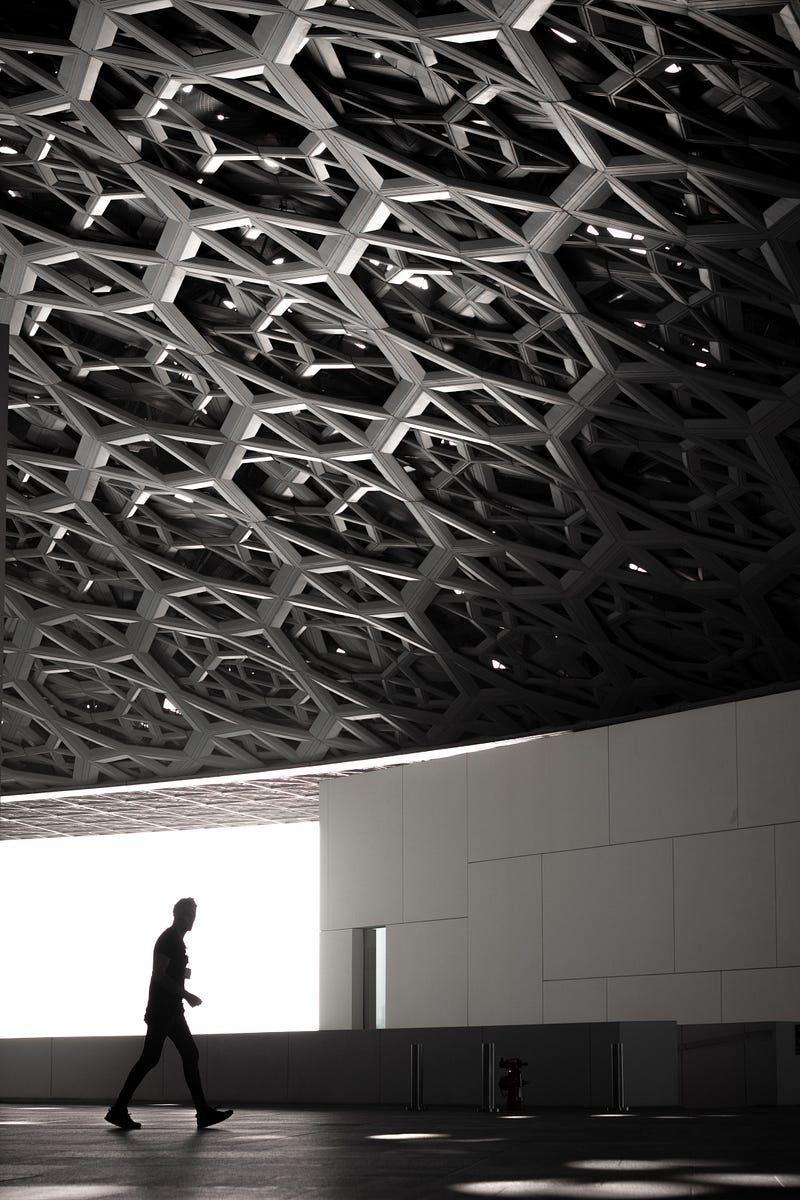
This is a manifesto for a building that could change the future. Its purpose is not solely to reshape the face of the city it dwells in but to provide a global anti-icon in an undefined urban landscape. That’s why this building needs to be built in an underdeveloped, not-yet globalized urban settlement.
Unlike the saturated globalized cities, filled with contemporary icons such as shopping malls, mega-museums, and high-rise office buildings, the not-yet globalized city offers a more fertile ground for something remarkable to emerge: the anti-iconic building.
The only condition is its incorruptible nature to money and power. Its highest merit would be its openness to all and un-monetization of space. That’s why the building will be called an anti-icon, it`s opposite to what Leslie Sklair describes as iconic architecture in the global capitalist system:
The culture-ideology of consumerism relentlessly promotes the view that the true meaning of life is to be found in our possessions. […]
To that end, iconic architecture promotes an insatiable desire for the fruits of consumer culture. [1]
The building will be called The Graft, a manifest for the anti-iconic building.
The Architectural Graft
In medicine, the graft is a tissue or artificial device inserted in the human body through a surgical procedure. Its purpose is to replace or support a damaged area. The graft integrates into the host’s body and ensures normal functioning of the whole.
Similarly, the architectural graft is an insertion. Its place is between buildings. It is meant to occupy and revitalize a dead space. It can also enhance the interconnectivity between spaces, or heal damaged urban areas. An architectural graft has the chance of becoming an iconic building- minimizing the presence of the surroundings and standing out on its own.
Just like a human body, we can imagine the city as a living organism. Or as a machine, always in need of care and replacement of broken elements.
Inserted in the original entity- bodies or cities, the graft carries the possibility of progress- because of its highly technological nature and novelty.
We live in a technocracy already. Technology decides what resources are needed, what wars must be fought, what news people should receive. The issue now is not Whether Technology but Which Technology. [2]
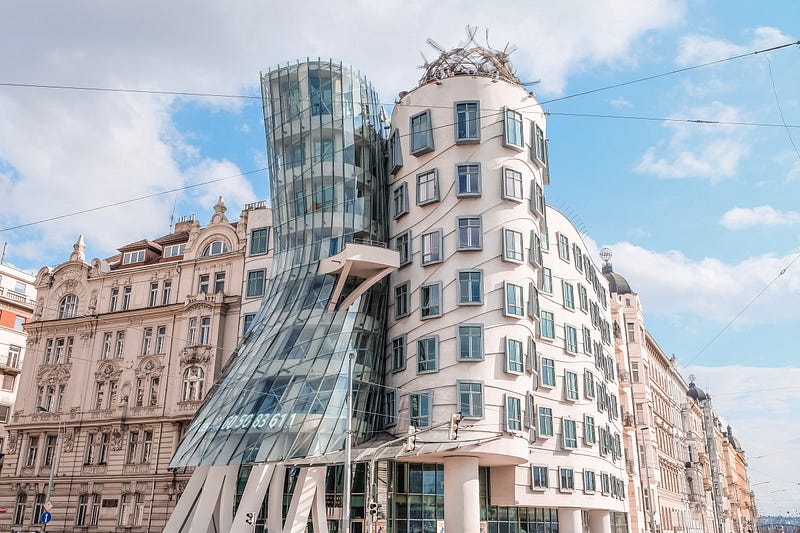
The hybrid
In a futuristic scenario, the alien entity inserted in a living organism outperforms the original body. It is always an enhancement, be it organic or artificial.
How far from us that future really is?
Hard to tell, as professor Warwick, also known as Captain Cyborg, was already controlling objects in 1998, including a robotic arm, with the aim of some implants in his body. [3]
Being a human was ok, I even enjoyed some of it. But being a cyborg has a lot more to offer.
professor Kevin Warwick for The Guardian
Putting the professor’s joke aside, the hybridization of human bodies with technological entities is a highly disputed concept. As contemporary philosopher Rosi Braidotti envisions, our world would be populated with perfect, high-tech bodies of the rich while augmented bodies of the working class would support the entire economy:
cyborgs include not only the glamorous bodies of high-tech, jet-fighter pilots, athletes or film stars, but also the anonymous masses of the underpaid, digital proletariat who fuel the technology-driven global economy without ever accessing it themselves. [4]
This draws a reference to what Thorstein Veblen wrote on the ‘leisure class’ in The Theory of the Leisure Class, in 1899.
But the architectural hybrid, consisting of a mixture of functions and structures, could become a powerful tool for the future democratization of space.
Be it for cyborgs or humans, architecture must follow the ethics.
The architectural hybrid
Hybrid architecture is beneficial to the city, especially to the unstructured, chaotic one. The architectural hybrid is a mixture of spaces, functions and structures that adapt to different usage scenarios. Hybrid architecture does not encapsulate space for a single purpose but offers the platform for space to become liquid.
As renowned architecture studio OMA sustains, a hybrid building inserted in a chaotic urban environment brings stability and coherence. The building’s architectural elements may become boulevards, safe passages, green areas, dormitories, and art scenes all in one. Basically anything that the urban island is lacking, in one building.
(Hyperbuilding) it can be read as the integration of several buildings into a larger whole. The different elements support each other in every sense: architecturally, they form an integrated complex; technically, issues of stability, access, circulation and servicing are organised collectively; urbanistically, the entire building becomes an urban quarter of a new kind. [5]
The iconic building
Iconic buildings seek the WOW effect. They are a chance for the anonymous architect to finally become a star. And they are a tool to highly monetize space.
Iconic buildings of today are the replacement for the monument of the past. Humans were always fascinated by big structures, whether to remind them of God and moral duties or the state power and their subordination to it. Now, people worship a different kind of power: money. [6]
And one way to access a large amount of money is through grabbing attention.
BUT…
… some iconic buildings, such as Frank Lloyd Wright’s Guggenheim Museum in New York, built in the ‘50s under the modernist style, are such a genius response to the urban surroundings and function that they end up iconic, without seeking any artificial wow effect.
In my readings, I haven’t found a stronger critic of the iconic building than professor Leslie Sklair from the London School of Economics. In his paper The Icon Project: Architecture, Cities, and Capitalist Globalization, he argues the monetization of space, encapsulated in fancy architecture that supports the everlasting consumption of goods.
This, in turn, results in the virtual privatization of public space through a process of creating new consumerist spaces tailored toward privileged publics — that is, people with money to spend. [7]
Iconic buildings often become an ego facet not only of the rich but also of their designer. While I agree that iconic architecture such as Burj Khalifa is exorbitant, unreachable for most of us, and a symbol of supremacy, there are examples of iconic architecture, improving the condition of an entire city through its extreme fashion.
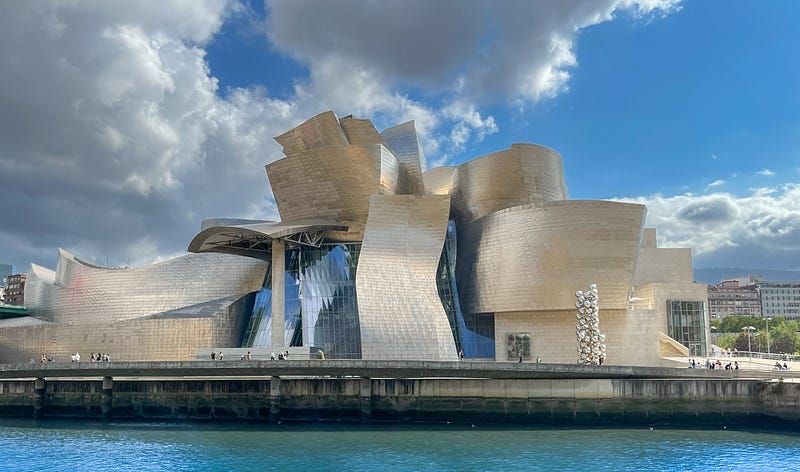
The case of Frank Gehry’s Guggenheim Museum Bilbao, described as the Bilbao Effect, revitalized the economy of the whole Spanish city, which was a rather dull, industrial city. Iconic architecture is a branding strategy, and it is the missing piece for many cities to become remarkable.
And everybody wants to redo the Bilbao Effect…
Between icons, chaos and poverty
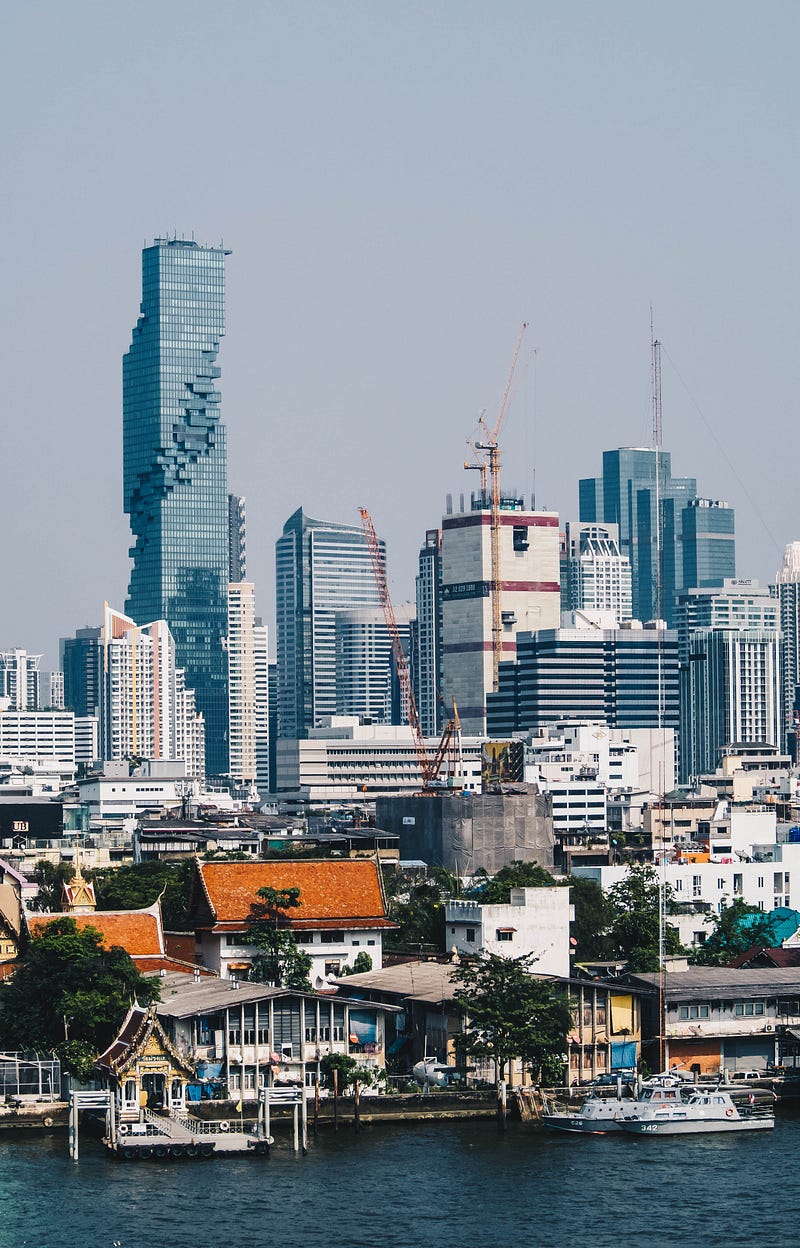
Professor Leslie Sklair states that iconic architecture is a product of capitalist hegemony, which I found to be obvious in the Thai metropolis, Bangkok.
Bangkok is composed of two different cities that seem to have nothing in common: the lower city- crowded, polluted, frantic and poor, and the upper city encapsulated in the high-rise buildings or shiny shopping malls for the wealthier classes.
The lower city spreads like a fractal, in an endless multiplication of huts, dirty, low-rise buildings, temples, open markets, vehicles, movements, and street food, while the upper city- business towers and luxurious apartments, emerge solitary in the clouds.
While the high-rise buildings look all the same, without any specific contextualization of the form, one of them dominates the metropolis’ line- MahaNakhon, the tallest building in Bangkok.
As the architecture office in charge, OMA, states in MahaNakhon’s architectural description on their site, the building’s pixelated facade mirrors the intensity of the city.
MahaNakhon’s pixelated and carved presence embraces and connects to the surrounding urban fabric rather than overpowering it. […] This architectural geography is conceived to convey the energy, intensity and inclusiveness of Thai society and celebrate Bangkok’s emergence as a true global capital, fitting the Thai meaning of the name MahaNakhon, translated as ‘great metropolis’.
But in my opinion, the description is far too fancy and unrelated to the reality of the city. Its only merit is that the pixelated-all glass-facade makes it somehow fade away in the rainy sky.
The Graft: manifest for the anti-icon
We have seen the good or bad impact of iconic buildings. But what would an anti-iconic building look like… and stand for?
1. The anti-icon acts like a graft
The anti-iconic building is fully connected to its context and, therefore is subdued to formal and size boundaries. While the iconic building overpowers and often destroys an existing urban tissue, the anti-icon grafts itself on the surroundings. The anti-icon enhances, empowers, and heals the existing fabric.
2. The anti-icon is a hybrid building
The anti-icon doesn’t serve only one or two functions. It occupies space with a purpose: providing different functions according to the citizens’ needs. It can be a nursery, as well as a hotel. A school, as well as a shelter.
3. The anti-icon is open to all
As a hybrid, the anti-icon can meet different kinds of needs, at the same time. Its highest merit is that people do not feel intimidated by its presence but welcome to come inside.
4. The anti-icon is not monetized
Realistically, any building needs an income to sustain itself.
But the anti-icon lives solely from donations. The anti-icon teaches giving something back to the community, not only encapsulating space for the use of the few.
5. The designer of the anti-icon is not just ONE
The anti-icon is not a project that brings fame to one. It is a team effort where the anonymous architects and engineers get equal recognition for the work.
6. The anti-icon is not a fancy, shiny building
Iconic buildings are shiny…and cold. Glazing facades, steel structures and concrete slabs are cold elements. The anti-icon is a tectonic building, it follows the honesty of structure and materiality, integrating them into an art form, embedded in its context.
7. The anti-icon is beyond fashion
The iconic building replaced the historical monument, as architectural historian Charles Jencks sustains. But the historical monument never went out of fashion. We still visit cities because of their historical centers. We still look up to monuments and give them important functions. We restore, protect, and view them as our identity.
The iconic buildings of today are at the risk of going out of fashion. The once tallest building, becomes the second, the third… We get bored easily and money can always bring the next hot stuff.
The anti-icon is beyond fashion, it becomes an identity or an artifact.
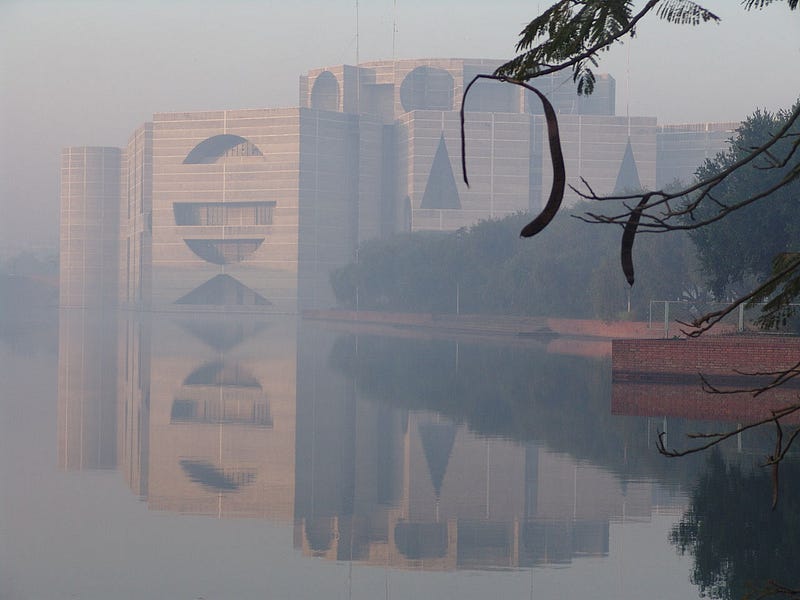
8. The anti-icon founds fertile ground in not-yet-globalized cities
Iconic buildings are a product of the fully globalized, capitalist city. The anti-icon has the chance to stand for something better: the democratization of space. The anti-icon can lead cities towards a more equitable, sustainable future. The anti-icon can change the future of the not-yet globalized city until is not too late.
Such a city can be the Romanian capital, Bucharest.
References and citations
[1] Sklair Leslie, The Icon Project: Architecture, Cities, and Capitalist Globalization, in The Brown Journal of World Affairs, Spring/Summer 2017, volume xxiii, issue ii.
accessed from: https://www.researchgate.net/publication/316279446_The_icon_project_architecture_cities_and_capitalist_globalization
[7] Cited work, pg. 129
[2] Fend, Peter & Sans, Jerome, The City as Machine for Living In, Grand Street, №50, Models (Autumn, 1994), pg. 27
accessed from: https://cdn.contemporaryartlibrary.org/store/doc/2102/docfile/original-fcf1825c93169b7b16c3799643a9b6ea.pdf
[3] Kool, V. K. & Agrawal, Rita, Psychology of Technology, Springer, 2016 (e-book). pg. 131
[4] Braidotti, Rosi, „The Posthuman”, Cambridge: Polity Press, 2013, pg. 90
[5] Hyperbuilding, OMA, 1996. https://oma.eu/projects/hyperbuilding
[6] Jencks, Charles, The iconic building is here to stay City. 10. 3–20, 2006, pg. 3, 10.1080/13604810600594605.
accessed from: https://www.researchgate.net/publication/248930157_The_iconic_building_is_here_to_stay/citation/download
I am an architect passionate about design, heritage and entrepreneurship. I run the architecture office Kule Arhitectura, and I am currently enrolled in a Master’s Degree in Heritage Conservation. I am happy to share my thoughts and experience with the world and learn from fellow writers on Medium!


