
The Anthropology of Us
Fiction for foreigners to their own tribes
I‘ve knocked on Anwar’s door and now I’m panicking and fumbling with the tangle on my face. Earbuds, wires, mask, glasses, hoodie.
It really hasn’t taken me long to become a hot mess. I only wear clean shirts if I will see someone ‘in person.’ Which means, rarely to never. Only now do I start to think about the fact that Anwar never wrote to me when he was gone. But I know he’s back even if he hasn’t been logging into the Zoom room.
Yet here I am. Once again, my reflexes are lightning fast, the thought process is more of a postmortem.
He did leave me his key. I mean, once upon a time, Alwar didn’t seem to mind having me around. He’s not answering so I guess I’ll just go in.
I am the queen of all that is awkward and the goddess of going too far. No need to stop now. That may not be why Alwar loves me, but it’s why he knows me. I might literally be the only person he does know.
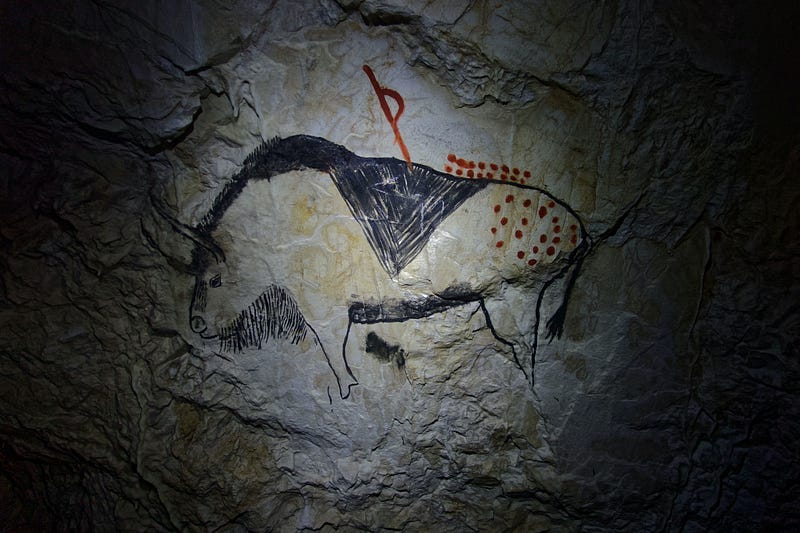
I remember meeting him in that lecture on cave art. Beautiful stuff. Tribal. Large mammals grazing on stone, hands outlined on the walls of rock. I could feel the emotion of it.
What was the theory? The first cave artists were neurodivergent — keen in focus and observation. That diversity saved humanity from the winter and lived on forever in our evolution.
Not sure how they gathered that from the cave art, but it’s a cool story. Alwar was unusually talkative at that seminar. And I was, well, me.
“Hey, you have a real visitor — you might want to put some pants on.”
The smell is all scorch and syrup. Alwar had that habit of burning bundles of herbs from different places he’d visited to purify the energy of the place — or, in my opinion, get that terrible smoke smell out of the couch. But this is a different flavor of desperation.
I swing open the cheezy kitchen doors, ready to crash his morning ritual.
You would think that self-preservation would tell you not to grab the cord of a smoking appliance. But I guess someone in the herd has to act fast and think later. I have a fistful of wires — and, apparently, luck.
Would my sneakers have insulated me in the event of a short? Some questions, I guess, will go unanswered.
The coffee pot is crackling and scorching with the heat of being empty and nothing is left but bitter smoke and obsidian dried to the bottom. He’s gone long enough for coffee to turn to stone. But not long enough for the place to burst into flames. Look at me, Anwar, who’s the archeologist now?
I wander to his couch. I’ve always marveled at just how far you sink into that thing. The disgusting stained mustard corduroy of it all. And here, in the crack. That’s not right. Alwar would never, never leave a page of his travel journal languishing in the uncharted savannah of this couch.
It’s also totally unlike him to be melodramatic and leave clues. Just like it’s totally like me to read any page of private correspondence that I sit on when I enter someone’s flat uninvited.
Home: me scribbling in a journal in this concrete box. Sent home by the pandemic. I was probably safer elsewhere.
It is so much saner studying the questions of others, remote places where you wrap yourself in the clothes of unknown cultures, sit in the dust of grass mats among pecking chickens. You observe the customs of strange tribes — and make sense of it.
Here I am, empty apartment, dusty backpack, isolation, and the narrow walls. The student sofa might swallow me whole, disappearing me along with the crumbs and loose change and the grooves worn by others, now come and gone.
What to do when the strange tribe is your own?
What is sacred about a linoleum floor and cheap coffee percolating in an even cheaper countertop altar to the cheap fix. Where is the meaning in all of this? Where is the hidden story of society? The threads handed down from our ancestors? What should I snap with my camera, jot in this travel journal?
And possibly, the more important question these days: can you live without a tribe?
Somehow I only know what I observe. And so I am wrong for this place.
It is so much easier to be an outsider when you are the strange, gangly, eternally single man and no one expects you to fit in anyway. Pose with me for a photo. Send your children to wander through the village after the strange foreigner. Let your babies cry at my strangeness.
All of that I can handle. But not the blank stares of my own.
A good way to avoid my own tribe? Study another one.
I could just take the 57 line out of town until it ends and the road winds up the mountain. Hike a little farther to the place where the road is impassable in winter. People don’t go to the periphery much anymore, but once upon a time, it appears this was the place.
A fabled place that may, or may not exist. Where people roamed barefoot before paper, bronze or so many cultivated swaths of land. A time when man was simply one of the wild and brave animals roaming these parts. A shadow painted thing on the wall of a cave somewhere in the background while pigments told the tale of the beasts who truly ruled the earth.
Shelter and food were found on day to day and home shifted and moved with the seasons and the hunt. A time before man committed his greatest mistake: staying put. Throwing up these four walls. To own, to possess. To possess each other.
What is left behind of the barefoot gatherer? Only what has been sheltered in the fabled caves up on the mountain. Maybe it’s only schoolboys and their rumors — hands stenciled on rock, creatures scrawled on stone. No one has found it, so far.
What might I find of them? Possibly not a trace, but I’m convinced that they are more real than this story that is unfolding around us now.
And anyway. Am I really ready to have a conversation with someone who thinks believing in the virus makes it so? It is a religion that makes it hard to be a non-believer.
By slipping on a mask, you make the virus real. And they banish you for it.
No, I’ll go spend the day searching for the prehistoric.
End of the line. The bus is pulling away and it’s too late to go back for a warmer jacket or to decide I really should have worn socks. The wind up here is finding it’s way into the ankles of my jeans, the back of my shirt. I really better not miss the last bus down. That could be my last mistake.
The trail heads up this nook — not quite a valley, just the north side of a ridge. Just this frozen zone that never sees the sun this time of year. I can tell by Anwar’s sketches where to go. My friends and I used to come here as kids. I wonder if he meant to go to the caves.
Clearly, he never got invited to one of our outings. Doesn’t surprise me. And who knew — who would have imagined that the cave art was, well, from cavemen and not teenagers bored with their modern-day tribe? Or maybe we just wanted to keep that place for ourselves. Maybe it was ours — too sacred to be famous.
All the trees on this side have moss and frost this time of year. The pond that gathers at the foot of the ridge is turning to ice. The tufts of grass are stiff with cold as I hop from one to another hoping not to slip and pierce the ice.
When you get to the clearing, it’s weird to see how higher is actually warmer. The rocks trap the heat of the sun. I just have to poke around to find the entrance. Here.
I at least have a lighter to see where I am. Not that it was part of any plan. Anwar’s backpack is not far from the entrance. Under the artwork. Roaming animals. Strangely small people keeping watch — or roaming too. Hands outlined in red — are they injuries? Self-inflicted? Or is that simply my modern eye?
It’s cold in here. I dig into the pack to find the sleeping bag I know Anwar will have thought to bring and crawl inside. It’s not good for me to miss that last bus, but then, I just have this feeling. It’s not good for Anwar to leave the tribe.
Maybe he doesn’t need us.
Maybe we need him.
© 2020 Trisha Traughber. Thanks for reading.


