
The Animal With Many Brains That Makes Us Rethink Intelligence
The octopus and its cousins are the closest things to alien intelligence. Their neurobiology coupled with their strange abilities raises many provoking questions.
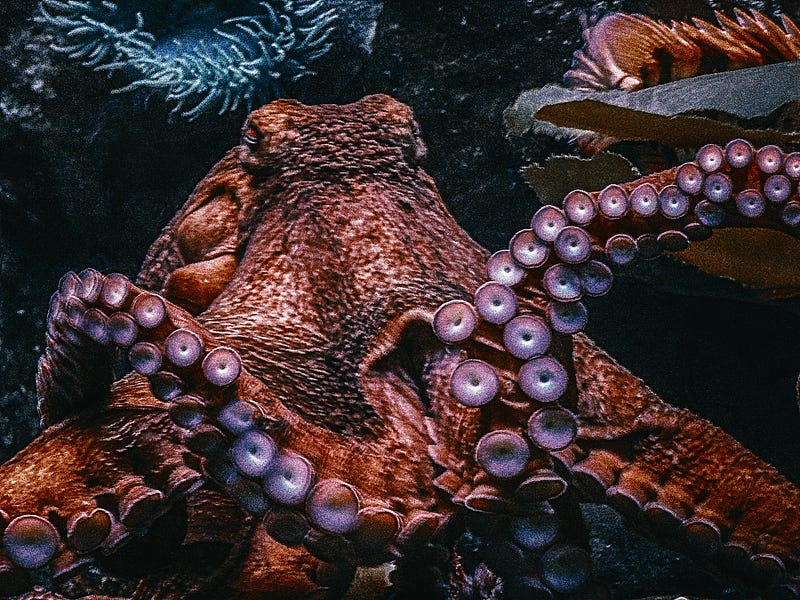
In 2016, a daring New Zealand inmate planned a careful escape from its prison. This inmate decided to slip away at night. The stunning disappearance of this inmate did not go unnoticed. A small trail of water was left behind, leading to a narrow drainpipe.
Inky, the octopus, escaped from a New Zealand aquarium. Slipping through a small hole in the aquarium, Inky slipped towards a narrow drainpipe leading to the open ocean.
These strange underwater dwelling creatures perform impressive cognitive feats. The octopus belongs to the class Cephalopoda that also includes their intelligent evolutionary cousins, squid and cuttlefish. These odd invertebrates evolved and adapted for thriving in an underwater environment. Their brain and nervous system are downright alien to us.
Their abilities, like camouflaging-at-will, are ripped straight from the pages of comic books. While they are nowhere near as social as humans or other primates, they nonetheless are capable of complex communication. The way these creatures function force us to expand our expectations for intelligent life.
But what is intelligence? According to psychologist Robert J. Sternberg, we can define it as follows:
Intelligence is one’s ability to learn from experience and to adapt to shape, and select environments.
Intelligence confers the ability to exert behavioural flexibility for adapting to the environment. The main drivers of the adaptation of vertebrate-intelligence are the formation and maintenance of complex social bonds and finding food. Whether it’s a pet dog or cat doing tricks, or a rat playing basketball, plenty of mammals are capable of performing these simple tasks, showcasing their intelligence.
Smarter animals like primates live longer and therefore require more intelligence to maintain their social bonds. As we dive into cephalopod neurobiology, we swim farther from these conventional notions. While food foraging is still a necessity, most cephalopod species are short-lived!
Behavioural Complexity
Unlike primates, cephalopods are semelparous, meaning they only breed once. They either die after laying their eggs or in the case of the female octopus, shortly after its offspring hatch. As a result, there are no inter-generational or parental relationships and no opportunities to pass along information. All of their skills and behaviours are self-taught.
Additionally, these creatures don’t form any cooperative social bonds either. You won’t find a school of octopi hunting together. They even show difficulty identifying individuals within their species due to their solitary lifestyle. Despite these social limitations, they exhibit an array of behavioural flexibility.
Octopus
These animals often forage for hard-shelled crustaceans to eat. The octopus employs different strategies to open these shells, including using the suction cups on its tentacles. When food is out of reach, they shoot a jet of water to move it closer. They even open jars and opaque boxes in aquariums to reach their food. Additionally, they use hard shells as defensive tools or hiding spots. They also use cells, called chromophores, to camouflage within their environment.
The octopus has one of the weirdest nervous systems on the entire planet. It includes 500 million brain cells called neurons organized in 40 different lobes.
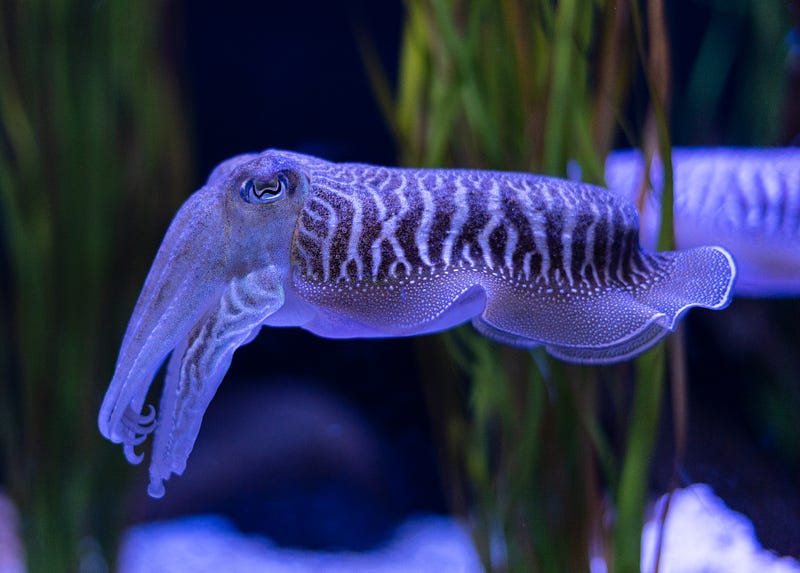
Cuttlefish
Although these unassuming creatures look harmless, their repertoire of foraging adaptations makes them more than formidable. They make smart decisions when hunting as they can intuitively calculate prey quantities. With an innate sense of counting and numbers, they discriminate between less food and more food. Additionally, they are incredible spatial learners, constantly identifying hiding places to shelter. When hunting, they may even disguise themselves as something harmless like a crab.
Cuttlefish display aspects of episodic memory. In humans and other animals, episodic memory allows us to remember previous experiences as well as associated sensations. Episodic memory involves associating locations, times, people and even emotions with a specific event. In mammals, it relies on a seahorse-shaped region of the brain called the hippocampus. Cuttlefish don’t have a hippocampus.
Nonetheless, they remember places where and when they’ve previously found prey and even their prey’s preferences. They use this information to optimize their future hunting patterns!
Just like the octopus, they quickly change the colourations of their skin to blend into their environment!
Squid
These sly cephalopods are rather difficult to study within the laboratory setting. Nonetheless, they quickly change their speed and swimming patterns while hunting their prey.
Chromophores and Cognition
Despite having a diffuse central nervous system with multiple brain-like hubs, octopi and cuttlefish make split-second decisions. When hunting or hiding, they quickly perceive their environment and coordinate different regions of their body independently to change colours. They can even camouflage themselves to match the colours of a novel kind of background, such as a black and white bulls-eye.
These creatures are difficult to study in their habitat. Thus much of what we do know involves anecdotal observations. Some cast doubt that much of the behavioural flexibility involves a cognitive component. Pursuing a better understanding of these chromophore-related camouflage decisions could help us approach an answer.
Genetic Regulation, A Cause of Behavioural Flexibility?
Cephalopods tinker and edit their genetic instructions 60x more than we do!
There is another remarkable aspect of cephalopods that may drive adaptation and intelligence. A double-stranded molecule called DNA encodes the genetic information within all living organisms. The bases in the DNA spell out codes, like instructions for biochemical bakeries.
To avoid losing a master copy of genetic information, DNA is first copied rather than being directly read this as a recipe by cellular bakers.
Genes within the DNA are copied, forming a single-stranded molecule called messenger RNA. This process is called transcription.
Messenger RNA travels to cellular factories. In these factories, ribosomes act as bakers or workers. They read and synthesize proteins that are encoded by the bases within messenger RNA. Proteins, originally encoded in DNA, mediate the majority of cellular processes. This process is called translation.
Surprisingly, cells within the cephalopod brain edit up to 60% of their messenger RNA! After they finish copying genomic instructions, these instructions are edit. When the code within the messenger RNA is changed, it alters the type of protein later produced.
Humans and other organisms typically only edit ~1% of the genes within their genomes. Cephalopods tinker and edit their genetic instructions 60x more than we do! Perhaps, it’s an evolutionary adaptation to drive more behavioural flexibility.
It is possible that editing their genes allows cephalopods to adapt to uncertain environmental conditions. Different combinations of conditions or stressors may favour specific edits within the proteins of the brain. That means that the cephalopods tinker with their genes, perhaps as an evolutionary adaptation to drive more behavioural flexibility.
Weird Anatomy
The octopus has one of the weirdest nervous systems on the entire planet. It includes 500 million brain cells called neurons organized in 40 different lobes. The majority of their brain is dedicated to sensing visual, touch and chemical sensations.
Though the different lobes of the brain are located across the eight-tentacled octopus body, they are well-connected. This is evident in their ability to coordinate camouflage. The large optical lobes process visual environmental information to coordinate camouflage, defence, motor movement and learning.
Interestingly, many brain cells across lobes actually perform similar functions. This built-in redundancy lets these creatures quickly adapt to stimuli they might sense on one side of the body. However, this means they are also capable of coordinating multiple independent movements!
Conclusions
At what point does behavioural flexibility become intelligence?
While cephalopods don’t keep records or communicate across generations, they are incredibly adaptable. They quickly perceive and respond to their environment, but it’s unclear to what extent they learn complex-cognitive patterns. While some perceive these creatures as intelligent, others simply ascribe their behavioural flexibility to environmental adaptation.
Are cephalopods an example of evolution generating intelligent creatures in response to different pressures?
If we do consider cephalopods intelligent, it also changes how we look for life on other worlds. These creatures did not face environmental pressures to form complex social bonds. All of their adaptation stemmed from foraging food in their environment. Perhaps planets with challenging ecological environments harbour similar creatures.
Cephalopods provide compelling evidence for a unique type of animal intelligence. We’ve only broken the surface when it comes to uncovering their neurobehavioural mysteries.


