
The Ancient World’s Best Kept Secret
Recent scholarship exposes a whitewashed Roman history
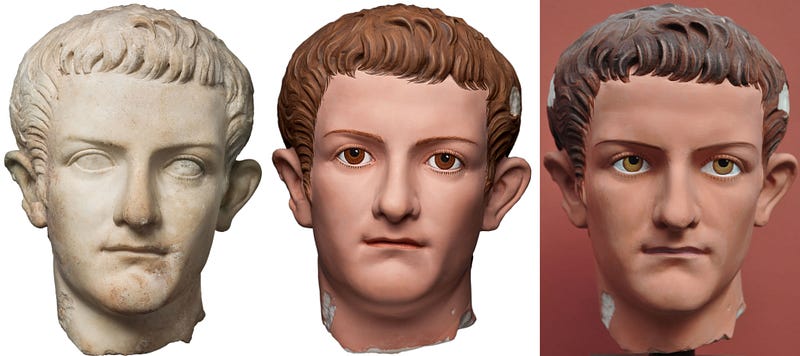
The ancient naturalist Pliny the Elder described the sculptor Praxiteles in his book Natural History, writing that “so much value did he assign to his coloring of surfaces,” that when asked to single out his favorite marble sculpture, Praxiteles replied, “The ones to which [the painter] Nicias has set his hand.”
Echoes of the sculptor’s response continue into the present, as the study of color in Roman sculpture has become something of a zeitgeist in the field. This stems in no small part from the need to correct the long-held belief, born in the Renaissance, that Roman works in marble have always maintained their infamous white skin. This “idealization of white marble,” argues Margaret Talbot in The New Yorker, “is an aesthetic born of a mistake.”
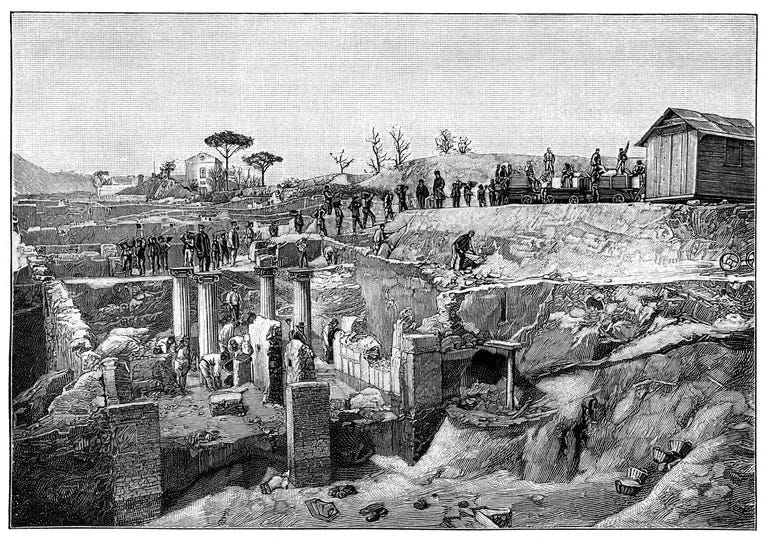
Ancient burial practices, weather, pigment disintegration, excavation and cleaning methods, and cast modeling have all played their part in the gradual and near-total dissolution of polychromy, or the presence of multiple colors, on ancient sculpture. The lack of evidence for color (as well as an impetus or means to find it) made a compelling case for centuries, aided, of course, by Eurocentric views, which long contended that the Romans were too sophisticated to color their art.
Twenty-first century white nationalist groups have since inherited these interpretations of ancient sculpture, calling for a return to an ancient “white” history that never existed. Contemporary research confirms that nearly all imperial Roman sculpture was partly or totally painted, and many were gilded and polished. In fact, polychromy in the Roman Empire is part of a much longer history of painted sculpture. Pharaonic Egypt, Qin Dynasty China, Ancient Greece, and the Hellenistic World saw paint applied to sculpture long before the Roman Empire, and the tradition would be upheld after the fall of the West by artists of the Byzantine Empire, Medieval Europe, Renaissance, Baroque, and contemporary practice.
So, how do we know, and why should we care?
How Do We Know?
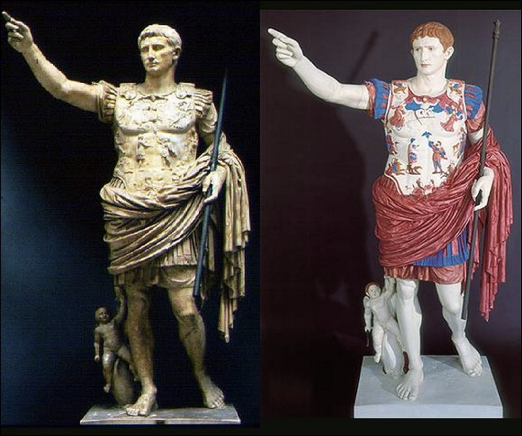
In some cases, visible traces clearly suggest the presence of color. Most famously, the Augustus Prima Porta, discovered in 1863, exhibits clear remains of red, blue, and gold. Although color-mixing complicates the picture (we may be seeing the traces of only one color that contributed to a final pigment), painted colors are undeniably present.
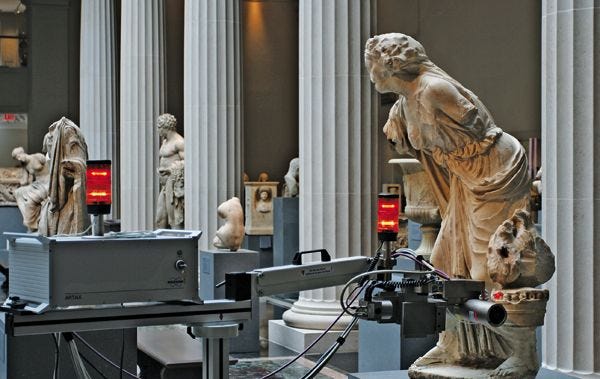
More recently, noninvasive techniques such as X-ray fluorescence analysis and Raman spectroscopy confirm the presence of color on Roman sculptures. But as art historian Bente Kiilerich points out, even these new technologies have their limits. For one thing, they do not show a complete picture of how the paint was actually applied. It is not always clear if the paint was used on the entire surface, or whether it was merely designed to accentuate particular features. What is more, not every color can be detected. Even when a pigment has been recorded, says Kiilerich, “it may still be difficult to ascertain its exact hue, since different binding agents (no longer preserved) resulted in different shades of colour.”
Ancient visual and written sources also provide critical evidence for the presence of color on Roman sculpture. Praxiteles’ praise of Nicias is but one example. In a later passage from Natural History, Pliny the Elder makes known his preference for earlier, simpler color palettes, used by “those most illustrious painters” in “their immortal works.” Common among Roman philosophers was the belief that since all representation was separated from reality, the simpler the selection of colors (note: the reference to any color at all), the more truthful the representation becomes to its source material. As Pliny would have it, “Everything in fact, was superior at a time when the resources of art were so much fewer than they now are.”
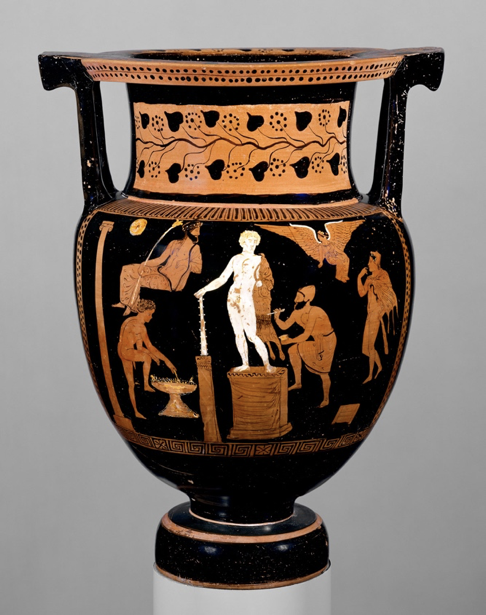
A fourth century terracotta column-crater provides an interesting source of visual evidence. It depicts an artist painting a lion-skin onto a statue of Hercules, as the Greek hero watches on. Nearby, an assistant prepares for ganosis, the application of wax and olive oil to protect the marble base and enhance the colors of the painted surface. Numerous wall paintings convey similar images of painted statues, sometimes so lifelike, that they are indiscernible from depictions of nearby humans. Taken together, the visible traces of color, evidence gathered using contemporary technologies, and ancient sources attesting to polychromy all point to the presence of color on ancient sculpture, reaffirming the old saying, “The absence of evidence is not evidence of absence.”
Material Reasons for Polychromy
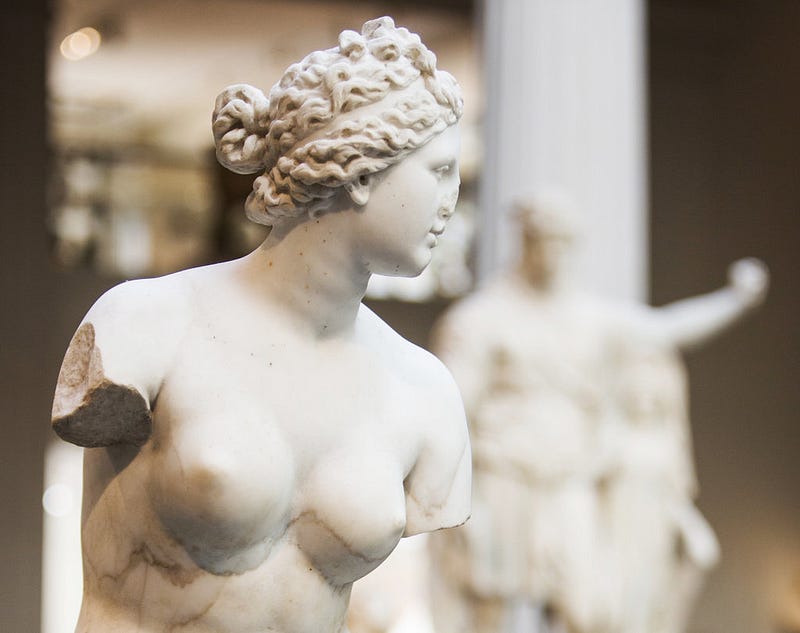
There are myriad practical reasons why color was applied to Roman sculpture. Most simply, one can argue that without paint, the now infamously white figures would have appeared unfinished to ancient Romans. Since many statues and busts were copies of Greek bronzes, painting these portraits was a necessity of artistic production, and reanimated and the original sculptures for the Roman era. The classicist Mark Bradley argues that since marble sculpture involved a collaboration between painters, sculptors, and so-called “finishers,” the Romans may not have thought about them as separate processes in this context. “It was not the norm,” he reasons “to talk about the painting of sculpture as if it were a separate and special part of the production process,” unless the coloring possessed some extraordinary qualities to it. As Sarah Bond concludes, marble “was considered a canvas, not the finished product for sculpture.”
Once colored, painted sculptures, friezes, and public monuments became easier to see, and easier to “read.” In larger sculptures, color enabled the spectator to distinguish among scenes and figures — particularly emperors, heroes, and gods — and appreciate the level of detail up close, or otherwise the sculpture’s majesty from further away.
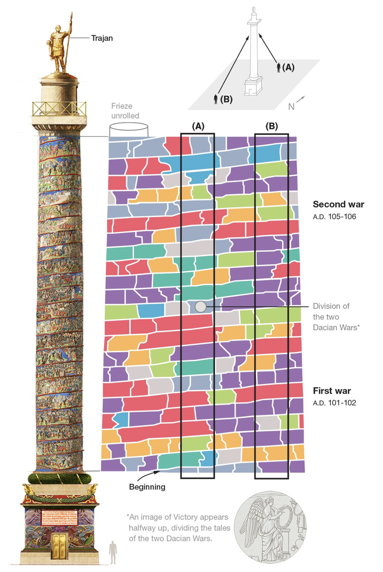
Trajan’s Column in the city of Rome, meticulously reconstructed in color by National Geographic, offers an excellent Roman example. The column’s 2,662 figures populate 155 scenes, 58 of which feature Trajan himself. A composition of this size and complexity “is difficult to take in,” argues Kiilerich, adding that color can create a “rhythmic flow, separate different parts of the narrative, set off specific entities and highlight particular elements.” Legibility played in a role in highly decorated smaller statues as well. The red, blue, and copper colored imagery on the cuirass of the Augustus Prima Porta, for instance, would have been more legible against the background in color.
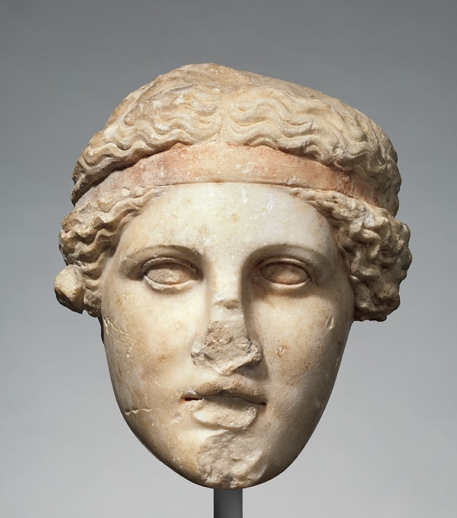
On smaller statues of single individuals, color also facilitated a sense of realism, by accentuating features such as eyes, lashes and brows, lips, hair, accessories, and drapery. See for instance the mid-to-late first century South Slope Head, in which traces of red can still be seen in the female figure’s hair, eyes, and corners of the mouth. As Bradley suggests, “public statues ‘intermingled’ with the world of the living,” adding that a white statue of Augustus does not populate this world. A sculpted portrait without color, then, “is like a mannequin without clothes.” To imitate life, a number of colors were layered to produce “a disarming fleshiness.” Reds, yellow ochres, and blacks served as underpainting. Egyptian Blue and compounds made of white lead (calcium carbonate) could lighten skin tones, while bone black, brown ochre, and umbers produced darker shades. Macroscopically, the diversity of painted skin tones in imperial Roman sculpture reflected the real diversity of the vast Roman Empire itself, an empire, one might note, that had no formal, systemic concept of racism. “Sculpture was not pure white,” argues Talbot, “and neither were the people of the ancient world.”
Social, Political, and Religious Reasons for Polychromy
The classicist Amalie Skovmøller suggests that sculpture was designed to achieve a level of realism in one or more types of mimesis. First, the sculptor-painter duo may be trying to trick the viewer into believing he or she is seeing the “real thing,” or at least as accurate a representation as possible. Conveying this effect through color and detail, they also distinguish themselves as first-rate craftsmen. Let us now turn to the third type of mimesis achieved through polychromy, one intended to foster a divine experience through a sculpture that brings emperors, heroes, and deities to life, or perhaps even larger than that. Picture, if you will, a marble sculpture depicting a god or heroic personality (the Augustus Prima Porta, might serve you well here). Already, this hypothetical statue is likely over two meters tall, cast in marble, inlaid with elements of gold, ivory, or precious gems. The statue is grandly displayed inside a temple surrounded by reflective pools, polished floors, and chiaroscuro-esque lighting. The figure is larger-than-life, clothed, armed, garlanded, and boldly painted. If your sculpture is indeed the Augustus Prima Porta, then you might recognize his scarlet cloak (paludamentum) as one worn by an imperator on the battlefield. Even post-mortem, Augustus appears victorious. Or you might admire his blonde-like hair (subflauus), the color of heroes and gods as well as youth and beauty, particularly in Augustan literature. This is the hair of Apollo. Perhaps the figure is clad in purple, the color of the emperor, a rarity derived from the murex sea snail. Noticing other bright colors, which you recognize as being a staple of the nobility, you instinctively assign the sculpture a degree of honor, prestige, wealth, or even majesty. In the Roman Empire, painted sculptures both participated in and transcended the realms of men. “The heroic statue,” argues Bradley, “was set up as both the passive spectacle that drew the viewer to it, and as an active protagonist that made an impact on the viewer’s world.”
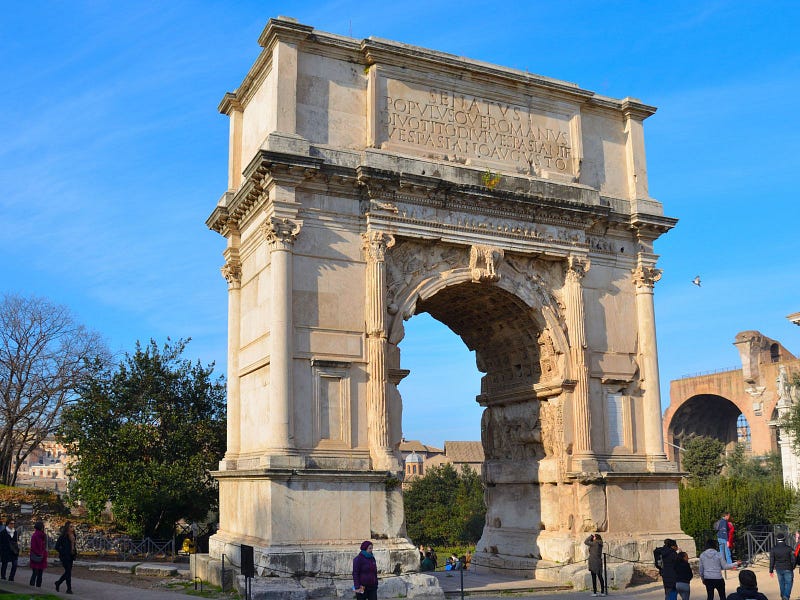
Under Augustus, the number of locations fit to display such painted statues increased, notably in the Forum of Augustus. Wealthy citizens and Roman governors soon followed suit in the provinces. The Roman Empire thus came to host what Marden Nichols terms “a ‘forest’ of statues or a second ‘population,’” much of which was aimed at political purposes. We have seen how color enabled emperors to legitimize their authority by referencing connections to gods and heroes of Roman history. Also significant was the ability to distinguish the emperor in friezes and sculptures. Furthermore, as evident in Trajan’s column, color facilitated the legibility and visibility of large monuments which served as testaments to emperors’ political authority and military victories. Triumphal columns and arches, such as the Arch of Titus, served similar purposes. Taking all of these factors together, polychromy enabled imperial Roman sculpture to deliver a clear political message. “There should be no doubt what was going on in the pictures,” explains Kiilerich, “it should be easy to tell the winner from the looser [sic] and easy to perceive the visual information with regard to topography, prosopography and paraphernalia.”
Painted Roman sculpture had tremendous socioeconomic and sexual implications as well. Many ancient written sources relate the importance of skin color, particularly as part of an intellectual exercise which linked one’s inner character and outward appearance. If we assume that polychromic sculpture was meant to effectively capture various skin tones, and the color of one’s skin was said to correspond to one’s moral character (at all social strata) then painted sculpture, by extension, was meant to do the same. At the zenith of the social pyramid, an emperor’s reign and personality appear to be tied to his physical traits. Suetonius, for instance, describes Caesar as having “been tall in stature, with a fair complexion, smooth limbs that were in proportion, a somewhat full face, and keen black eyes, with favourable health.” Harsher criticism can be found in Seneca the Younger’s Constant. Describing Caligula, he comments that “such was the ugliness of his pale face bespeaking his madness, such the wildness of his eyes lurking beneath the brow of an old hag.”
Skin color was used to judge the ordinary citizen as well, a practice that was most probably inherited from Greece. Take for example this fourth century B.C. passage from one Physiognomanoica:
Too black a hue marks the coward, as witness Egyptians and Ethiopians, and so does also too white a complexion, as you may see from women. So the hue that makes for courage must be intermediate between these extremes. A tawny colour indicates a bold spirit, as in lions; but too ruddy a hue marks a rogue, as in the case of the fox. A pale mottled hue signifies cowardice, for that is the colour one turns in terror. The honey-pale are cold, and coldness means immobility, and an immobile body means slowness. A red hue indicates hastiness, for all parts of the body on being heated by movement turn red. A flaming skin, however, indicates madness, for it results from an overheated body, and extreme bodily heat is likely to mean madness.”
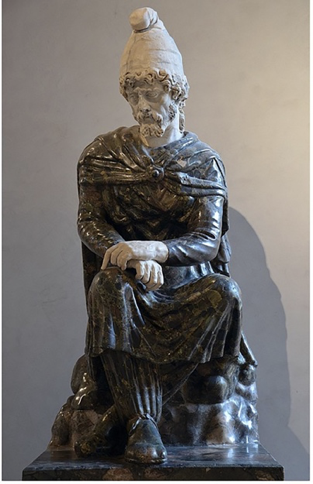
As Rome’s borders expanded through military campaigns and conquest throughout the first and second centuries, so too were specific colors increasingly used to demarcate non-Romans, suggest social stereotypes, distinguish among socioeconomic classes, and convey beauty ideals. Red-headed figures, for instance, were commonly associated with barbarian captives, and were often depicted wearing pants — a stark contrast to the Greco-Roman toga, thus characterizing them as “uncivilized.” One statue of a conquered barbarian further suggests how the figure’s body language might have reflected the status of enslavement or captivity: notice his crossed arms (possibly originally bound), and kneeling posture, suggesting submissiveness to the Roman Army.
Polychromy could also define elements of masculinity and femininity. The pale noblewoman was prized as a symbol of beauty and refinement, her light skin (commonly depicted by exploiting the translucent properties of marble) showed that this was a woman who did not have to use her hands in outdoor labor. The idealized figure of masculinity, on the other hand, was expected to be darker skinned, suggesting outdoor labor, time spent on the battlefield, or competing in athletic events (note that all three undermine white nationalists’ argument that the ideal form was a light-skinned male.) Although “defining cultural identity of an individual from collective racial and ethnographic colour categorizations was most likely commonly practiced in the greater cities of the Roman Empire,” which exhibited more profound diversity, the use of color to reflect one’s moral character and social, economic, and sexual identity is evident here.
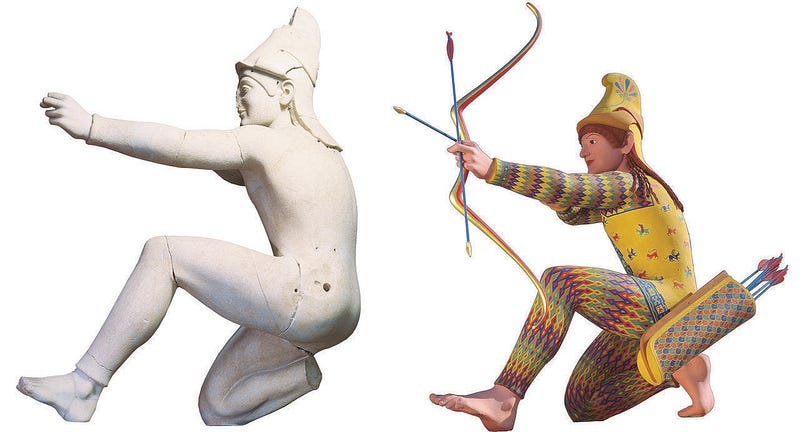
In the last twenty years, attempts have been made to reconstruct from plaster what these marble sculptures may have looked like in their original painted condition, most notably by the German archaeologist Vinzenz Brinkmann. While Brinkmann’s statues have been popular as part of the traveling Gods in Color exhibition, they have also received high criticism for being too flat and opaque. Many argue that the Romans would have used subtler colors, more “sophisticated” painting techniques, and that marble and plaster absorb paint in entirely different ways. For the present, however, Brinkmann’s decades of work can be interpreted as the byproduct of a much longer process to re-examine polychromy in ancient Roman sculpture.
Perhaps we ought to follow Sarah Bond’s call to “abandon the Eurocentric art history of the 18th century and its championing of whiteness as equal to beauty.” Instead, we can embrace the polychromy of the ancient Mediterranean world — in all its senses.
📝 Save this story in Journal.
🌎 Wake up every Sunday morning to the week’s most noteworthy stories in Society waiting in your inbox. Read the Noteworthy in Society newsletter.