
The Anatomy of an AI Art Prompt
A Practical Guide To Prompt Crafting
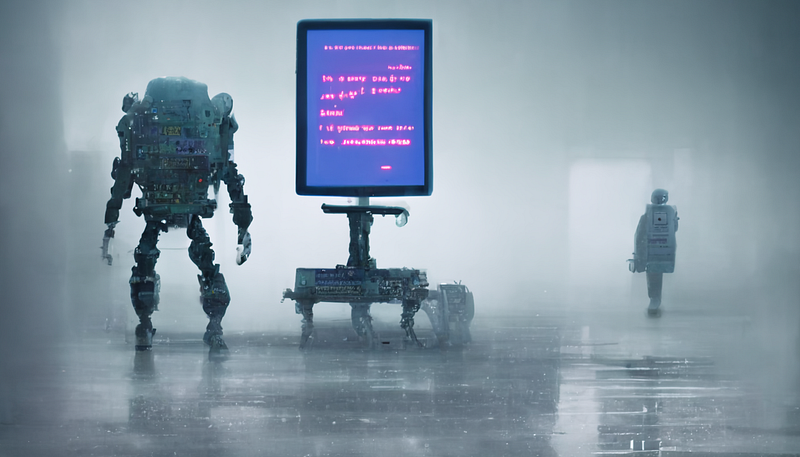
Understanding how to write a good prompt will help you in getting the output you are looking for.
While there are some good UI tools that can write prompts for you, the ability to change, fine-tune and craft your own prompts is a skill that will serve you well. There’s even a term used to describe that skill — sometimes referred to as “prompt crafting” or “prompt engineering.”
Of course it's entirely possible to get some amazing results without following any guidelines at all. I’ve seen some beautiful images rendered from just a simple word or phrase. However, if you want consistency and the ability to improve your output, you will need to learn how AI responds to language patterns.
The AI artists that I follow on community forums and discord channels have mastered this skill, and studying how they write their prompts has helped me at writing better prompts myself.
What I would like to do in this article is show you the thought process that I use when I am writing a prompt. I am also writing this agnostic to any specific AI art tool, as while there might be differences in the syntax between the different tools, the writing approach is largely the same. For the examples below, I will be showing art generated from Midjourney.
Crafting Your Prompt
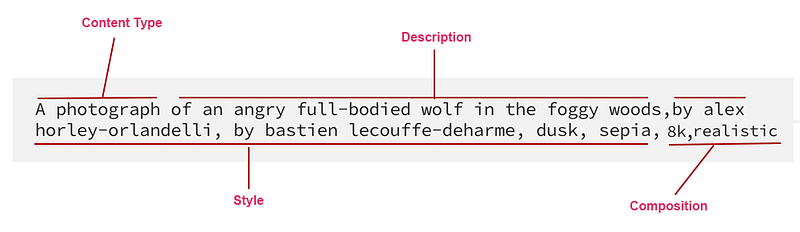
I like to think of the anatomy of the prompt in four distinct groupings and in a specific order (note the order affects how AI prioritizes the output).
- Content type
- Description
- Style
- Composition
Let’s take a look at each of them in the process of writing out a prompt.
1. Content type
When you approach creating a piece of artwork, the first thing to think about is what is the type of artwork you want to achieve, is it a Photograph, Drawing, Sketch or 3D render?
So the prompt would start with…
A photograph of...2. Description
a description refers to defining the subject, subject attributes, and the environment/scene. The more descriptive you can be with the use of adjectives the better the output.
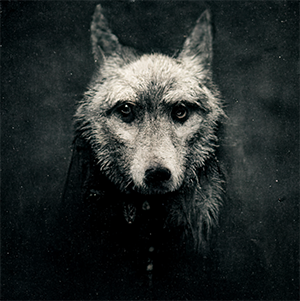
So a simple description of a subject might be…
A photograph of a wolfAnd the result would be something like this…
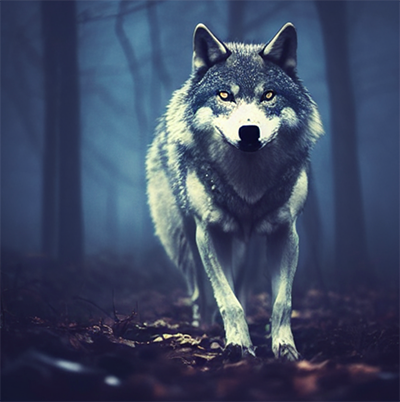
But a better description would be to add subject attributes along with the environment/scene descriptions.
A photograph of an angry full-bodied wolf in the foggy woodsAnd we get this…
In addition to the text description, you can also include one or more image URLs and the AI would use those as visual inspiration. Like this…
http://www.wolfsite.com/wolf.jpg A photograph of an angry full-bodied wolf in the foggy woodsAlthough it wouldn’t apply in this example, an additional important aspect of the description would be the era or historical time you wish to capture. So if there were any people or buildings in this image, the context of ‘when’ would be important.
Here are some words you can use for historical eras:
Primitive society, antiquity, middle ages, renaissance, modern world, contemporary, future3. Style
The art style plays a huge factor in the rendition, and I like to think of style in three sub-categories:
Lighting, Detail, and Art styles.
Here are some words you can use for lighting:
accent lighting, backlight, blacklight, blinding light, candlelight, concert lighting, crepuscular rays, direct sunlight, dusk, Edison bulb, electric arc, fire, fluorescent, glowing, glowing radioactively, glow-stick, lava glow, moonlight, natural lighting, neon lamp, nightclub lighting, nuclear waste glow, quantum dot display, spotlight, strobe, sunlight, ultraviolet, dramatic lighting, dark lighting, soft lightingThe detail of an artwork is not just about sharpness but also derives from the specific camera lenses or digital rendering engines.
Here are some words you can use for detail:
highly detailed, grainy, realistic, unreal engine, octane render, bokeh, vray, houdini render, quixel megascans, depth of field (or dof), arnold render, 8k uhd, raytracing, cgi, lumen reflections, cgsociety, ultra realistic, volumetric fog, overglaze, analog photo, polaroid, 100mm, film photography, dslr, cinema4d, studio qualityArt styles can be descriptions of different techniques or can be defined as historical art genres.
Here are some words for historical art styles:
Abstract, Medieval art, Renaissance, Baroque, Rococo, Neoclassicism, Romanticism, Impressionism, post-Expression, Cubism, Futurism, Art Deco, Abstract Expressionism, Contemporary, pop art, surrealism, fantasyHere are some words for artistic techniques and materials:
Digital art, digital painting, color page, featured on pixiv (for anime/manga), trending on artstation, precise line-art, tarot card, character design, concept art, symmetry, golden ratio, evocative, award winning, shiny, smooth, surreal, divine, celestial, elegant, oil painting, soft, fascinating, fine artNow, let’s add some styles to our wolf prompt.
A photograph of an angry full-bodied wolf in the foggy woods, dusk, unreal engine, 8k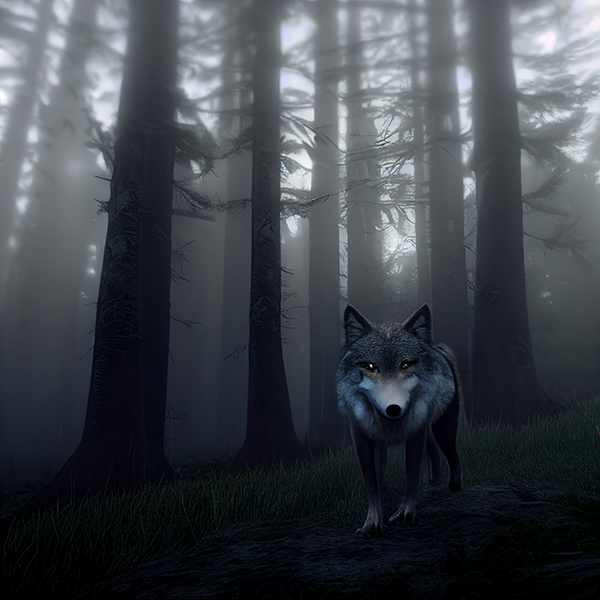
You can see that the woods look highly detailed in 8k, lighting is dim from the low sunlight produced during dusk, and the wolf looks like it is modeled in an Epic game.
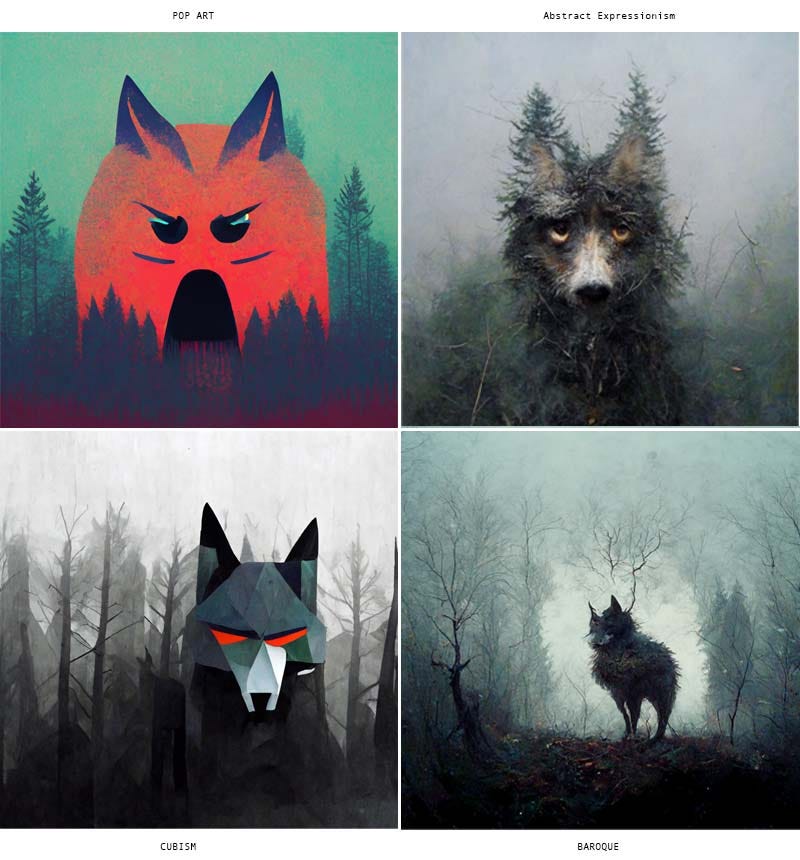
Here are some examples of adding some historic art styles: This prompt below includes the historical style of pop art.
A photograph of an angry full-bodied wolf in the foggy woods, pop artYou can see how much influence the styles have on the output:
Artist Names As Styles
When it comes to art styles, the most popular form used, and the one that AI seems to really like is the use of artist names. It is also common to use more than one artist name to explore style variations.
Click here for an incredible resource of artists and styles maintained by the Midjourney community.
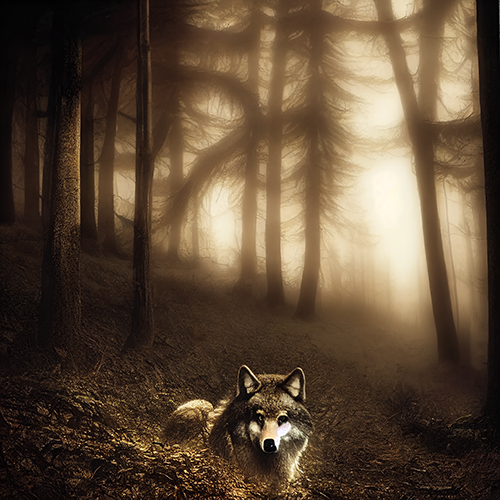
So to build upon our wolf prompt, I picked 2 artists from the resource sheet, I removed unreal engine to go back to the photographic look, and I added ‘sepia’ as a color.
As you can see… prompt crafting is about refining and re-rolling your output by continually changing your text input.
A photograph of an angry full-bodied wolf in the foggy woods,by alex horley-orlandelli, by bastien lecouffe-deharme, dusk, sepia,And this is the result:
4. Composition
The remaining element is composition which refers to…
Aspect ratio, camera view, and resolution.
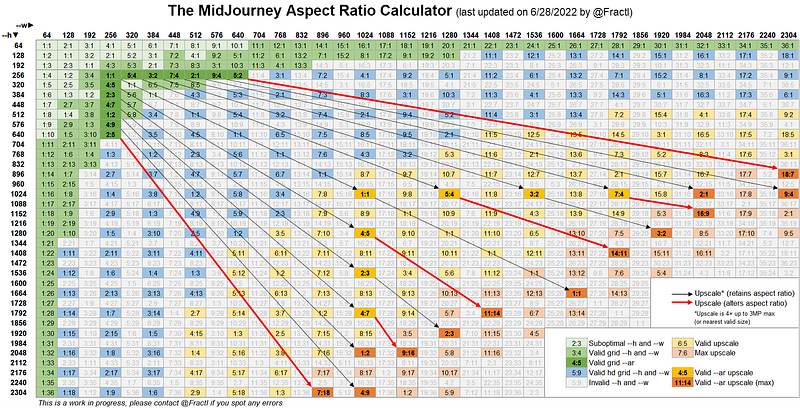
The aspect ratio is really important when you are targeting specific purposes. Like if you were creating a banner, that would be a different aspect ratio than if you were creating a screen saver.
This is a great resource that shows you how the different aspect ratios apply to different sizes.
Camera view is all about the perspective of the image. Will your art work be close-up, wide-angle, fisheye, etc…
The question to ask is what is the viewers perspective?
These are some words you can use for camera view:
ultra wide-angle, wide-angle, aerial view, massive scale, street level view, landscape, panoramic, bokeh, fisheye, dutch angle, low angle, extreme long-shot, long shot, close-up, extreme close-upResolution would apply to the detail, quality, and size you are aiming for. Words you can use for resolution might be as follows:
highly detailed, depth of field (or dof), 4k, 8k uhd, ultra realistic, studio quality. Additional Tool-Based Parameters
Each of the AI generators like MidJourney, Stable Diffusion, and DALL-E 2 will have additional command parameters to further craft the output. For example, Midjourney has the following additional parameters
--beta = new experimental algorithm for higher quality output
--no = negative prompting to not include any specific objects
--s = The stylize argument sets the strength of the stylization
--q = sets the quality of the output
--chaos = includes an option to add randomness to the output
--seed = sets the starting point from a specific already rendered image (each image has a unique ID), This is great if you want a consistent perspective
I will be writing more about how to use these tool-based commands in future articles, so make sure to follow me.
Final Thoughts
I hope this journey through the creation of a prompt was helpful for you. It really is a lot of fun once you understand how to arrange your prompts.
Here is the anatomy breakdown of the prompt:
I would be interested in hearing any prompt techniques you might use, and what the differences would be compared to what I am doing.
Prompt crafting is an evolving skill, but a necessary one.
If you liked this article, throw out some Medium love… claps, comment, and be sure to follow.
You can also support my work on Medium and get unlimited access by becoming a member using my referral link.


