avatarTim Ward, Mature Flâneur

Free AI web copilot to create summaries, insights and extended knowledge, download it at here

4475

Abstract

need to be reborn as a <i>man </i>before she could hope to attain Nirvana). In this, Honen reminds me of Jesus, who also hung out with fishermen and women and taught that God’s love was for everyone, not just religious muckity-mucks.</p><p id="bd4d">As with the case of the gentle carpenter from Gallilee, mayhem and bloodshed ensued.</p><figure id="312d"><img src="https://cdn-images-1.readmedium.com/v2/resize:fit:800/1*sVUS9hPHuzaebOzFg-u--Q.jpeg"><figcaption>A statue of Amitabha Buddha above a quiet pool at Chion-In</figcaption></figure><p id="5c86">The muckity mucks of other Buddhist lineages were not at all happy with Honen, nor with the rising popularity of his sect. They protested that the masses, beguiled by the promise of a free ride to Nirvana, would abandon all morality. Indeed, some of Honen’s followers did behave recklessly. The rival monks took their complaints to the emperor, but to no avail.</p><p id="c5bb">Then, one of Honen’s disciples converted two of the emperor’s ladies in waiting. They not only joined the <a href="https://en.wikipedia.org/wiki/J%C5%8Ddo-sh%C5%AB">Jōdo-shū</a>, they left the imperial court, took monastic vows and became nuns. The emperor was furious. The proselytising monk and three others were executed, while Honen was defrocked and exiled to the mountains far away. Clearly, no one fucks around with the emperor’s ladies in waiting!</p><p id="6c77">Honen was pardoned five years later. He returned to Kyoto at age 77, where he died the following year.</p><figure id="bf9e"><img src="https://cdn-images-1.readmedium.com/v2/resize:fit:800/1*iIF2HaMrSS5hEDX0N7wvRg.jpeg"><figcaption>Jōdo-shū’s founder, Honen, is also a feature of the autumn light show.</figcaption></figure><p id="4fda">Schisms, infighting and outright hostilities between Honen’s disciples plagued the new faith in the decades to follow. This led to more official banishments and splinter groups setting up their own temples all across the country. As <a href="https://en.wikipedia.org/wiki/J%C5%8Ddo-sh%C5%AB">Jōdo-shū</a> dispersed, so too it flourished. 850 years after Honen, today it is the most popular Buddhist sect in Japan, and in the USA as well.</p><figure id="836f"><img src="https://cdn-images-1.readmedium.com/v2/resize:fit:800/1*VNrkxxgOOQv33QS5DAbP8A.jpeg"><figcaption>Chion-In’s main Temple</figcaption></figure><p id="4169">When I reached the end of the garden, I thought the tour was over, but a lighted path led me up to a wide open courtyard with a massive temple in the middle of it. The whole exterior was lit up with bright yellow, pink and purple floodlights. A loud voice was coming from the interior, so I headed over, took off my shoes and walked in the back. A monk with a microphone was warming up the crowd, all seated in chairs for an evening lecture of some kind.</p><figure id="4c35"><img src="https://cdn-images-1.readmedium.com/v2/resize:fit:800/1*ZlEgmvrNQcLpr7arUQlJeg.jpeg"><figcaption></figcaption></figure><figure id="2a10"><img src="https://cdn-images-1.readmedium.com/v2/resize:fit:800/1*dSh8woKrni454YeP6HrL9g.jpeg"><figcaption>Left: Waiting for evening service to start. Right: Meditation in front of a statue of Amitabha.</figcaption></figure><p id="4bfd">The monk spoke in the warm, enthusiastic tones of a variety show host; he was making his audience chuckle. This was so unlike what I have encountered at other temples, where the work of a monastery is no laughing matter. But, maybe this warmth, this humanity, is the real secret sauce of Jōdo-shū?</p><p id="dcdc">I didn’t stay for the service, which would all be in Japanese. Instead I meandered over to a smaller side temple. Through the screen I could see the heads of many people sitting cross-legged in meditation before a giant golden statue (above right). I wondered, is Amitabha being named and claimed for those seeking entrance to His Pure Land?</p><figure id="3a88"><img src="https://cdn-images-1.readmedium.com/v2/resize:fit:800/1*tPHWmGLtub-d6Dqn5ZVrZA.jpeg"><figcaption>A fountain and a pagoda at Chion-In</figcaption></figure><p id="a1c0">There was one more level I had yet to obtain. A rope of bright LED lights snaked up a stairway through the forest. At the top, in a little clearing high on the hillside, was a massive temple bell, the biggest bell I think I have ever seen. Indeed, it turned out to be the largest bell in all Japan. The bell is nearly eleven feet tall and weighs 70 tons. It’s over 650 years old. It takes several

Options

monks just to ring it; for this they use ropes to pull back a large, suspended log, and bang it into the backside of the bell. Tonight it was brightly illuminated with a purple mandala, and though silent, the bell resonated.</p><figure id="a902"><img src="https://cdn-images-1.readmedium.com/v2/resize:fit:800/1*ueJJSRH_XbEtozW2oURrtg.jpeg"><figcaption></figcaption></figure><figure id="17cd"><img src="https://cdn-images-1.readmedium.com/v2/resize:fit:800/1*y1NFBZJnL_BOuaTEGP9P1w.jpeg"><figcaption>Big bell</figcaption></figure><p id="7de5">Having reached the end of the Amitabha Autumn Night Light Show, there was nothing left for me to do but descend back to the entrance and into the night of the busy, modern city. I took one last deep breath of fresh forest air. A Pure Land. Wouldn’t that be something, if indeed it were true? <i>Namu Amida Butsu, Namu Amida Butsu, Namu Amida Butsu.</i></p><p id="3433"></p><p id="23b3">I’ve been inspired for this Globetrotter Monthly challenge on spirituality by <a href="">Matthew David</a>, who wrote about being one of the first to trek the newly opened Buddhist Sanctuary Trail in Nepal. I strongly resonated with his story; such mountains are spiritual beings that can live inside of you long after you have left the physical rocks behind.</p><div id="1dfd" class="link-block"> <a href="https://readmedium.com/a-blessing-in-shangri-la-ffb4e71a11fc"> <div> <div> <h2>A Blessing in Shangri-La</h2> <div><h3>Trekking in the heart of a Buddhist sanctuary</h3></div> <div><p>medium.com</p></div> </div> <div> <div style="background-image: url(https://miro.readmedium.com/v2/resize:fit:320/1*EJ3XSC0z96ih1_4i1Qzs2g.jpeg)"></div> </div> </div> </a> </div><p id="acb6">And by <a href="">Jillian Amatt — Artistic Voyages</a>’ story of her visit to a Mosque in Morocco while under covid lockdown. It’s a vivid encounter with both the people and a place in a time of crisis and change.</p><div id="dabc" class="link-block"> <a href="https://readmedium.com/we-snuck-through-the-garden-to-visit-an-old-mosque-during-lockdown-9b891e592810"> <div> <div> <h2>We Snuck Through the Garden to Visit an Old Mosque During Lockdown</h2> <div><h3>It felt good to get outside and stretch our legs</h3></div> <div><p>medium.com</p></div> </div> <div> <div style="background-image: url(https://miro.readmedium.com/v2/resize:fit:320/1*vhSVlAE5HpWz9X305UVTIQ.jpeg)"></div> </div> </div> </a> </div><p id="5f8f"></p><p id="fe58">Tim Ward is the author of <i>What the Buddha Never Taught: A Behind-the -Robes Account of Life in a Thai Buddhist Monastery</i>, and <i>Mature Flâneur: Slow Travels through Portugal, France, Italy and Norway.</i></p><div id="4eee" class="link-block"> <a href="https://www.collectiveinkbooks.com/changemakers-books/our-books/what-buddha-never-taught"> <div> <div> <h2>What the Buddha Never Taught: 20th Anniversary Edition from Changemakers Books</h2> <div><h3>There is still a place in the jungles of Thailand, where you can leave it all behind... A cult classic and bestseller…</h3></div> <div><p>www.collectiveinkbooks.com</p></div> </div> <div> <div style="background-image: url(https://miro.readmedium.com/v2/resize:fit:320/0*q21yblalAl3UwAQL)"></div> </div> </div> </a> </div><div id="72cb" class="link-block"> <a href="https://www.collectiveinkbooks.com/changemakers-books/our-books/mature-flaneur-slow-travel-europe"> <div> <div> <h2>Mature Flâneur from Changemakers Books</h2> <div><h3>In the aftermath of the pandemic, author Tim Ward and his wife, Teresa, decided to leave their home and professional…</h3></div> <div><p>www.collectiveinkbooks.com</p></div> </div> <div> <div style="background-image: url(https://miro.readmedium.com/v2/resize:fit:320/0*Ycu-d6tx1reQmqbP)"></div> </div> </div> </a> </div></article></body>

Mature Flâneur

The Amitabha Autumn Night Light Show in Kyoto

Chion-In Temple’s tourist trap is more profound than it sounds
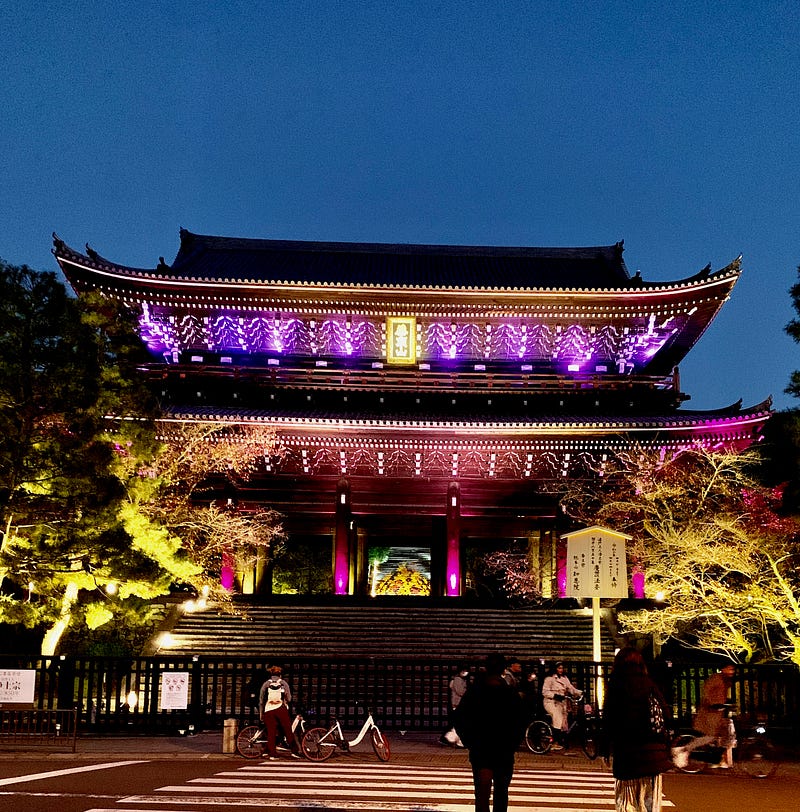
Chion-in Buddhist Temple Gate. All photos by Tim Ward

A bald, blue-robed monk with a megaphone in one hand was rattling away on the street in Japanese. I did not understand a word, but I knew exactly what he was shouting at passersby. The gates of Chion-in Buddhist Temple were about to open for the evening autumn light show, and he was shilling for the crowd. He gestured to the lit-up ticket kiosk. It was dusk, and darkness was falling fast on the city of Kyoto. I could see lights glowing on the other side of the entrance. I seized the moment and joined the queue.
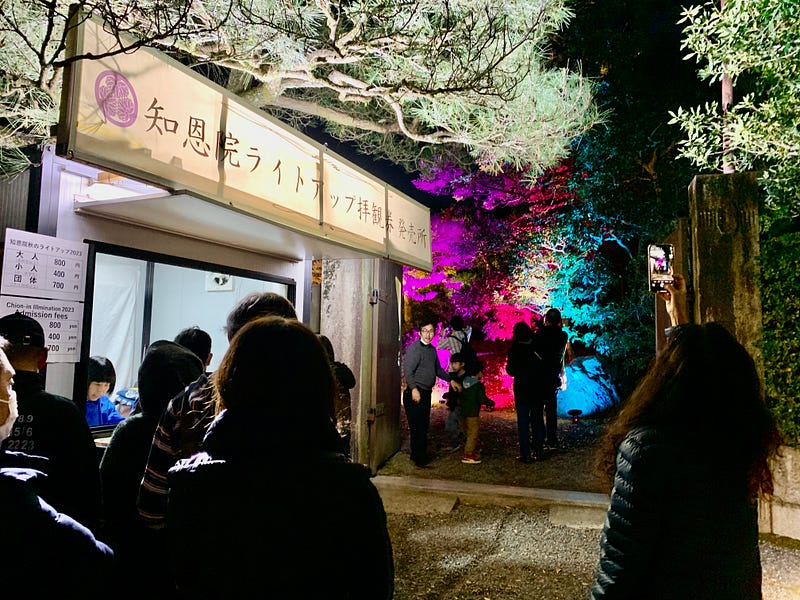
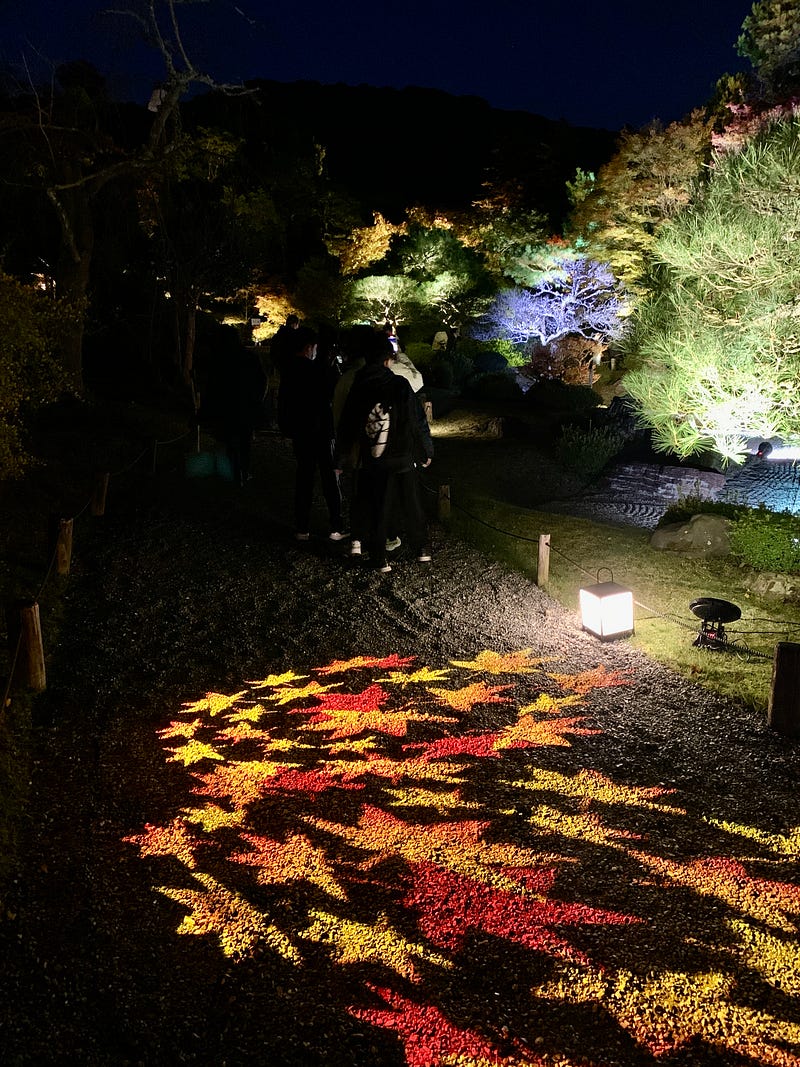
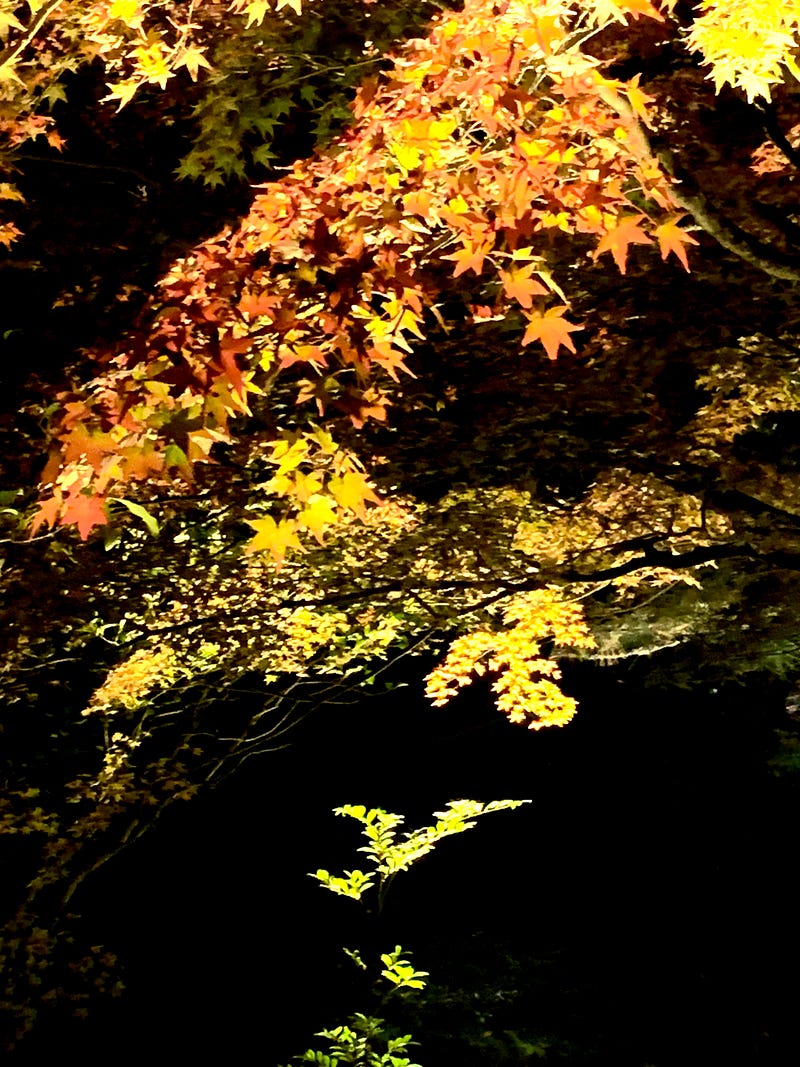
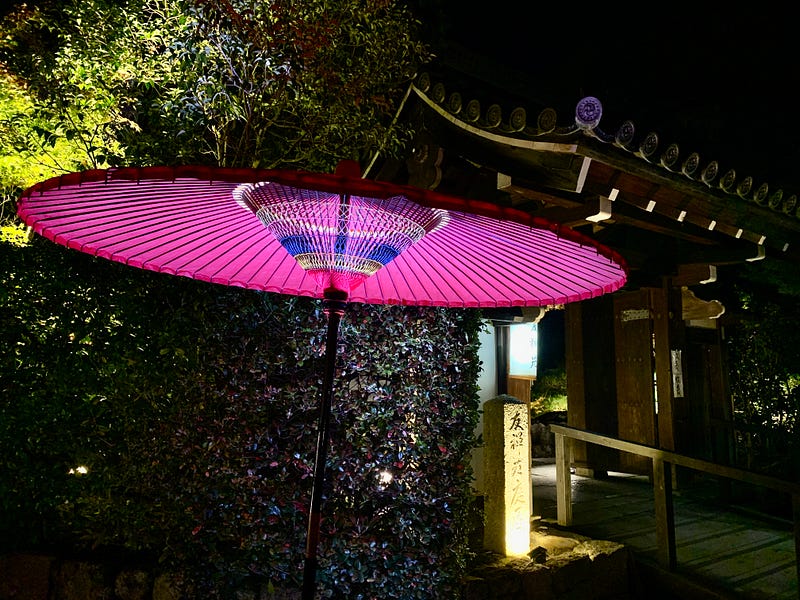
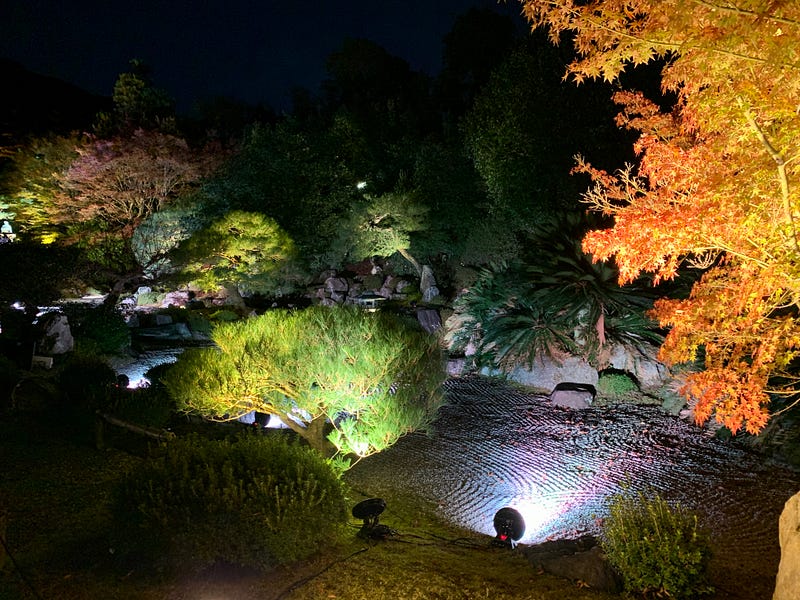
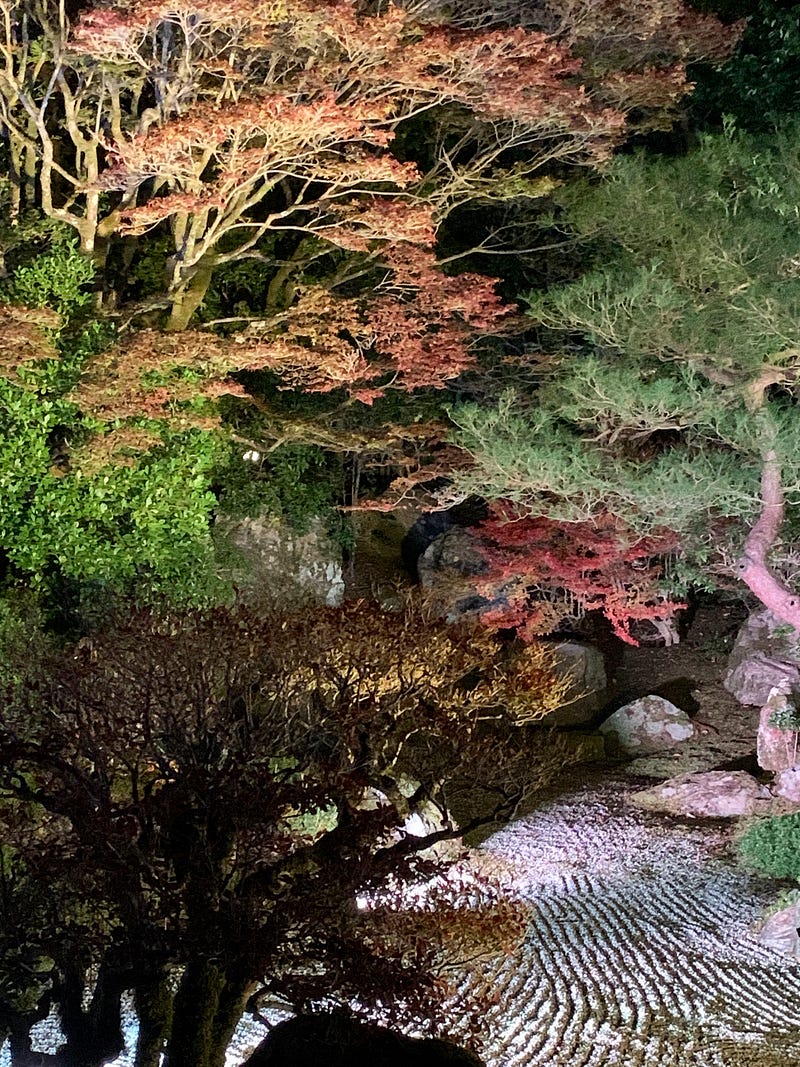
Ten minutes later I paid my 800 yen and stepped into the vast monastery garden, more of a forest really, filled with maples turning red and yellow in the crisp fall air. Lights had been artfully placed along the path, highlighting the spots where the transformation of the leaves was the most striking, and illuminating the wavy patterns of raked gravel that are the signature mark of a Japanese temple garden.

I confess I was prepared to be underwhelmed, even cynical, at the monks’ exploitation of their monastery grounds for the sake of tourists’ loose change. But the garden took my breath away. I was charmed, I was captivated, I was walking in an autumn wonder land.
Choin-in Temple is the headquarters of the Jōdo-shū, or “Pure Land” sect of Buddhism. Pure Land Buddhism began as a backlash against the rigors of esoteric and elitist monastic practices of many older schools. Such training was believed essential for anyone who sought freedom from the wheel of suffering and endless rebirth. Buddhists of the time believed only a very few monks ever succeeded in attaining Nirvana, and only after many lifetimes. Pure Land taught that Nirvana could be made available for all, even the most common peasant, by taking rebirth in the Pure Land of the Buddha Amitabha in one’s very-next lifetime. There, Amitabha himself would guide the devotee to Nirvana.

Though Pure Land practices originated in China, the Japanese scholar-monk Honen was the innovator who popularized it in Japan. According to a brillant article on LionsRoar.com:

Honen (1133–1212) is the great revolutionary of Japanese Pure Land history. Drawing on his broad erudition in Mahayana philosophy…Honen came to see the recitation of the name of Amitabha, “Namu Amida Butsu,” as the essential practice [for obtaining rebirth in the Pure Land]. Because this simple practice is possible for all people, regardless of gender or social station, it exemplifies the universal compassion and wisdom of Amitabha Buddha. Honen inspired a movement that, though persecuted by the powers that be, ended up transforming Japanese Buddhism by creating a “Buddhism of the Pure Land.”

Honen quickly amassed many followers, including those of lower class and status: fishermen, prostitutes, fortune tellers, and women (traditional Buddhist teachings were that a woman would need to be reborn as a man before she could hope to attain Nirvana). In this, Honen reminds me of Jesus, who also hung out with fishermen and women and taught that God’s love was for everyone, not just religious muckity-mucks.

As with the case of the gentle carpenter from Gallilee, mayhem and bloodshed ensued.
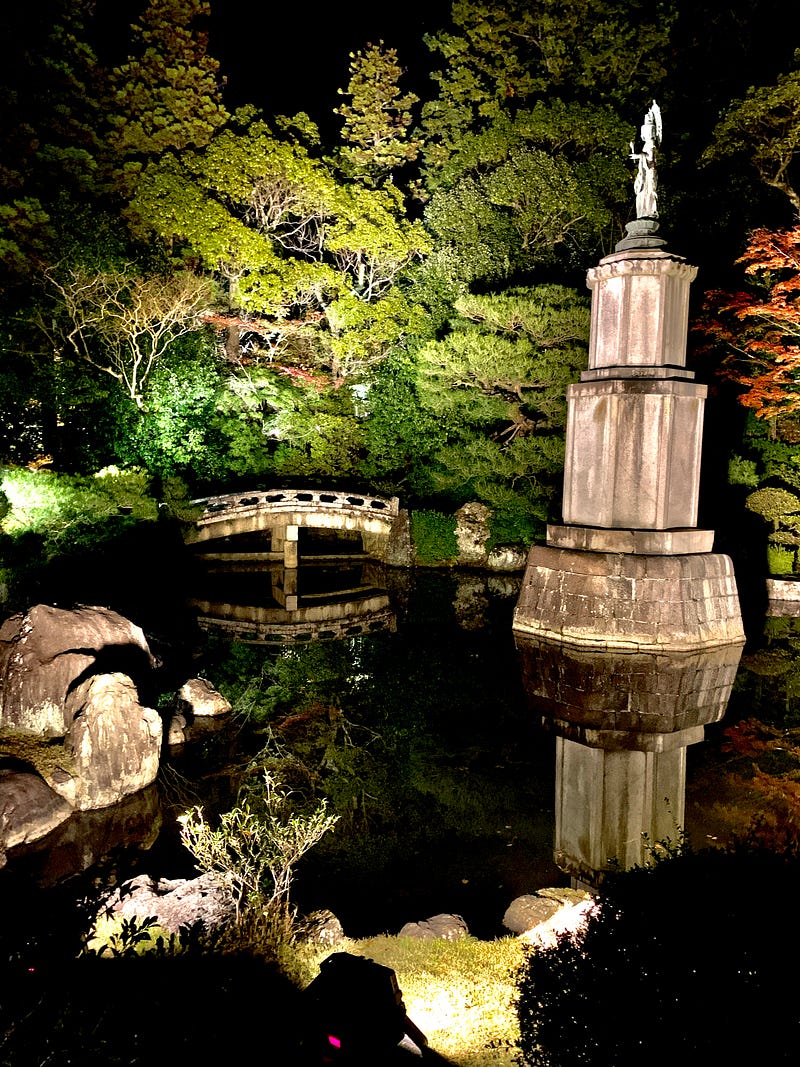
A statue of Amitabha Buddha above a quiet pool at Chion-In

The muckity mucks of other Buddhist lineages were not at all happy with Honen, nor with the rising popularity of his sect. They protested that the masses, beguiled by the promise of a free ride to Nirvana, would abandon all morality. Indeed, some of Honen’s followers did behave recklessly. The rival monks took their complaints to the emperor, but to no avail.

Then, one of Honen’s disciples converted two of the emperor’s ladies in waiting. They not only joined the Jōdo-shū, they left the imperial court, took monastic vows and became nuns. The emperor was furious. The proselytising monk and three others were executed, while Honen was defrocked and exiled to the mountains far away. Clearly, no one fucks around with the emperor’s ladies in waiting!

Honen was pardoned five years later. He returned to Kyoto at age 77, where he died the following year.
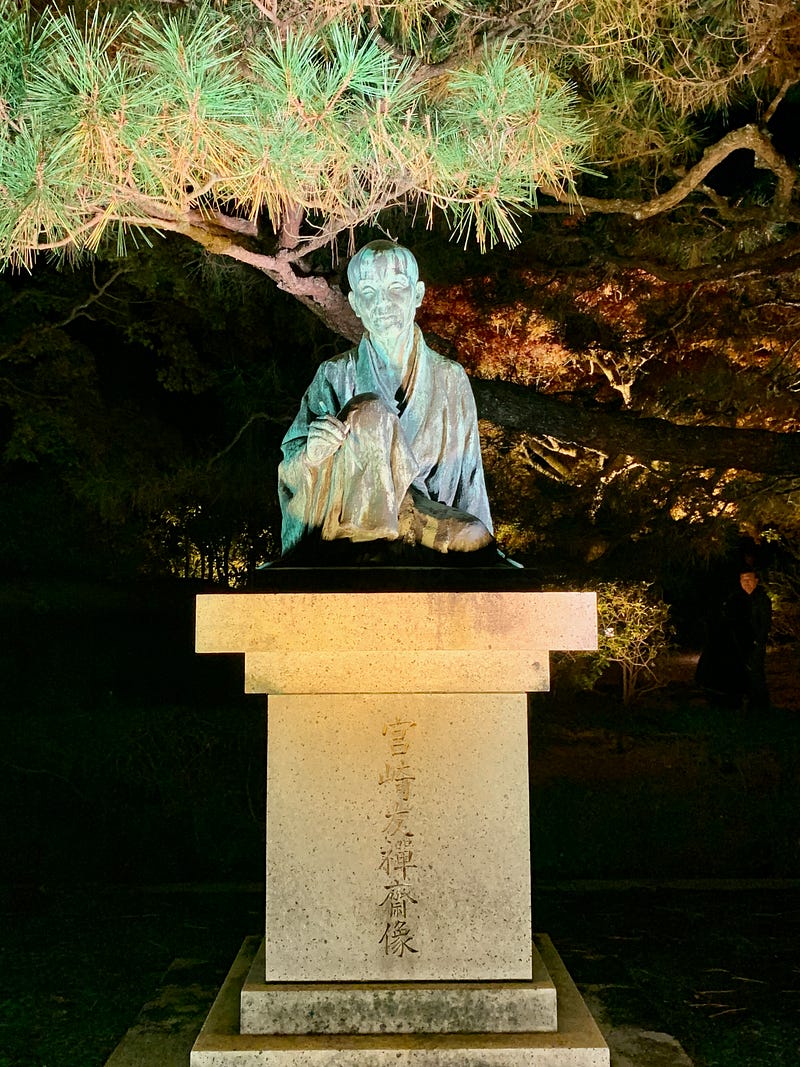
Jōdo-shū’s founder, Honen, is also a feature of the autumn light show.

Schisms, infighting and outright hostilities between Honen’s disciples plagued the new faith in the decades to follow. This led to more official banishments and splinter groups setting up their own temples all across the country. As Jōdo-shū dispersed, so too it flourished. 850 years after Honen, today it is the most popular Buddhist sect in Japan, and in the USA as well.
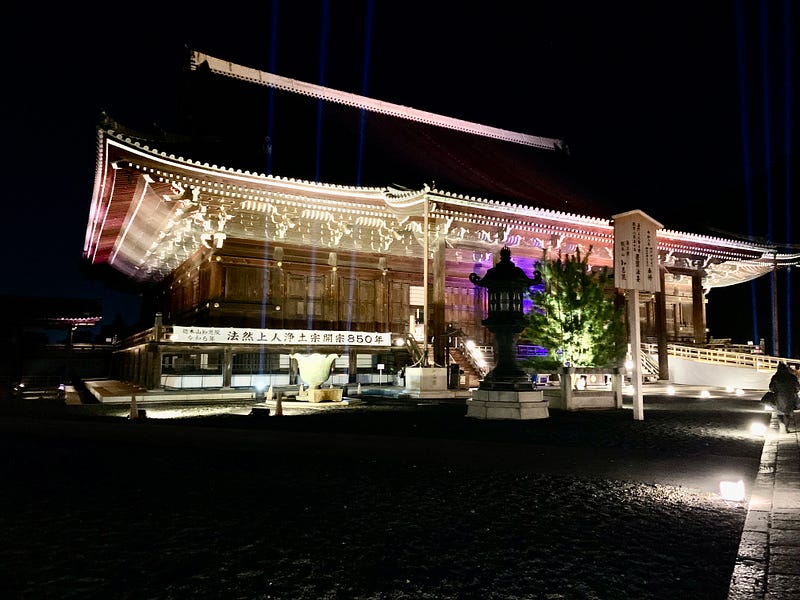
Chion-In’s main Temple

When I reached the end of the garden, I thought the tour was over, but a lighted path led me up to a wide open courtyard with a massive temple in the middle of it. The whole exterior was lit up with bright yellow, pink and purple floodlights. A loud voice was coming from the interior, so I headed over, took off my shoes and walked in the back. A monk with a microphone was warming up the crowd, all seated in chairs for an evening lecture of some kind.
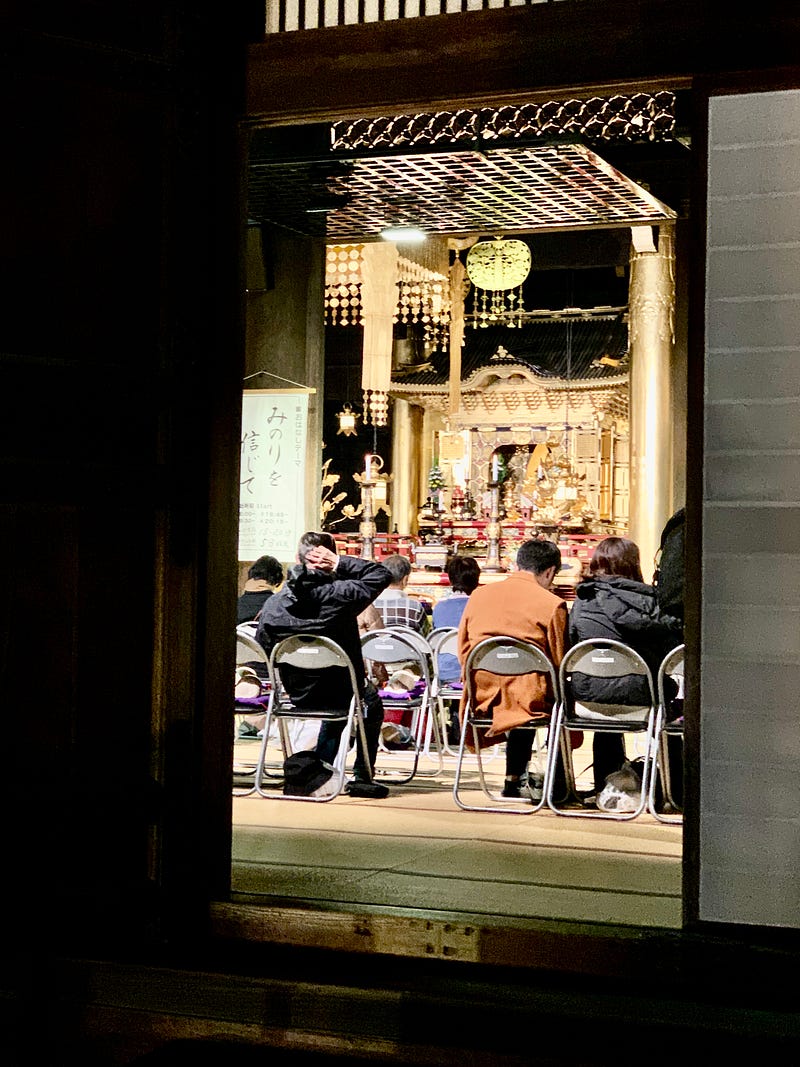
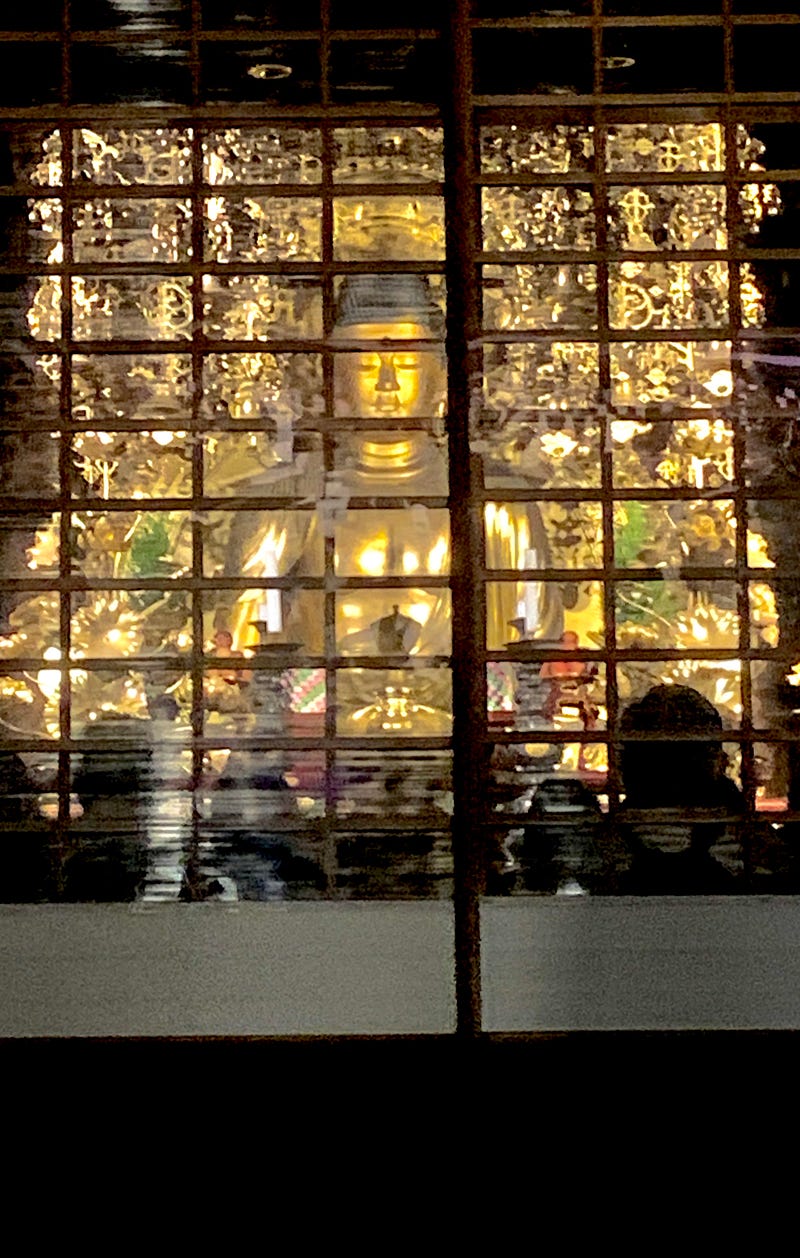
Left: Waiting for evening service to start. Right: Meditation in front of a statue of Amitabha.

The monk spoke in the warm, enthusiastic tones of a variety show host; he was making his audience chuckle. This was so unlike what I have encountered at other temples, where the work of a monastery is no laughing matter. But, maybe this warmth, this humanity, is the real secret sauce of Jōdo-shū?

I didn’t stay for the service, which would all be in Japanese. Instead I meandered over to a smaller side temple. Through the screen I could see the heads of many people sitting cross-legged in meditation before a giant golden statue (above right). I wondered, is Amitabha being named and claimed for those seeking entrance to His Pure Land?
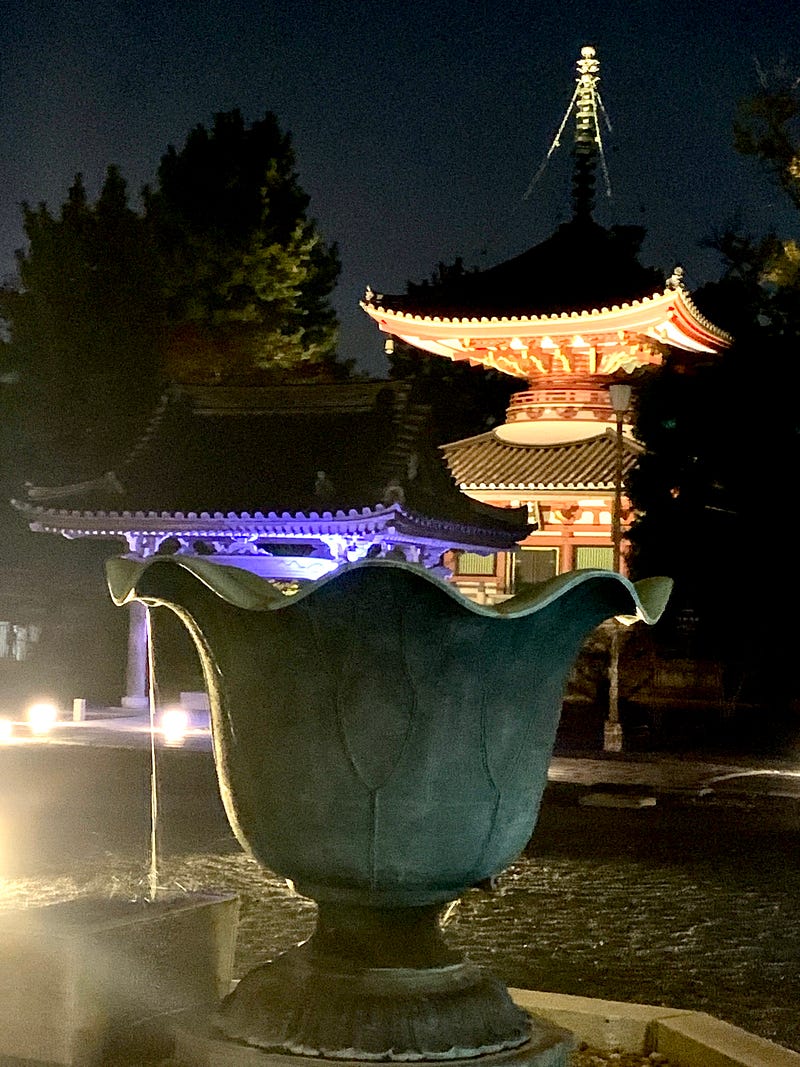
A fountain and a pagoda at Chion-In

There was one more level I had yet to obtain. A rope of bright LED lights snaked up a stairway through the forest. At the top, in a little clearing high on the hillside, was a massive temple bell, the biggest bell I think I have ever seen. Indeed, it turned out to be the largest bell in all Japan. The bell is nearly eleven feet tall and weighs 70 tons. It’s over 650 years old. It takes several monks just to ring it; for this they use ropes to pull back a large, suspended log, and bang it into the backside of the bell. Tonight it was brightly illuminated with a purple mandala, and though silent, the bell resonated.
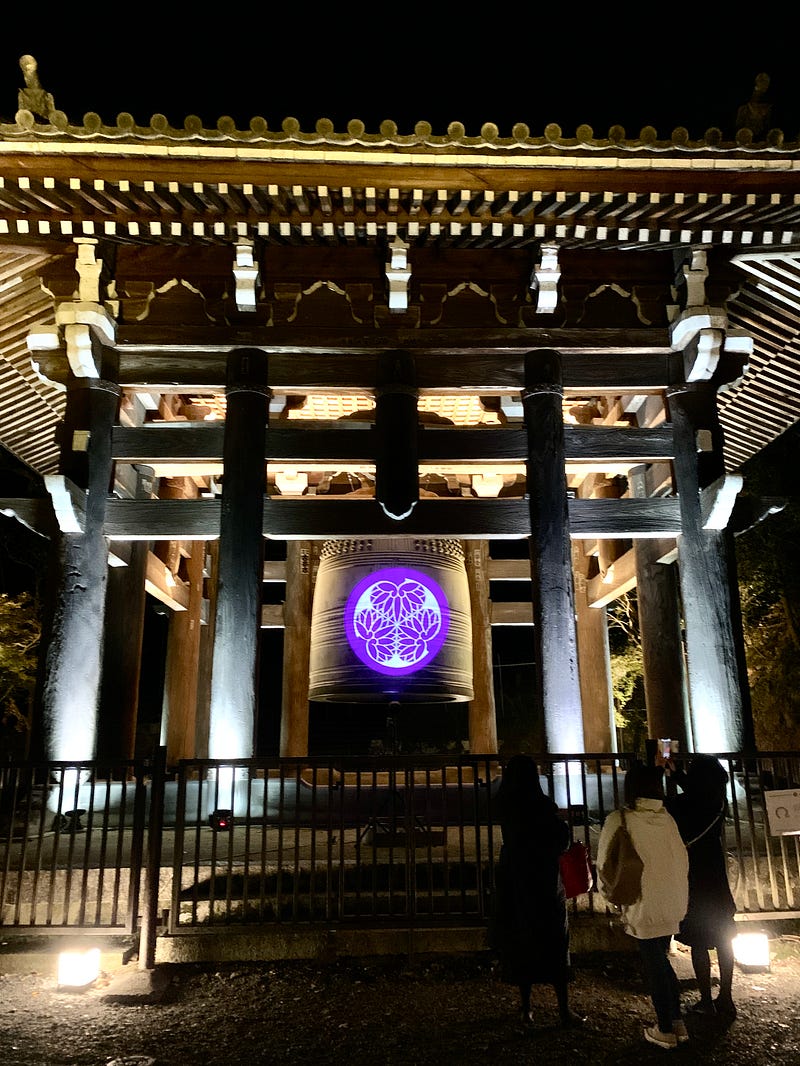
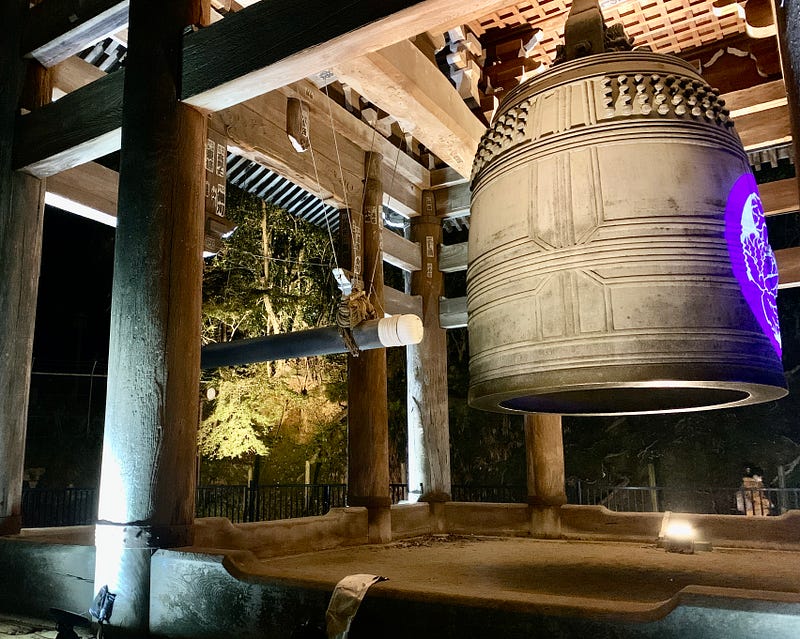
Big bell

Having reached the end of the Amitabha Autumn Night Light Show, there was nothing left for me to do but descend back to the entrance and into the night of the busy, modern city. I took one last deep breath of fresh forest air. A Pure Land. Wouldn’t that be something, if indeed it were true? Namu Amida Butsu, Namu Amida Butsu, Namu Amida Butsu.

***

I’ve been inspired for this Globetrotter Monthly challenge on spirituality by Matthew David, who wrote about being one of the first to trek the newly opened Buddhist Sanctuary Trail in Nepal. I strongly resonated with his story; such mountains are spiritual beings that can live inside of you long after you have left the physical rocks behind.

And by Jillian Amatt — Artistic Voyages’ story of her visit to a Mosque in Morocco while under covid lockdown. It’s a vivid encounter with both the people and a place in a time of crisis and change.

***

Tim Ward is the author of What the Buddha Never Taught: A Behind-the -Robes Account of Life in a Thai Buddhist Monastery, and Mature Flâneur: Slow Travels through Portugal, France, Italy and Norway.

Kyoto
Travel
Globetrotter
Monthly Challenge
Buddhism
Recommended from ReadMedium