
“The American President” at 25: An Ode to My Favorite Movie
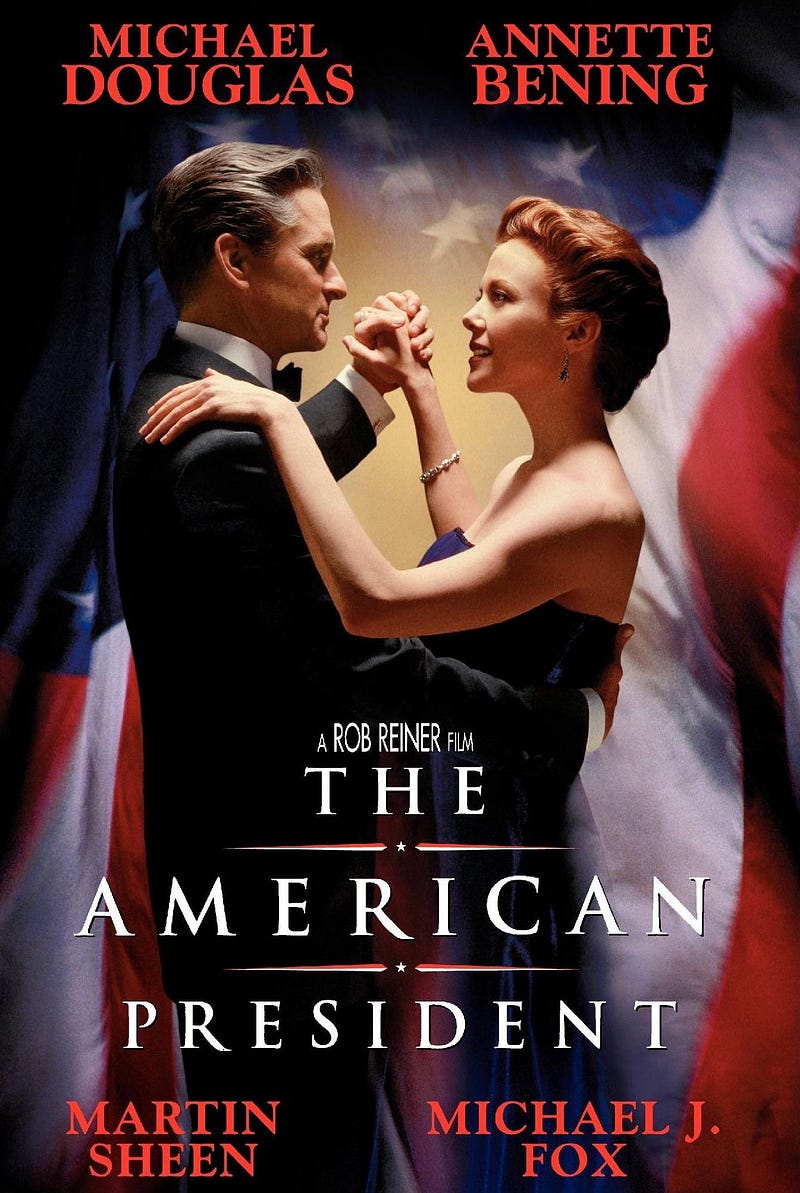
This month marks the 25th anniversary of my favorite movie of all time. Written by a pre-West Wing Aaron Sorkin, directed by a post-When Harry Met Sally… Rob Reiner, and featuring a sterling ensemble that included some of the finest work of Michael Douglas, Annette Bening, and Michael J. Fox’s careers, The American President is a highly underrated, politically charged romance. It was released to warm critical reception and strong but unspectacular box office, but never got the following that I believed it deserved. In honor of its silver anniversary, I revisited the film and take a look at how it holds up.
My Discovery of the Movie
I have never claimed to have been a typical child. One of the many ways I deviated from the norm was through my interest in movies, music, and television that were clearly meant to appeal to consumers decades older than me. I appreciated behind-the-scenes craftsmanship, polished writing, challenging subject matter, and complex themes from a very young age.
At least once a week during my childhood, I would venture to the video store to rent one (or two or three) movies. I still remember the feeling of walking around the video store to see the new releases, what was in stock, and what was coming soon. Honestly, I probably could have spent hours browsing the small Blockbuster Video in our town (or maybe that was even before Blockbuster came to Rome, New York and I was at the mom and pop shop).
One day when I was in 6th grade, I had stayed home from school either because I had one of my classic ear infections or because I was in need of a “mental health day” (which my mother lovingly indulged). We went to the video store and picked up a copy of The American President on VHS. My mom loved Michael Douglas, I had read good coverage of it in Entertainment Weekly (my Bible as an adolescent), and it wasn’t Rated R, so we picked it up.
It was my Mom’s day off so we sat at home and popped it in the VCR. We loved it so much that when the credits roll, we immediately rewound it and watched it all over again. Since then I have seen it at least 30 times, probably more.
So what was it about this middle aged, heterosexual romantic comedy-cum-liberal political fable that intrigued a 12-year-old closeted gay boy growing up in a largely isolated Republican town? Well, everything.
What Makes the Movie Work So Beautifully
Here’s the movie’s setup:
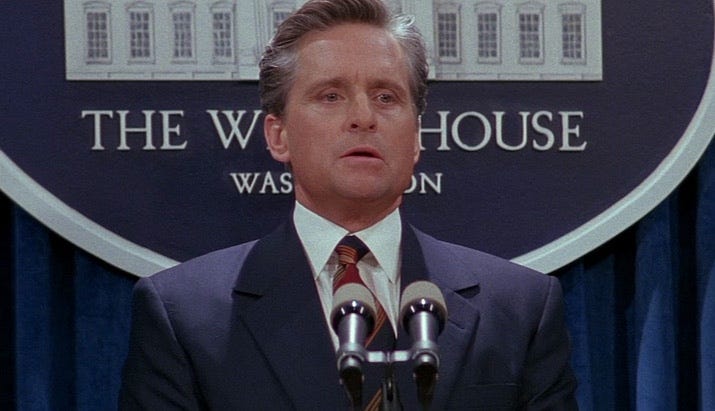
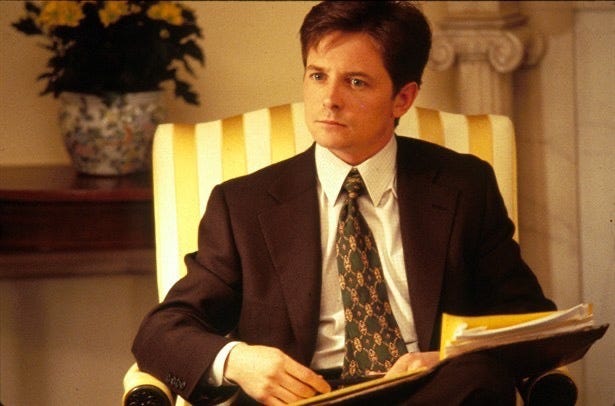
Andrew Shepard (Oscar-winner Michael Douglas) is the President of the United States. Widowed during his presidential campaign, he rode a wave of sympathy to his win and is now enjoying nearly historic approval ratings. He is a couple of months away from the State of the Union, where he plans to announce bold legislation regarding crime prevention and fossil fuel reductions. He is supported by his Chief of Staff A.J. McInnerney (Martin Sheen), domestic policy advisor Lewis Rothchild (Michael J. Fox), press secretary Robin McCall (Anna Deavere Smith), White House Deputy Chief of Staff Leon Kodak (David Paymer), and personal aide Janie Basdin (Samantha Mathis).
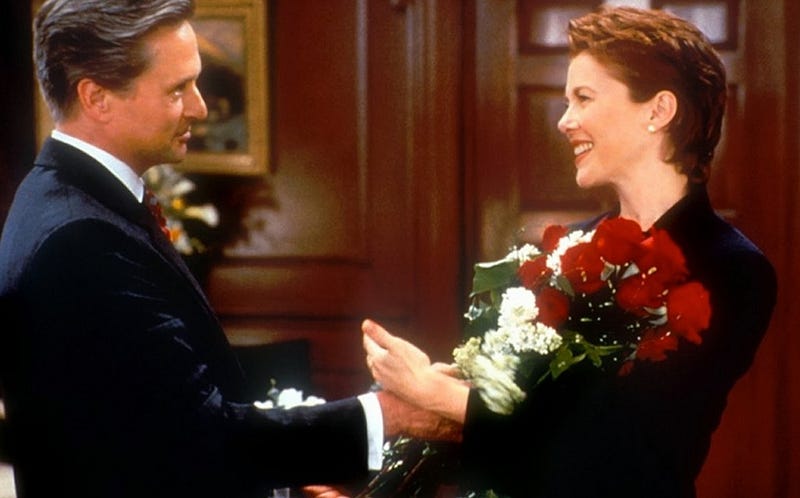
Sydney Ellen Wade (four-time Oscar nominee Annette Bening) is a liberal lobbyist recently hired by a high profile environmental agency. She works under Leo Solomon (John Mahoney) and alongside Susan Sloane (Wendy Malick) and David (Joshua Malina). On her first trip to the White House she boldly critiques the president’s “mockery of environmental leadership” in a meeting with his Chief of Staff not knowing that the President is standing behind her. He is instantly smitten. (It’s a “meet cute” that could have been endlessly shmaltzy, but this film is way too sharp and sophisticated for that.)
Their whirlwind courtship instantly grabs major media attention and is exploited by the presumptive Republican nominee for President (Robert Rumson, played by Oscar winner Richard Dreyfuss) to launch a character attack on Shepard. As the attacks heat up and the fossil fuel legislation is threatened, tensions erupt everywhere.
The film has countless strengths. The most obvious at first is the superlative acting. Douglas is so charismatic and convincing as Shepard that it makes me wonder how he didn’t carve out a niche as the go-to president portrayer in his post-Fatal Attraction and Wall Street years. Perhaps most impressively is how he goes toe-to-toe with Bening, who turns in one of her finest performances, which is saying something given her utterly remarkable career. She oscillates from swooning romantic to ferocious political powerhouse with remarkable ease. Both Douglas and Bening get spectacular speeches before the credits roll that alone should have earned them Oscar nominations.
They are supported by a top-notch supporting cast. Michael J. Fox takes on his most mature role to date and knocks it out of the park as the only member of the President’s team who is truly willing to challenge him. Martin Sheen effortlessly commands the screen in a fully believable, lived-in performance. Anne Deavere Smith, John Mahoney, Wendie Malick, and Joshua Malina don’t get much in the way of character development or back story but they have several memorable moments. Richard Dreyfuss is mostly a one-dimensional antagonist, but he sneers with perfection. Every role down to the smallest seems to have been cast with the utmost care.
One of the things that makes the acting so impressive is the fact that the screenplay is so challenging. Aaron Sorkin is known for his incredibly dense, verbose, fast-paced screenplays. This was his third movie screenplay, following Oscar-nominated A Few Good Men and the forgettable Alec Baldwin-Nicole Kidman thriller Malice. Sorkin’s biggest successes were ahead of him. He is perhaps most famous for creating and wrote the massively successful series The West Wing (more on the striking influence of The American President on that show below) and his Oscar win for writing David Fincher’s Facebook origin story The Social Network (he also scored additional Oscar nominations for writing Moneyball and Molly’s Game). But everything that made those projects so brilliant is evident here in droves — the wit, sophistication, intelligence, charm, tension, and power. Even as Sorkin continues to impress (his latest film, The Trial of the Chicago 7, recently premiered on Netflix and is garnering well-deserved Oscar buzz), I will always consider The American President his finest and most under-appreciated work.
The American President was directed by Rob Reiner. The Emmy-winning star of iconic 1970s sitcom All in the Family and son of comedy legend Carl Reiner, Reiner had an absolutely remarkable run as a director through the 1980s and early 1990s, including When Harry Met Sally…, The Princess Bride, Stand By Me, This is Spinal Tap, Misery, and A Few Good Men (making this his second collaboration with Sorkin). He directs his ninth film with vision and precision. He brings together the superb production values beautifully — the sweeping score of Marc Shaiman, the lush and detailed production design, the warm cinematography, and the seamless editing that keeps everything perfectly paced.
Oddly, one of the things that makes me appreciate the film is the moments that don’t work. There is a minor error in the script toward the beginning of the film (Sydney says tells security that she’s never been to the White House and then tells the President that she’s been on the public tour of the White House a couple scenes later) and a very brief moment of slapstick that doesn’t quite fit tonally (the Carmen’s House of Flowers scene). These elements are not problematic or notable enough to stick out in a typical film, but in one so elegant and polished they do.
I find everything about the movie to be an absolutely entrancing delight. Its endlessly quotable dialogue, lush visuals, charismatic performances, and crisp pace have enthralled me on each of my several dozen viewings. It was also the first movie to spark my political consciousness and get me curious about the inner workings of government. For that alone it holds a special power.
Just because it is my favorite movie of all time doesn’t mean that I think it is the best movie of all time; there are many others that are more significant, powerful, funny, or influential. But I return to this one more than the rest. I have honestly never understood how The American President did not make a bigger splash at the time of its release and how it has not ascended to a high-profile spot in the romantic comedy pantheon in the quarter century since its release. Nevertheless, the greatness of The American President is a hill I’m willing to die on.
Rating for The American President: 5/5 stars
Thoughts on Viewing the Film in 2020
Most movies and television shows feel dated after a few years, let alone a quarter century. And there are at least two key ways in which The American President is dated. The first is that politics became dramatically sleazier and more savage in the intervening years. The showdown between Shepard and Rumson regarding family values may have played believably in the Reagan and Bush years, but it already seemed undeniably quaint when the Bill Clinton-Monica Lewinsky scandal broke just over two years after its release and it certainly seems tame now in the era of our President pointedly (and often viciously) mocking opponents on Twitter.
The second is that there is very little focus on diversity. Anna Deavere Smith is holding down the fort in this area as the only notable person of color in the film and the only woman with a non-secretarial role on the President’s staff. In a world that is deliberately (and importantly) centering conversations about who gets a seat at the table, it is hard not to notice how unabashedly white and male-dominated The American President feels. Although the degree to which that was the film being a product of its time and the degree to which that is a result of Aaron Sorkin generally writing white and male-dominated projects is still up for debate. (Of note, Sydney Ellen Wade rivals The West Wing’s CJ Cregg as the best female character Sorkin has ever written.)
But there are many aspects of the film that are decidedly not dated, especially compared to many of its contemporaries. There are some minor aesthetic things to note here, mainly that there are few disastrous mid-90s fashion statement and that the film’s whole aesthetic veers toward timeless elegance. More substantively, however, is the fact that the key issues facing the White House in the film are an even bigger problems now than they were in 1995. The screenplay focuses on the needs to fight climate change, enact gun control laws, and achieve stability in the Middle East. The discourse surrounding these issues that occurs is tragically still relevant (if not more so) in 2020 than it was in 1995. And the way the Republican party is portrayed in the film — soulless opportunists who harness traditional values to wield immeasurable harm — was understandably cited by many as reductionistic and unfair at the time, but seeing as how a substantial portion of the party has doubled down on this in the intervening years it is a rather incisive take.
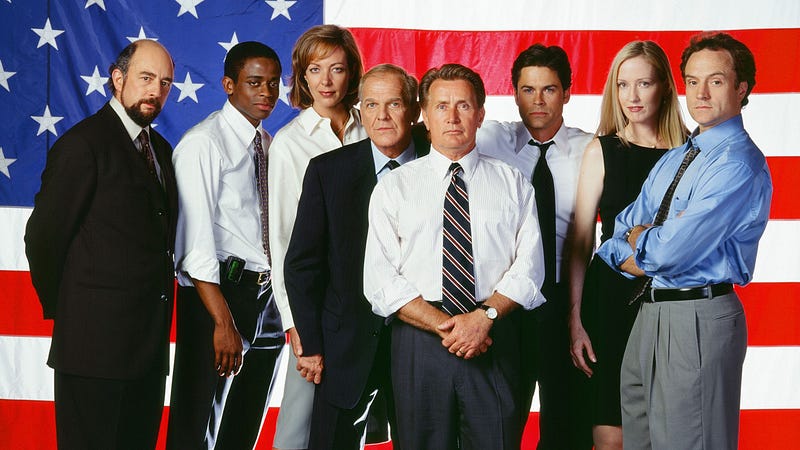
It is difficult to watch the film in 2020 and not see how elements of it are featured in so many of Sorkin’s future — and more successful — projects. In many ways it was the blueprint for The West Wing (which aired 154 episodes on NBC over the course of seven seasons and won an astonishing 27 Emmy awards from 96 nominations). First, there’s the subject matter and content. Both are about the personal and professional lives of the United States President and his staff. In fact, Sorkin has stated that much of the first season of The West Wing is composed of scrapped plotlines from his screenplay for The American President and there are a number of blink-and-you-miss-it tie-ins to the film in its early seasons. Second, there’s the tone and style. The liberal-leaning, well-informed, and incredibly witty political debates that dominated the series are on full display here, as are the romantic dynamics, grand speeches, and fast-paced “walk and talk” scenes that were iconic features of the series. Third, there is the casting. Martin Sheen gets promoted from Chief of Staff in The American President to the President himself in The West Wing, Joshua Malina became a series regular in Season Four, and Anna Deavere Smith had a recurring role. And, finally, both The American President and The West Wing are consummate competence porn.
For those unfamiliar with the term, “competence porn” refers to any fiction that portrays effective and compassionate government leadership. The American President and The West Wing show governments that are certainly flawed but ultimately are kind, ethical, functional, resilient, and aspirational. And after the last four years (or, let’s face it, the last few decades) who couldn’t use that kind of escapism?
Read recent 25th Anniversary Celebrations by this author.
A Celebration of Speed on its Silver Anniversary


